

You want to observe Dhanurmasam properly, but the calendar can make a simple devotional intention look complicated. There is a Sankranti moment, a location-specific Punyakalam, a month of worship before sunrise, and thirty Tiruppavai hymns to recite and understand.
Keep those layers separate. Once you know what belongs to Dhanu Sankranti and what belongs to the month that follows, you can build a practice that is reverent, sustainable, and rooted in meaning rather than hurried ritual accumulation.
Separate the Sankranti moment, the month, and the text
Dhanu Sankranti marks Surya’s transit from Vrischika Rashi into Dhanu Rashi. Dhanurmasam is the ensuing sacred period, observed with particular devotion in Vaishnava traditions. Tiruppavai is Sri Andal’s cycle of thirty hymns, traditionally recited at dawn during this season.
| Layer | What it determines | What you should do |
|---|---|---|
| Dhanu Sankranti | The calendrical transition into Dhanu Rashi and its Punyakalam | Check the Sankranti moment and auspicious window for your location |
| Dhanurmasam | The continuing period of pre-sunrise devotion | Establish a repeatable morning discipline rather than a one-day observance |
| Tiruppavai | A thirty-hymn devotional and contemplative curriculum | Combine recitation with meaning, reflection, and a practical response |
This distinction prevents two common calendar errors. Punyakalam is connected to the Sankranti transition; it is not another name for every dawn of Dhanurmasam. Conversely, Dhanurmasam does not end when the Sankranti-day rites are complete. Its strength lies in returning to worship morning after morning.
For the 2025-26 observance, Dhanu Sankranti fell on 16 December 2025. That date should not be copied into another year as a standing rule. The precise transit and the Punyakalam or Mahapunyakalam attached to it must be taken from a dependable Panchang or temple calendar calculated for your city. If you live outside Bharat, do not reuse an Indian city’s clock time; your local date or time window may differ.
Build a dawn practice with a fixed core
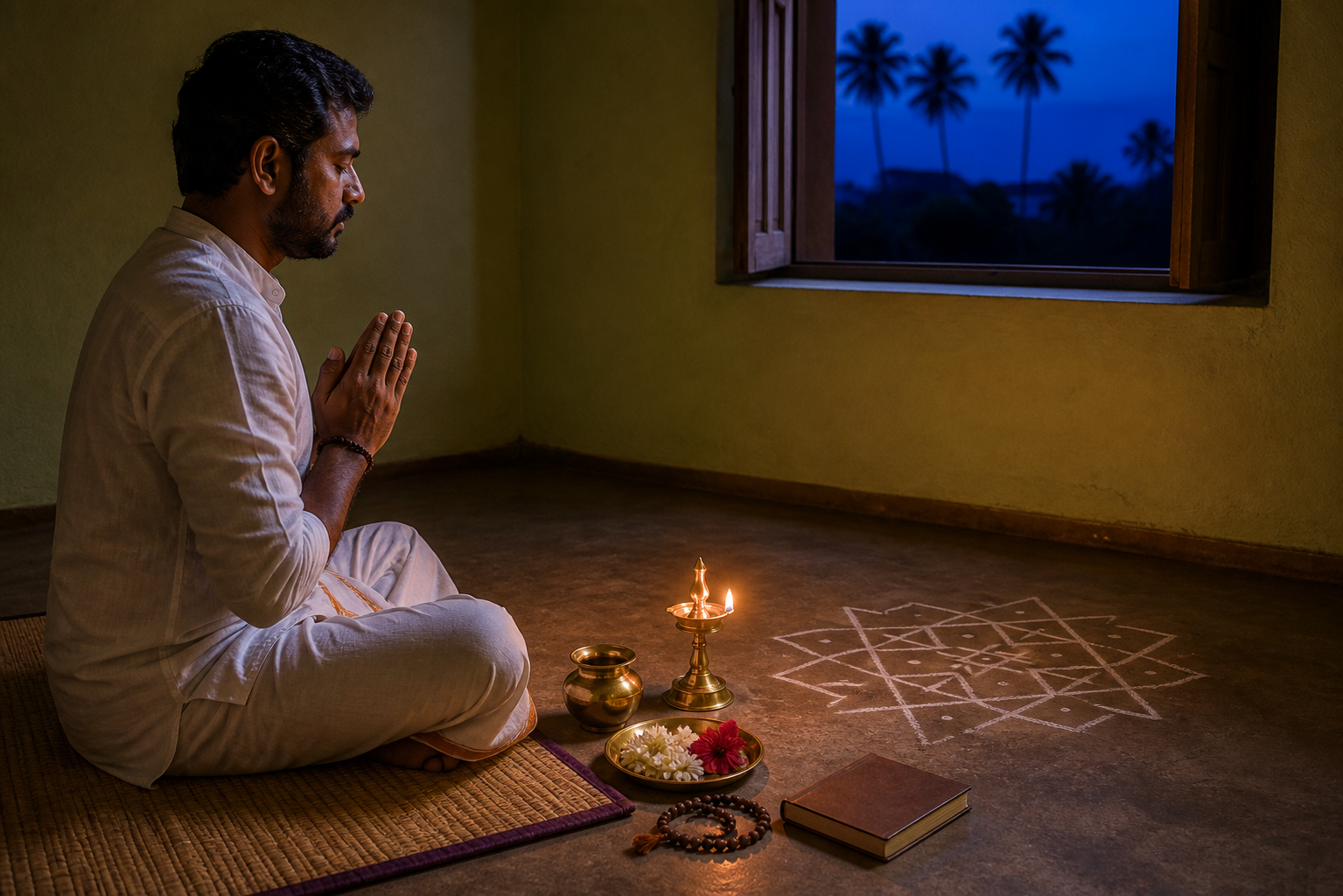
The most workable Dhanurmasam routine has a fixed core and a small number of optional observances. The core protects continuity. The optional layer lets you follow your family, temple, or sampradaya without turning every morning into a test of endurance.
- Confirm the local calendar first. Record the Sankranti date, the local Punyakalam, any Mahapunyakalam shown, and the pre-sunrise service time at the temple you may attend. These are different pieces of information.
- Prepare before sleeping. Place your Tiruppavai text, transliteration or translation, notebook, and worship materials together. Removing small decisions at dawn makes regular observance easier.
- Begin before sunrise when feasible. Bathe or wash according to your circumstances and household practice, light the lamp safely, and settle the mind before opening the text. The point is to arrive attentive, not merely early.
- Recite the appointed Tiruppavai hymn or selection. Follow your inherited recitation order if you have one. If your temple or teacher recites the complete work, keep that discipline rather than replacing it with a private scheme.
- Read for meaning. Keep the original or transliteration beside a trusted meaning or commentary. Write one sentence stating what the hymn asks you to notice, seek, renounce, or do.
- Close with one supporting practice. Choose japa, Vishnu Sahasranama, Tulasi archana, a simple offering, or silent contemplation as appropriate to your tradition. Do not add every available observance merely because it is listed somewhere.
If work, caregiving, illness, or another real constraint makes an extended dawn session impossible, preserve a modest dawn anchor: offer the lamp, recite the day’s selection, and state your intention. Read the fuller explanation later, when you can actually attend to it. A shorter practice completed with awareness serves you better than an elaborate schedule abandoned after the opening days.
Dhanu Sankranti itself can receive a distinct observance. Where customary and feasible, bathe near sunrise, pray or perform japa during the locally calculated Punyakalam, offer the lamp, and give food or essentials in charity. Some households also offer sesame and jaggery or recite Aditya Hridayam. Treat these as tradition-shaped options, not as a universal checklist that overrides your family’s achara.
Turn thirty hymns into thirty days of attention
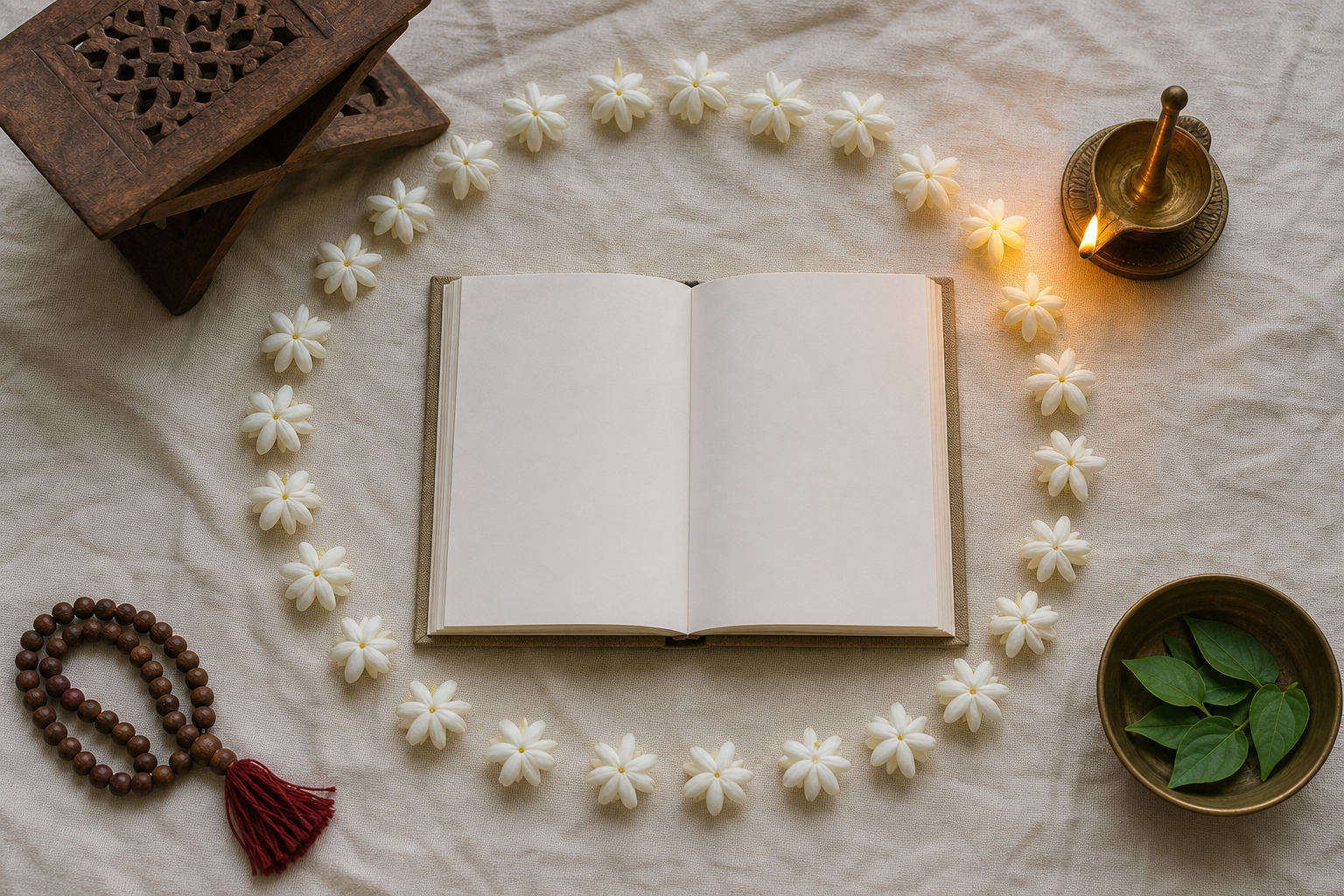
Tiruppavai study becomes shallow when recitation and understanding are treated as rivals. Sound, memory, meaning, and conduct can reinforce one another. If Tamil is unfamiliar to you, use a transliteration and meaning side by side. You do not need to postpone reflection until your pronunciation is perfect, but you should keep improving pronunciation through a knowledgeable teacher or established community recitation.
A one-hymn-per-day study cycle gives each of Andal’s thirty hymns room to work on you. This study cycle can sit alongside whatever fuller recitation your sampradaya prescribes.
Use a six-line Tiruppavai notebook
- Text: Record the hymn number and the opening words so you can find it again.
- Plain sense: Paraphrase the movement of the hymn in one sentence. Avoid copying a commentary without first checking that you understand it.
- Voice and address: Ask who is speaking, who is being addressed, and what response is sought. These questions keep devotional poetry from becoming a collection of isolated slogans.
- Key term: Select one word or image that needs further explanation. If translations differ, note the difference instead of forcing premature certainty.
- Dharmic demand: Identify the quality brought into focus, such as devotion, compassion, discipline, or shared responsibility. Then ask what that quality costs in ordinary conduct.
- Living response: Write one concrete action for the day. It might involve completing a duty without complaint, repairing a neglected relationship, sharing food, or giving another person your undivided attention.
This method also protects against an easy misreading: finding a familiar English word in a translation and assuming that the word exhausts the hymn. A translation helps you enter the verse; it does not replace the literary, theological, and sampradaya context carried by a good commentary or pravachanam. Keep unresolved questions in the notebook and bring them to a scholar rather than inventing certainty.
Community study can supply that missing context. During the 2025-26 season, the TTD Alwar Divya Prabandha Project scheduled Tiruppavai pravachanams from 16 December 2025 through 14 January 2026 at 233 centres across India. That month-long format is a useful model: recitation establishes rhythm, explanation opens the text, and repeated reflection carries it into conduct. For another season, verify current venues and timings with the participating temple or TTD-affiliated centre instead of relying on an old announcement.
Connect worship, temple learning, and seva
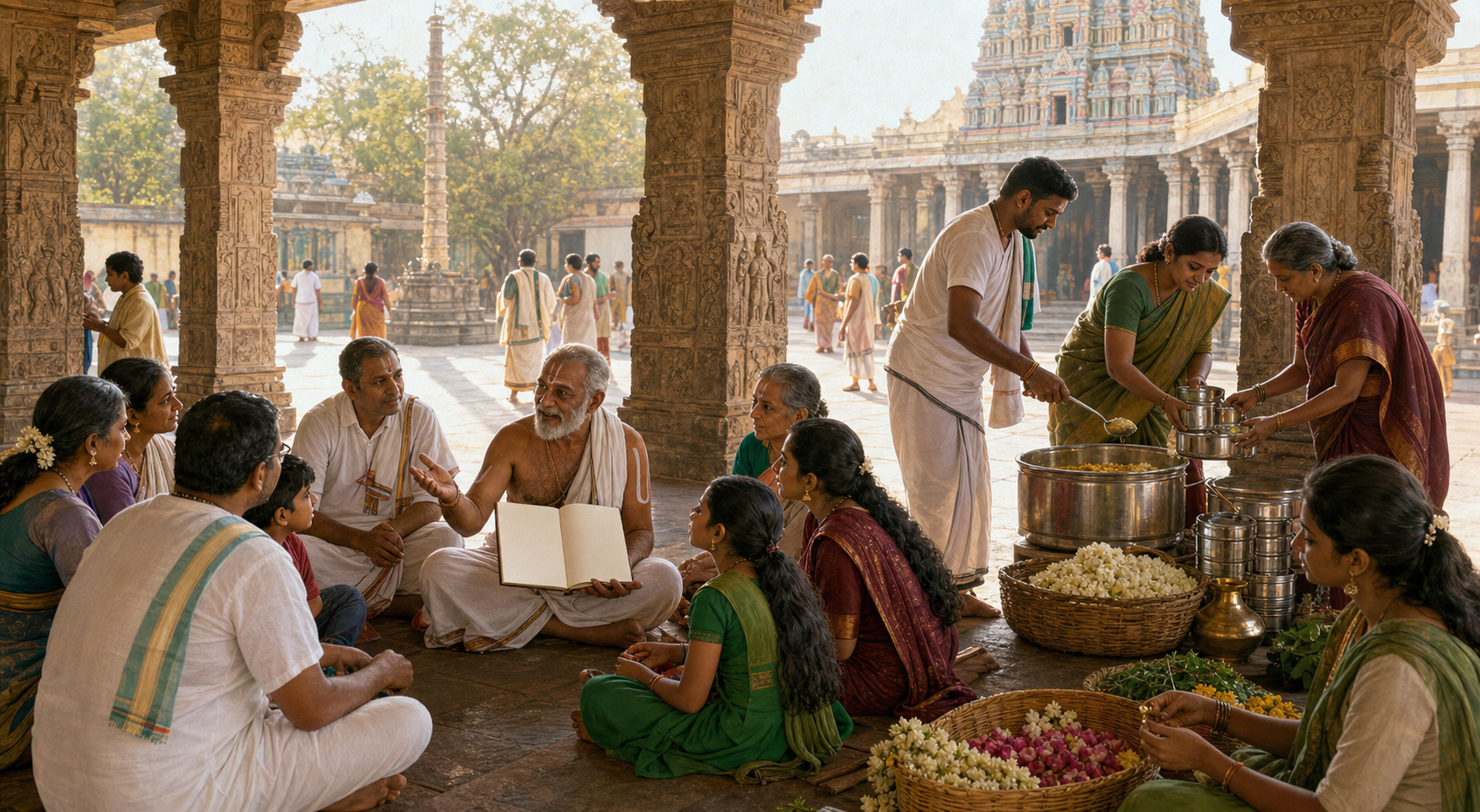
Dhanurmasam is not strengthened by collecting the largest number of practices. It is strengthened when worship, learning, and service point in the same direction. Choose a daily core, a Sankranti-day observance, and one continuing form of generosity.
- For the daily core: Keep the dawn lamp, Tiruppavai recitation, and a brief engagement with meaning.
- For the Vaishnava devotional layer: Add Tulasi archana, Vishnu Sahasranama, temple seva, or another practice received through your family or sampradaya.
- For Dhanu Sankranti: Use the local Punyakalam for focused prayer or japa, and observe Sankranti snan where it belongs to your custom.
- For service: Support annadanam or give useful food and essentials directly. Decide what you will give before the day arrives so charity does not remain a vague intention.
- For learning: Attend a pravachanam when available, note one unresolved question each day, and ask it in a setting where the hymn’s context can be explained carefully.
If you worship with children or relatives at different levels of familiarity, divide roles without diluting the practice. One person can recite, another can read the meaning, and another can state the day’s practical resolution. The household then encounters Tiruppavai as a shared discipline rather than a performance controlled by the most knowledgeable member.
The rites themselves remain Hindu and, in this form, distinctly Vaishnava. Their emphasis on disciplined attention, compassion, non-harm, and service can still be recognised across the wider Dharmic family. That recognition should deepen mutual respect without pretending that Hindu, Buddhist, Jain, and Sikh teachings are interchangeable.
Key takeaways for your Dhanurmasam plan
- Dhanu Sankranti is the calendrical transition; Dhanurmasam is the continuing devotional period; Tiruppavai is the thirty-hymn text that can structure your study.
- Use a reliable Panchang or temple calendar for your own city. Never copy another location’s Punyakalam without checking.
- Protect a simple daily core: dawn preparation, Tiruppavai recitation, attention to meaning, and one supporting devotional practice.
- Study each hymn by asking who speaks, who is addressed, what response is sought, which term needs explanation, and what conduct should change.
- Let service complete the practice through annadanam, food, essentials, or another deliberate contribution suited to your circumstances.
- Follow your family, acharya, or temple where ritual details differ; Dhanurmasam discipline does not require manufacturing uniformity among sampradayas.
Begin with the next practical step. Find the local calendar, place your Tiruppavai text and notebook near the altar, and decide which act of service will accompany the month. At dawn, open the first hymn with enough quiet to let it address your life.
References
- DharmaRenaissance Blog – Dhanu Sankranti 2025: Auspicious Date, Punyakalam Timings Guide, Meaning & Rituals
- DharmaRenaissance Blog – Experience the Sacred Dawn: TTD Tiruppavai Pravachanams Nationwide (233 Centres), Dec 16-Jan 14
