

If you came here asking who owns the disputed 1.30 acres, the answer is direct: a court held that the land belongs exclusively to Gurubasava Virakta Math. The competing Wakf Board claim was overturned, and the ruling treated the property as having no connection to the Board.
That is a meaningful victory for the Math. It is not, however, a blanket decision about every Wakf claim or every parcel held by a Hindu institution. If you want to understand the case, cite it responsibly, or protect another religious property, the most important discipline is to separate the exact legal outcome from the larger arguments people may attach to it.
What the ruling settles, and where its limits begin

Three established points can be stated without embellishment:
- The dispute concerned 1.30 acres.
- The court recognized Gurubasava Virakta Math as the exclusive owner.
- The competing Wakf Board claim was rejected through judicial adjudication.
Those points establish legal clarity for the land at issue. They do not authorize broader claims such as “all Wakf entries are invalid” or “every Math property dispute will end the same way.” A land judgment ordinarily turns on an identified parcel, the claims pleaded by the parties, the documents placed before the court, and the applicable law. Another institution must prove its own title from its own records.
The publicly established facts here do not identify the court, case number, date of decision, survey number, village, complete evidentiary record, precise relief granted, or current appeal status. Do not fill those gaps from social-media captions or memory. If you plan to quote the ruling in litigation, a representation to an authority, an institutional resolution, or a public campaign, obtain the full authenticated judgment and have a local property lawyer verify its operative portion.
This caution does not weaken the victory. It preserves it. An accurate statement is harder to discredit than an inflated one, especially in a dispute carrying religious and communal sensitivity.
Why documentary discipline matters more than slogans
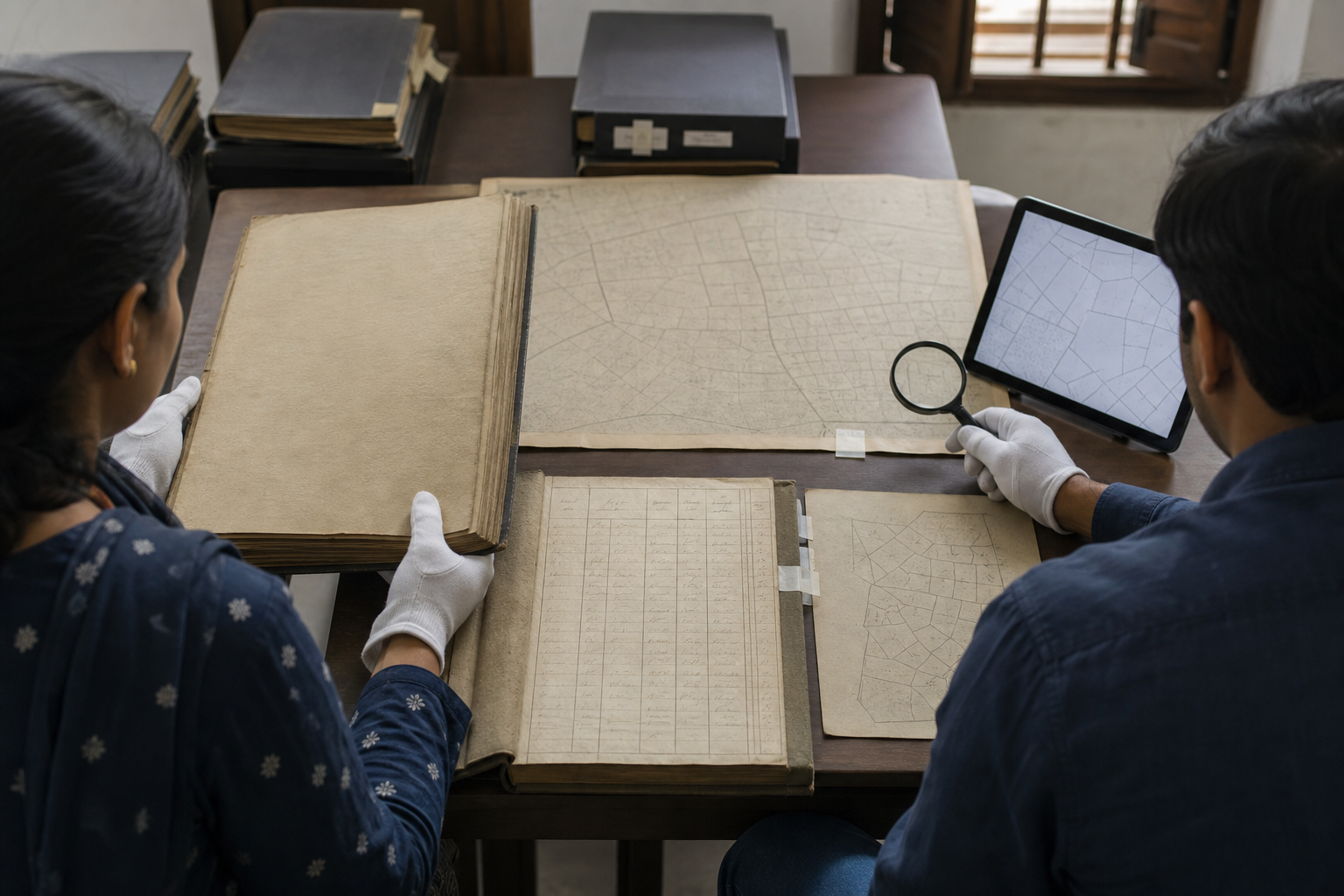
A dispute may involve a Math and a Wakf Board, but religious identity by itself does not prove ownership. Identity explains why the property matters. Title must still be established through evidence and lawful process.
That distinction is particularly important for a pro-Dharmic audience. Sacred institutions cannot protect their assets through outrage alone. They need a traceable chain of records, administrators who know where those records are kept, and counsel who can connect each document to the exact parcel under dispute. The Gurubasava outcome shows the practical value of taking that institutional work seriously.
Clear title gives a Math the legal foundation from which its land can be managed for religious, cultural, educational, or community purposes. It does not, by itself, prove that this particular parcel is currently used for every one of those functions. Nor does victory in a title dispute automatically guarantee sound administration. What it does provide is a defined asset for which the institution can be held responsible.
Formal adjudication also changes the public character of the disagreement. A claim tested in court is no longer merely a contest of slogans. The parties must present their positions within a process that can examine evidence, issue an order, and provide legally recognized avenues for any further challenge. That is how property conflicts should be resolved in a constitutional society.
You do not have to choose between defending Hindu institutions and supporting communal harmony. Precise claims, proper records, and lawful remedies serve both. The dangerous alternative is to convert one parcel dispute into an accusation against an entire community, because that obscures the evidence and makes a durable resolution harder.
A six-step protection plan for Math and temple land

If you serve a Math, temple trust, religious endowment, or heritage organization, treat this result as a prompt to inspect your own records before a dispute appears. The exact legal requirements vary by jurisdiction, so the plan should be supervised by local property counsel rather than copied mechanically.
- Create an authoritative parcel register. For every property, record the institution’s exact legal name, the land identifier used by the relevant authority, stated extent, location, boundaries, current use, custodian, and the physical location of the original records. Do not rely on an informal list maintained by one office-bearer.
- Build the chain of title. Collect, as applicable, grants, deeds, endowment records, revenue or mutation entries, survey maps, tax records, possession records, leases, encumbrance information, prior orders, and litigation papers. The presence of one entry should not be treated as conclusive without checking its legal effect and its relationship to the rest of the chain.
- Reconcile names, measurements, and boundaries. A historic institution may appear under different spellings or administrative descriptions. Parcel measurements and boundary descriptions may also change across records. List every discrepancy instead of silently choosing the version that seems favorable, then ask counsel and the responsible authority how it should lawfully be corrected.
- Preserve originals and usable copies. Keep originals in secure storage protected against unauthorized access, fire, water, and ordinary deterioration. Maintain legible digital scans with descriptive filenames, controlled access, and backups. A scan is useful for rapid response, but it may not replace an original or authenticated copy when the law requires one.
- Audit the register periodically. Set a review interval with counsel and record each completed audit. Check for new notices, altered entries, encroachments, unapproved occupation, expired arrangements, boundary changes, and missing documents. Assign each exception to a named office-bearer and give it a recorded follow-up date.
- Adopt a notice-response protocol. Staff should know who receives a government, court, Wakf, revenue, municipal, or survey notice; who alerts the governing body; where the title file is retrieved; and which lawyer is contacted. A notice left unanswered because it reached the wrong desk can turn an administrative weakness into a serious legal problem.
Do not attempt an eviction, demolition, fencing operation, forcible possession, or alteration of an official record merely because you have read that a similar institution won a case. Such action can create fresh legal exposure, interfere with another proceeding, and intensify communal tension. Have a qualified local lawyer identify what the operative order permits and which authority must implement it.
How to assess the next Math-versus-Wakf claim

Religious land disputes travel quickly online because a short caption can turn a technical proceeding into a civilizational verdict. Before you share, donate, organize, or draw a political conclusion, ask the following questions:
- What exact parcel is involved? Look for its area, official identifier, location, and boundaries. A familiar institution’s name is not enough.
- What kind of claim is being contested? Ownership, possession, management, an administrative entry, and the right to collect income are related but distinct questions. Do not substitute one for another.
- What did the court actually order? Find the operative directions, not only a summary of the arguments or a celebratory headline.
- What is the procedural status? Determine whether the order finally disposes of the dispute, whether implementation remains pending, and whether further proceedings affect what can lawfully happen next.
- Which documents support the conclusion? Ask whether the claim rests on a demonstrable title chain or only on an assertion repeated by supporters.
- How broad is the holding? A decision about one identified property should remain tied to that property unless the judgment expressly establishes a wider legal principle.
- Is the public language accurate? Words such as “reclaimed,” “transferred,” “restored,” “entry removed,” and “title confirmed” are not interchangeable. Use the formulation supported by the order.
This method allows you to defend Dharmic interests without becoming vulnerable to misinformation. It also keeps attention on the decisive question: who can establish a lawful right to the identified land?
Key takeaways
- A court recognized Gurubasava Virakta Math as the exclusive owner of the disputed 1.30 acres and overturned the Wakf Board’s competing claim.
- The ruling establishes clarity for the land before the court; it should not be presented as an automatic decision about unrelated properties.
- Documentary evidence, accurate parcel identification, and due process are the practical foundations of religious-property protection.
- Maths and temple institutions should maintain a parcel register, preserve the complete title chain, audit records, and prepare a formal notice-response process.
- Before acting on any similar claim, verify the full judgment, operative relief, and procedural status with qualified local counsel.
If you are connected to a Math or temple, put one concrete question on the agenda of its next governing meeting: can the institution promptly produce an authenticated record for every parcel it claims to own, and is one named person responsible for responding to a legal notice? If the answer is no, begin there. The strongest use of the Gurubasava victory is better governance, not a louder online quarrel.
References
