
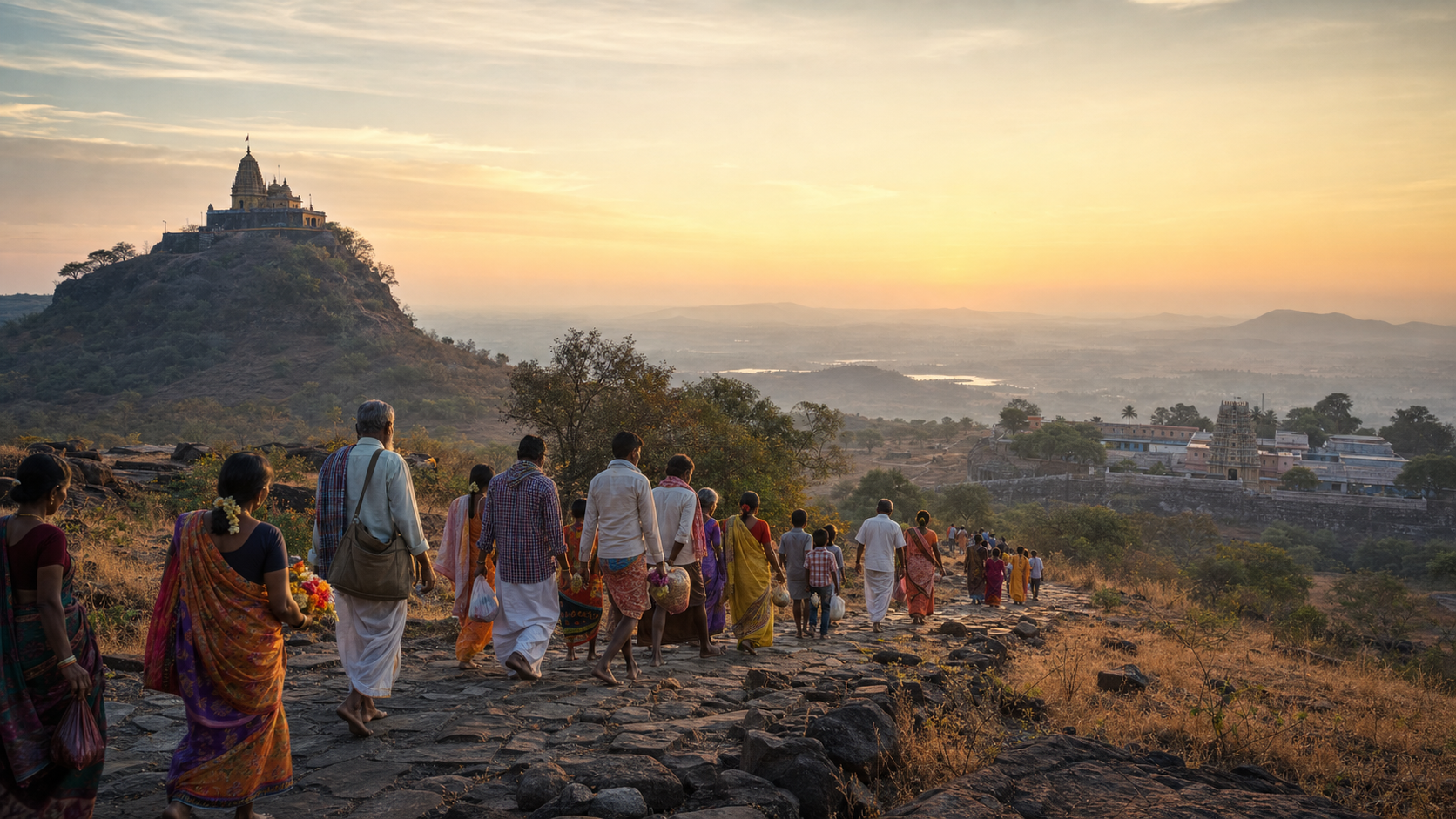
You may reach for a Deccan pilgrimage because of a family vow, a kuladevata connection, a saint’s teaching, or a date circled on the devotional calendar. Before you reserve a journey, decide what you are actually seeking. A festival crowd can give you darshan, but only a clear sankalpa turns the journey into sadhana.
Two sacred centers show how differently pilgrimage can work in the Deccan. Jyotiba’s hill near Kolhapur gathers devotees around divine protection, light, and collective celebration. Sri Veerabrahmendra Swami Matham in Andhra Pradesh gathers them around remembrance, ethical teaching, and seva. You will understand both more fully if you preserve that difference rather than treating them as interchangeable temple visits.
Choose the pilgrimage by the spiritual work before you
Begin with the inner task, not the travel map. The Chaitra Purnima yatra at Jyotiba is centered on a warrior-protector associated with the joined symbolism of Shiva and Surya. Pilgrims ascend the sacred hill, offer lamps, participate in abhishekam, fulfill vows, and enter a public celebration marked by drums, conch calls, and gulal. Its moral question is direct: what should your strength protect?
Sri Veerabrahmendra Swami Jayanti has a different emphasis. The observance honors the Telugu saint also revered as Brahmamgaru and Kalagnani. At Sri Veerabrahmendra Swami Matham in Kandimallayapalle, the customary focus includes special pujas, collective chanting, pravachanam, remembrance, and service such as annadanam. The 2026 Jayanti falls on April 26, giving devotees a fixed civil date around which to begin planning. Its moral question is equally practical: which teaching will change your conduct after the celebration?
Use these questions to choose deliberately:
- If your family carries a Jyotiba kuladevata connection or an existing vow, begin by learning that household commitment rather than creating a new ritual from fragments.
- If you are drawn to Brahmamgaru’s counsel, make space for discourse, study, and seva instead of arranging a journey concerned only with a brief darshan.
- If you want a colorful public festival, accept the discipline that comes with it: patience in crowds, respect for local ritual order, and care for the sacred landscape.
- If travel is not possible, choose the observance whose central virtue you can practice honestly at home. A simple deepa and a kept ethical commitment are more coherent than an elaborate ritual performed without attention.
This choice prevents a common pilgrimage failure: collecting sacred places while leaving the purpose of the journey undefined. Write your sankalpa in a single sentence before making the itinerary. It might concern truthful speech, compassionate service, disciplined worship, protection of someone vulnerable, or repair of a neglected family duty.
Read each sacred landscape on its own terms
Jyotiba: protection, luminosity, and the hill
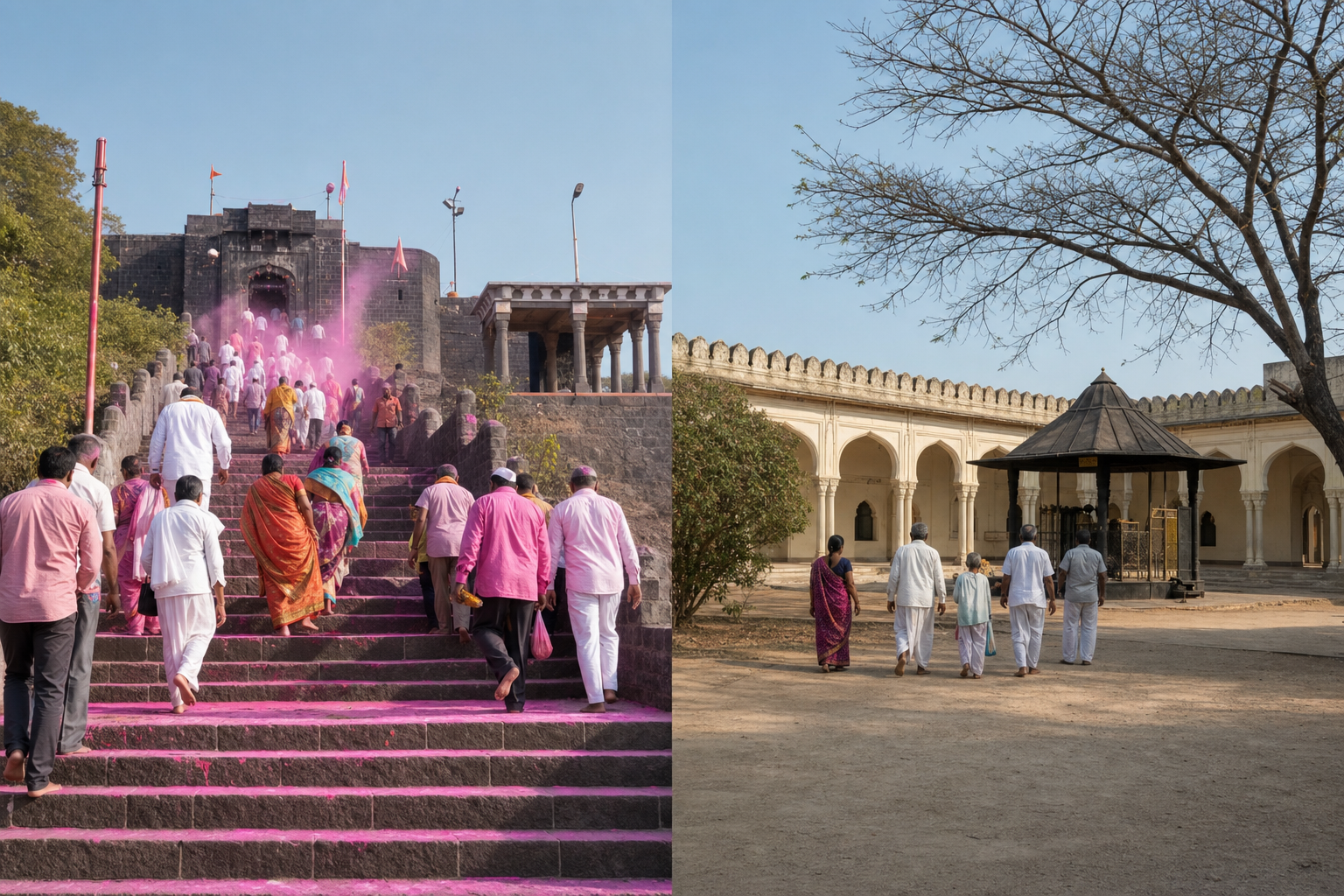
Jyotiba’s setting at Wadi-Ratnagiri near Kolhapur is not incidental scenery. The deity is revered as a kshetrapala, a guardian of place, within a landscape connecting agrarian plains, uplands, and older routes of regional life. The ascent places protection within geography: devotees move toward a guardian whose strength is understood as service to dharma, not aggression for its own sake.
Jyotiba is often interpreted through a Shiva-Surya synthesis. Shiva’s transformative force and Surya’s ordered radiance meet in the image of a luminous warrior-protector. Devotional parallels with Khandoba can help you recognize a wider Deccan pattern, but they should not erase local distinctions. Jyotiba’s Chaitra Purnima yatra is famously marked by crimson or pink-hued gulal, while Khandoba’s Jejuri is associated with turmeric bhandara. Treating those signatures as interchangeable misses the ritual grammar of each kshetra.
The nearby devotional relationship with Kolhapur’s Mahalakshmi, also known as Ambabai, adds another layer. Oral traditions remember Jyotiba as assisting Mahalakshmi in overcoming asuric forces and restoring order. If you visit both sacred centers, do not reduce them to stops on a sightseeing checklist. Notice how Shakta, Shaiva, and solar meanings form a connected sacred geography while each deity retains a distinct identity.
During the yatra, let the color, sound, and ascent support attention rather than overwhelm it. Learn the meaning of a family vow before fulfilling it, follow the locally established order for offerings and abhishekam, and ask before photographing worshippers. Gulal is part of a living devotional act, not merely a visual background.
Brahmamgaru: the matham as a place of instruction
Kandimallayapalle in Kadapa district, Andhra Pradesh, holds a different kind of sacred concentration. The matham is the spiritual focal point for devotees who seek darshan, listen to teachings, chant together, and serve the community. The place is best approached as a living center of guidance rather than as a monument to a finished past.
Brahmamgaru’s legacy is closely associated with Kalagnanam, remembered through oral histories and manuscript transmission. Popular interest sometimes narrows that tradition to prophecy. That is usually the least useful way to enter it. Its enduring devotional force lies in dharma, satya, compassion, restraint, and seva, not in turning spiritual counsel into a timetable for sensational predictions.
Use a simple test when you hear or read a dramatic claim connected with Kalagnanam: does the interpretation make you more truthful, disciplined, compassionate, and useful to others, or does it merely produce fear and speculation? The former belongs to ethical practice. The latter can distract you from the saint’s actionable legacy.
Confirm the observance before building the itinerary
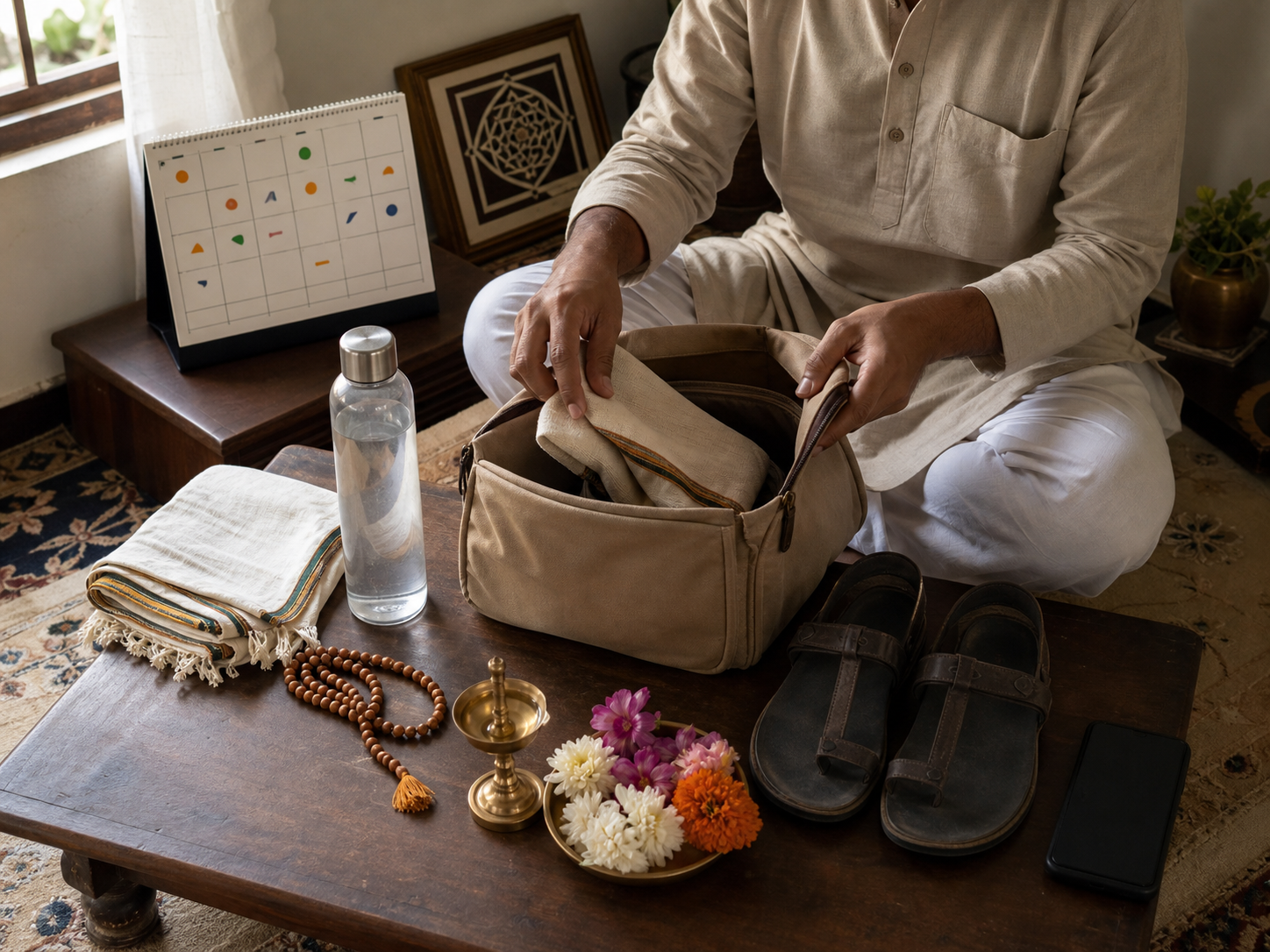
A civil date is not always the whole ritual calendar. Sri Veerabrahmendra Swami Jayanti is listed for April 26 in the 2026 Hindu festival calendar, but tithi calculations and puja timings can vary slightly among regional panchangams. The local temple or matham schedule should guide your sankalpa, puja window, and participation in public programs.
Jayanti and Aradhana must also be kept distinct. A saint’s Jayanti commemorates birth, while Aradhana generally marks the separately observed sacred remembrance associated with the saint’s passing. Communities devoted to Brahmamgaru may honor both, but one date should not be silently substituted for the other. Confirm the exact name of the observance when asking for a schedule.
Jyotiba’s principal yatra is tied to Chaitra Purnima. Because a corresponding civil date is not supplied here, do not infer one from memory or reuse a date from another year. Check the current temple announcement and the panchangam followed by the community with which you will worship.
A dependable planning sequence is:
- Write down the full name of the festival, the deity or saint, and the sacred place. This prevents confusion with similarly named observances.
- Confirm the civil date, relevant tithi, and local puja schedule through the temple, matham, or the regional panchangam used by your sampradaya.
- Ask which programs are open to pilgrims. At Kandimallayapalle, these may include puja, chanting, pravachanam, and community seva, subject to local arrangements.
- Check crowd-management guidance before committing to arrival and departure times. For the Jayanti Utsavalu, local authorities or temple volunteers are the appropriate contacts for current arrangements.
- Secure travel and accommodation early when attending a major festival. If elders, children, or anyone with mobility needs is joining you, settle the meeting point and pace before entering the gathering.
- Prepare a simple home observance as a fallback. A schedule change should not erase the sankalpa that gave the journey its meaning.
This order matters. Booking first and checking ritual details later can leave you present in the town but absent from the observance you intended to attend.
Make darshan visible in your conduct
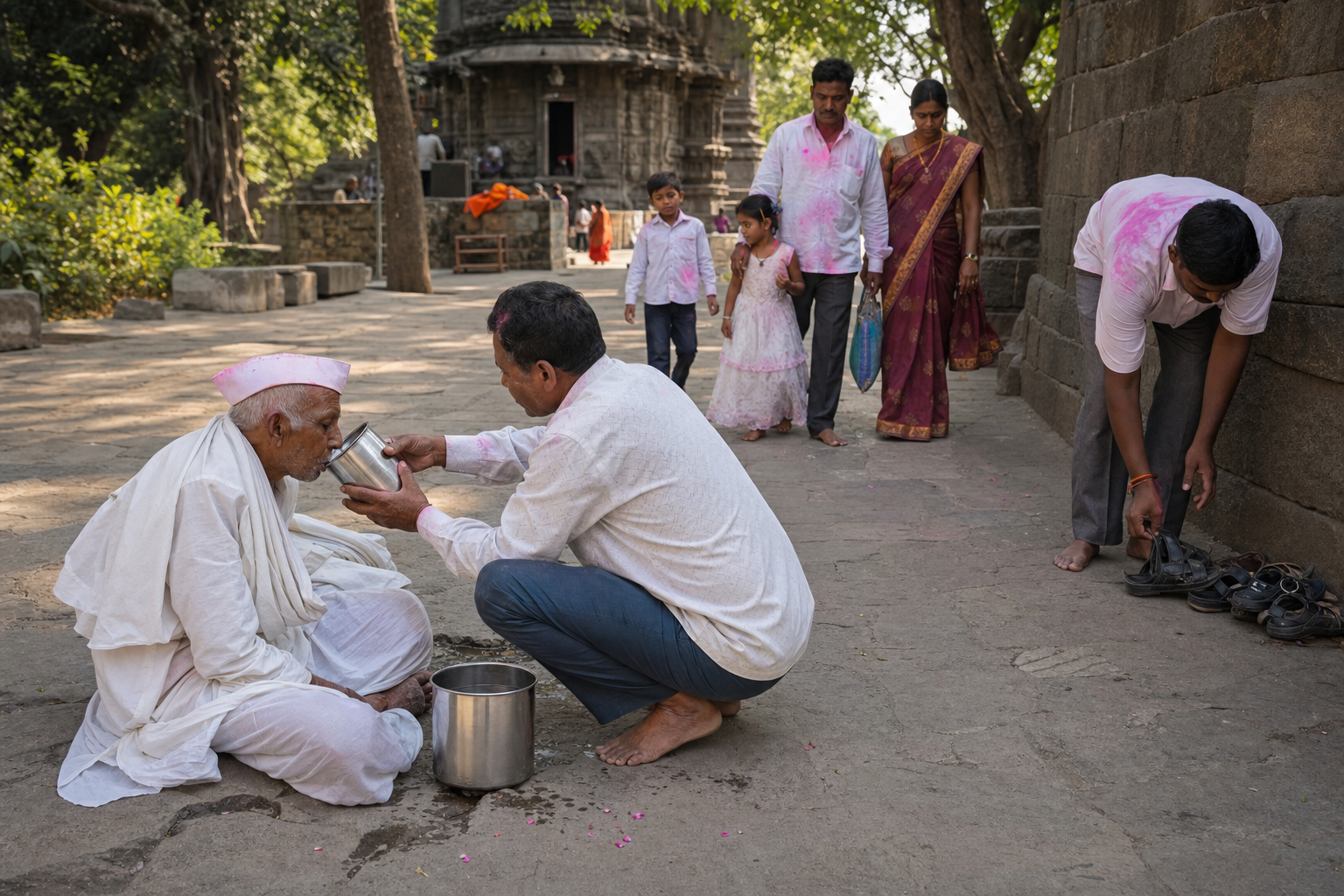
The Deccan festival tradition does not separate inward devotion from public responsibility. Jyotiba’s martial symbolism consecrates strength to protection and order. Brahmamgaru’s remembrance joins worship to truth, compassion, self-restraint, and service. In both cases, the measure of pilgrimage appears after you leave the sacred center.
If you remain at home for Sri Veerabrahmendra Swami Jayanti, the customary framework is intentionally accessible: begin with a morning sankalpa, light a deepa, perform nama-japa or recite a stotra, offer a simple satvik naivedyam with fruit, and spend time with an accessible presentation of the saint’s teachings. Conclude with quiet reflection on truthfulness, restraint, and compassion. Do not imitate a temple-scale utsava in the household; preserve its ethical center.
Whether you travel or worship at home, connect the ritual to a concrete act:
- For satya: correct a statement you know is misleading, especially when leaving it uncorrected benefits you.
- For seva: contribute to annadanam where it is locally organized, volunteer through an accountable community effort, or meet a specific need of someone vulnerable.
- For discipline: continue the nama-japa, stotra, or brief dhyana you undertook for the festival instead of abandoning it with the decorations.
- For protection: use your influence to defend dignity and order without turning courage into hostility.
- For stewardship: follow designated paths, dispose of festival materials responsibly, and support the custodians who keep the sacred landscape usable.
The shared ethical language also opens a wider Dharmic horizon. Non-violence, truth, generosity, disciplined awareness, divine light, and service resonate in different ways across Hindu, Buddhist, Jain, and Sikh traditions. Recognizing those resonances can strengthen mutual regard, but it should not flatten distinct theologies or local rites into a generic spirituality. Unity is strongest when difference is understood rather than erased.
You can apply the same discipline to children and younger relatives. Before the journey, explain whom you are visiting and why the place matters. During the observance, give them a small act of participation rather than asking them only to watch. After returning, invite them to name the virtue the pilgrimage asks the family to practice. That turns inherited identity into understood responsibility.
Key takeaways
- Choose Jyotiba when the living connection is to the guardian deity, hill pilgrimage, kuladevata memory, or a vow shaped by protection and courage.
- Choose Sri Veerabrahmendra Swami Jayanti when your central intention is remembrance, ethical teaching, disciplined worship, and seva.
- For 2026, Brahmamgaru’s Jayanti falls on April 26, but local panchangam timings and matham announcements should govern the actual ritual schedule.
- Do not confuse Jayanti with Aradhana, or Jyotiba’s gulal with the turmeric bhandara associated with Khandoba at Jejuri.
- At a crowded yatra, respect local ritual order, establish a meeting point for your group, and treat the festival’s color and sound as worship rather than spectacle.
- If you cannot travel, a focused household observance can still carry the festival’s purpose when sankalpa, worship, study, and ethical action remain connected.
Your next step is modest but decisive: choose the sacred center and observance by name, confirm its local calendar, and write the virtue you intend to carry home. Plan the journey only after those three things are clear.
References
- DharmaRenaissance Blog – Veerabrahmendra Swami Jayanti 2026: Sacred Date, Legacy, Rituals, and Pilgrim Guide
- DharmaRenaissance Blog – Jyotiba of Maharashtra’s Sacred Hills: Radiant Warrior-Protector, Fusion of Shiva and Surya