

If you are putting Chaitra 2026 into a family calendar, do not copy one festival date and assume everything else follows from it. The lunar month, the Indian national calendar and Meena Khar Maas use different calendrical rules, even though all three meet in the same few weeks.
For practical planning, reserve 19-27 March for Chaitra Navratri, mark 27 March for Sri Rama Navami and 28 March for Shalivahana Jayanti. Also flag approximately 15 March-14 April as Meena Khar Maas if you are considering a wedding, griha pravesh or another major auspicious beginning. Your final ritual timings should come from a panchang calculated for your location.
Start by separating three meanings of Chaitra time
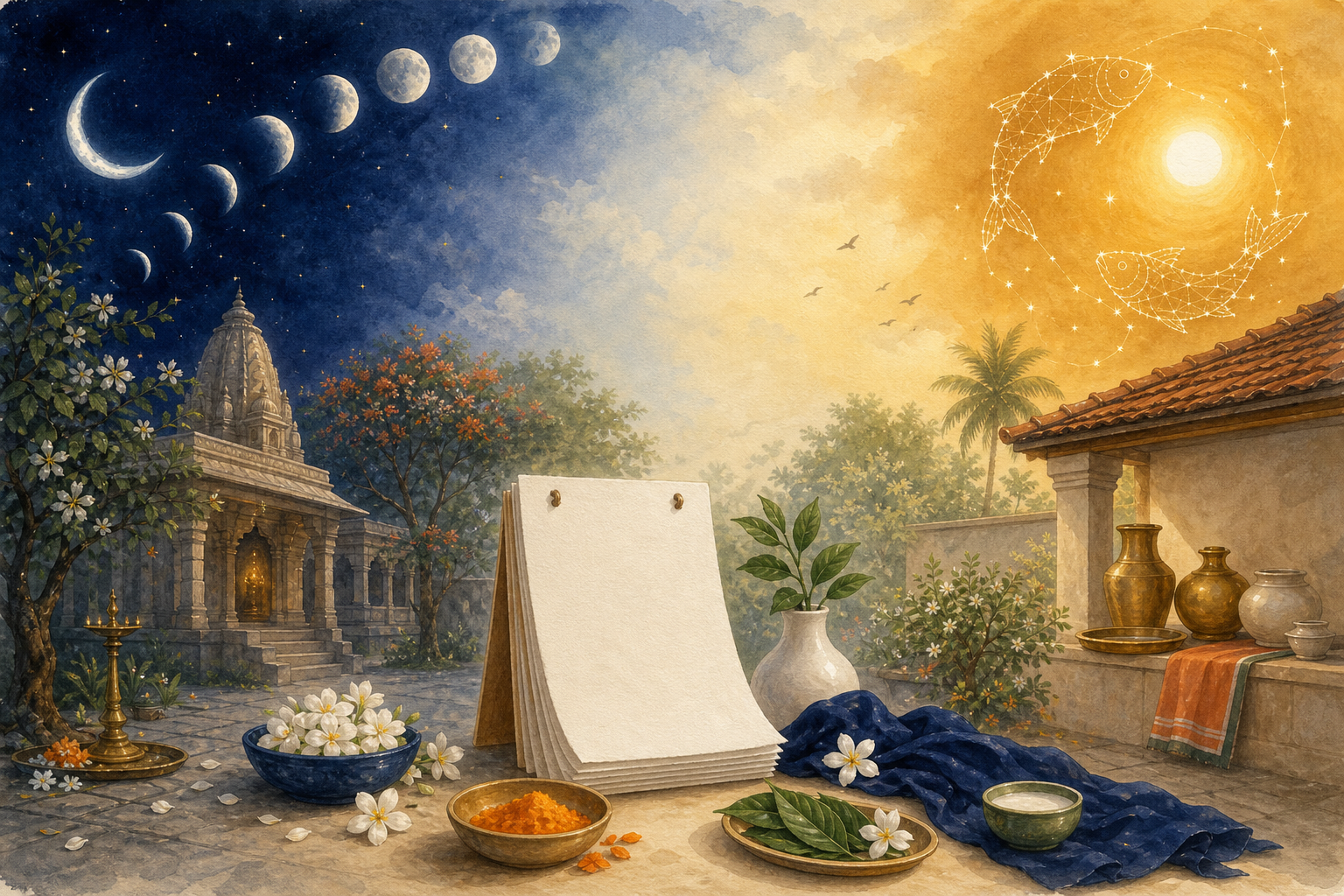
The apparent disagreement between calendars usually comes from comparing unlike systems. Before entering dates, label which system each date belongs to.
- Lunar Chaitra: Festivals such as Navratri, Rama Navami and Chaitra Vijaya Dashami follow tithis. A tithi represents a 12-degree change in the angular separation of the Moon and Sun. It can begin or end at any civil hour, so the tithi present at local sunrise often determines the observance date.
- National-calendar Chaitra: The Indian national calendar uses the Saka era, whose epoch is 78 CE. Chaitra is its first civil month and begins on 22 March in a common year such as 2026. This civil date does not replace the lunar tithi used for puja.
- Meena Khar Maas: This is a solar interval determined by Surya’s sidereal transit through Meena, not by the beginning of lunar Chaitra. In 2026 it runs approximately from 15 March to 14 April in IST.
This distinction explains why Chaitra Navratri can begin on 19 March while national-calendar Chaitra begins on 22 March. It also explains why a sacred festival season can unfold during Khar Maas: the latter restricts certain new worldly undertakings in many traditions, but it strongly supports worship, vrata, study, charity and service.
Your working Chaitra 2026 calendar
The dates below give you an India-facing planning framework. They are not a substitute for city-specific tithi and muhurta calculations, particularly outside India or near a tithi transition.
| Date in 2026 | Calendar marker or observance | What to plan |
|---|---|---|
| 15 March, approximately | Meena Khar Maas begins in IST | Flag the start boundary before fixing a wedding, griha pravesh or formal inauguration. |
| 19 March | Chaitra Shukla Pratipada; Navratri Day 1, Shailaputri; regional New Year observances | Perform Ghatasthapana in the locally valid window. Ugadi, Gudi Padwa and Navreh are observed in their respective traditions. |
| 20 March | Day 2, Brahmacharini | Continue the chosen vrata, daily puja, japa and reading discipline. |
| 21 March | Day 3, Chandraghanta | Keep the same morning and evening rhythm rather than adding practices you cannot sustain. |
| 22 March | Day 4, Kushmanda; Chaitra 1 in the Indian national calendar | Keep the civil Saka date separate from the lunar tithi on invitations and community notices. |
| 23 March | Day 5, Skandamata | Continue Devi worship and any household seed-sprouting observance begun with the kalasha. |
| 24 March | Day 6, Katyayani | Maintain the vrata appropriate to your health and family tradition. |
| 25 March | Day 7, Kalaratri | Prepare in advance for the concluding Ashtami or Navami rites followed by your parampara. |
| 26 March | Day 8, Mahagauri; Ashtami in many calendars | Kanya pujan, havan or special Devi puja may be performed here where prescribed locally. |
| 27 March | Day 9, Siddhidatri; Chaitra Shukla Navami and Sri Rama Navami | Complete Navratri rites and add Rama puja, Ramayana reading and the family’s customary naivedya. |
| 28 March | Chaitra Shukla Dashami, or Chaitra Vijaya Dashami; Shalivahana Jayanti | Treat this as a distinct commemoration after Navratri, centered on history, rajadharma and service. |
| 14 April, approximately | Meena Khar Maas ends with Mesha Sankranti in IST | Confirm the exact ingress and your tradition’s sunrise rule before scheduling a major ceremony immediately at the boundary. |
Do not be surprised if a temple calendar outside India places a rite differently. Tithis are astronomical intervals rather than midnight-to-midnight dates. A change near sunrise can move an observance to the previous or following civil date, while a temple may also apply a madhyahna or lineage-specific rule.
Build a Navratri observance you can actually maintain
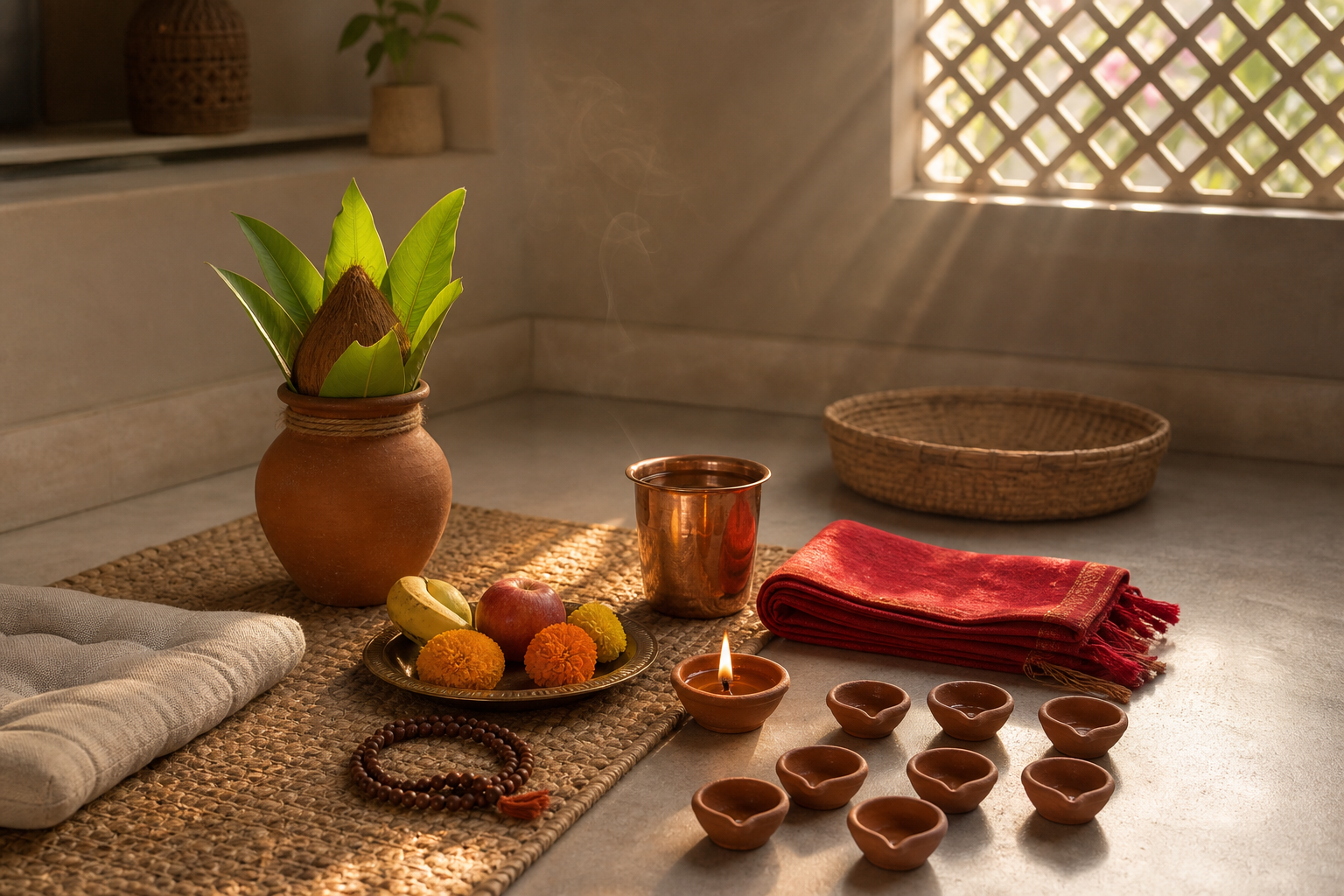
Chaitra Navratri is a nine-day discipline, not a collection of unrelated festival appointments. Decide the shape of your observance before 19 March so the first morning is devoted to sankalpa and worship rather than last-minute calculation.
Confirm Ghatasthapana before preparing the altar
Ghatasthapana is ordinarily performed during the first third of the day while Pratipada prevails after sunrise. Traditions that account for Vaidhriti or Vyatipata yoga may avoid an otherwise convenient period; Abhijit Muhurta can serve as an alternative when the prescribed early window is unavailable. Because these conditions depend on local time, a generic date graphic cannot supply a reliable muhurta for every city.
- Set your panchang to the city where the puja will physically occur, not merely to Indian Standard Time.
- Check that Pratipada prevails during the proposed Ghatasthapana period and note any yoga restriction followed by your parampara.
- Confirm the selected window with your family priest or temple when your household follows a specific regional method.
- Prepare the kalasha, clean water, mango leaves, coconut, red cloth and any barley or wheat seedbed before the muhurta begins.
- If you intend to keep an akhand jyot, use a stable location and arrange continuous safe supervision. If that cannot be done, choose a safely supervised lamp during puja rather than leaving an open flame unattended.
The kalasha represents the presence of Devi, while the sprouting seedbed makes seasonal renewal visible over the nine days. The lamp gives the household a steady focal point. These objects matter because they support disciplined attention; collecting elaborate decorations is not the purpose of the rite.
Choose one daily rhythm and one realistic vrata
Honor the nine forms in sequence: Shailaputri, Brahmacharini, Chandraghanta, Kushmanda, Skandamata, Katyayani, Kalaratri, Mahagauri and Siddhidatri. A workable household rhythm is morning and evening puja, aarti, japa and a measured portion of the Devi Mahatmyam or another text accepted in your tradition. The Navarna mantra, “Om Aim Hreem Kleem Chamundayai Vicche,” should be approached in keeping with your lineage’s guidance.
For fasting, decide whether you will follow phalahar or another restricted diet before the festival begins. Common Navratri foods include fruit, milk, seasonal produce, kuttu, sabudana and singhara, while many households avoid ordinary grains, onion and garlic. Do not turn vrata into a contest. Children, elders, people who are unwell and those with medical or medication-related dietary needs should use the moderated practice accepted by their family and tradition.
Settle your Ashtami and Navami plan early. Kanya pujan, havan and prasada distribution are commonly associated with these concluding days, but some households perform them on Ashtami and others on Navami. On 27 March, the Navratri culmination also meets Sri Rama Navami, so Devi worship and Rama worship need not compete. Complete the Navratri rite followed by your household, then make space for Rama puja, Ramayana reading and naivedya.
After Rama Navami, Dashami arrives but Khar Maas continues

Keep 28 March distinct as Shalivahana Jayanti
Saturday, 28 March is Chaitra Shukla Dashami, traditionally called Chaitra Vijaya Dashami in this context. It is not a tenth day added to Navratri. It carries a different purpose: remembering Shalivahana, the Deccan’s Satavahana legacy, the Saka era and the obligations of ethical rule.
Later tradition associates Shalivahana with Gautamiputra Satakarni, the powerful Satavahana ruler remembered for opposing Sakas, Yavanas and Pahlavas. That identification should not be stated as uncontested history. Scholars distinguish the legendary Shalivahana figure from the securely attested ruler, even though the two converge in later cultural memory.
The larger calendrical inheritance is clearer. The Saka era begins in 78 CE and forms the basis of India’s national calendar, officially adopted in 1957. Related Saka reckonings also traveled through trade, learning and temple-monastery networks into parts of Southeast Asia, including Bali and historical Java. Chaitra therefore belongs not only to a list of dates but to a wider Indic grammar of sacred and civil time.
A household observance on 28 March can be simple and substantive: bathe, light a lamp, take a sankalpa naming Chaitra Shukla Dashami, learn a reliable outline of Satavahana history and make an act of dana or seva. For children or a community gathering, use coins, inscriptions and a map of the Deccan to discuss rajadharma – protection of the vulnerable, fairness, support for learning and responsibility for public welfare.
Use Meena Khar Maas as a filter, not a shutdown
Meena Khar Maas remains in effect after Navratri and continues until approximately 14 April in IST. In traditions that observe this convention, it is prudent to defer weddings, griha pravesh and ceremonial launches of major ventures. Some communities also postpone naming ceremonies, upanayana, property or vehicle purchases and similar beginnings. An urgent case needs local priestly guidance because customs differ.
Khar Maas does not cancel nitya puja, Navratri, Rama Navami or Shalivahana Jayanti. It is especially suited to japa, svadhyaya, homa, vrata, dana, annadana, meditation and seva. Ordinary duties do not stop; the customary restraint concerns selected auspicious initiations.
Do not confuse Khar Maas with Mal Maas or Adhik Maas. Khar Maas is a recurring solar convention tied to Surya’s passage through Dhanu or Meena. Adhik Maas is an intercalary lunar month, inserted roughly every 32.5 months to reconcile lunar and solar reckonings. Both may affect ceremonial planning, but they arise from different rules and cannot be treated as interchangeable names.
The start and end of Khar Maas also require local care. One tradition may treat the exact Sankranti instant as decisive, while another applies a sunrise-to-sunrise rule. If you are considering a ceremony close to 15 March or 14 April, obtain the exact local ingress time and ask which boundary rule your family follows before printing invitations or paying a non-refundable deposit.
Key takeaways for your Chaitra 2026 diary
- Mark approximately 15 March-14 April as Meena Khar Maas in IST, then verify both boundaries locally before fixing a major auspicious ceremony.
- Begin Chaitra Navratri on 19 March, with Ghatasthapana performed in a city-specific Pratipada muhurta.
- Keep 19-27 March together as one nine-day practice, using a sustainable rhythm of puja, vrata, reading, japa and service.
- Confirm whether your family performs its concluding Devi rites on Ashtami, 26 March, or Navami, 27 March.
- Observe Sri Rama Navami on 27 March alongside the Navratri culmination, according to your parampara.
- Reserve 28 March for Shalivahana Jayanti and Chaitra Vijaya Dashami rather than treating it as an extension of Navratri.
- Label lunar tithi dates, national Saka dates and solar-transit dates separately so one calendar system is not used to overrule another.
- Outside India, rely on a panchang set to the place of worship; local sunrise and tithi transitions can change the civil date.
Open your calendar now and enter the fixed planning dates, but leave the Ghatasthapana time, Ashtami or Navami choice and Khar Maas boundaries provisional until your local panchang confirms them. That one distinction between a planning date and a ritual time will prevent most Chaitra scheduling errors.
References
- HinduPad – Shalivahana Jayanti 2026: Date, Saka Era Legacy, and Chaitra Vijaya Dashami Significance
- HinduPad – Chaitra Navratri 2026 Starts 19 March: Definitive Guide to Dates, Ghatasthapana, and Puja
- HinduPad – Kharmaas 2026 Guide: Precise Dates, What to Avoid, and Uplifting Rituals
