
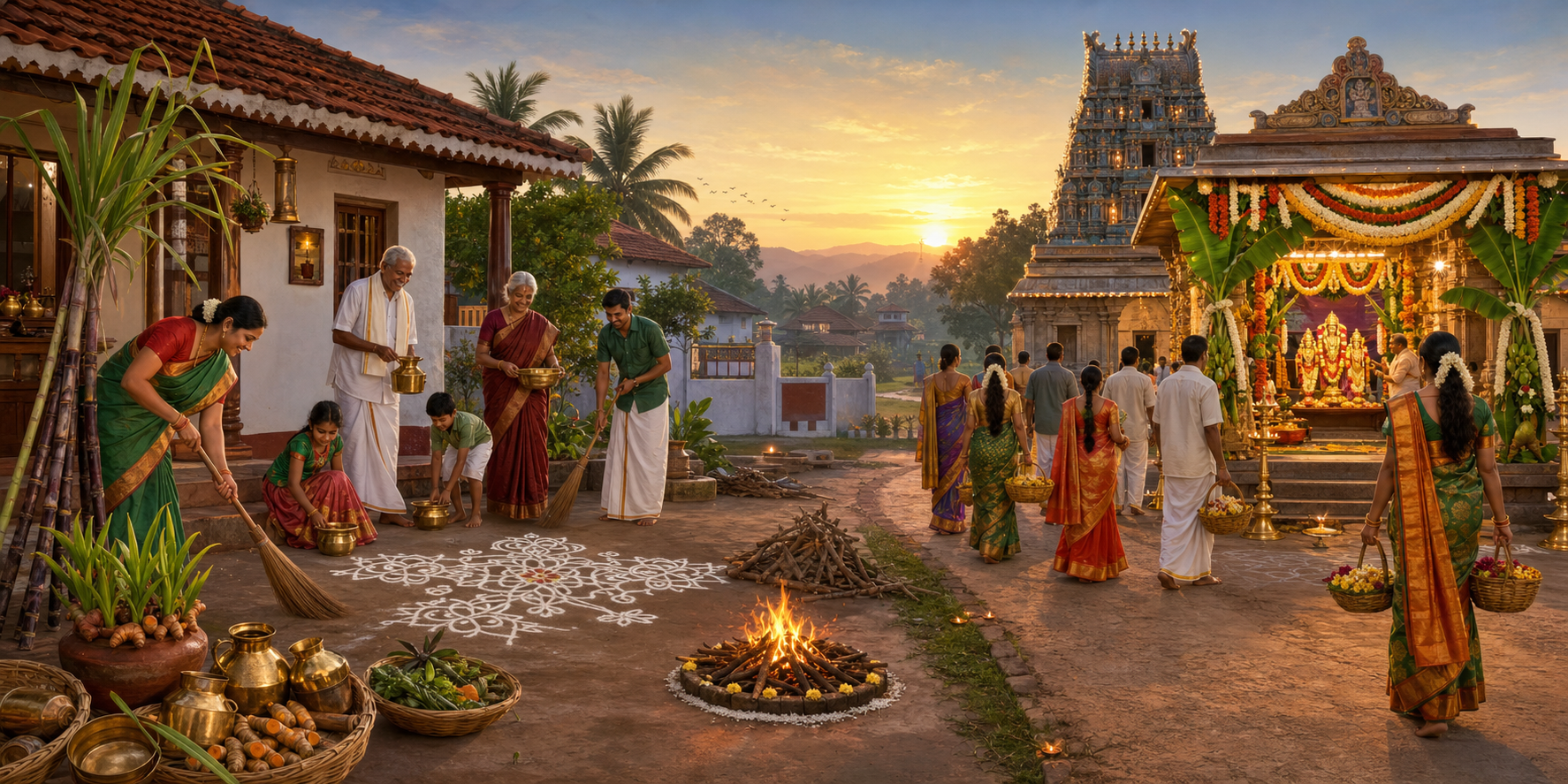
If you are trying to honor your family’s Bhogi customs and Andal Kalyanam on the same morning, the pressure often comes from treating them as one long ritual checklist. They are not the same observance. Bhogi Pongal centers household and agrarian renewal; Andal Kalyanam marks the fulfillment of a devotional vow.
Once you keep those meanings distinct, the day becomes easier to plan. Prepare the home for Bhogi, preserve the practices your family has inherited, and give Andal’s Tiruppavai and divine wedding their own devotional attention.
Two traditions meet at a sacred turning point
Across Andhra Pradesh and Karnataka, Bhogi opens the four-day Sankranthi season; Tamil communities observe the day as Bhogi Pongal before Surya Pongal. Its characteristic actions face outward toward the household, neighborhood, fields, seasonal produce, and the forces that sustain agricultural life. Cleaning and reorganizing the home are therefore more than routine chores. They express a deliberate release of what has become useless and create room for a more disciplined beginning.
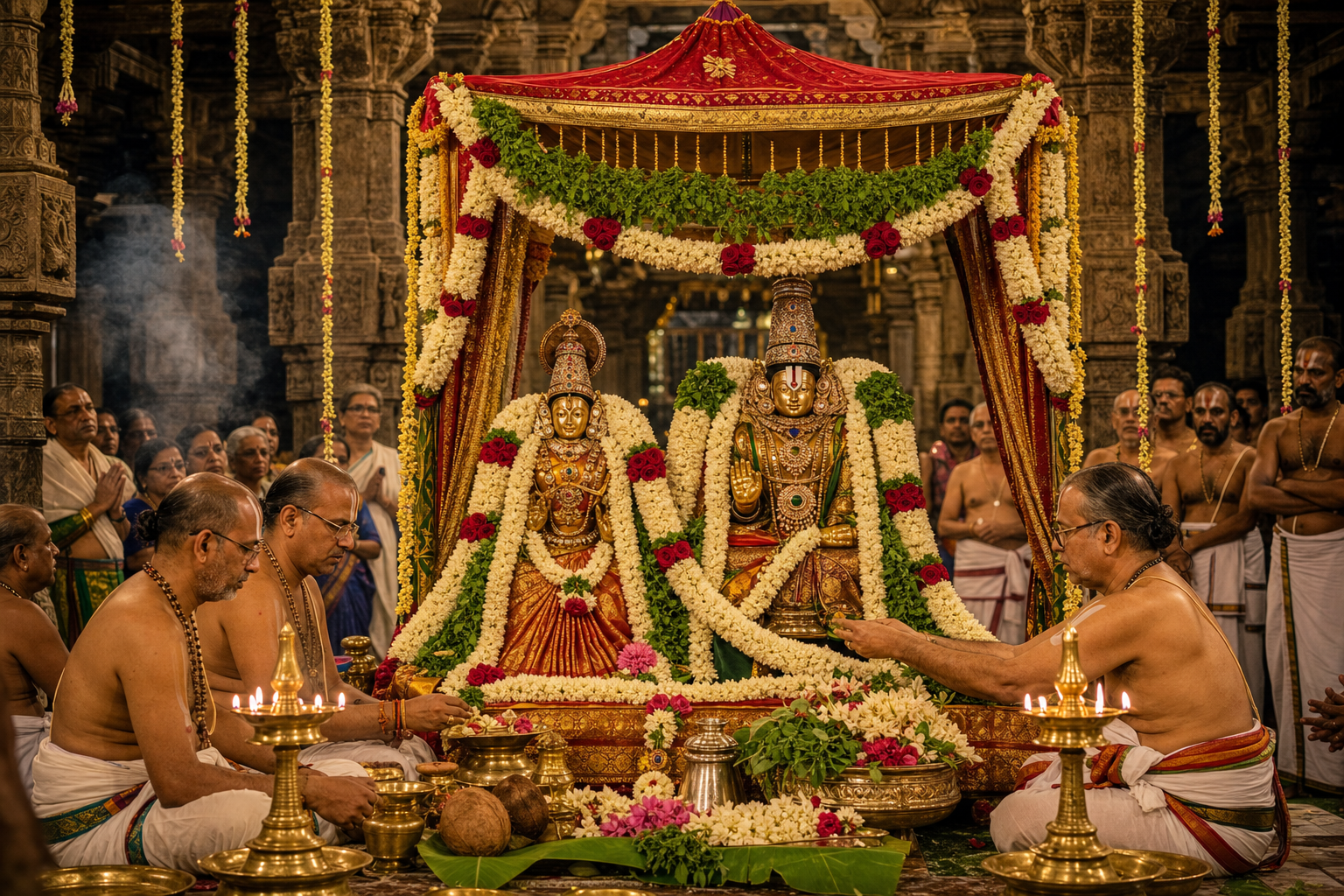
Andal Kalyanam belongs to another ritual movement. At Srirangam, the divine wedding concludes the Dhanurmasam celebrations on Bhogi Pongal. Andal’s Paavai Nombu during Margali, expressed through the Tiruppavai, reaches its fulfillment in union with Lord Ranganatha. Devotees often understand that union as the meeting of the jivatma with the Paramatma.
The two observances share a calendrical threshold, but they should not be collapsed into one ritual. Bhogi Mantalu belongs to the seasonal work of cleansing and renewal. The kalyanotsavam enacts the union of Andal and Ranganatha after a period of disciplined devotion. One asks what you must release before entering a new season; the other asks whether devotion has matured into surrender, fidelity, and service.
This distinction also helps you explain the day to children. You can tell them that Bhogi prepares the home and community for a new agricultural season, while Andal Kalyanam celebrates the fulfillment of Andal’s loving vow. Neither meaning needs to be diluted for the other to matter.
Prepare for Bhogi as an ethical reset
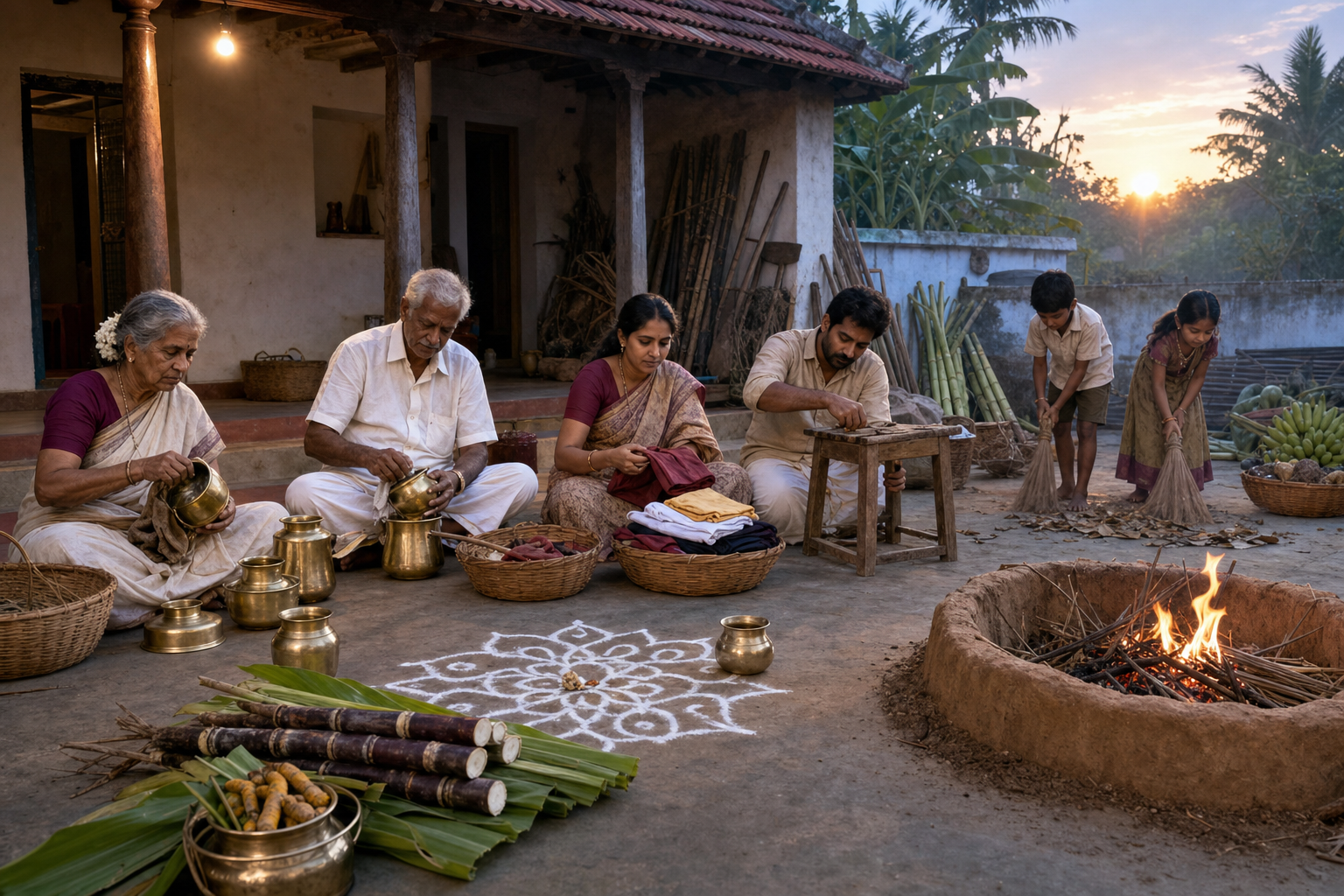
Begin the previous evening. The principal customs start early, and hurried cleaning at dawn turns a reflective practice into household stress. A simple preparation sequence keeps the symbolism intact:
- Sort what has accumulated. Separate what you still use from what can be repaired, passed on, recycled, or responsibly discarded. The purpose is to release the obsolete, not to destroy useful possessions for the sake of spectacle.
- Clean the entrance after the sorting is finished. Draw the kolam or muggu on a properly prepared threshold, add a mango-leaf toran if that belongs to your custom, and place gobbemmalu only where your family or region traditionally uses them.
- Set aside the seasonal foods and offerings. Fresh rice, sugarcane, and sesame preparations belong to the wider harvest setting, but the exact menu should follow your household tradition rather than an improvised universal recipe.
- Decide how you will participate in Bhogi Mantalu. A community-managed fire is safer than several unsupervised household fires. Keep children under direct adult supervision, follow local fire rules, and never treat the sacred bonfire as a general waste-disposal fire.
- Prepare Bhogi Pallu separately before the morning becomes busy. Common ingredients include regi pallu, or jujube fruit, pieces of sugarcane, rice, turmeric, flower petals, and sometimes coins. If very young children are participating, omit loose coins or handle them separately rather than mixing them into what falls around the child.
During Bhogi Pallu, elders gently shower the prepared mixture over children while offering wishes for health, growth, protection, and freedom from drishti. Keep the gesture gentle and keep the mixture away from the child’s eyes and mouth. The blessing is the center of the practice; an exact ingredient count is not.
Regional variation is normal. A Telugu household, a Kannada household, and a Tamil household may arrange the morning differently while sharing the same concern for renewal, gratitude, and collective well-being. If your inherited recipe or sequence differs from a list circulating online, difference alone does not make the family practice deficient. Ask what the elders received, preserve what is meaningful, and make only the changes required for safety or present circumstances.
Approach Andal Kalyanam as the fulfillment of a vow
The devotional center of Andal Kalyanam is not the spectacle of a wedding. It is a vow carried through with discipline. Andal’s Paavai Nombu places devotion within a life of self-restraint, truthfulness, prayer, and concern for collective welfare. The wedding becomes meaningful because it is the culmination of that sustained orientation toward Ranganatha.
If you are attending at Srirangam
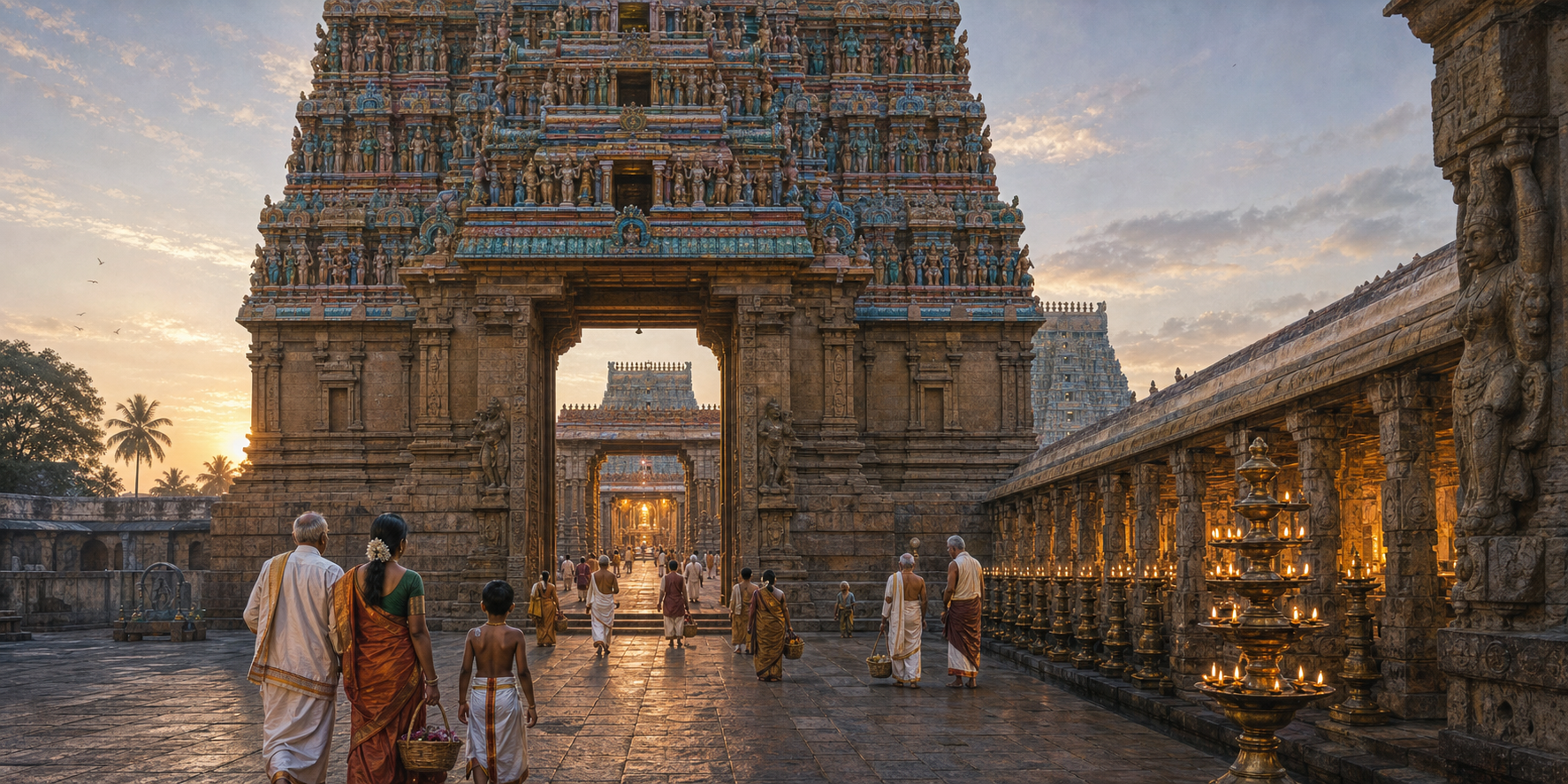
The Srirangam observance normally includes early recitations, alankaram for Andal and Namperumal, and the formal wedding with Vedic chanting, auspicious music, and offerings. Treat those elements as a sequence rather than arriving only for a brief view of the divine couple.
- Check the temple’s announced timetable for the year instead of relying on an old festival schedule. The calendar date and the detailed sequence are separate planning questions.
- Arrive early enough for the pre-dawn Dhanurmasam observances if you intend to participate in them. Complete your main household preparation before leaving home.
- Read or recite the Tiruppavai beforehand. Familiarity with the hymns changes the experience from watching a ceremony to recognizing the vow that the ceremony fulfills.
- Follow temple instructions, maintain the movement of queues and passages, and keep conversation and phone use subordinate to worship. Collective order allows more devotees to participate without diminishing the sanctity of the occasion.
If you are observing from home
A home observance does not need to imitate every element of a temple kalyanotsavam. Recite the Tiruppavai in the form your family or sampradaya recognizes, prepare a clean place for worship, and make the customary flower and food offerings. If you intend to conduct a formal wedding ritual, follow an established acharya, priest, or inherited family procedure rather than assembling Vedic rites from disconnected instructions.
You can make the observance intelligible to younger family members with one clear explanation: Andal’s disciplined love for Ranganatha is honored as divine union. Then connect that explanation to conduct. Ask each person to choose one concrete expression of the vow’s values, such as completing a neglected duty, speaking truthfully in a difficult matter, or serving someone without seeking recognition. This does not replace worship; it prevents worship from ending when the ceremony does.
Build a schedule that does not force the rites to compete
The practical difficulty is timing: Bhogi customs begin before dawn or in the morning, and Dhanurmasam recitations also take place early. Choose one anchor for the morning and arrange the other household practices around it.
When the temple observance is your anchor
- Finish sorting, cleaning, decorating, and most food preparation on the previous evening.
- Ask your elders which Bhogi customs must be completed before departure and which can be observed after returning. Do not shift a time-sensitive family rite merely for convenience without first understanding its place in the tradition.
- Follow the temple’s announced sequence for recitations, alankaram, and kalyanotsavam. Leave enough travel time to arrive without pushing through the gathering.
- Reserve the later part of the day for seasonal food, relatives, neighbors, and the community hospitality associated with Bhogi.
When the household observance is your anchor
- Join Bhogi Mantalu before dawn if the bonfire belongs to your local tradition and can be conducted safely.
- Complete Bhogi Pallu in the morning, when children and elders can participate without being rushed.
- Set apart an undisturbed period for Tiruppavai recitation and Andal worship at the time recognized by your family or sampradaya.
- Use the daytime for visits, sharing seasonal preparations, and preparing for Surya Pongal. Let the evening gathering strengthen family and neighborhood ties rather than becoming another crowded ritual program.
Do not measure devotion by how many customs you can compress into a few hours. A carefully observed family rite and attentive participation in one devotional sequence carry more meaning than racing between several ceremonies while understanding none of them.
Key takeaways for planning the day
- Explain Bhogi Pongal and Andal Kalyanam separately: the first concerns seasonal and household renewal; the second fulfills Andal’s devotional vow.
- Move cleaning, sorting, decoration, and ingredient preparation to the previous evening because the significant observances begin early.
- Treat Bhogi Pallu as a blessing for children, not as a test of one supposedly universal recipe.
- If you are attending Srirangam, make the temple’s announced timetable the anchor and arrange household customs around your inherited practice.
- If you remain at home, recite the Tiruppavai and follow your sampradaya rather than improvising a formal kalyanotsavam.
- Carry the day’s meaning forward through one specific change in conduct: release something obsolete, keep a neglected commitment, or perform an act of service.
Before the next Bhogi morning arrives, decide which observance will anchor your family’s schedule, speak with the elders about the customs that cannot be moved, and prepare the home the night before. Then you can enter the day with enough attention to recognize both movements: the clearing that makes renewal possible and the devotion that reaches fulfillment.
References
- DharmaRenaissance Blog – Bhogi Festival Explained: Significance, Bhogi Mantalu, Bhogi Pallu, and Pongal Traditions
- DharmaRenaissance Blog – Sri Andal Kalyanam at Srirangam on Bhogi Pongal 2026: Date, Rituals, and Sacred Significance
