
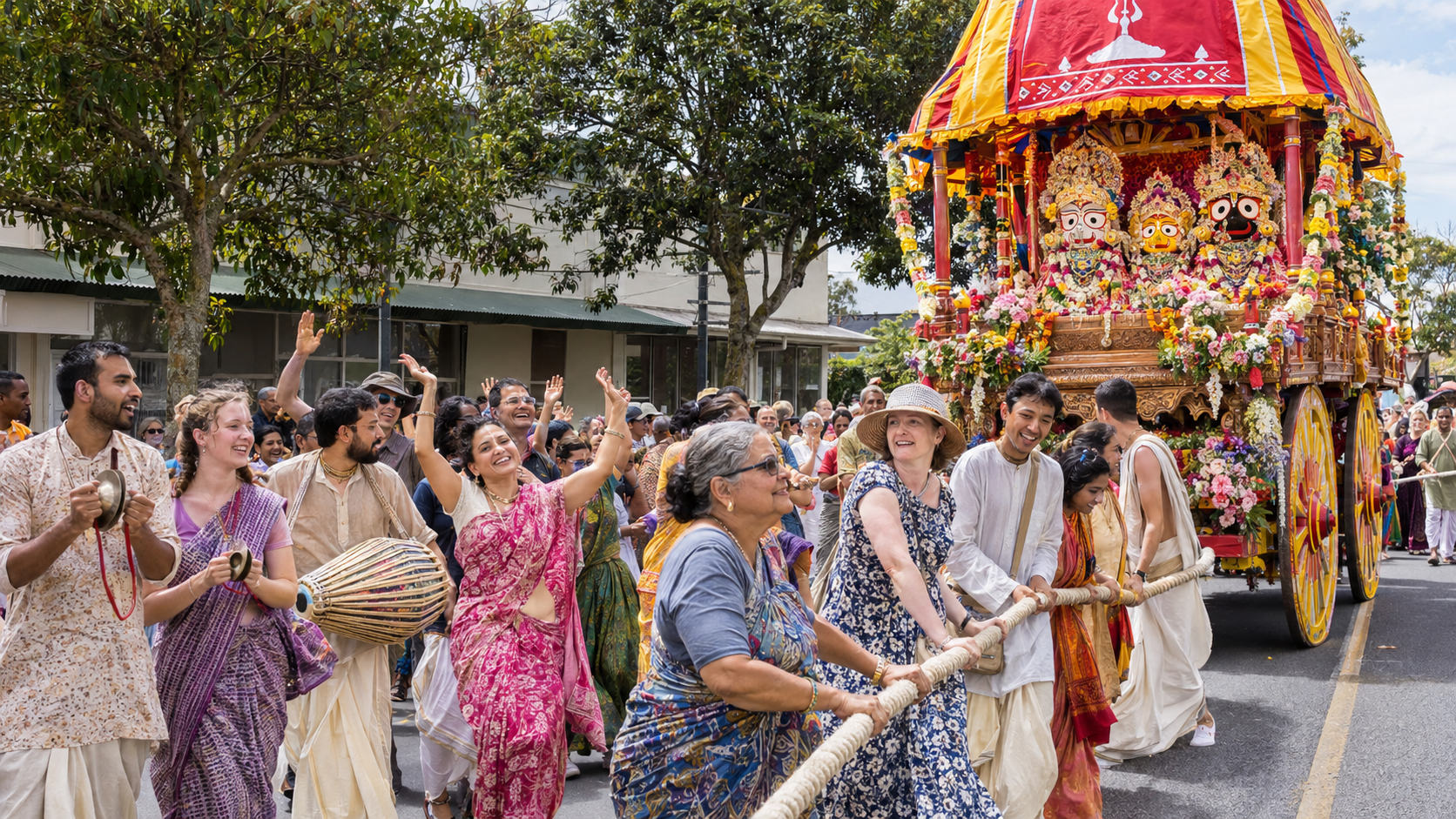
If you encounter Rathayatra in an Auckland street parade, you may wonder whether you are watching a cultural performance, a religious procession, or an event you are welcome to join. The clearest answer is that it is public worship expressed through sacred images, music, movement and community participation.
You do not need prior knowledge to take part respectfully. Once you understand who is at the centre of the procession and why devotees chant and dance around them, the celebration becomes much easier to read.
Key takeaways
- Auckland hosted two local Rathayatra celebrations, one in Helensville and another in Manurewa.
- In both places, the Rathayatra group participated in a council-organized parade as one of its floats.
- Jagannatha, Balarama and Subhadra formed the sacred centre of the procession, while devotees accompanied them with chanting and dancing.
- You may watch quietly, join the repeated chant or dance with the group, provided you follow the directions of parade stewards and respect the deities.
- If you plan to attend a future celebration, confirm the exact neighborhood, route and time rather than assuming that Helensville and Manurewa are stops on one procession.
What happened in Helensville and Manurewa
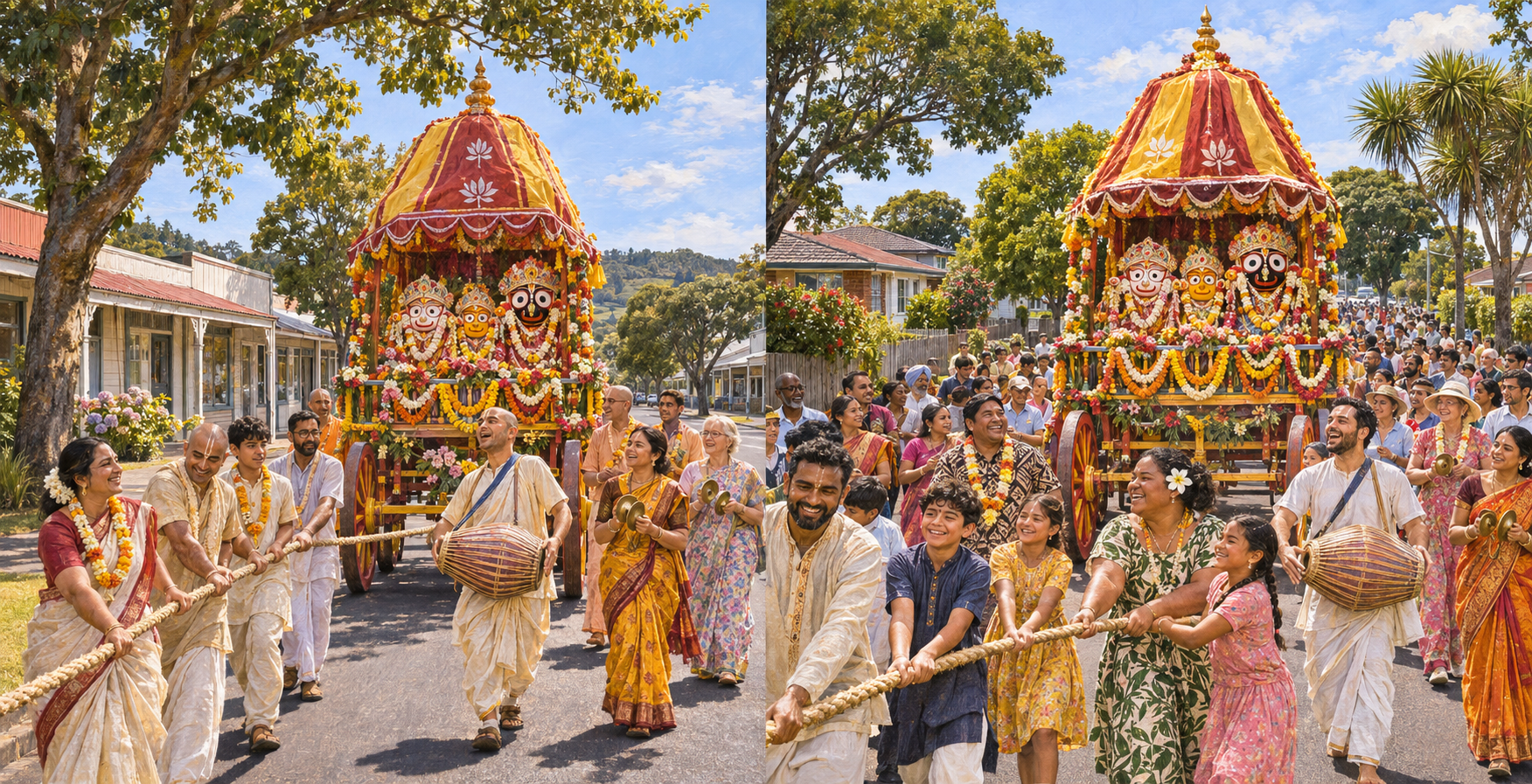
The Auckland celebrations took a distinctive local form. Devotees attended two Rathayatras, one in Helensville and the other in Manurewa, joining the council-organized parade in each area as a float.
That detail matters if you are trying to find or attend the celebration. These were separate neighborhood events connected to their respective local parades, not two documented stops along a single route. For a future Rathayatra, check both the devotional community’s announcement and the relevant civic parade information. The first should explain the religious gathering; the second is more likely to carry route, access and traffic details.
The spiritual centre remained the same in both places: Jagannatha, Balarama and Subhadra appeared before the public, surrounded by devotees chanting and dancing. Spectators did not have to enter a temple or already belong to the community. The celebration met them in a shared civic space.
Seeing more than a parade float
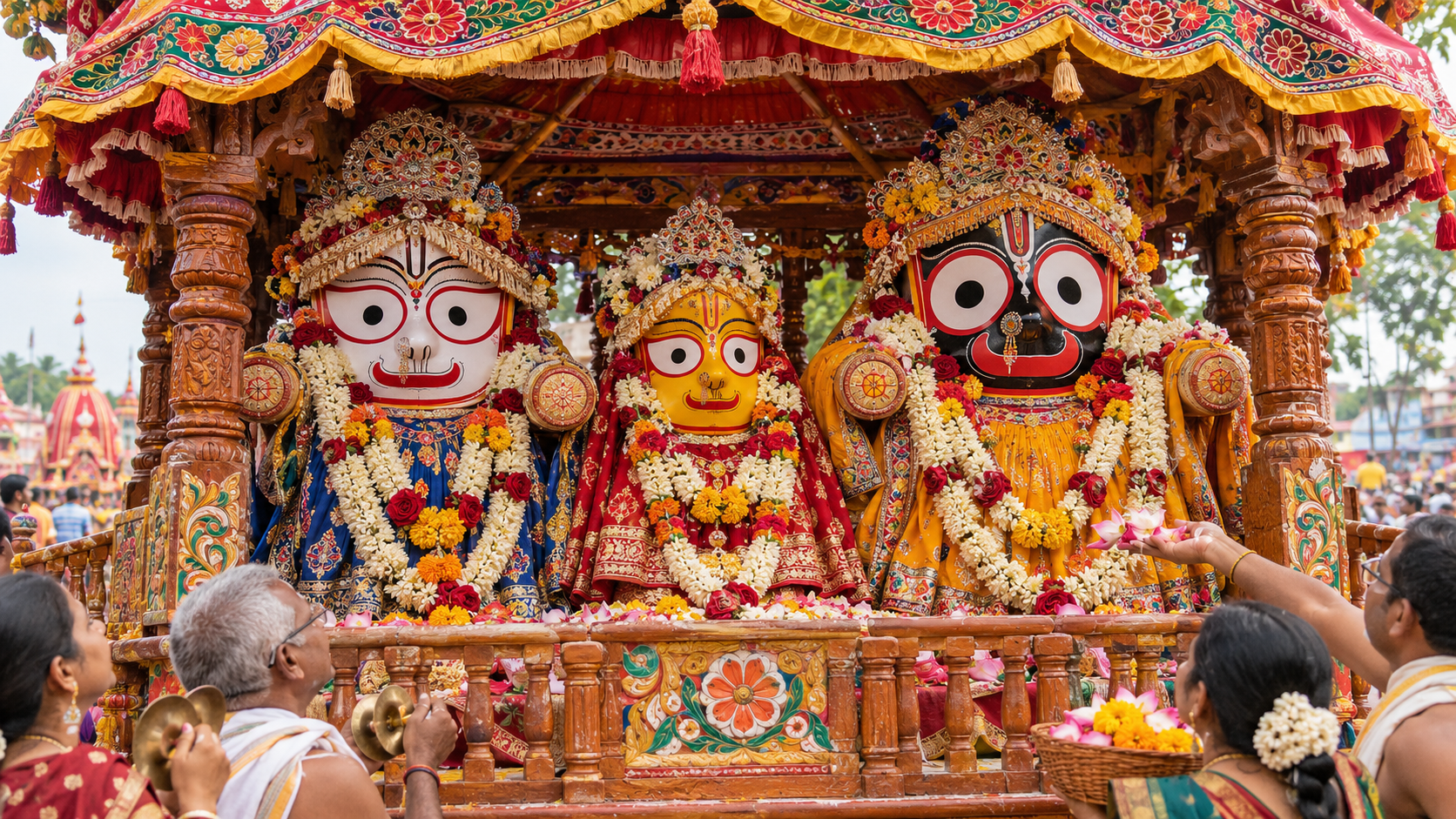
A civic parade naturally presents everything in the visual language of floats, costumes and performances. Rathayatra asks you to notice another layer. The platform may function as a parade float, but the figures upon it are not decorative characters. They are sacred forms receiving devotion.
Jagannatha is commonly understood as the Lord of the universe. He appears with Balarama and Subhadra, the familiar triad at the heart of the Rathayatra tradition. For devotees, their emergence into public view is not merely a display of identity. It makes darshana, the encounter with the sacred presence, accessible beyond the usual boundaries of a shrine.
The chanting and dancing should be read in that devotional frame. They are not entertainment added to hold the crowd’s attention. Voice and movement are themselves forms of worship. At the Auckland parades, this devotion also created an immediate point of contact with spectators: the crowds responded with delight as the devotees chanted and danced.
If this is your first Rathayatra, pay attention to three things. First, identify the sacred centre: Jagannatha, Balarama and Subhadra. Second, watch how the devotees orient their singing and movement around that centre. Third, notice how a repeated chant enables people at the edge of the procession to move from spectatorship into participation. Those three observations will tell you more about the celebration than treating it simply as an especially colorful float.
How to participate respectfully
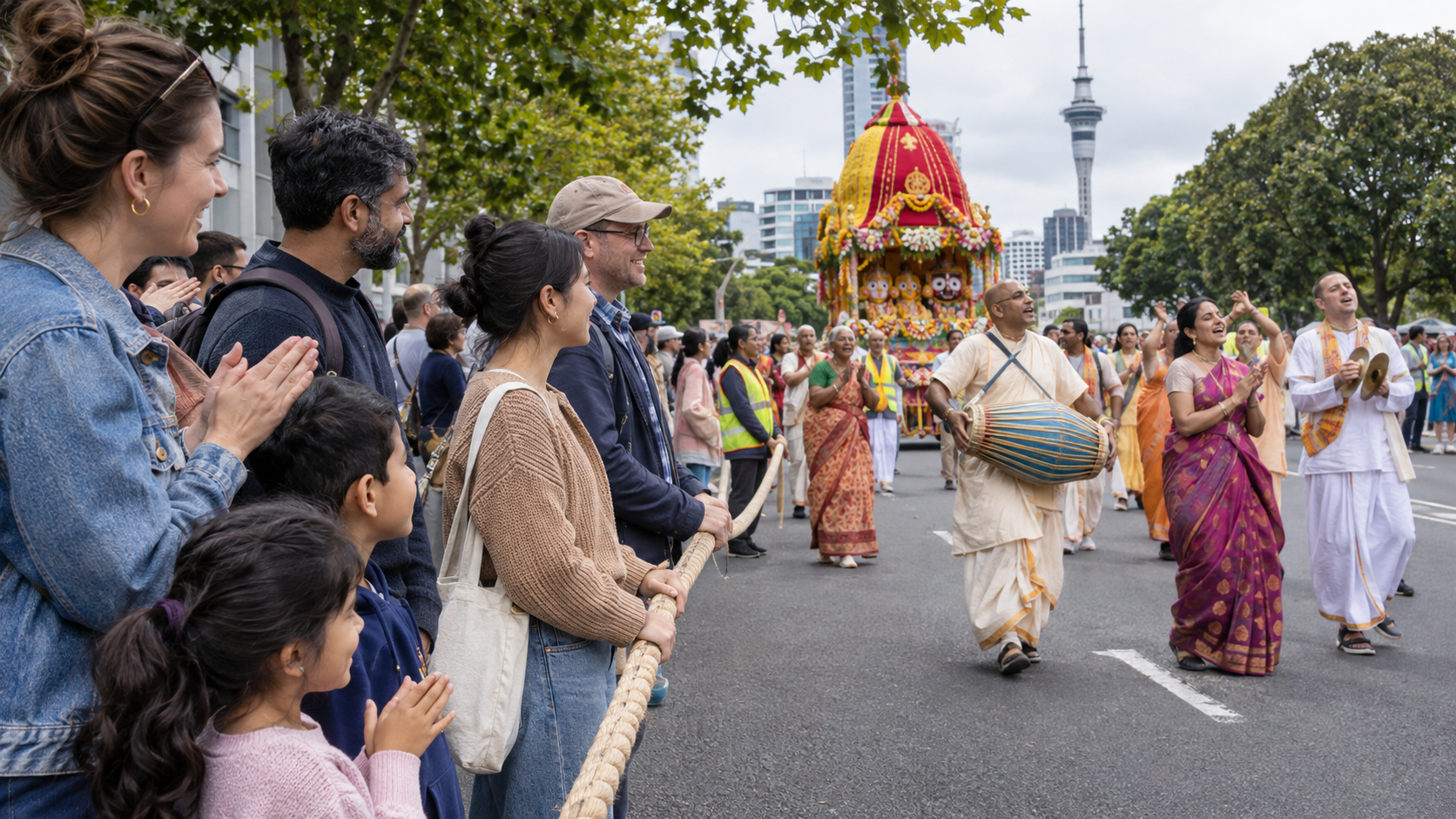
Rathayatra is deliberately public, so you need not remain distant out of fear that you will intrude. Respect does not require expertise. It requires attention to the sacred character of the event and to the practical rules of a moving parade.
- Confirm the exact event before travelling. Helensville and Manurewa hosted distinct local celebrations, so verify the neighborhood, parade route, assembly point and starting time for the occasion you intend to attend.
- Arrive before the procession begins if you want an unobstructed view. Once a civic parade is moving, barriers, road closures and stewarding may limit where you can cross or join.
- Follow parade stewards rather than stepping directly toward the float. Keep clear of wheels, ropes, musicians and moving groups, even when the devotional activity feels informal and welcoming.
- Listen for the repeated response in the chant. You can join that response without knowing every word. If you prefer not to sing, watching with attention is also a respectful form of presence.
- Dance only where participants and stewards have left room. Match the pace of the group and avoid blocking the procession for a photograph.
- Treat Jagannatha, Balarama and Subhadra as worshipped deities. Do not touch the deities, climb onto the float or handle sacred objects unless a responsible organizer explicitly invites you.
- Use considerate photography. A public parade may be photographed, but ask before taking close portraits of children or individual worshippers. Do not push between a devotee and the deities to secure a better angle.
- If food, flowers or another devotional item is offered, receive it from the volunteer distributing it. Do not assume that every item placed near the deities is available for spectators to take.
If you are bringing children
Give children a simple explanation before the float arrives: “These are Jagannatha, Balarama and Subhadra. Rathayatra brings the deities into public view. The singing and dancing are ways of worshipping them.” That is enough context for a child to distinguish the sacred procession from the other parade entries without turning the moment into a long theology lesson.
Then give one practical instruction: stay beside the adult and behind any marked boundary. A moving float attracts attention upward, which makes it easy for a child to overlook what is happening at street level.
What Auckland’s celebrations show about public dharma
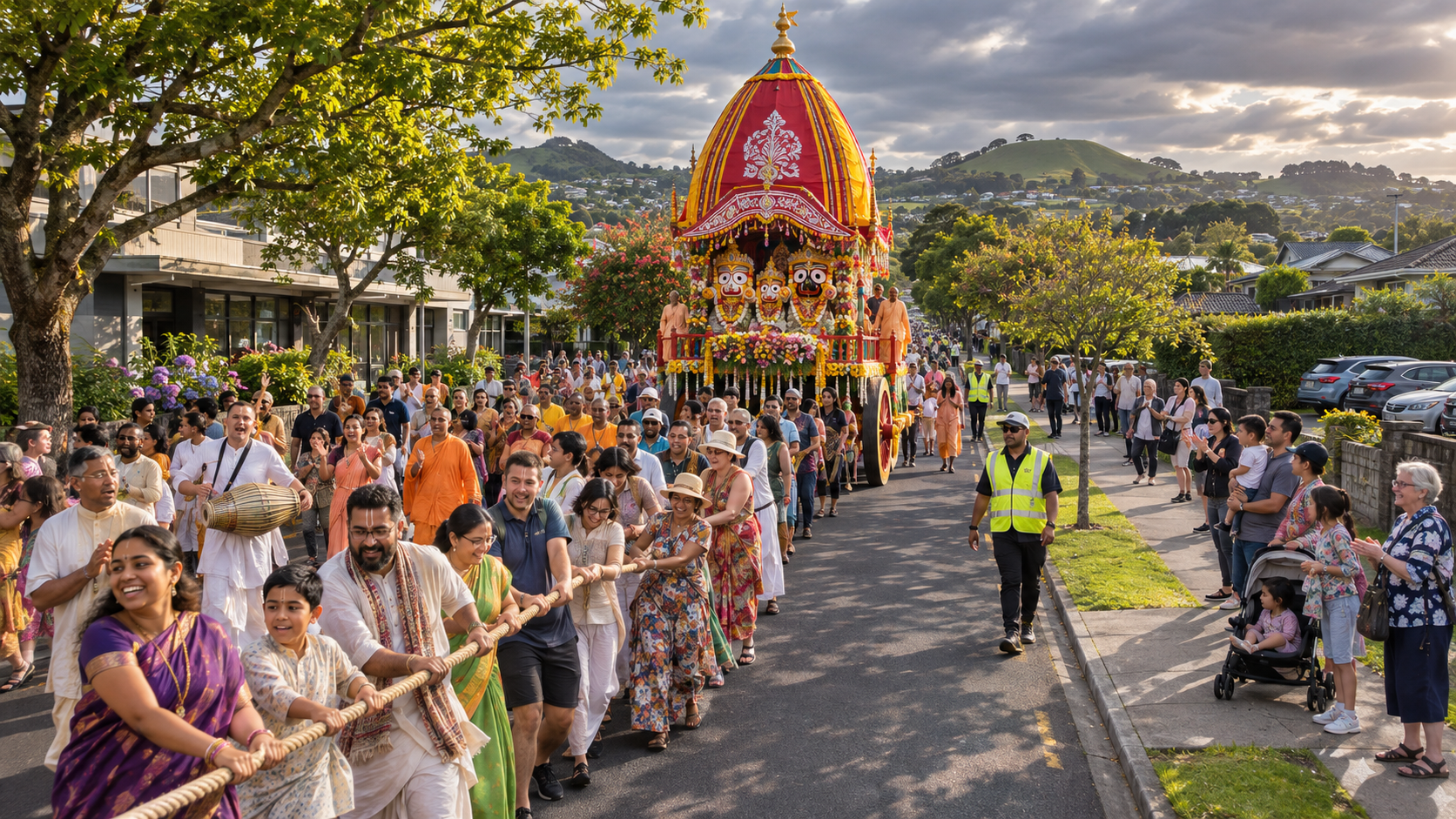
The Helensville and Manurewa appearances offer a useful model for a diaspora community. Dharmic visibility need not be confined to a private venue, and participation in a civic event need not strip a religious tradition of its devotional substance. The Auckland groups entered an existing public framework while keeping Jagannatha, Balarama and Subhadra at the centre and maintaining chanting and dancing as acts of worship.
For community organizers, four decisions make that balance easier to preserve:
- Make the sacred centre immediately legible. Spectators should be able to see that the deities, rather than performers or decorations, are the focus.
- Prepare a one-sentence explanation for newcomers. Naming Jagannatha, Balarama, Subhadra and the purpose of Rathayatra is more useful in a moving crowd than a lengthy doctrinal account.
- Make participation easy to understand. A clearly led, repeated chant gives interested spectators a respectful way to join without pretending to knowledge they do not have.
- Plan the civic interface carefully. Route rules, timing, barriers and steward instructions protect participants while allowing the devotional group to remain open and welcoming.
This also offers a sound way to judge whether public representation is working. The test is not simply whether the float draws attention. Ask whether a newcomer can identify the sacred figures, recognize the chanting and dancing as devotion, and understand how to respond respectfully. Auckland’s two local celebrations brought those elements together in the ordinary public setting of neighborhood parades.
If Rathayatra next passes through your part of Auckland, go prepared to do more than watch a float. Learn the three names, follow the stewards, listen for the chant and allow the procession to introduce itself on its own devotional terms.
References

Leave a Reply
You must be logged in to post a comment.