
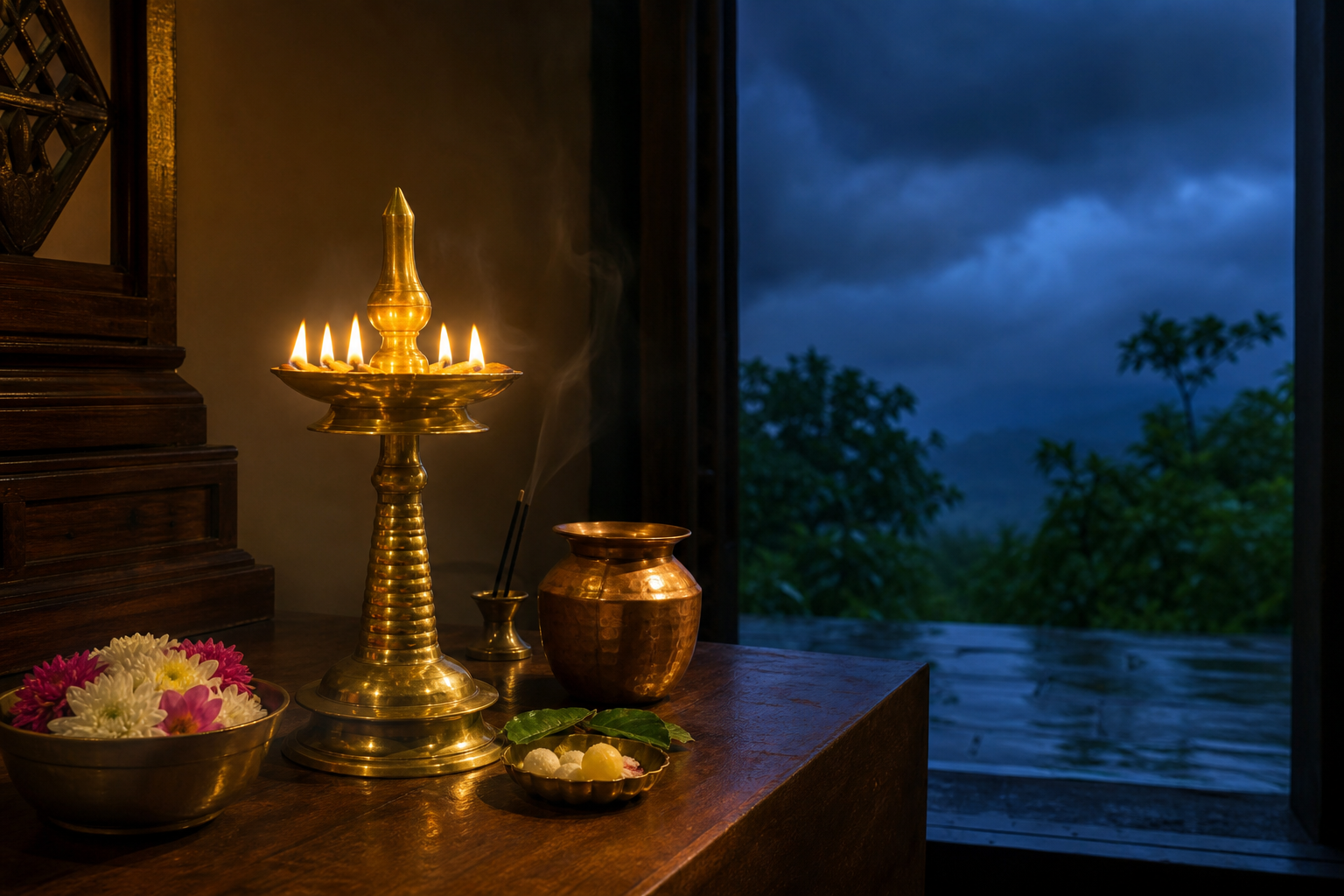
Ashada Amavasya brings several forms of observance onto one lunar threshold: remembrance of ancestors, worship of sacred lamps, regional vratas, and preparation for the devotional discipline of Shravan. The result is not one uniform festival program but a family of practices shaped by calendar tradition, region, and household sampradaya.
Two DharmaRenaissance reports approach the occasion from complementary directions. One emphasizes the wider ancestral and regional setting, while the other examines the preparation, symbolism, and domestic practice of Deepa Puja. Read together, they clarify the two reported dates for 2026 and show how a simple flame can connect cosmic time, household order, memory, and spiritual intention.
Key takeaways
- Both source articles report July 14, 2026, for North Indian calendar traditions and August 12, 2026, for Marathi, Gujarati, Kannada, and Telugu traditions.
- The difference reflects purnimanta and amanta systems of naming lunar months; a household should therefore use its local panchang rather than combine the dates.
- Deepa Puja treats the lamp as a sacred presence associated with consciousness, clarity, auspiciousness, and renewal, not merely as festive decoration.
- Ashada Amavasya also carries ancestral and regional meanings, including Pitru observances, Chukkala Amavasya, Bheemana Amavasya, and Gatari Amavasya.
- The sources support a focused household observance while repeatedly cautioning that exact procedures vary by region, lineage, and family custom.
Why Ashada Amavasya has two reported dates in 2026

The general Ashada Amavasya report and the Deepa Puja report agree on the central calendrical point: the festival name appears on two civil dates in 2026 because regional Hindu calendars do not all assign the dark fortnight to the same named month.
| Calendar tradition reported by the sources | Reported 2026 date | Month-reckoning context |
|---|---|---|
| North Indian Hindi calendars | July 14 | Commonly purnimanta |
| Marathi, Gujarati, Kannada, and Telugu calendars | August 12 | Commonly amanta |
In the purnimanta approach described by the sources, a lunar month is reckoned from the day after one Purnima to the next Purnima. In the amanta approach, the month ends with Amavasya. The dark fortnight can consequently receive a different month name in the two systems. The dates should not be treated as competing claims or merged into a universal two-day observance; each belongs to a particular calendrical framework.
The general report adds an important technical qualification: Amavasya is a tithi determined by the relationship of the Sun and Moon, not a fixed midnight-to-midnight civil date. Its beginning and ending can interact with local sunrise rules and location. For practical observance, the decisive reference is therefore the panchang, temple calendar, or inherited calendar practice actually used by the household.
Why a lamp matters on a moonless lunar day
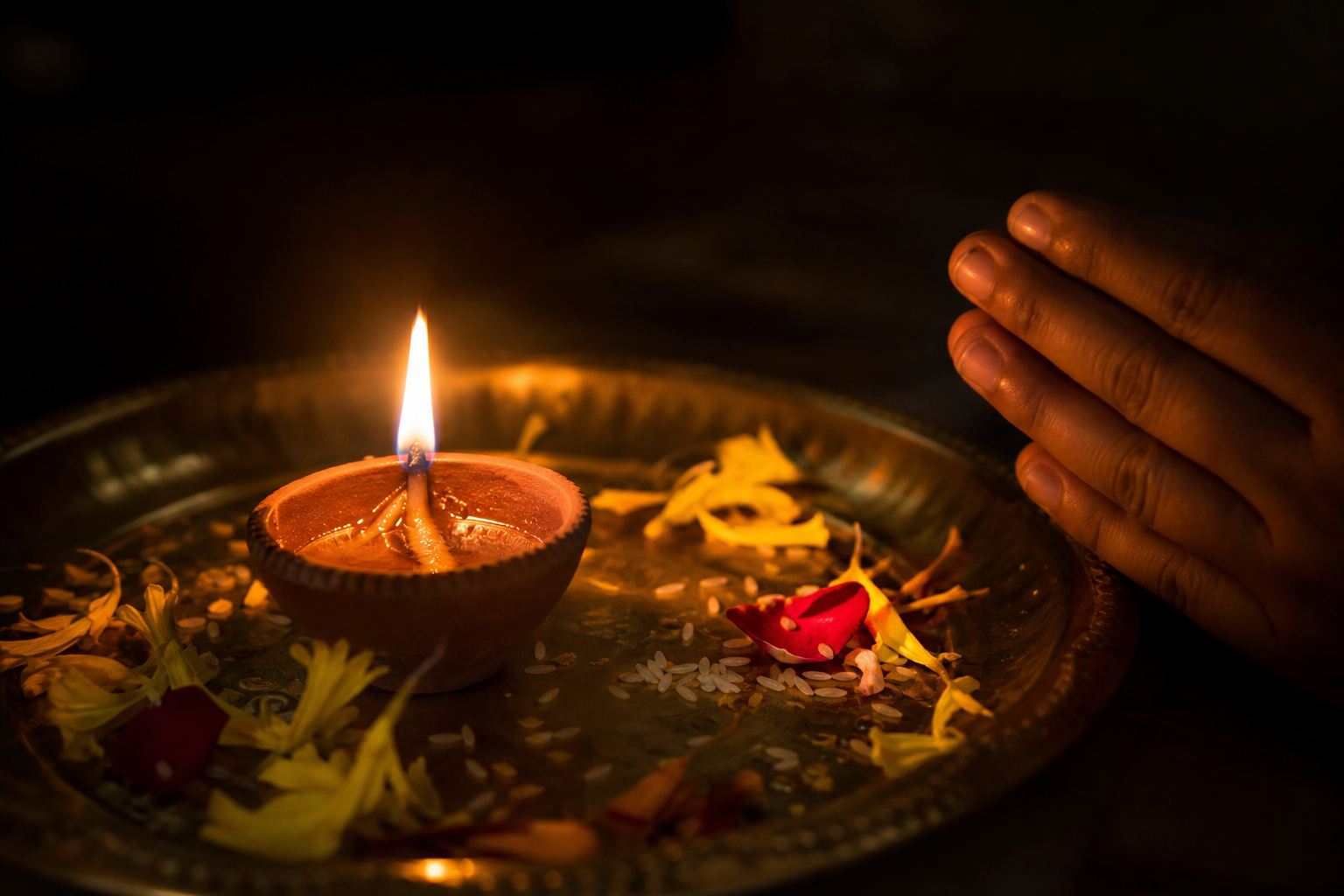
Both articles interpret Deepa Puja through the relationship between darkness and deliberate illumination. Amavasya is associated in the sources with introspection, restraint, prayer, charity, purification, and ancestral remembrance. Lighting a lamp does not erase that inward quality. It gives it a visible discipline: the devotee responds to an unlit sky by tending a small, ordered flame within the home.
The lamp-focused report describes the flame as Deepa Jyothi and associates it with consciousness, dharma, prosperity, protection, and moral clarity. It can be offered in relation to an Ishta Devata rather than to one mandatory deity for every family. The same ritual symbol can therefore serve Shaiva, Vaishnava, or Shakta devotion without losing its recognizable form.
That report also presents the diya as a compact image of the Pancha Bhootas. Its clay or metal form, sustaining oil, cotton wick, flame, and surrounding space bring material form, nourishment, embodiment, transformation, and radiance into one ritual object. This interpretation helps explain why cleaning and filling the lamp are meaningful parts of worship: the flame depends on several elements being brought into a careful relationship.
The lamp-focused article further connects Deepa Puja with Lakshmi, Parvati, and Saraswati, representing auspicious abundance, strength and protection, and knowledge and clarity. It also reports an association with Asta Aishwaryas, understood broadly enough to include forms of well-being beyond money. In this reading, prosperity is incomplete if it is separated from health, learning, courage, family harmony, or inner contentment.
The wider Ashada Amavasya article places this symbolism beside Pitru Rina, Pitru Tharpan, and Pinda Pradhan. Together, the sources suggest that Deepa Puja is not simply a request for future fortune. It can also express gratitude for inherited life, culture, and care. The household becomes a meeting place for memory and renewal: what has been received is honored before the next devotional season begins.
A practical household observance with room for tradition
Preparing the lamps and worship space
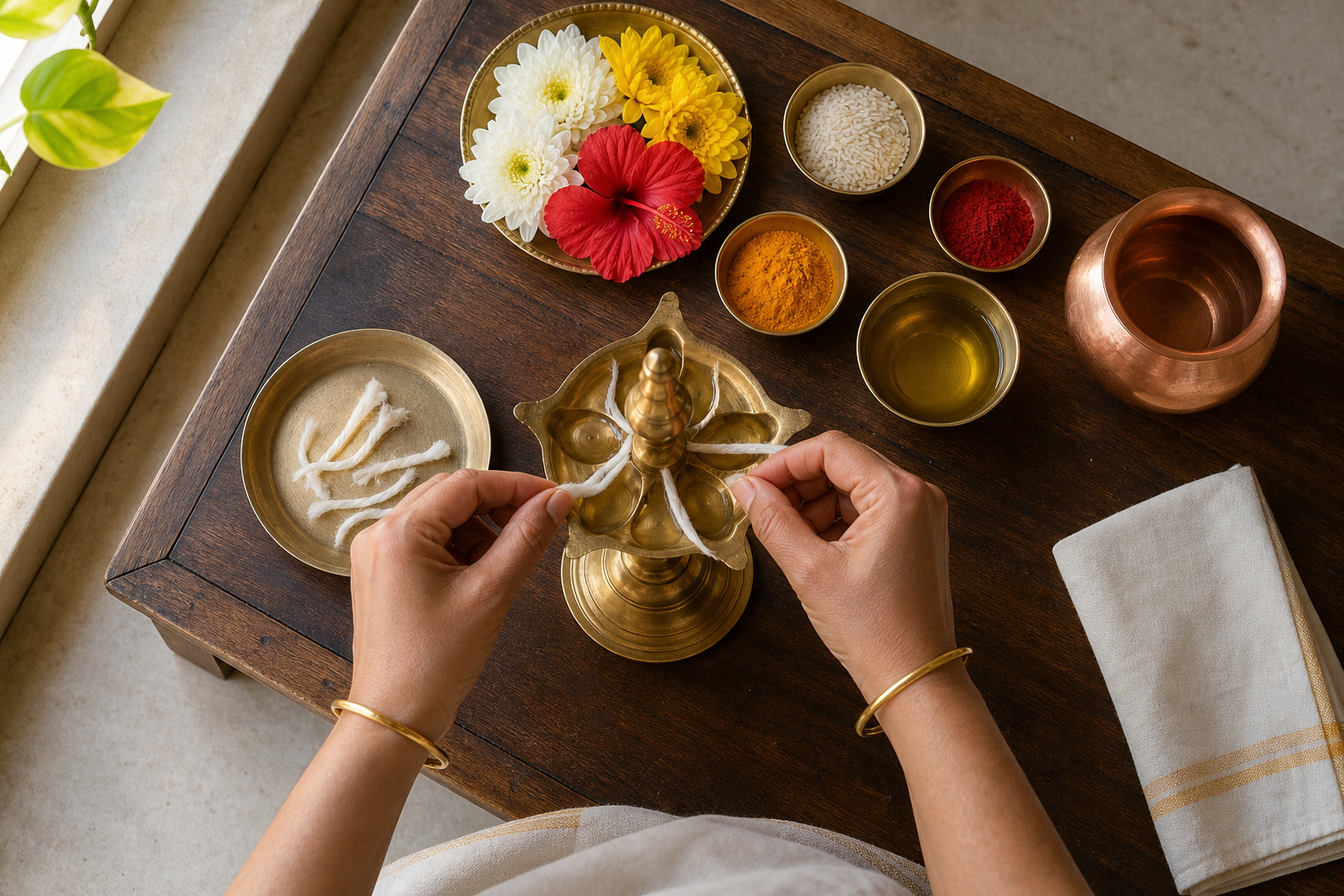
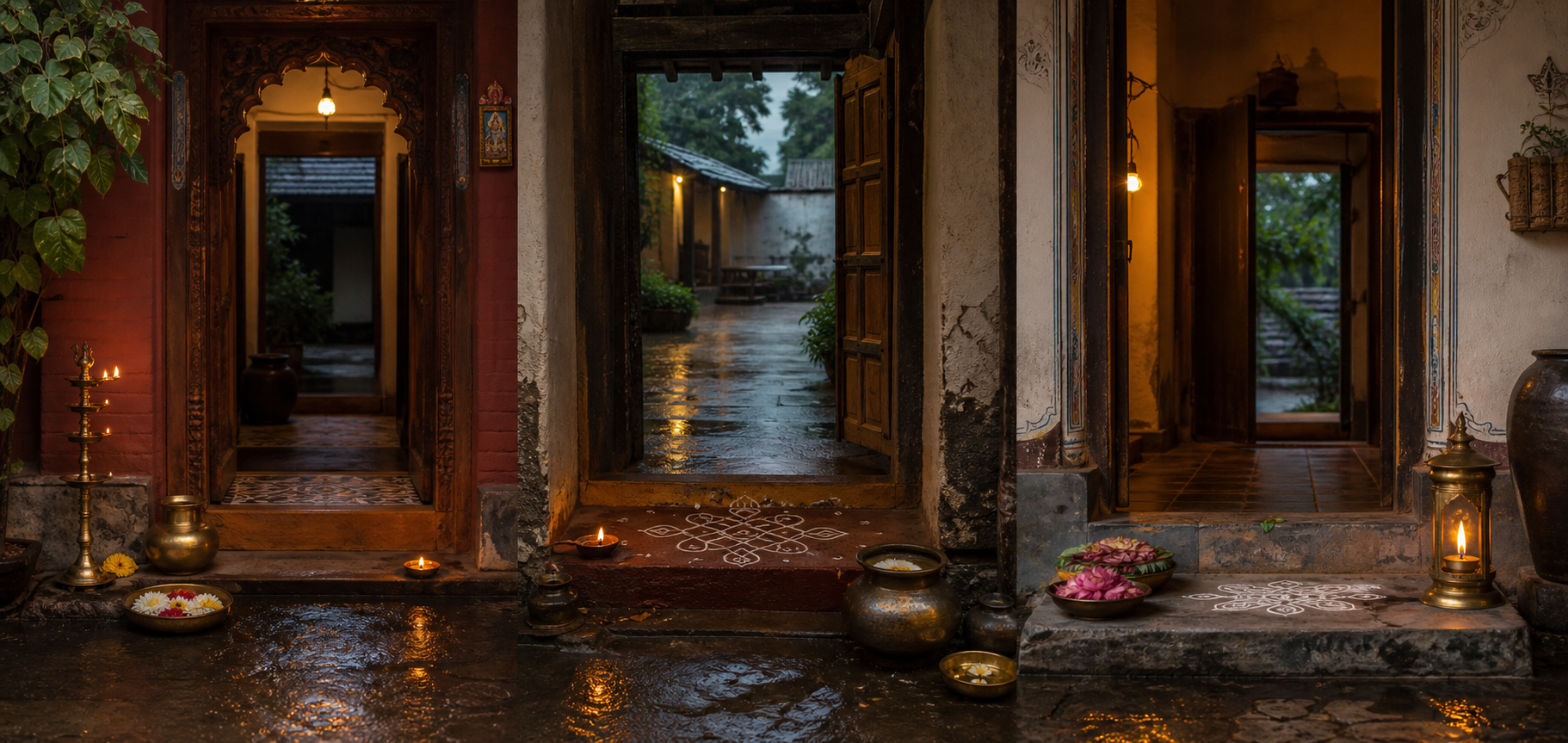
The lamp-focused article describes cleaning the home and puja area, removing soot and old residue from the lamps, and arranging the deepas on a clean table, wooden plank, or puja platform. Some households add flowers, rangoli, or kolam. These actions are presented as more than decoration: physical order establishes a boundary of attention and helps prepare the mind for worship.
Oil or ghee and cotton wicks are then placed in the lamps. The report explicitly allows variation in the oil, number of lamps, and arrangement. A single central lamp and a larger gathering of diyas can both express the central principle, provided the observance is conducted with reverence. Ordinary fire safety remains essential: lamps should be stable, supervised, and kept clear of loose fabric or other flammable materials.
Honoring the flame
The described puja may include lighting the lamps, offering flowers, applying turmeric or kumkum where appropriate, offering incense, reciting a familiar lamp prayer or names of the chosen deity, and performing a simple arati. The source does not make ritual complexity the measure of sincerity. Attention, cleanliness, and devotion remain the organizing values.
Families whose tradition includes ancestral rites should not assume that a general lamp-puja outline replaces the procedures for Pitru Tharpan or Pinda Pradhan. The wider report mentions water, sesame, darbha, cooked rice preparations, prayer, remembrance, and charity within the ancestral ritual setting, but it also advises following family sampradaya or competent priestly guidance for exact procedure and timing.
Extending the observance into the evening
The lamp-focused report says that some households light diyas again in the evening and place them around the home in a manner reminiscent of Deepavali. This creates a sensory transition as darkness gives way to many small points of light. Traditional belief interprets the illumination as protective and auspicious; at the level of lived practice, it also gives the family a shared act of order, warmth, and hopeful attention.
Regional observances reveal a shared day, not a single script
The general report identifies Deepa Puja as a principal Ashad Amavasya observance in several North Indian traditions, while the lamp-focused article discusses the practice across the regional calendar systems that assign the festival to different dates. The two emphases can be read together: lamp worship is a major strand of the occasion, but it does not exhaust the meanings attached to the tithi in every region.
In Andhra Pradesh and Telangana, the wider report says the occasion is known as Chukkala Amavasya and is associated with Gauri Puja. In Karnataka, it reports Bheemana Amavasya, also connected with Pathi Sanjivini Vrata or Jyotir Bheemeswara Vrata. Married women traditionally observe that vrata for the health and longevity of their husbands. In Maharashtra, the same report describes Gatari Amavasya as a cultural threshold before Shravan, a month it associates with fasting, vrata, Shiva worship, and heightened devotional discipline.
Ancestral remembrance supplies another layer rather than a competing festival identity. The general article gives Pitru Tharpan and Pinda Pradhan a central place, linking them with gratitude and recognition of obligations to lineage. It also notes that a person unable to perform a full rite can still approach the day through remembrance, charity, and conduct that honors inherited responsibilities.
This regional range argues against a one-size-fits-all checklist. A practice prominent in one community should not be declared mandatory for another, yet the variations are not unrelated. Each turns lunar time into a form of responsibility: toward ancestors, a spouse, the household, the chosen deity, or the discipline about to intensify with Shravan.
For 2026, the soundest next step is to confirm the relevant date and tithi locally, then choose an observance consistent with family tradition. Whether centered on a lamp, ancestral gratitude, Devi worship, or a regional vrata, the occasion can prepare the household to enter the coming sacred season with greater steadiness and attention.
References
- DharmaRenaissance Blog – Ashada Amavasya 2026: Powerful Rituals, Dates, and Ancestral Significance
- DharmaRenaissance Blog – Deepa Puja on Ashada Amavasya: Sacred Lamps, Ritual Meaning, and 2026 Dates