
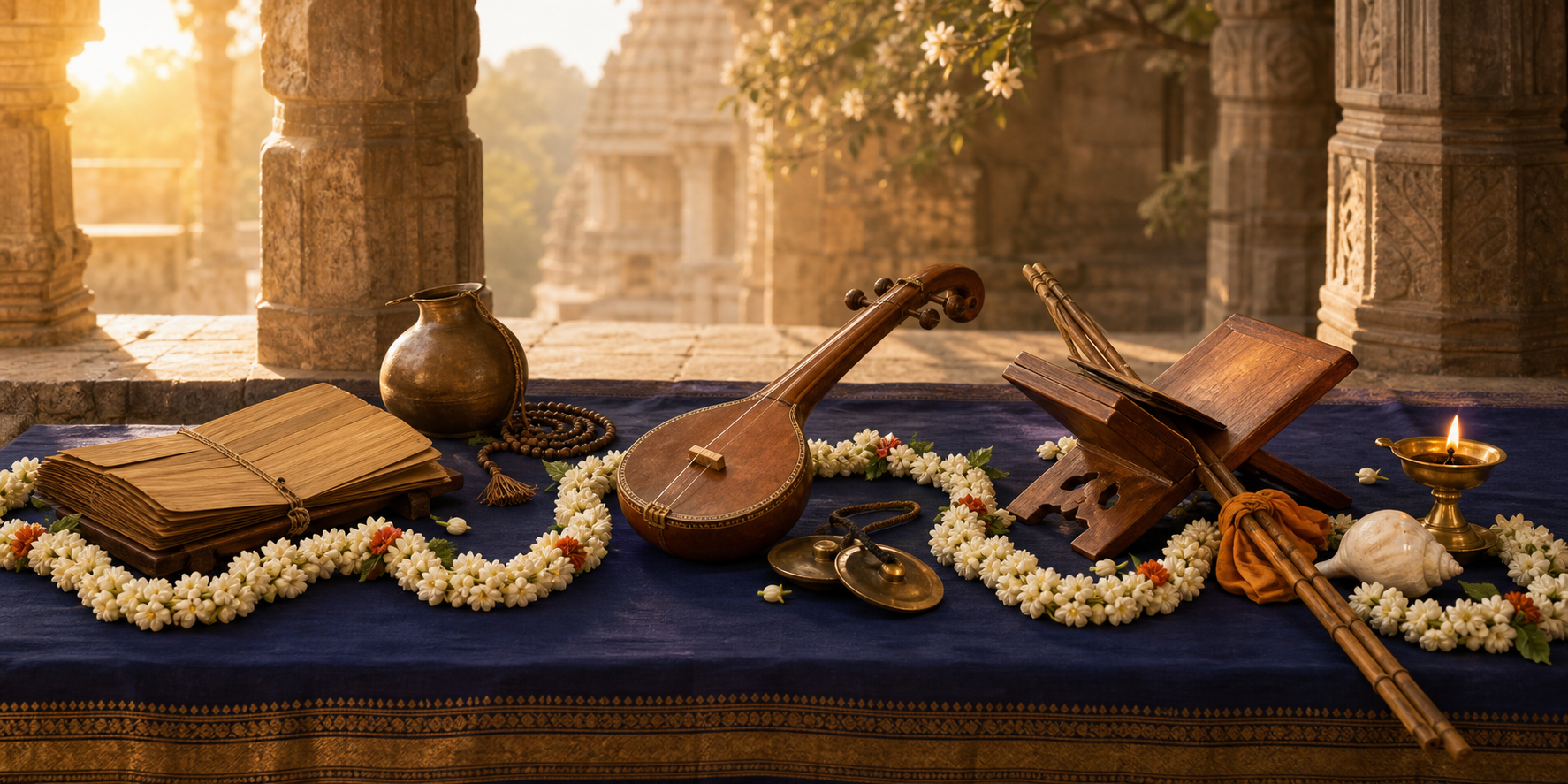
If you want to honor April’s Vaishnava teachers and poets, the calendar can feel unexpectedly crowded: three commemorations fall within six days, and the last two are back to back. A generic puja for all three would be easy, but it would miss what makes each remembrance worth keeping.
Plan the period as a spiritual sequence. Receive Bhagavata wisdom with Shukadeva Muni, give Krishna bhakti a human voice with Surdas, and then turn devotion into disciplined thought and service with Sri Ramanuja. You will end the week with more than three dates checked off; you will have moved through hearing, singing, understanding, and acting.
Put the civil dates in your calendar, then verify locally
The practical planning dates are 17 April for Muni Shukadeva Jayanti, 21 April for Surdas Jayanti, and 22 April for Ramanuja Jayanthi. Put these dates aside now if you are arranging leave, a family gathering, a temple visit, musicians, a study circle, or an act of dana.
| Date in 2026 | Commemoration | Calendrical basis | Practice to place at the center |
|---|---|---|---|
| 17 April | Muni Shukadeva Jayanti | Amavasya; Vaishakh in the Purnimant system and Chaitra in Amavasyant calendars | Bhagavata shravana, meditation, and quiet reflection |
| 21 April | Surdas Jayanti | Vaishakh Shukla Panchami in the North Indian Purnimanta reckoning | Krishna puja, Surdas padas, kirtan, and literary or musical seva |
| 22 April | Ramanuja Jayanthi | Chaitra Shukla Panchami; Ardra or Tiruvadirai is important in some lineages, especially in Tamil observance | Acharya-vandanam, Sri Vaishnava recitation, philosophical study, and service |
The civil date and the ritual determination are not quite the same thing. A tithi does not begin at midnight, and local traditions may prioritize the tithi present at sunrise. A lineage may also give weight to a nakshatra: for Ramanuja Jayanthi, some Tamil communities follow Tiruvadirai in Chithirai. Time-zone differences can move a diaspora observance to an adjacent civil date.
The month names should not be forced into a single Gregorian sequence. Shukadeva’s Amavasya is called Vaishakh in Purnimant regions and Chaitra in Amavasyant regions. Surdas is remembered on Vaishakh Shukla Panchami in the North Indian convention, while Ramanuja’s commemoration is articulated through Chaitra Shukla Panchami or Tiruvadirai according to regional practice. These labels belong to inherited calendrical systems, not to a simple count of days on a Western calendar.
Use the dates above to organize your life, but use your family’s parampara, local temple, or location-specific panchang to settle the ritual day. Choose that authority before comparing calendars. Selecting whichever calculation gives the most convenient date reverses the proper order: the tradition determines the observance, and your schedule should adapt to it.
Give each figure the practice his legacy calls for
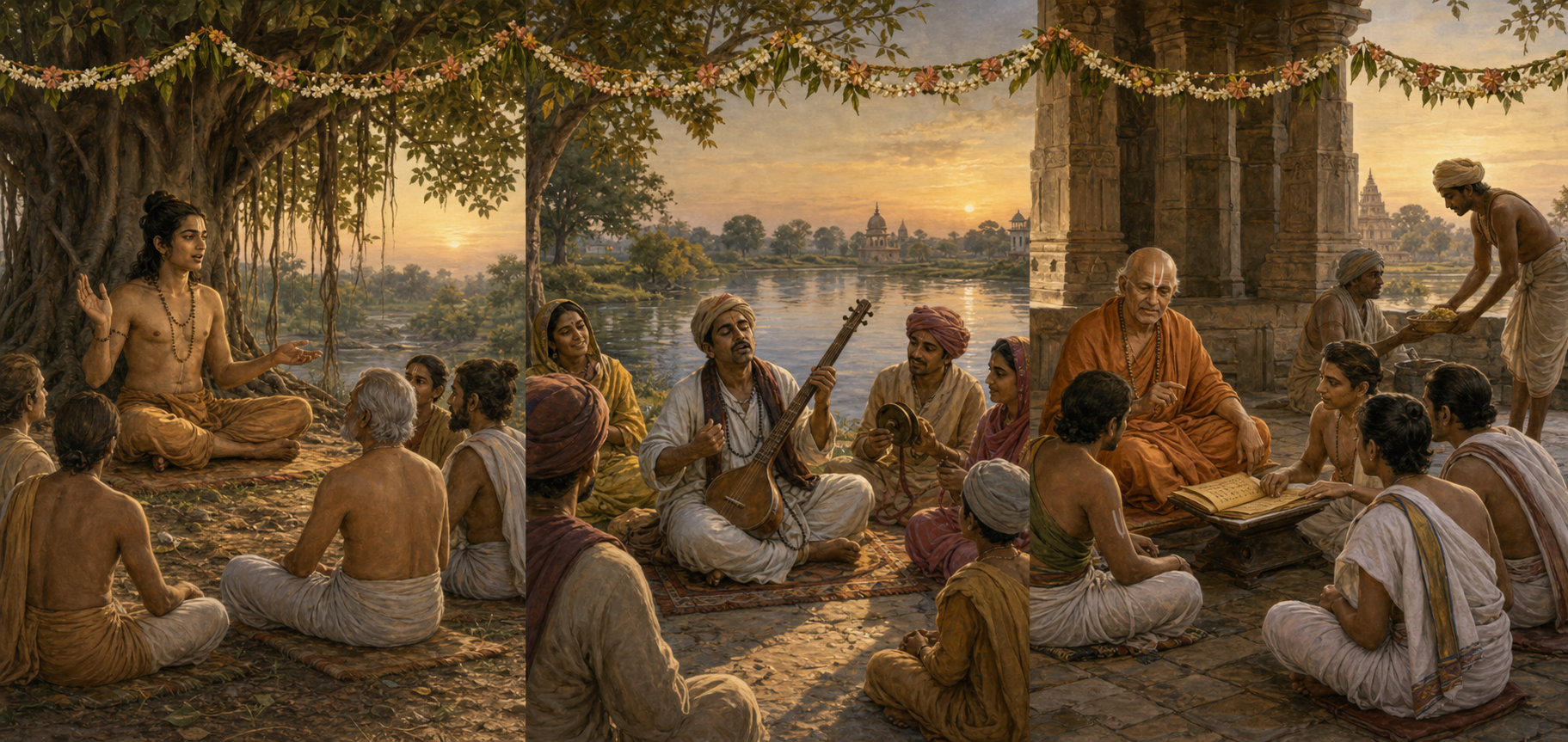
A jayanti becomes memorable when its practice reflects the person being honored. The three observances share Krishna bhakti, guru reverence, recitation, and seva, but they do not emphasize them in the same way.
17 April: learn to receive sacred teaching with Shukadeva
Shukadeva Muni is remembered as the realized son of Veda Vyasa who transmitted the Srimad Bhagavatam to King Parikshit over seven days. His importance is not merely that he possessed knowledge. He joined self-knowledge, freedom from attachment, compassion, and devotion in the act of teaching someone who urgently needed to hear the truth.
That makes attentive hearing the heart of the day. At home, prepare a clean place for images or symbols of Sri Krishna, Veda Vyasa, and Shukadeva. A simple panchopachara offering of fragrance, flowers, incense, lamp, and naivedya is sufficient if that is your custom. Then give an uninterrupted period to a coherent selection from the Bhagavatam. Read aloud, listen to a katha, or take turns reading as a family. Do not let elaborate decoration consume the time meant for shravana.
Amavasya supports the day’s inward mood. If your family keeps a vrata, follow the form your health and tradition allow rather than making the severity of a fast the measure of devotion. Conclude the reading with japa, arati, and a prayer for the welfare of all beings. Annadana or support for scriptural education gives the transmission of knowledge a living continuation.
For a youth discussion, move beyond biographical recall. Ask what Parikshit’s situation teaches about attention, why hearing can be a spiritual discipline, and how detachment differs from indifference. Those questions keep Shukadeva from becoming a remote image of renunciation; they show why clarity must become compassion when another person needs guidance.
21 April: let Surdas teach you to hear bhava in language
Surdas made Krishna’s lila intimate through Braj Bhasha poetry. His padas dwell especially in vatsalya, the tenderness directed toward child Krishna, and madhurya, the sweetness of loving devotion. The poems were not designed to remain silent on a page. They live through melody, congregational singing, rasa-lila, and the raga-shaped temple tradition of Haveli Sangeet.
Choose one pada instead of rushing through many. Read the Braj text, use a reliable translation to establish its literal sense, and then listen to or sing it. Notice who is speaking, which relationship with Krishna is being enacted, and how repetition changes the emotional force of the words. Even a household that is not musically trained can recite a refrain together and allow the poem’s rhythm to lead nama-smarana.
A simple Krishna puja may include tulsi, flowers, milk preparations, or makhan-misri. The important distinction is that Surdas Jayanti should sound like a poet’s commemoration. If you organize a public gathering, print the original words with a translation, let the audience hear the pada in its devotional setting, and leave space for congregational response. A lecture followed by an unrelated bhajan does not reveal how poetry itself became seva.
Present Surdas’s biography with care. His connection with Vallabhacharya and Pushtimarg is strong in devotional memory, while precise chronology and familiar details such as blindness belong partly to hagiographic tradition. Modern scholarship commonly places him in the late fifteenth to early sixteenth century, with approximately 1478-1583 often cited, but not every episode is securely dated. In a school or temple handout, distinguish phrases such as “tradition remembers” from historically firmer claims. That small editorial choice protects both devotion and truthfulness.
Suitable seva includes supporting students of music or literature, making devotional performances more accessible, sharing prasad, or feeding people in need. Surdas made high theological feeling available through the language and music of ordinary people. Your observance should widen access in the same spirit.
22 April: study how Ramanuja joined devotion, thought, and service
Sri Ramanuja did more than defend a philosophical position. He helped consolidate a Sri Vaishnava world in which Sanskrit shastra and the Tamil Divya Prabandham could stand together, and in which temple worship, lineage, learning, surrender, and community stewardship reinforced one another.
For a manageable study theme, take the sharira-shariri relationship in Vishishtadvaita. Narayana is the one Brahman, while individual selves and the cosmos remain real as Brahman’s body, with Brahman as their indwelling controller. This is why the English expression “qualified non-dualism” must not be heard as vague compromise. Unity is affirmed without treating souls or the world as spiritually meaningless. Bhakti, prapatti, knowledge, and selfless action consequently belong to one ordered life.
At a home shrine, offer acharya-vandanam and remember the Alvars and the guru-parampara. Select one substantial practice rather than accumulating a recital list you cannot complete attentively: Vishnu Sahasranama, a passage from the Divya Prabandham, Sri Ramanuja Nootrandadi, Yatiraja Vimsati, or japa of Om Namo Narayanaya. Follow it with a focused reading from or about the Sri-bhashya, Vedarthasangraha, or Gita-bhashya, using a trusted commentary appropriate to your level.
Do not end with study. Ramanuja’s legacy makes the quality of communal life a spiritual concern. Pair recitation with an action that has a clear beneficiary: annadana, educational support, temple seva, manuscript preservation, or assistance for the training of scholars and archakas. If your community commemorates him with a discourse, announce the service commitment in the same program and report its completion afterward. That prevents seva from becoming ceremonial vocabulary.
Use the six-day span as one continuous sadhana

The dates are close enough to form one observance arc. You do not need three elaborate events. You need a deliberate progression in which each day adds something the previous one did not.
- Before 17 April, confirm your local panchang or temple schedule. Set aside the Bhagavata passage, Surdas pada and translation, and Ramanuja reading you intend to use. Decide on one feasible act of seva before the devotional mood arrives, not after it passes.
- On 17 April, reduce distraction and receive the Bhagavata teaching in one uninterrupted sitting. Let silence, listening, and contemplation dominate the observance. Record one question you want to carry into the following days.
- Between the commemorations, keep the question visible. Continue with brief reading, japa, or recollection instead of dismantling the observance after Amavasya. The interval is where a festival starts becoming practice.
- On 21 April, give devotion a voice. Read and sing a Surdas pada, offer Krishna puja, and share its meaning with someone who does not know Braj. Let sweetness become hospitality rather than private sentiment.
- On 22 April, place that devotional feeling within an acharya-parampara. Offer Ramanuja vandanam, study one precise idea from Vishishtadvaita, and carry out or formally begin the seva you selected.
- Afterward, keep the one practice that proved sustainable. It may be a recurring Bhagavata reading, a Surdas pada in family kirtan, Om Namo Narayanaya japa, a study circle, or regular support for a temple or educational effort.
The back-to-back dates of 21 and 22 April require particular care from community organizers. If resources permit, let the Surdas gathering center music and poetry, then let the Ramanuja program center parayanam, teaching, and institutional seva. If both must share one event, divide the program visibly. Name the Surdas segment, change the mode from performance to study, and then begin Ramanuja vandanam. A single undifferentiated “bhakti evening” would conceal the distinctive work of both figures.
Families with children can assign one intelligible role on each day: listening or reading for Shukadeva, singing for Surdas, and explaining or serving for Ramanuja. This is more effective than asking children to sit through three similar ceremonies. They will notice that a tradition survives through different human capacities: memory, voice, reason, discipline, and care.
Recognize dharmic kinship without erasing Vaishnava form
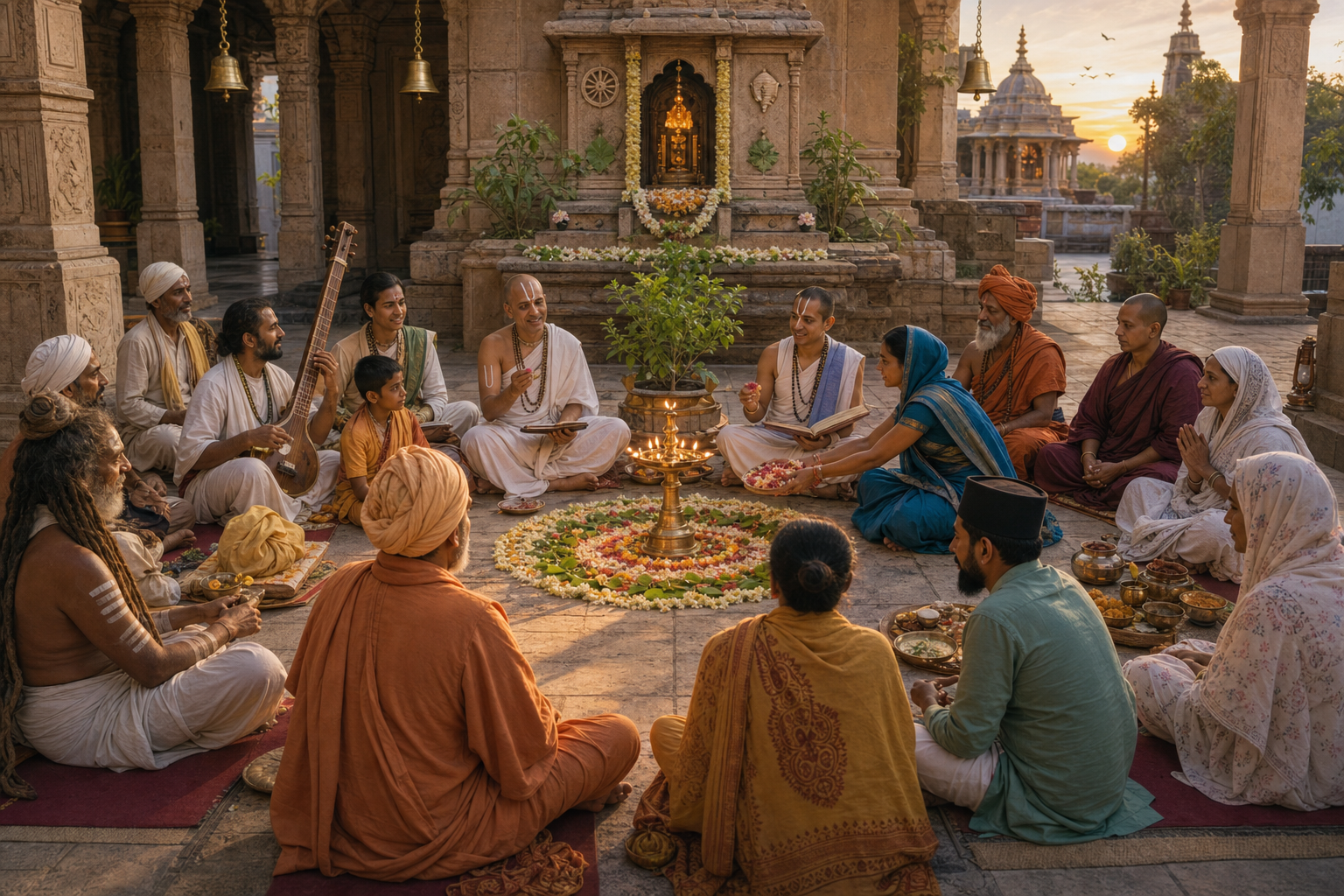
These commemorations also help you speak about the wider dharmic family with precision. Shukadeva’s vairagya and insight resonate with Buddhist and Jain disciplines of renunciation and inner clarity. Surdas’s congregational singing offers an intelligible point of contact with Sikh shabad-kirtan. Ramanuja’s union of devotion and service stands beside the high place given to compassion, ahimsa, and seva across Hindu, Buddhist, Jain, and Sikh traditions.
Resonance is not sameness. Shukadeva’s teaching is transmitted through the Bhagavata and directed toward loving remembrance of Bhagavan. Surdas’s emotional world is Krishna’s Braj lila. Ramanuja’s theology is explicitly ordered around Narayana, prapatti, and the Sri Vaishnava lineage. Removing those names in search of a generic spirituality would weaken the very traditions that make genuine dharmic dialogue possible.
If you are preparing an inter-dharmic program, use a simple order. First explain the practice in its own Vaishnava setting. Then identify the shared virtue. Finally, allow participants from another dharmic path to describe the parallel in their own terms. This approach produces mutual recognition without asking anyone to surrender theological clarity.
The same discipline applies within Vaishnavism. Do not flatten Bhagavata transmission, Braj poetry, Pushtimarg performance, and Sri Vaishnava philosophy into interchangeable expressions. Their common devotion becomes more impressive, not less, when you can see the different languages, regions, texts, and institutions through which Bharat preserved it.
Key takeaways for your April observance
- Reserve 17 April for Muni Shukadeva Jayanti, 21 April for Surdas Jayanti, and 22 April for Ramanuja Jayanthi, while confirming the ritual determination through your local panchang, temple, or parampara.
- Match the central practice to the legacy: hear the Bhagavata with Shukadeva, sing Krishna bhakti with Surdas, and unite study with service for Ramanuja.
- Do not judge the days by the size of the puja. One coherent reading, one carefully understood pada, or one serious philosophical concept can be more faithful than a crowded program.
- Distinguish devotional tradition from securely dated history when presenting Surdas’s biography. Accuracy is a form of respect, not a threat to bhakti.
- Choose one concrete act of dana or seva before the commemorations begin, and retain one recurring discipline after they end.
Your next move is modest and practical. Check the calendar used by your lineage, choose the three readings or recitations, and identify the person or institution your seva will support. When 17 April arrives, you will be ready to do more than remember three great Vaishnavas: you will be ready to receive, express, understand, and continue what they carried.
References
- DharmaRenaissance Blog – Ramanuja Jayanthi 2026: Date, Rituals, and Vishishtadvaita Legacy of Sri Ramanujacharya
- DharmaRenaissance Blog – Muni Shukadeva Jayanti 2026: Date, Amavasya Tithi, Puja Vidhi, and Bhagavata Wisdom
- DharmaRenaissance Blog – Surdas Jayanti 2026: Date, Panchang, Rituals and the Timeless Bhakti Legacy of Krishna’s Poet