

You want to observe Aadi sincerely, but the advice can sound contradictory. Families postpone weddings and housewarmings, while Amman temples become busier, vows intensify, lamps are lit, and food is shared. The contradiction disappears once you understand that Aadi changes the kind of activity being favored.
You do not need an elaborate festival calendar to keep the month well. Choose one dependable rhythm, worship the form of Shakti rooted in your family or locality, and connect the ritual to a practical act of care. This approach is more faithful than attempting every observance without understanding its purpose.
Aadi is restrained for expansion, not inauspicious for worship
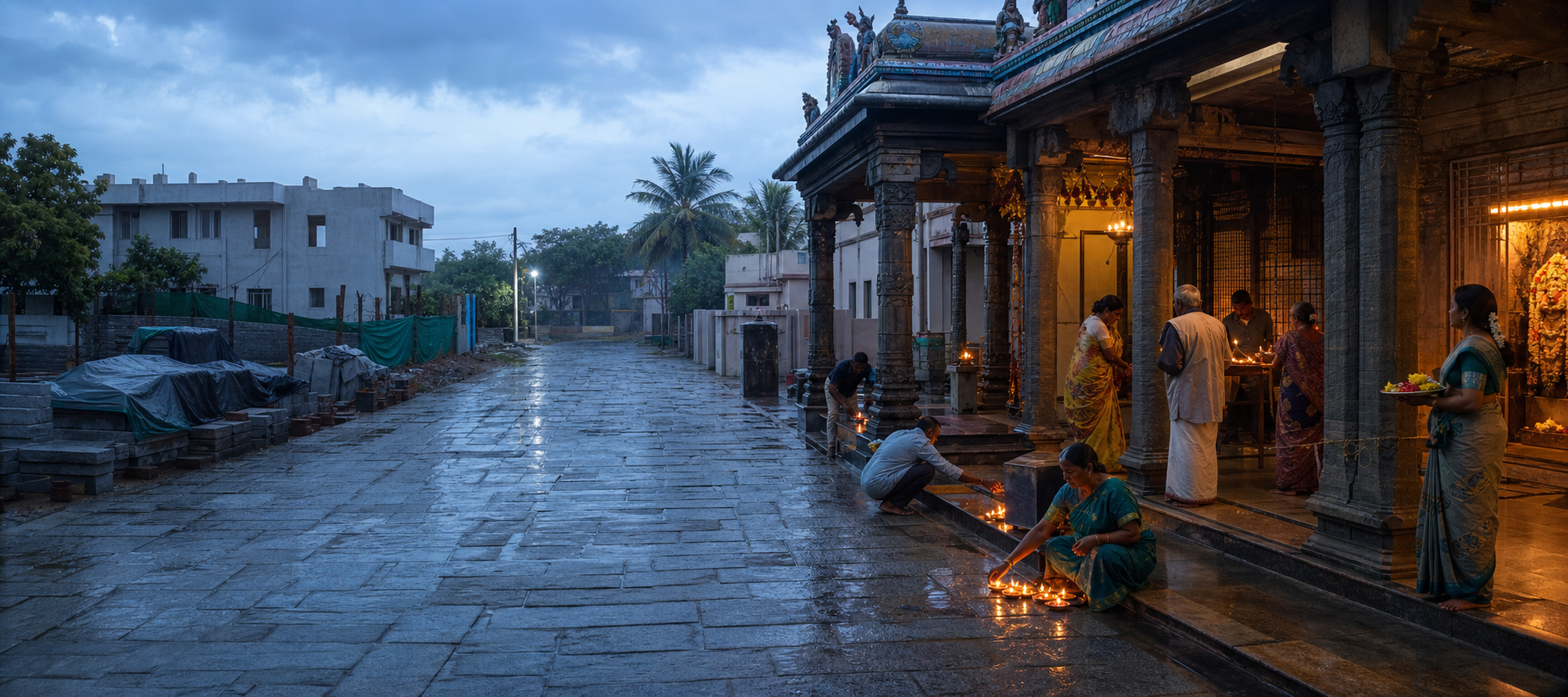
Aadi is the fourth month of the Tamil solar calendar. It begins when the Sun enters Kataka, or Cancer, and generally runs from mid-July to mid-August. Its opening also stands near the beginning of Dakshinayana, traditionally understood as the Sun’s southward course and a season suited to consolidation, vrata, japa, worship, and inward discipline. That is why major public-facing samskaras are often deferred while Devi worship intensifies.
The practical distinction is between expansion and protection. A wedding, housewarming, or large inauguration begins a new public chapter and depends on a carefully selected muhurta. A weekly lamp, an Amman vrata, ancestral remembrance, annadanam, or service at a water body strengthens what already sustains life. Calling the entire month inauspicious erases this distinction.
This also explains why Shakti is central. In Aadi, the Divine Mother is not treated as a decorative symbol of femininity. She is approached as the power that protects a household, steadies a village, nourishes the soil, guards water, and helps a community endure uncertain conditions. Mariamman, Angala Parameswari, Karumariamman, Kamakshi, Meenakshi, Kali, Durga, Mutharamman, and other local forms embody particular relationships between devotees, lineage, land, and shrine. In the grama-devata and kula-deivam traditions, Amman worship binds hearth, field, family memory, and local well-being.
Aadi’s seasonal setting matters just as much as its calendrical one. The month faces the strengthening monsoon, rising rivers, irrigation needs, field preparation, and the replenishment of tanks and aquifers. The traditional reduction in large social ceremonies leaves attention and resources available for agriculture, household stability, worship, and mutual aid. Aadi is therefore not a month of passive avoidance. It is a disciplined reordering of priorities.
Remember that Aadi itself is solar, but several observances inside it depend on a lunar tithi or nakshatra. Amavasai follows the new moon, while Pooram and Krithigai follow their respective stars. This combination of solar-month boundaries with lunar and stellar markers is why a reliable local Tamil panchangam remains more useful than a generic date copied from another city.
Choose one primary observance before adding the rest
Key takeaways for planning your Aadi
- Aadi is highly auspicious for Shakti worship, vrata, dana, ancestral remembrance, and water-centered seva, even where weddings and inaugurations are postponed.
- If you need a sustainable household rhythm, choose either Aadi Velli or Aadi Chevvai and keep it consistently rather than assembling a different puja every week.
- Use a local panchangam or temple notice for Amavasai, Pooram, Krithigai, and any observance tied to a precise ingress or nakshatra window.
- Let your family sampradaya or kula-deivam relationship determine the form of Shakti you worship. Aadi does not require replacing an established tradition with a fashionable one.
- Complete the ritual through prasada, annadanam, water stewardship, or another concrete act of care. The social and ecological action is part of the month’s meaning.
| Observance | Calendar anchor | Primary focus | Best fit for you if… |
|---|---|---|---|
| Aadi Pirappu | First day of Aadi; 17 July in 2026 | Opening the month, seasonal gratitude, Amman and Surya worship | You want one household observance that frames the whole month |
| Aadi Velli | Fridays during Aadi | Amman worship, lamps, household well-being, auspicious offerings | Your family already associates Friday with Devi or Lakshmi worship |
| Aadi Chevvai | Tuesdays during Aadi; commonly 21 and 28 July, and 4 and 11 August in 2026 | Protective Shakti, courage, disciplined vows, health and family prayers | You want a firm weekly vrata or regularly visit an Amman temple |
| Aadi Perukku | Eighteenth day of Aadi; 3 August for most locations in 2026 | Rivers, irrigation, rainfall, food security, gratitude for water | You want to join worship to ecological responsibility |
| Aadi Amavasai | New moon occurring within Aadi | Ancestors, lineage memory, pitru-karya | Your priority is honoring forebears and inherited obligations |
| Aadi Pooram | Pooram nakshatra within Aadi | Andal, bhakti, surrender, temple celebration | Your family follows a Sri Vaishnava or Andal-centered tradition |
| Aadi Krithigai | Krithigai nakshatra within Aadi; 7 August in 2026 | Muruga, the vel, discipline, courage, gratitude to the Krittika nurturers | Muruga bhakti is central to your household or temple life |
Aadi Pirappu is the natural choice if you can keep only one day. Clean the threshold, draw a kolam, light a lamp, invoke Ganesha, worship Amman, and offer water to Surya according to family custom. In 2026, Aadi Pirappu fell on Friday, 17 July. Exact sankramana-related timings vary by location, but the ordinary household celebration can still be kept in the morning unless your tradition requires the precise punya-kala window.
Choose Aadi Velli when you want a gentle, household-centered rhythm. Lamps, flowers, turmeric, kumkum, thamboolam, a simple naivedyam, and a familiar Devi recitation are enough. Choose Aadi Chevvai when your devotional temperament is more vow-centered or when your local Amman temple gives Tuesday special importance. Chevvai is also associated with Sevvai, or Mars, so its devotional mood emphasizes courage, vitality, protection, and decisive action. The four commonly observed Aadi Tuesdays in 2026 are 21 July, 28 July, 4 August, and 11 August; some local calendars may also treat 18 August as a fifth, so follow the temple you actually attend.
Aadi Perukku is the clearest choice for a family trying to recover the ecological meaning of ritual. Traditionally kept on Aadi 18, it honors rivers, canals, tanks, irrigation, and the water that makes cultivation possible. A packed meal of variety rice, a lamp, flowers, or a yellow thread may belong to local custom, but the decisive modern question is what you leave behind. Carry every non-organic item home, use reusable or biodegradable materials, and do not turn reverence for a river into litter on its bank.
Aadi Amavasai has a different mood. It is sober rather than festive and is devoted to ancestors. If your family has an established form of tarpanam using water, sesame, and darbha, follow that lineage carefully. If you have never been taught the rite, ask a knowledgeable elder or priest instead of assembling a technical ritual from fragments. You can still keep the day through respectful remembrance, prayer, food offered in gratitude, and service performed in your ancestors’ memory.
Aadi Pooram and Aadi Krithigai show that the month is broader than a single ritual category. Aadi Pooram honors Andal and her path of total devotion; it should be approached through the language and discipline of her own Vaishnava tradition rather than casually relabeling her as another village Amman. Aadi Krithigai centers Muruga, whose sixfold birth narrative remembers the maternal care of the Krittika maidens. In 2026, Aadi Krithigai falls on 7 August, with the local panchangam determining the relevant nakshatra window.
A complete home Shakti puja can remain simple
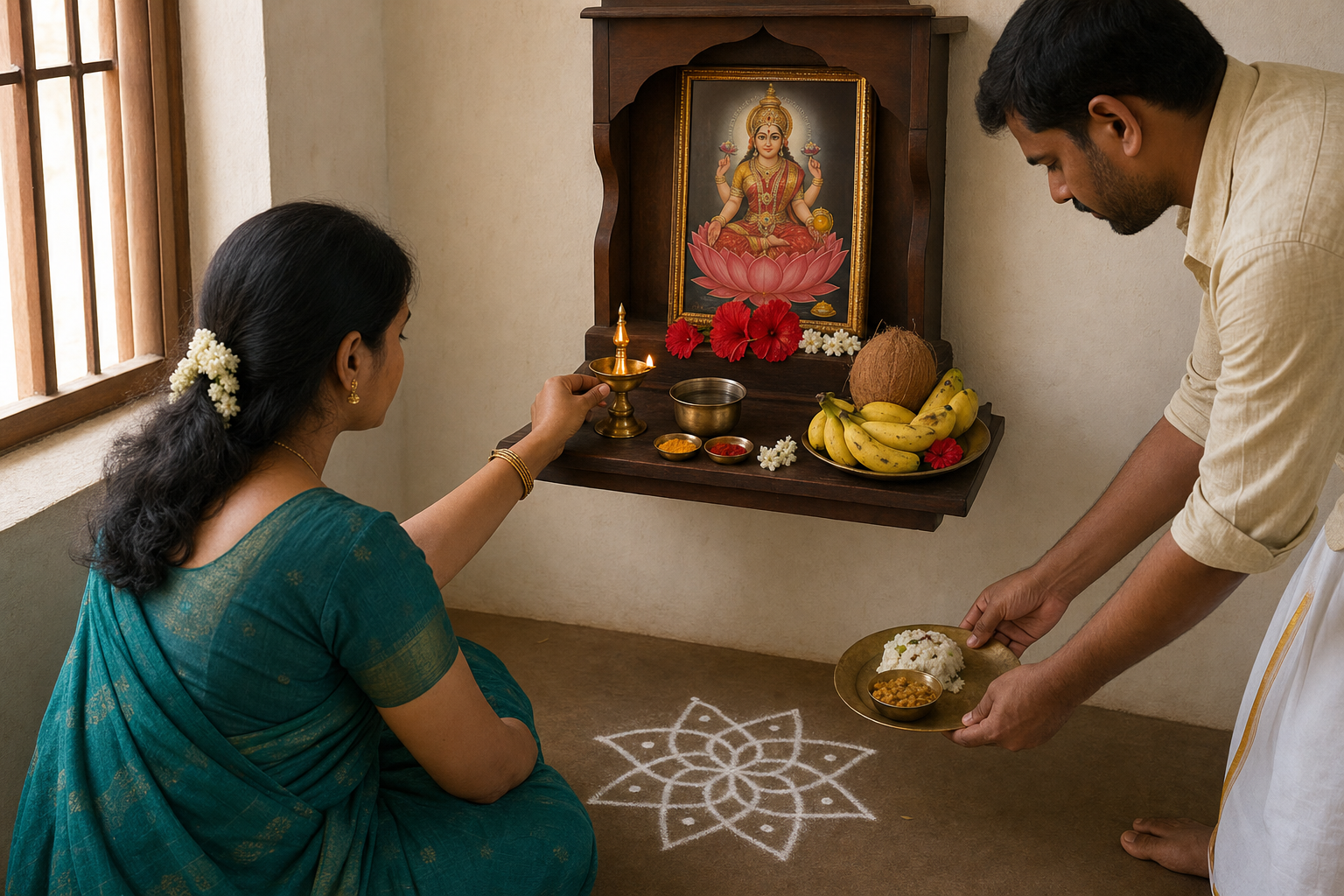
A home observance does not need to imitate a temple abhishekam. Temple worship operates through its own Agamic procedures, trained priests, inherited sequences, and shrine-specific customs. At home, consistency and attention matter more than multiplying ritual substances. A focused Aadi Velli or Aadi Chevvai observance can fit within roughly 20 to 40 minutes.
- Choose the form of Devi before the day begins. Use the Amman, Durga, Lakshmi, Kali, Kamakshi, Meenakshi, Mariamman, Angala Parameswari, or other form already honored in your family. If you have a kula deivam, begin there.
- Prepare one clean place. Bathe, clean the altar and threshold, draw a kolam if that is your practice, and place the lamp where it cannot be knocked over. A mango-leaf festoon may be used for Aadi Pirappu where available and customary.
- State a realistic sankalpa. Name the day, the deity, and the discipline you will actually keep. A plain-language resolve is sufficient: to worship Amman during Aadi, cultivate steadiness, protect the household, share food, and care for water.
- Invoke Ganesha. Begin with your familiar Ganesha prayer before turning to Devi. This preserves the ordinary order of household puja without requiring a lengthy preliminary rite.
- Offer the essentials. Present clean water, a lamp, flowers, turmeric, kumkum, fruit, coconut, or betel leaves according to availability and family custom. Red flowers are common in Shakti worship, but a locally available fresh flower offered respectfully is better than wasteful excess.
- Recite what you understand and can sustain. Lalita Sahasranama, selected portions of Devi Mahatmya, Sri Suktam, or a familiar Amman stotra may be used according to tradition. If the full recitation is beyond your available time, chant a shorter set of names or the simple name of your chosen Devi with attention.
- Offer one modest naivedyam. Fruit or a simple sweet is enough for a weekly puja. Sweet pongal, payasam, vadai, coconut rice, or lemon rice can be prepared when the household is keeping a fuller observance. Maavilakku, made with rice flour and jaggery, belongs to many Aadi traditions but should be prepared only where it is familiar.
- Close through sharing. Perform arati safely, sit quietly for a few moments, distribute prasada, and complete any promised dana or seva. Do not let the social action remain an intention indefinitely; decide who will receive the food or help before the puja begins.
If you want to keep a vrata, choose one that remains truthful for the whole period. Options include a simple sattvic diet on the chosen day, a fixed daily recitation, restraint from angry speech, one weekly food donation, or a commitment to avoid disposable plastics during temple visits. Fasting is not the only measure of discipline, and a demanding fast should never be used to display devotion or imposed on another person.
Do not add a home homa, large open flame, or unfamiliar mantra merely to make the observance seem more advanced. Fire rites require a safe setting and competent guidance. An oil lamp, nama-japa, and sincere offering provide a complete alternative when you do not have that training.
Offerings such as turmeric, kumkum, bangles, sari cloth, lemons, or thamboolam carry local and familial meanings. Use them where the symbolism is understood. The amount spent is not a measure of Shakti bhakti. One usable offering, respectfully given, is preferable to a pile of objects that becomes temple waste.
Approach temple vows through lineage, oversight, and service
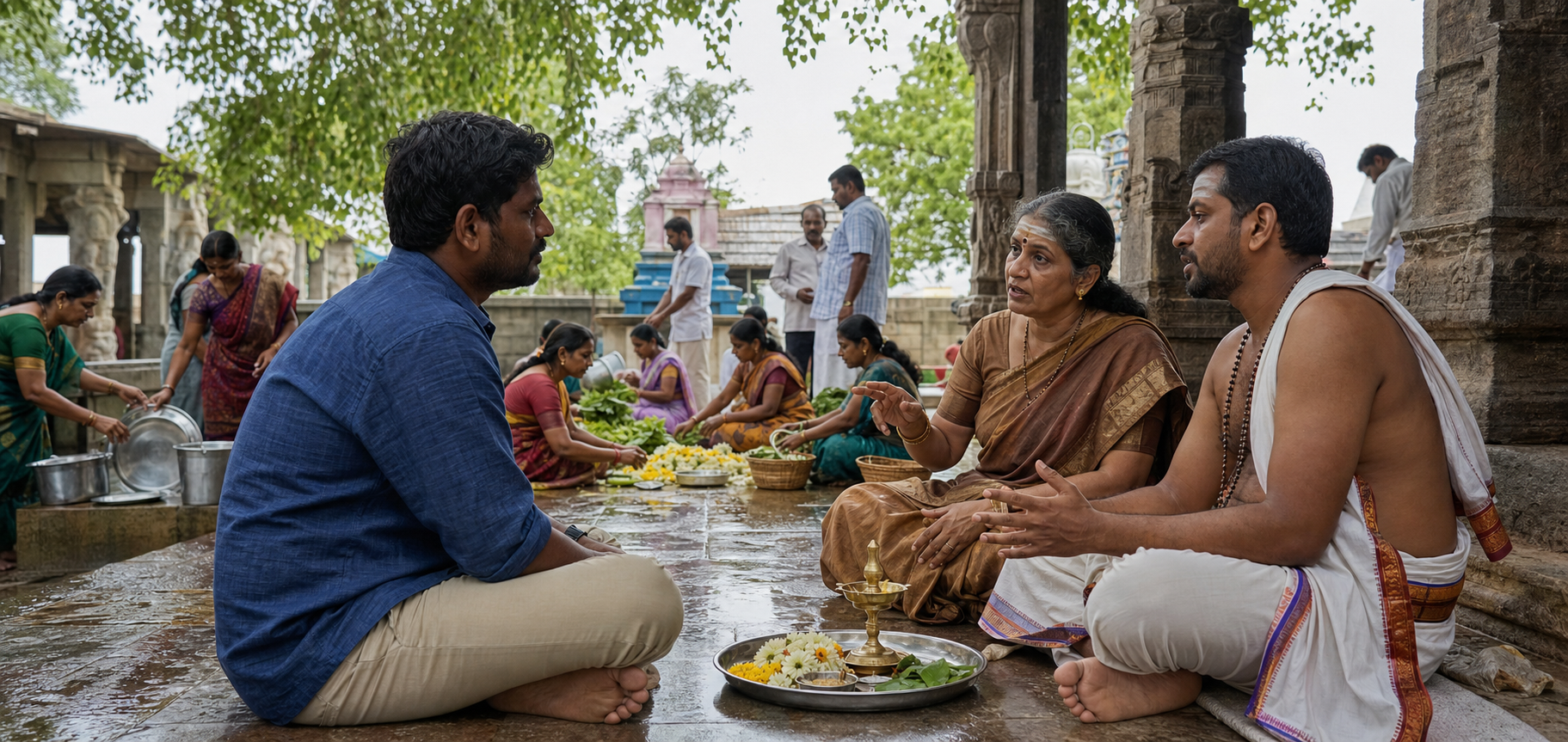
Aadi temple worship can be intense. Special abhishekam, turmeric and kumkum archana, neem decoration, elaborate alankaram, deepa-aradhana, paal kudam, karagam, mulaipari, kappu tying, processions, koozh distribution, and annadanam all appear in different Amman traditions. The variation is important: there is no single universal Aadi program that every Shakti temple must reproduce.
Before attending, identify the actual relationship involved. Is this your kula-deivam temple, your neighborhood Amman shrine, or a temple you are visiting for the first time? A kula-deivam visit may carry inherited promises and family procedures that a general darshan does not. Ask an elder what was previously vowed, offered, or completed; do not assume that every family bearing the same deity’s name follows the same custom.
- Check the temple’s current notice for abhishekam, archana, procession, and annadanam timings. Nakshatra windows and local month boundaries can affect the schedule.
- Ask before bringing milk pots, garlands, sari cloth, cooked food, or large quantities of flowers. A shrine may have rules governing what can enter the sanctum or distribution area.
- Wear modest clothing, follow queue discipline, keep the sanctum quiet, and respect photography restrictions.
- Bring reusable containers or a cloth bag where permitted. Decline unnecessary plastic packaging around offerings.
- If you sponsor or join annadanam, help with orderly distribution and cleanup as well as the ceremonial presentation.
Embodied vows require particular care. Paal kudam and regulated processions should follow the temple’s route, instructions, and physical-safety arrangements. Fire-walking, piercing, and trance-associated customs occur in some local traditions, but they are not general requirements of Aadi devotion and should never be improvised, pressured on someone, or detached from temple oversight. The welfare and consent of the participant take priority over spectacle.
Mulaipari offers a useful picture of what these traditions are trying to hold together. Sprouting grains in decorated pots makes fertility and agricultural hope visible. Koozh and annadanam turn nourishment into shared prasada. Neem, turmeric, water, and local flowers connect the sanctum to the material world of health, rain, soil, and household care. At Angala Parameswari and other guardian-deity shrines, lineage devotion and community protection meet in these seasonal practices.
If you live far from a Tamil temple, resist the urge to stage a regional folk rite without its community context. Keep a domestic lamp, learn the names and history of your family’s deity, call an elder, prepare prasada, and support a temple or food-service effort you trust. Diaspora practice remains authentic when the relationship is preserved, even if the public scale is smaller.
Let water and seva reveal whether the observance is complete
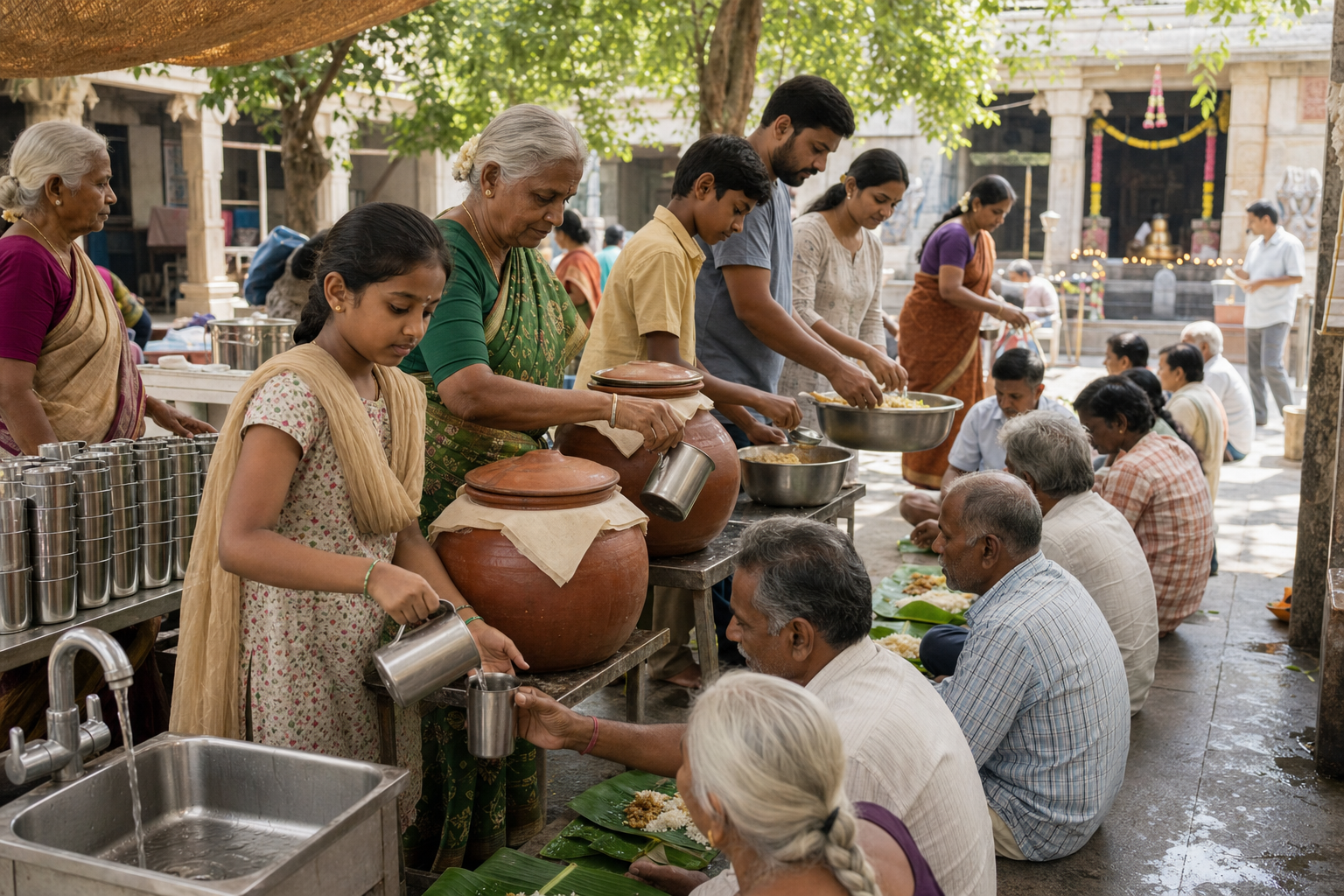
Aadi’s ritual language repeatedly returns to water because monsoon water is not an abstraction. It fills tanks, feeds rivers, recharges the ground, supports sowing, and gives a community its food. Aadi Perukku makes that dependence visible, while Aadi Pirappu opens the season with gratitude for renewal. The traditional agrarian work of strengthening bunds, clearing channels, maintaining tanks, and preparing fields shows what gratitude looks like when translated into labor.
You can apply the same principle even if you do not farm. Before Aadi ends, choose one action with a visible result: remove plastic from a local shoreline where this can be done safely, support a community water-body cleanup, stop using disposable plates at your household observance, repair a leaking tap, contribute to annadanam, or serve a meal. Keep the action proportionate and finish it. A symbolic promise that produces more ritual waste defeats the point.
At a river or tank, keep offerings on the bank unless local custom and ecological rules clearly permit otherwise. Take home thread spools, cloth, glass, foil, plastic, food containers, and lamp parts. Organic flowers should be returned to soil only where appropriate; biodegradable does not mean that an unlimited quantity belongs in the water. Water conservation, biodegradable materials, and protection of rivers and tanks bring the outward form of Aadi into agreement with its dharmic purpose.
The wider Dharmic family also recognizes the monsoon as a time to slow outward movement and deepen discipline. Buddhist Vassa emphasizes settled practice during the rains; Jain Caturmas intensifies restraint, reflection, and ahimsa; and Sikh Barah Maha poetry uses the monsoon season as a setting for remembrance and longing for the Divine. These are distinct traditions and should not be flattened into one theology. Their resonance lies in a shared civilizational insight: seasonal restraint can create room for spiritual attention, compassion, and service.
Choose your next Aadi day now. Put one Friday, Tuesday, ancestral observance, river-centered day, or temple visit on the calendar. Decide on the prayer, the offering, and the act of service together. When all three are realistic enough to complete, your observance has found its proper scale.
References
- DharmaRenaissance Blog – Aadi Pirappu 2026 Definitive Guide: Date, Rituals, Monsoon Blessings, and Cultural Meaning
- DharmaRenaissance Blog – Aadi Masam Unveiled: Deep Significance, Sacred Rituals, and Monsoon Blessings in the Tamil Calendar
- DharmaRenaissance Blog – Aadi Chevvai 2026: Sacred Tuesdays for Goddess Shakti, Dates, Puja Guide, Temple Insights
- DharmaRenaissance Blog – Aadi Krithigai 2026: Sacred Date, Skanda Purana Legend, Muruga Rituals & Aarupadai Veedu Guide
- DharmaRenaissance Blog – Angala Parameswari Amman of Sathyamangalam: Aadi Utsavam Rituals, Lineage Devotion, and Living Heritage
