

Aadi Masam 2026 is not one festival extended across a month. It is a layered religious season in which solar dates, lunar observances, nakshatras and weekly vows create different points of emphasis for Goddess worship, Murugan devotion, ancestral remembrance, river gratitude and the honouring of teachers.
Three temples make that diversity especially clear. At Samayapuram, Aadi Perukku connects Mariamman with water and cultivation; at Mylapore’s Mundaka Kanni Amman Temple, Fridays intensify neighbourhood Shakti worship; and near Thazhakudy, the Avvaiyar Amman Temple gives the Tuesdays of Aadi a distinctive women-led and literary-devotional character.
The 2026 calendar uses several ritual clocks
Both the general Aadi Masam guide and the Avvaiyar Amman Temple guide report that the 2026 month runs from Friday, July 17, through Monday, August 17. Under the Tamil calendar convention used by those sources, that is an inclusive sequence of 32 civil dates. July 17 is Aadi 1 as well as the first Aadi Velli.
The month itself is solar: it opens with the Sun’s sidereal ingress into Karkataka, traditionally associated with Karka Sankranti and Dakshinayana. The festivals within it do not all use that same clock. Aadi Perukku is fixed by the solar-month count at Aadi 18; Aadi Amavasai follows a lunar tithi; and Aadi Krithigai and Aadi Pooram depend on nakshatras. This is why a Gregorian date can be useful for planning without supplying every required puja time.
| Observance | 2026 date reported by the sources | Principal emphasis |
|---|---|---|
| Aadi Pirappu | Friday, July 17 | Opening of Aadi, Karka Sankranti and the first Aadi Velli |
| Aadi Velli | July 17, 24 and 31; August 7 and 14 | Five Fridays associated with Goddess worship |
| Aadi Chevvai | July 21 and 28; August 4 and 11 | Four Tuesdays of Amman worship and household or temple vows |
| Aadi Perukku | Monday, August 3 | Aadi 18; gratitude for water, abundance and agricultural sustenance |
| Aadi Krithigai | Friday, August 7 | Murugan worship, coinciding with the fourth Aadi Velli |
| Aadi Amavasai | Wednesday, August 12 | Ancestral remembrance and customary family rites |
| Aadi Pooram | Friday, August 14 | Andal in Sri Vaishnava tradition and Goddess-centred temple observances; also the final Aadi Velli |
The general calendar reports that the relevant Krithigai nakshatra begins on the preceding evening in Chennai-based calculations, illustrating why midnight is not the governing boundary for every rite. The same guide places Guru Pournami and Vyasa Pooja on July 29 and also records Shashti, Ekadashi, Pradosham, Masa Shivaratri and other vratas during the month. Aadi is therefore strongly associated with Shakti without being exclusively a Goddess festival cycle.
These dates form a Tamil Nadu-centred planning framework, not universal clock times. The sources repeatedly caution that local sunrise, the beginning and ending of a tithi or nakshatra, sectarian practice and temple rules can affect the assigned day or puja period. A city-specific panchangam and the current notice from the relevant temple remain the final practical authorities.
Weekly worship becomes local at Mylapore and Thazhakudy
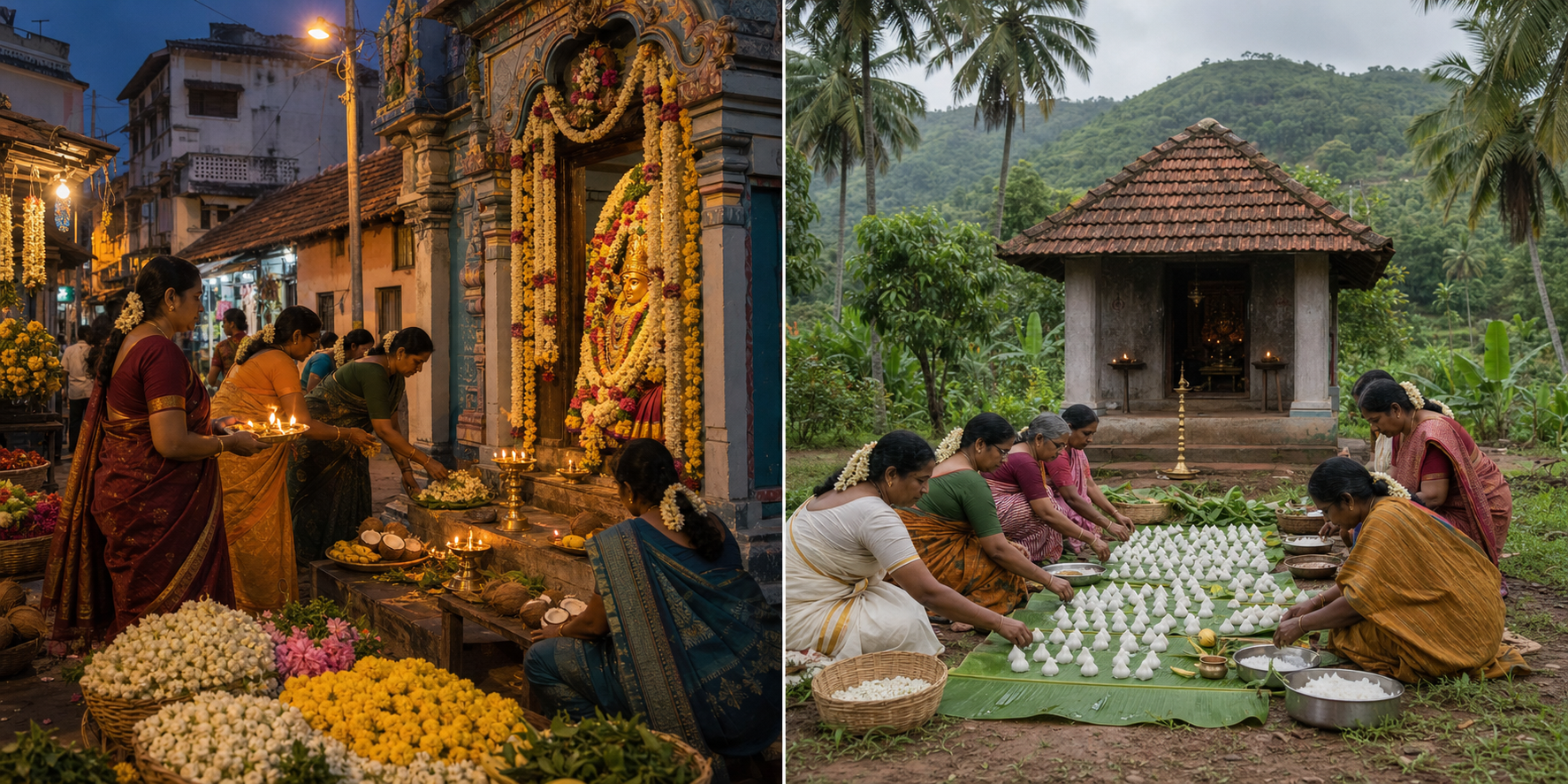
The contrast between Aadi Velli and Aadi Chevvai shows how one calendar acquires different local centres of gravity. Both Friday and Tuesday observances honour forms of Amman, but the sources do not present them as interchangeable programmes or as rites conducted identically at every shrine.
At the Mundaka Kanni Amman Temple in Mylapore, Friday worship extends beyond the sanctum into Mundagakanniamman Koil Street. The temple guide describes flowers, lamps, turmeric, kumkum, banana stems and food offerings turning the surrounding urban lane into part of the ritual setting. Families, established devotees and neighbourhood participants connect formal temple service with household vows and public food sharing.
The Mylapore source also records an earlier five-Friday framework in which successive Fridays were associated with different forms of the Divine Mother. It expressly treats that sequence as a local devotional interpretation rather than a rule binding every Amman temple. Although the 2026 calendar contains five Aadi Fridays, visitors should not transfer a programme documented for another year into 2026 without confirmation from the temple.
At Avvaiyar Amman Temple near Thazhakudy in Kanniyakumari district, the month starts on July 17, but the characteristic weekly cycle begins with the first Aadi Chevvai on July 21. The Avvaiyar guide reports four relevant Tuesdays and describes worship, women’s vows and food offerings as central to the gathering. July 17 and July 21 are therefore not competing festival dates: the first opens Aadi, while the second opens the temple’s better-documented Tuesday observance.
This distinction also guards against a common planning mistake. Aadi Perukku, Krithigai, Amavasai and Pooram belong to the wider calendar, but their appearance in that calendar does not prove that every one has a special programme at Avvaiyar Amman Temple. A temple-specific schedule is a separate category of evidence.
Aadi Perukku joins Shakti worship to water and cultivation
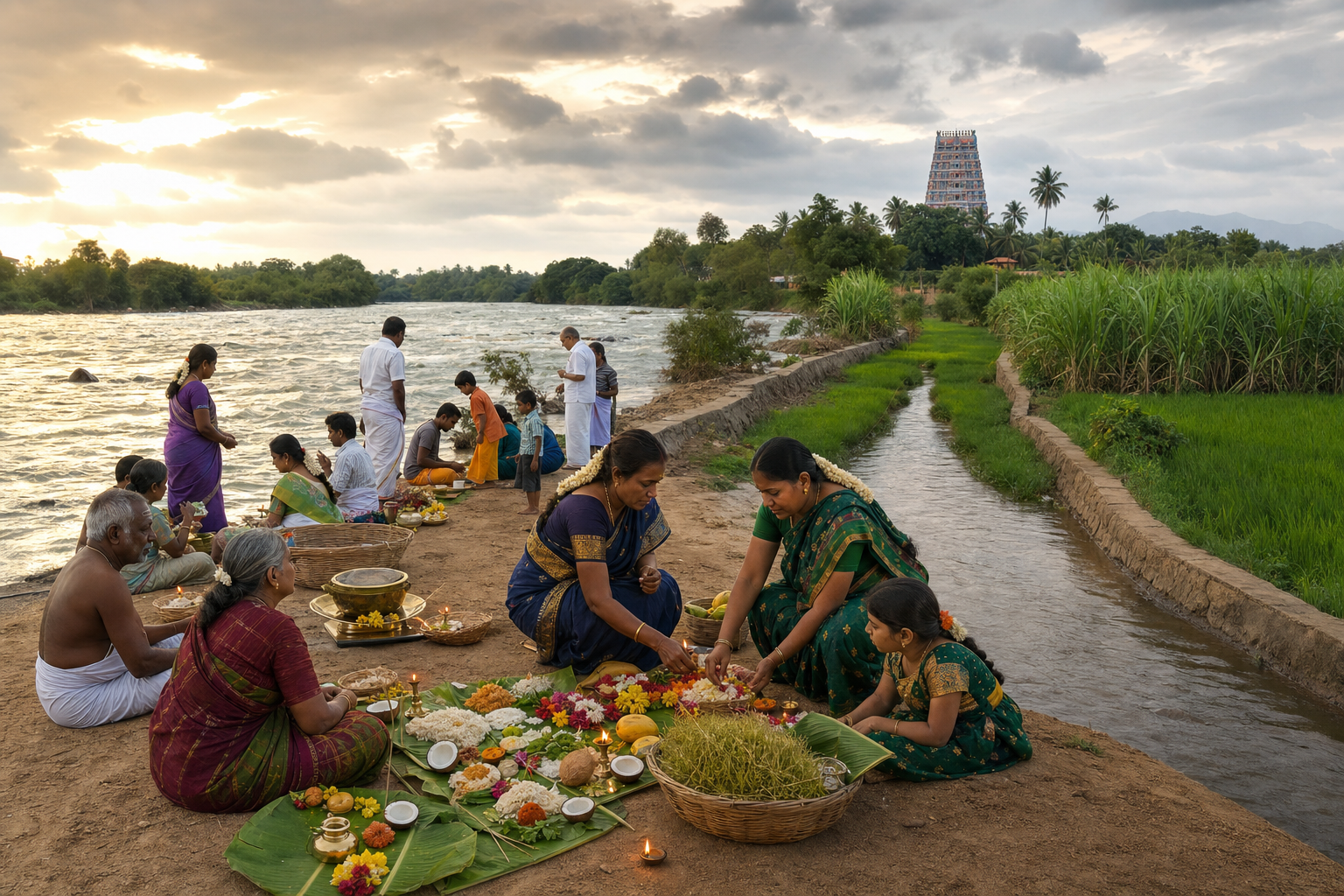
The general Aadi overview and the Samayapuram report both place Aadi Perukku on Monday, August 3, 2026. Its alternative names, including Padinettam Perukku, Aadi Padinettu and Aadi Padinettam, refer to the eighteenth day of the month. The Samayapuram source explains perukku through ideas of increase, swelling and abundance rather than through a separate lunar or numerological requirement.
In the Cauvery region, that abundance is simultaneously ecological, agricultural and sacred. The Samayapuram account presents the river as a system connecting fields, canals, settlements, temples, fishing communities and domestic rites. Seasonal replenishment becomes an occasion to acknowledge the water supporting crops, animals and households, while the river’s maternal religious meaning gives gratitude a devotional form.
Samayapuram Mariamman Temple supplies a particularly strong Shakti setting for this observance. The source locates the shrine about 15 kilometres from Tiruchirappalli and describes Mariamman as a protective form of the Divine Mother associated in devotional tradition with rain, fertility, health and communal well-being. A festival of replenished water can consequently be understood there as an expression of the Goddess’s sustaining power.
The agricultural meaning requires more precision than the familiar claim that Aadi Perukku simply begins rice cultivation. Drawing on Tamil Nadu Agricultural University guidance, the Samayapuram report says that Kuruvai sowing occurs in June and July in many delta districts, while the longer Samba season commonly starts in August. Aadi 18 instead falls at a transition when crops, field preparations and irrigation needs may be at different stages.
The same report records a traditional belief that sowing on Aadi 18 supports a good harvest, but it does not treat the custom as a guarantee independent of seed, soil, rainfall, irrigation and crop management. Its continuing value lies in synchronising attention around water, seed and seasonal preparedness. The older image of an inevitably swelling river must also be read alongside the source’s account of reservoirs, irrigation releases, groundwater use and variable rainfall influencing modern flows.
Women are prominent in this intersection of ecology and worship. According to the Samayapuram account, they organise household rites, prepare offerings, maintain family customs and pass their meanings to younger generations. Their leadership carries agricultural memory, culinary knowledge, kinship and devotion together rather than functioning as a merely ceremonial presence.
Temple forms and sacred memories shape the rituals
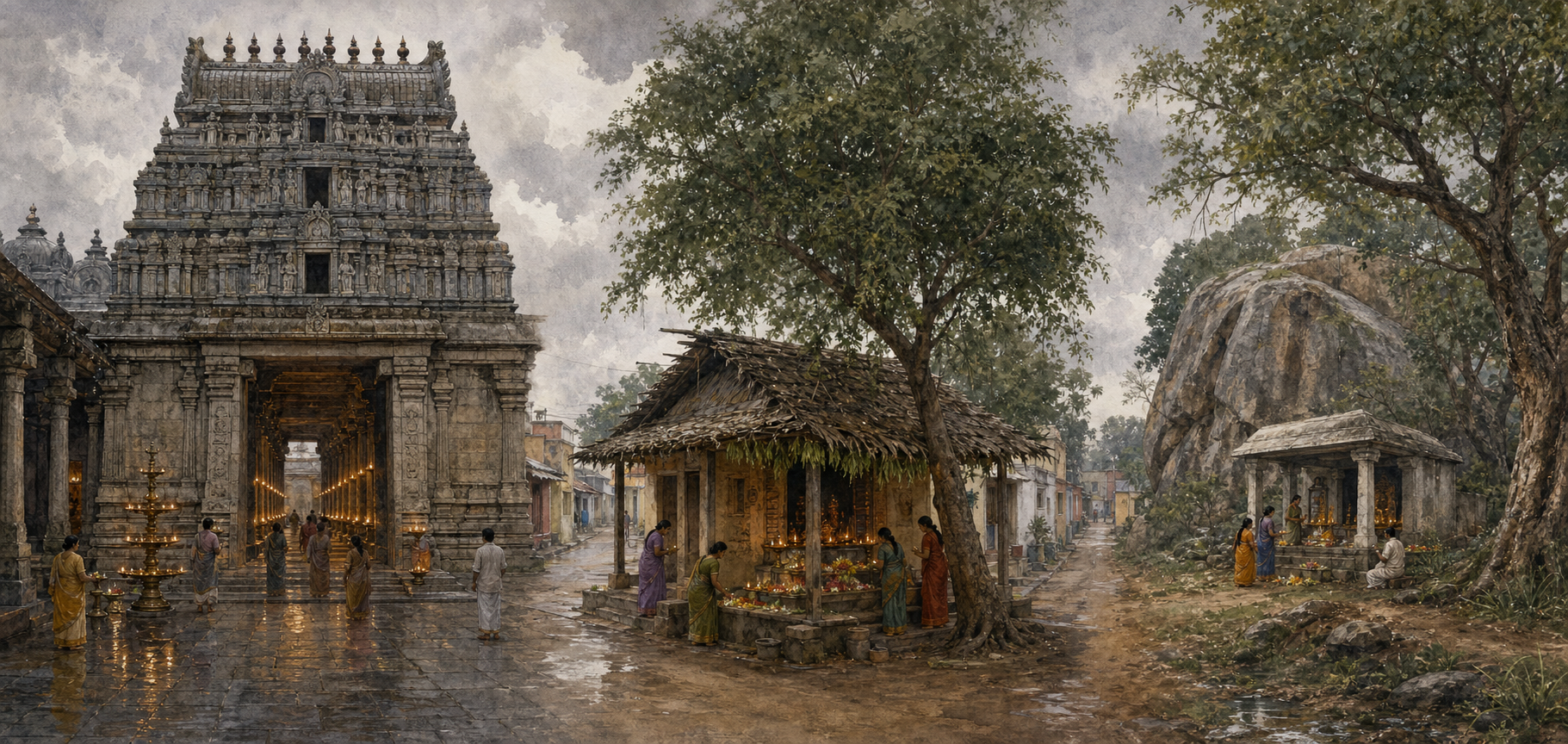
The three temple accounts show that ritual is partly governed by the material and narrative character of each sacred site. Shared reverence for Shakti does not erase differences in icons, buildings, guardian traditions or local understandings of the presiding figure.
At Samayapuram, the principal Mariamman image is reported to be made from sand and clay. Abhishekam is therefore not performed directly on that image; ritual washing is associated with a smaller stone image placed before it. What might otherwise look like an inconsistency in a service description is an adaptation protecting the material form of the moolavar.
At Mundaka Kanni Amman Temple, the presiding presence is described as swayambhu and as a small natural or conical form ritually adorned with a sandal-paste face. The guide connects its upper shape with a lotus bud and notes a trident motif. A thatched covering above the sanctum, together with a banyan tree, an anthill and naga worship behind the shrine, preserves the visual and devotional vocabulary of a smaller Amman shrine within metropolitan Chennai.
The Mylapore source distinguishes devotional tradition from empirical verification: the account that a serpent visits the Goddess belongs to oral belief, while the shrine’s religious significance rests in the relationship among the deity, earth, tree and naga imagery. It makes a similar distinction about age. Temple tradition assigns the shrine an antiquity of about 1,300 years, but the source notes that this figure is not presently secured by published inscriptional evidence.
Avvaiyar Amman Temple presents a different meeting of history and sacred memory. The source explains that Avvaiyar was a title applied to respected women and that scholarship distinguishes multiple poets from different periods, even though popular remembrance may gather their stories into one wise elder. At the temple, literary and ethical memory has become embodied in the devotional language of Amman, motherhood, protection, image, place and food.
The temple’s chronology remains layered. The Avvaiyar guide reports a community estimate of approximately 300 years, while a cited heritage field account provisionally relates the existing architecture to a sixteenth- or seventeenth-century Vijayanagara-Nayaka horizon. Rather than forcing those claims into a single foundation date, the source suggests that sacred presence, masonry, enlargement and renovation may belong to different phases.
Samayapuram’s account likewise separates regional history from the oral story of a processional image that could no longer be moved from the site. Across all three cases, historical caution does not require dismissing sacred memory. It requires identifying whether a claim comes from inscriptions, architecture, published research, official temple tradition or community narration.
Planning an Aadi visit without flattening local practice
The most useful itinerary begins with the shared calendar and then narrows to a named temple. This is especially important where English spellings vary: the Mylapore shrine appears under forms such as Mundaka Kanni, Mundakanni and Mundagakanni, while Thazhakudy may also appear as Thalakudy. The Avvaiyar guide additionally warns that another Avvaiyar-associated shrine exists in the wider Kanniyakumari region, so the Thazhakudy location should be confirmed before departure.
Key takeaways
- Use July 17 through August 17 as the Tamil Nadu-centred planning frame reported by the two calendar sources, while confirming local ingress, tithi and nakshatra rules.
- Treat the five Aadi Fridays and four Aadi Tuesdays as recurring rhythms whose ritual programmes differ by temple, year and community.
- Recognise August 3 as Aadi Perukku in the source calendars, but interpret its agricultural meaning as a seasonal transition rather than one universal sowing date.
- Do not assume that every major Aadi observance has a special programme at every shrine; consult the current temple notice.
- Respect healing vows, naga worship and sacred histories as forms of lived faith without presenting them as clinical proof, zoological verification or established chronology.
The Samayapuram source reports votive offerings connected with prayers for health but cautions that temple worship should not replace qualified diagnosis, treatment or emergency care. That same discipline of respectful precision applies throughout Aadi: devotional expectations can be described fully without converting them into medical or historical guarantees.
As temple programmes for 2026 are issued, local notices and city-specific panchangams can turn this common calendar into an accurate plan while preserving the regional variation that gives Aadi its vitality.
References
- DharmaRenaissance Blog — Aadi Perukku 2026 at Samayapuram: Essential Guide to Water, Women and Shakti
- DharmaRenaissance Blog — Aadi Masam 2026: Complete Guide to Sacred Festivals, Rituals and Key Dates
- DharmaRenaissance Blog — Sacred Aadi Velli at Mylapore’s Mundaka Kanni Amman Temple: A Complete Guide
- DharmaRenaissance Blog — Aadi Festival 2026 at Avvaiyar Amman Temple: Sacred Dates, Rituals and Visitor Guide