
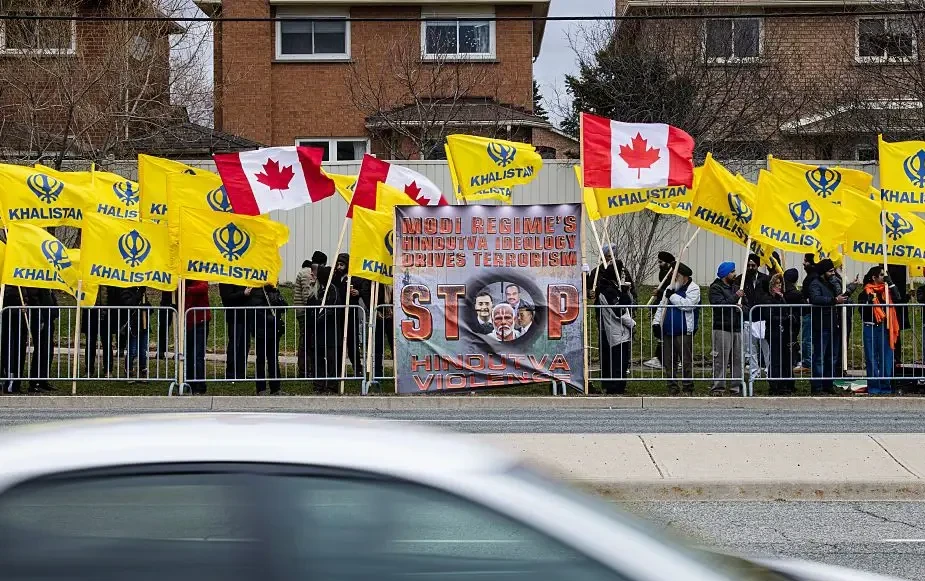
Access to a mandir should not require families to pass hostile political displays or abusive slogans. When a demonstration is deliberately placed at the entrance to a sacred space, the issue extends beyond public order to religious freedom, dignity and equal citizenship.
That is the central concern raised by the Coalition of Hindus of North America (CoHNA) in its account of protests outside temples in Brampton, Ontario, and Surrey, British Columbia. Its report also shows why preventing violence is necessary but insufficient if devotees remain intimidated while trying to worship.
Key takeaways
- CoHNA reported targeted protests outside two Hindu temples during Hanuman Jayanti celebrations.
- Police separation, a municipal bylaw and a court injunction reportedly reduced the risk of direct confrontation.
- Physical distance did not eliminate the alleged intimidation experienced by devotees, including families with children.
- Defending Hindu worship must be paired with a clear refusal to blame Sikhs collectively for separatist activism.
What CoHNA reported at the two temples
According to CoHNA, demonstrations occurred outside Triveni Mandir in Brampton and Lakshmi Narayan Mandir in Surrey while devotees were gathering for Hanuman Jayanti. The organization characterized those involved as Canada-based Khalistani extremists and said its representatives observed the situations at both locations.
CoHNA further reported that the timing coincided with Easter weekend and Passover, affecting neighbourhoods in which several faith communities were marking sacred occasions. Its statement is an advocacy account rather than a complete evidentiary record: the supplied material does not include responses from protest organizers or independent findings addressing every allegation. The characterization of the demonstrators should therefore be understood as CoHNA’s.
Buffer zones protected bodies, but not peace of mind
The most concrete development in the account was the use of legal separation. CoHNA said Peel Regional Police enforced Brampton’s Protecting Places of Worship from Nuisance Demonstrations By-law 173-2024, keeping protesters away from temple property. In Surrey, it said Lakshmi Narayan Mandir had obtained an injunction from the Supreme Court of British Columbia that enabled a similar buffer zone. The source also noted that provincial Bill 13-2026, the proposed Safe Access to Places of Public Worship Act, was being advanced.
These measures reportedly helped avert the kind of direct escalation associated in the source with events during Diwali celebrations on November 3, 2024. Yet CoHNA said devotees still encountered graphic imagery and loud, abusive slogans, with children among those exposed. An event can be managed in a narrow policing sense while remaining frightening or degrading for the people entering a place of worship.
Political purpose does not erase religious impact
CoHNA said the protesters presented their activity as opposition to alleged Indian state involvement rather than hostility toward Hindus. That distinction may explain the organizers’ stated political purpose, but it does not by itself answer whether selecting a temple imposed an unfair burden on worshippers.
Temples are religious and community institutions, not interchangeable extensions of a foreign government. CoHNA noted that temples may independently host activities such as consular services for older Indian-origin residents seeking pension documentation or life certificates. It also emphasized that Triveni Mandir was founded and is administered by Caribbean Hindus, complicating any blanket portrayal of the institution as an arm of the Indian state.
The proper civil-rights test is therefore contextual: can political dissent be expressed without making a religious minority run a gauntlet to reach its sacred space? Protecting speech need not mean ignoring location, conduct, intent or the practical ability of others to worship.
Dharmic solidarity requires precision, not collective blame
The source identifies a Khalistani political fringe; that description must not be converted into suspicion of Sikhs generally. Sikhism belongs within the wider Dharmic civilizational family, and Sikh communities cannot be held responsible for every movement that invokes Sikh identity. Hindus, Sikhs, Buddhists and Jains all have a shared interest in protecting sacred institutions from intimidation and preventing political extremism from rupturing community relations.
A constructive Hindutva response joins firmness about Hindu rights with an equally firm refusal to stigmatize an entire Sikh community. Such precision strengthens the case against extremism: it directs criticism toward conduct and ideology while preserving bonds among Dharmic traditions.
Authorities should measure access, not only arrests
Future policy should judge success by more than the absence of physical clashes. Authorities should also consider whether entrances remain practically accessible, whether families can arrive without targeted harassment, whether restrictions are applied neutrally across faiths and whether protest arrangements place the burden of de-escalation almost entirely on worshippers.
Canada can protect robust political disagreement while drawing a defensible boundary around intimidation at sacred sites. Consistent, viewpoint-neutral safeguards would allow dissent to continue without treating Hindu devotees as acceptable collateral in a political confrontation they did not choose.
Inspired by this post on CoHNA.
