

If someone puts a pamphlet in your hand and tells you that a coconut offering, a flower in a woman’s hair, a camphor flame or sambrani is wrong, you don’t have to choose between accepting the insult and starting a quarrel. You can defend Dharma more effectively by identifying the exact claim, preserving evidence, asking for accountability and explaining the practice in its own terms.
In Hosur, that method matters now. The immediate task is not to win a pavement debate. It is to protect people, establish an accurate record and refuse a caricature of Hindu life without making claims that the known facts cannot support.
Begin with what is known, alleged and still unknown
In July 2026, women described as religious preachers reportedly distributed material in Hosur that questioned breaking coconuts at temples, wearing flowers in the hair, lighting camphor and using sambrani. Members of the Vishwa Hindu Parishad intervened and approached the police. The distributors allegedly declined to identify the church or organisation with which they were associated, and several children reportedly accompanied them.
Those details justify scrutiny. They do not establish the identity of a sponsoring church, the existence of a larger network, a police finding or the commission of a particular offence. Keep those boundaries intact whenever you discuss the incident.
- State the reported occurrence: material criticising named Hindu practices was reportedly distributed while religious preaching took place.
- Label allegations as allegations: the distributors allegedly refused to disclose an affiliation when questioned.
- Do not fill the gaps: no particular church or Christian organisation should be blamed unless its involvement is independently established.
- Do not invent an official result: approaching the police is not the same as a police finding, charge or conviction.
This precision is not timidity. It protects the credibility of Hindu advocacy. A factual statement can survive scrutiny and support appropriate action; an exaggerated claim gives attention to the exaggeration instead of the original denigration.
The pamphlet’s argument misunderstands embodied worship

God is not the One you carry and bear; God is the One who carries and bears you.
Text reproduced from the pamphlet reportedly circulated in Hosur
The sentence may sound profound until you notice the assumption built into it. It treats carrying an offering or using a material symbol as though Hindus believe the Divine depends physically on that object. That does not follow. A person can understand the Divine as sustaining all existence while still approaching the Divine through a murti, flame, fragrance, flower, mantra or offering.
Hindu worship is embodied because human life is embodied. Sight, sound, fragrance, gesture, food and beauty can all be directed toward reverence. The material act does not exhaust the spiritual reality; it gives the worshipper a disciplined way to participate in it.
- Coconut offerings: depending on the temple and local tradition, offering or breaking a coconut may accompany surrender, a vow, gratitude, an auspicious beginning or a prayer. Ask the relevant priest or practitioner what it means in that setting instead of imposing a single universal explanation.
- Camphor: a camphor flame can form part of arati, in which light is offered and then reverently received. The act does not claim that the Divine is confined to the flame.
- Sambrani: fragrant smoke has a place in household and ritual settings. Its role may involve worship, atmosphere and inherited custom. There is no need to attach unsupported medical or scientific claims to defend its religious use.
- Flowers in the hair: this may be cultural adornment, an expression of auspiciousness, a devotional association or a combination of these. Declaring it wrong reaches beyond theological disagreement and attempts to regulate an ordinary feature of lived culture.
A common defensive mistake is to insist that every inherited practice must be scientifically proven. That accepts the critic’s frame and places ritual before a test it never claimed to be conducting. A custom may deserve preservation because it carries devotion, beauty, memory, identity and communal continuity. Those are real human goods even when the practice is not a laboratory intervention.
This does not prevent Hindus from examining safety, waste, commercial exploitation or poor temple management. Internal dharmic evaluation asks how a practice can be conducted responsibly. It is different from declaring the practice misguided merely because another theology does not recognise its symbols.
Use a calm, evidence-first response at the scene
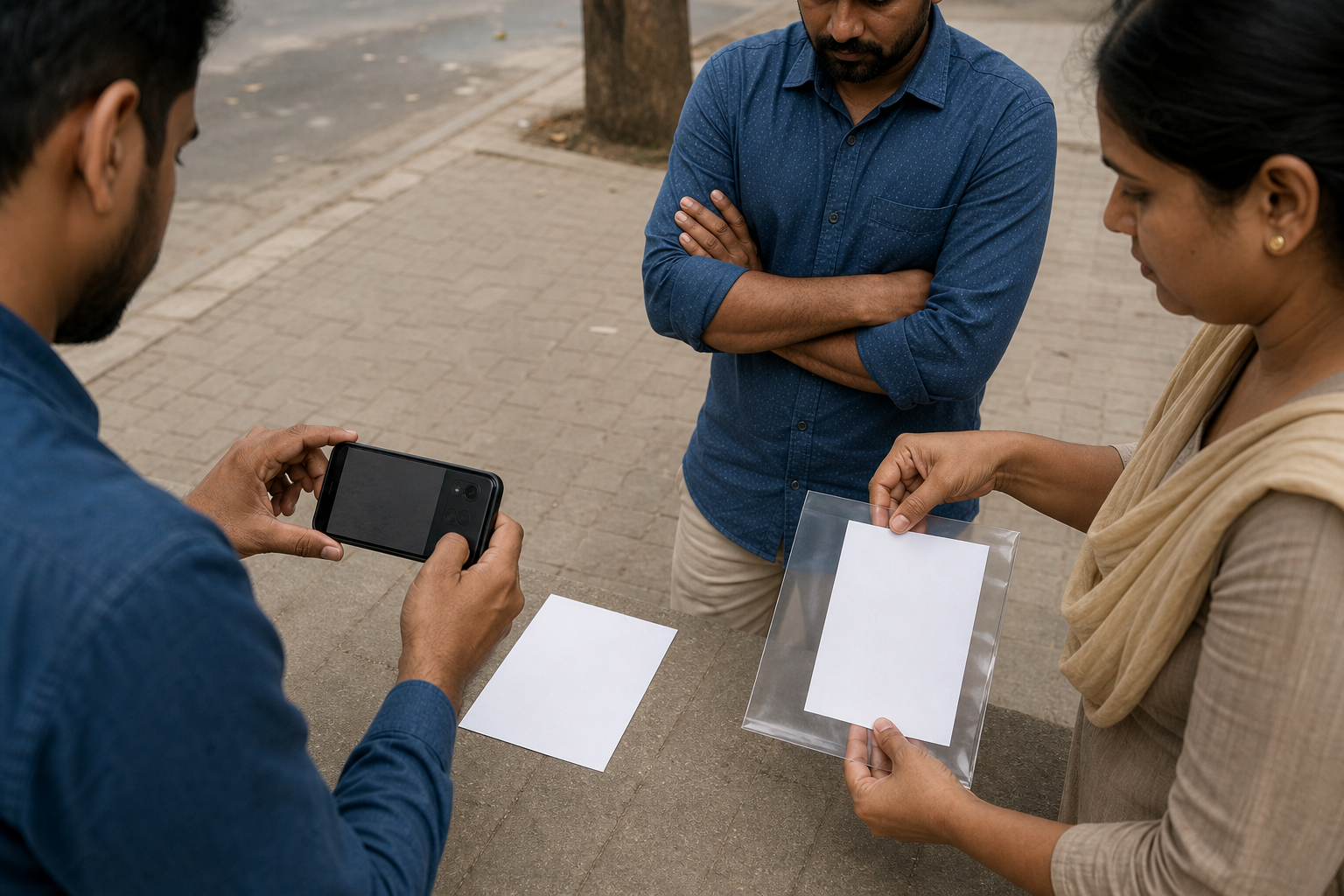
If you encounter similar distribution near a temple, home, market or neighbourhood gathering, your conduct in the first few moments will shape everything that follows. Use a simple sequence.
- Reduce the temperature. Ask bystanders not to surround, touch or threaten anyone. Let a designated adult speak while another person observes. Physical intimidation weakens a legitimate complaint and can create a separate safety problem.
- Preserve the material accurately. Keep an original copy if it was voluntarily handed to you. Photograph every side, note the date and exact location, and write down the words and actions you directly observed. Do not crop the material into a provocative social-media image before preserving the complete version.
- Ask neutral accountability questions. Request the distributor’s name, organisational affiliation, public contact details and the identity of whoever authorised the activity. Record the response accurately. A refusal to answer is relevant, but it is not permission to search, seize, detain or publicly identify someone through speculation.
- Identify the setting and conduct. Note whether the activity occurred on a public street, private premises, temple property or another controlled site. Record whether permission was sought, whether a request to leave was ignored, and whether there were threats, persistent pressure or obstruction. These facts are more useful than angry labels.
- Escalate the specific concern. Contact the police when there is an immediate safety issue or conduct that may require official attention. For a non-urgent complaint, give the complete material and direct witness details to the relevant temple committee, community organisation, police station or qualified local lawyer. Local law can depend on the place, permission, exact words and surrounding behaviour, so let the appropriate authority identify any applicable legal provision.
- Communicate only what you can prove. Separate your objection to the pamphlet’s content from any allegation about the distributors’ behaviour. Correct mistakes publicly if later information changes the picture.
Suggested wording: On [date] at [place], people distributing a pamphlet described [name the practices exactly] as wrong. We asked for their organisational affiliation, and they [state the exact response]. The complete material has been preserved, and [name the body contacted] has been asked to review the matter. We request calm and lawful handling.
Avoid terms such as criminal conspiracy or conversion gang unless reliable evidence establishes the relevant conduct. Do not attach an unverified church name. Do not publish private addresses, phone numbers or the faces of accompanying children. The strongest public statement is usually the narrowest one that contains all the verified facts.
Answer the criticism without accepting its frame
You are not obliged to conduct a full theological debate on the street. If a conversation is calm and voluntary, ask questions that expose the pamphlet’s assumptions.
- Which Hindu teaching supposedly says that the Divine depends on a coconut, flower, flame or fragrant substance?
- Why does carrying an offering imply that the worshipper believes the Divine cannot carry or sustain the worshipper?
- Is the objection about a demonstrable harm, or only that the practice differs from the distributor’s theology?
- Why is a woman’s choice to wear flowers being treated as a religious error?
- Is the distributor inviting a reciprocal discussion, or demanding that Hindus accept a conclusion already printed for them?
A concise reply is enough: Hindu offerings do not imply that the Divine needs our coconut, flame, fragrance or flower. These objects can help people express gratitude, honour a vow, focus attention and participate in an inherited form of worship. Another person is free not to practise these customs, but non-participation does not prove that the customs are wrong.
Then set a boundary. On private or temple property, the responsible authority can state that unsolicited preaching is not welcome and ask the person to leave. In a public place, avoid trying to exercise powers you do not have. Document any genuine disturbance and seek the proper official response.
The people in Hosur were described as Christian missionaries, but their reported refusal to identify a church leaves institutional responsibility unresolved. Criticise the pamphlet and the conduct that can be established. Do not transfer an unverified allegation to every Christian neighbour, congregation or believer. A confident dharmic response can name anti-Hindu denigration without converting it into collective prejudice.
Build a community protocol before the next incident
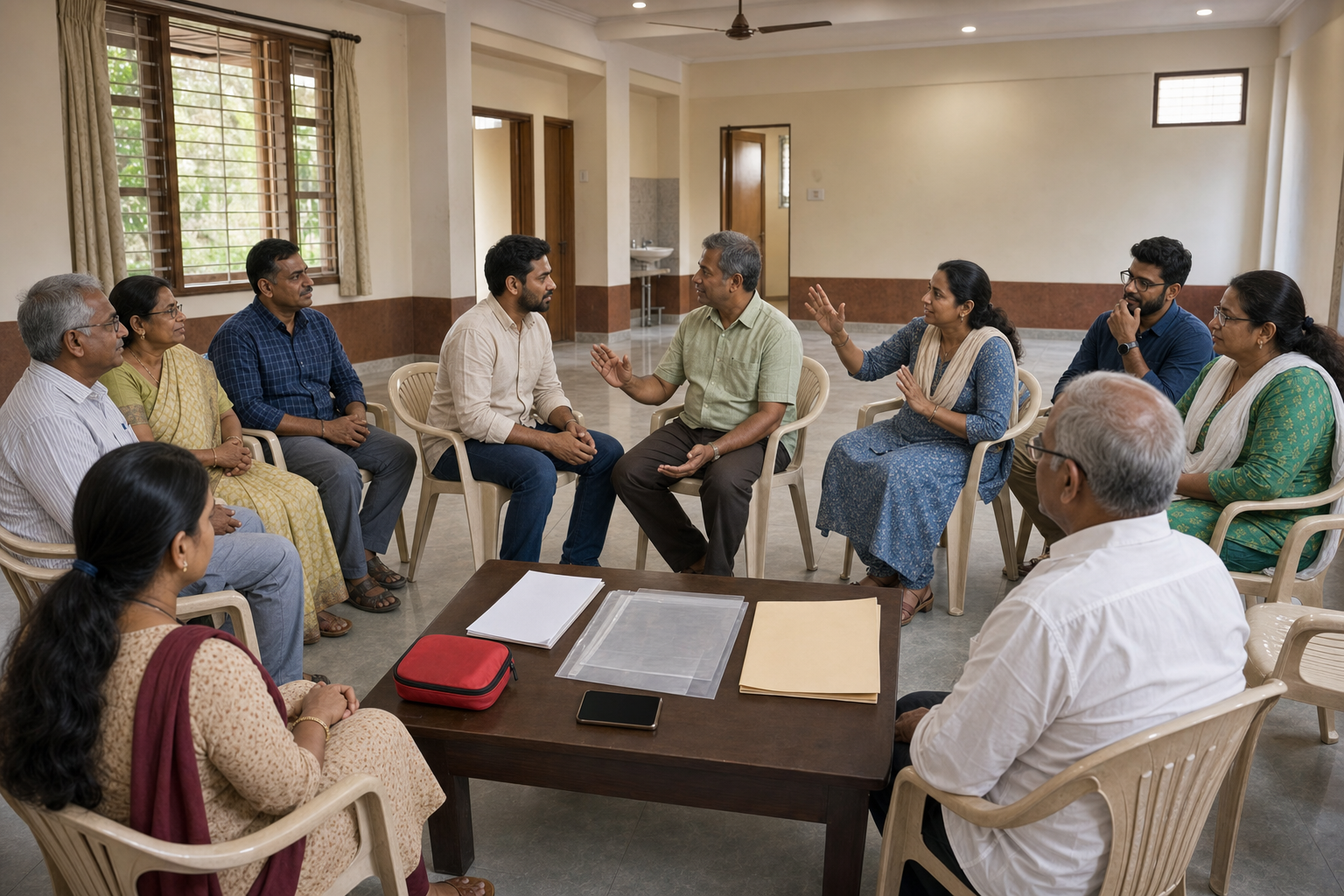
Temples and neighbourhood groups should not have to invent a response while a crowd is forming. Prepare a small protocol that assigns responsibility before another pamphlet appears.
- A designated contact: choose who speaks for the temple or community, who preserves material and who contacts authorities when necessary.
- An evidence log: keep complete scans, dates, locations, witness names and official acknowledgements together. Preserve originals instead of relying on forwarded social-media images.
- A practice explainer: prepare clear descriptions of commonly targeted customs. State what each practice can mean, acknowledge regional and sampradaya differences, and correct the specific misconception without making grand scientific claims.
- A safeguarding rule: treat accompanying minors as protected bystanders. Do not question them, draw them into an argument or expose their faces online. If a child appears to face an immediate welfare risk, contact the appropriate authority rather than conducting a public interrogation.
- An escalation map: know which temple officer, community representative, police contact or qualified lawyer should receive different kinds of concern.
- A correction rule: if an affiliation, quotation or allegation proves wrong, correct it promptly and visibly. Credibility is a form of community protection.
Key takeaways
- Preserve the complete pamphlet before debating or posting about it.
- Record the exact place, conduct and words; separate direct observation from allegation.
- Confirm an organisational affiliation before naming a church or wider network.
- Explain Hindu customs through devotion, symbolism, lineage and lived culture, not unsupported scientific claims.
- Keep children, private information and uninvolved neighbours out of public confrontation.
- Use community education for the theological claim and lawful channels for conduct that may require official action.
If similar material appears in your lane or near your temple, begin with the original pamphlet, an exact location and a calm witness. Let the community explain what its practices mean, and let the proper authorities assess conduct. That combination defends Hindu dignity without sacrificing truth, restraint or responsibility.
References
