

If you came here after seeing messages about a Muslim family, a Hindu man, and violence in Ulhasnagar, do not let the religious labels decide what you believe or do next. Ask four narrower questions: Are both partners legally eligible adults? Did each person freely consent? Is anyone in immediate danger? What has the police actually confirmed?
The 13 May 2026 allegations from Ulhasnagar describe a violent altercation arising from family opposition to an interfaith marriage. The incident details remain provisional without a cited official record from Thane district police or Maharashtra Police. Two duties therefore apply at once: protect anyone facing a credible threat, and refuse to turn an unverified account into a verdict against an entire community.
Key takeaways
- For two legally eligible adults, free consent is the central question. Family or communal approval does not replace it.
- If threats or violence are occurring, move to safety, contact the police, preserve evidence, and request protection before attempting reconciliation.
- The Special Marriage Act provides a civil route for an interfaith couple. Objections must concern legal eligibility, not religion, caste, family honour, or social dislike.
- An allegation against particular people is not evidence of collective guilt. Share only verified facts and withhold identities, addresses, and travel details that could expose the couple.
- A Dharmic response joins ahimsa with accountability: restrain retaliation, protect the threatened, establish the facts, and apply the law evenly.
Separate verified facts from the communal story growing around them

Interfaith-marriage conflicts become communal flashpoints when people answer the identity question before the evidence question. A Hindu partner and a Muslim partner may be relevant to understanding family opposition, but those identities do not establish who threatened whom, whether the marriage was voluntary, or whether every circulating claim is true.
Use three factual buckets before you forward a message, confront anyone, or call for public action:
- Confirmed: a fact contained in an official police record, a court order, or an authenticated statement made directly by one of the adults.
- Alleged: a claim about an assault, threat, motive, participant, or sequence of events that has not yet been officially established.
- Unknown: anything the available information does not answer, including the exact sequence of the altercation, the role of each participant, the evidence collected, and the offences police may ultimately record.
This distinction is not a plea for passivity. If someone may be in danger, police protection should not wait for social-media certainty. But public accusation has a different threshold from emergency protection. You can support immediate safety while remaining honest about what has not been proved.
Do not publish the couple’s address, telephone numbers, live location, marriage-office appointment, vehicle details, or the location of a safe residence. Do not identify relatives as attackers merely because they appear in a photograph or belong to the family. If a video may be evidence, preserve the original file and the message in which it arrived; avoid trimming it into a clip that removes context.
Charged labels also hide the questions that matter. If coercion, confinement, assault, abduction, or intimidation is alleged, ask what concrete conduct supports that allegation. The religions of the couple are not evidence of coercion. Conversely, calling a conflict a private family matter does not make violence harmless. Conduct must be examined on evidence, person by person.
If an official record later contradicts an early claim, correct the claim with the same visibility with which you shared it. Accountability includes accountability for misinformation, especially in a densely populated and religiously diverse city where a false detail can travel far beyond the people involved.
If either partner is at risk, follow a safety sequence
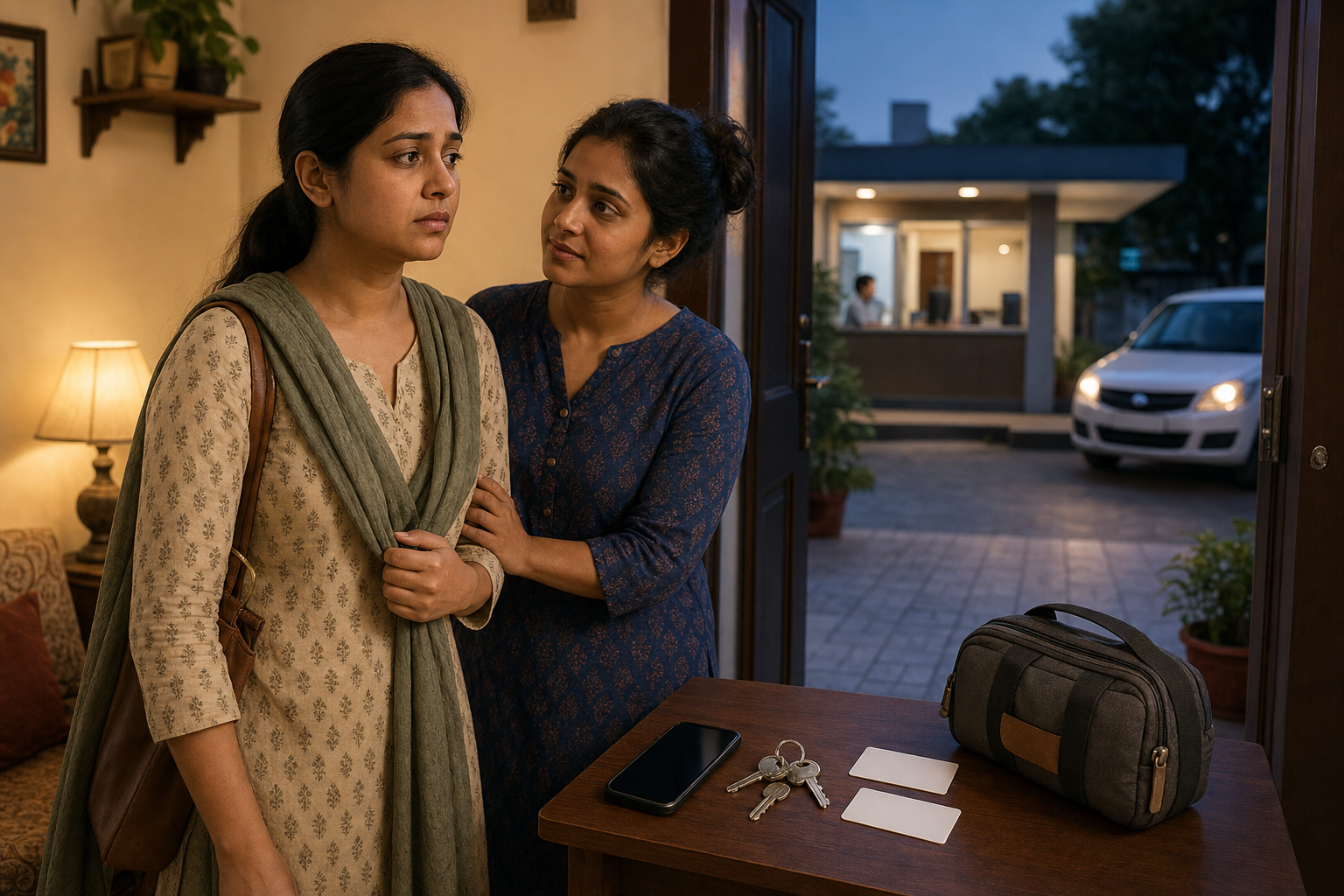
If you are one of the partners, a friend, or a relative trying to help, do not begin with a family summit. A hostile meeting can create another opportunity for confinement, phone seizure, intimidation, or assault. Deal with immediate danger first and reconciliation later.
- Leave the confrontation. Move to a secure place and contact the police if violence is occurring or appears imminent. Do not meet a threatening person alone to demonstrate goodwill.
- Attend to injuries. Obtain medical care when needed. Safety takes priority over filming, posting, or arguing about who started the confrontation.
- Preserve threats and create a chronology. Retain call logs, voice messages, emails, photographs, and unedited message threads. Write down dates, times, places, witnesses, and the exact conduct you observed. Keep a copy with a trusted person or legal representative.
- Make a factual police complaint. State who did what, when, and where. Separate what you personally witnessed from what someone told you. Avoid communal slogans and claims about motive that the evidence cannot yet support.
- Do not accept jurisdictional uncertainty as a reason for inaction. Where information discloses a cognizable offence and the correct police-station boundary is uncertain, ask the receiving station to record the matter through the Zero FIR mechanism and transfer it as required.
- Request protection expressly. Explain previous incidents, current threats, access the threatening person has to the couple, and any upcoming appointment that could expose them. Ask about a threat assessment, safe-house access, an escort, a quick-response arrangement, the district helpline, or the relevant women’s or special cell.
- Plan movement quietly. Arrange secure transport for legal and marriage-office appointments. Share the itinerary only with people who need it, and ensure that witnesses understand the security concern.
The protective framework associated with Shakti Vahini includes safe houses, round-the-clock helplines, special cells, escorts, and rapid intervention for couples facing honour-based threats. Availability and access can differ locally, so a lawyer or district legal-services authority may need to help identify the working channel in Thane district.
When a complaint discloses a cognizable offence, police are expected to register an FIR. An FIR begins an investigation; it is neither a conviction nor permission for indiscriminate arrest. Arrest and custody remain subject to legal safeguards, while the couple’s protection should be assessed independently of whether an arrest is immediately necessary.
Cross-complaints are common risks in a bitter family dispute. One side may allege coercion or abduction while the other alleges threats or confinement. Do not respond by inventing a stronger counter-story. Preserve evidence, ensure that each adult can state their wishes independently, and obtain legal advice about the complaint, protection request, and any bail issue. This is especially important before signing a statement or attending a meeting arranged by an opposing relative.
This sequence is practical orientation, not individual legal advice. A lawyer familiar with the current criminal-law framework in Maharashtra should review the facts where an FIR, arrest risk, protection petition, or allegation of coercion is involved.
The legal line is adult consent, not family permission

Indian constitutional jurisprudence places an adult’s choice of spouse within life and personal liberty under Article 21. Lata Singh v. State of Uttar Pradesh in 2006, Shafin Jahan v. Asokan K.M. in 2018, and Shakti Vahini v. Union of India in 2018 establish a clear direction: families and community bodies cannot replace an adult’s choice with coercion, and authorities must respond to honour-based threats.
That protection does not make every proposed marriage automatically lawful. Legal eligibility still matters. It means that eligibility is decided by law, while the choice itself belongs to the two adults.
For a couple choosing a religion-neutral civil marriage, the Special Marriage Act, 1954 process ordinarily involves:
- giving written notice to the appropriate Marriage Officer;
- a 30-day notice period during which legally relevant objections may be considered;
- the appearance of the parties and required witnesses; and
- solemnization once the statutory conditions are satisfied.
An objection is not a public vote on the relationship. The Marriage Officer’s task is to examine statutory matters such as legal eligibility, a prohibited relationship, or an existing marriage. A parent’s dislike of the match, the religions of the partners, neighbourhood pressure, and anxiety about family standing are not substitutes for a statutory ground.
The notice stage can expose a vulnerable couple to harassment because information about the intended marriage may reach hostile relatives. High Courts have addressed privacy and security concerns in this area, and implementation may not be identical in every office. Before submitting personal information, ask the Marriage Officer or a qualified lawyer what procedure currently applies, what information may be displayed, and how a protection request should be coordinated with the appointment. Do not assume that completing a form by itself solves a known safety risk.
Keep three decisions in separate lanes:
- Marriage eligibility: the Marriage Officer and, where necessary, a court apply the statutory conditions.
- Possible crime: police investigate evidence of threats, confinement, assault, intimidation, or other unlawful conduct.
- Family relationship: the couple and relatives may use counseling or mediation, but only when participation is voluntary and the setting is safe.
Combining those lanes is dangerous. A mediator cannot bargain away an adult’s liberty. A crowd cannot decide that a crime occurred. A police station should not treat a protection complaint as merely a disagreement to be sent back to the family. And a marriage application should not be treated as proof that every allegation made by either side is false.
A Dharmic response protects the person and disciplines the crowd

Family opposition often begins in fear: concern about a sibling, uncertainty about religious practice, anxiety about social standing, or suspicion that consent is not genuine. Those concerns may justify calm questions. They do not justify confinement, assault, threats, forced separation, or the use of a crowd to frighten the couple.
If you are a parent or sibling, begin with questions that can produce useful answers:
- Can each adult state their wishes privately, away from the partner and both families?
- Is there specific evidence of coercion, deception, confinement, or a threat, rather than an inference drawn from religious identity?
- Have the partners checked their legal eligibility and the current civil-marriage procedure with a competent professional?
- Are practical questions about residence, finances, religious observance, and future family life being discussed without demands or threats?
- Would both partners voluntarily accept a neutral counselor or mediator who understands that reconciliation cannot mean forced separation?
If both adults freely choose the marriage, the family’s difficult task is to keep a relationship with them without claiming ownership over the decision. You may disagree, decline to celebrate immediately, or ask for time. You may not seize a phone, block a doorway, threaten a partner, fabricate a criminal claim, or recruit neighbours to impose the family’s preference.
If concrete evidence of coercion exists, take that evidence to the police or a lawyer. Do not stage a rescue through private force. A genuine victim can be endangered by the resulting confrontation, and an unsupported accusation can be used to erase an adult woman’s own account of what she wants.
Ulhasnagar’s Hindu, Muslim, Sikh, Jain, and Buddhist residents already have civic relationships through neighbourhoods, markets, associations, youth groups, and local institutions. Community leaders should use those relationships narrowly and early. A small peace committee can identify one liaison for each family, discourage gatherings at homes and police stations, ask influential people not to circulate rumours, and communicate that retaliation will not be tolerated.
Police response should remain equally focused:
- record cognizable threats or violence promptly and in neutral language;
- assess danger to the couple independently of family pressure;
- document statements, digital material, injuries, witnesses, and protective requests carefully;
- prevent crowds from reaching the couple, their home, or marriage appointments; and
- communicate verified information without disclosing details that could expose vulnerable people.
Media pages and social-media users have a parallel responsibility. A headline that assigns guilt to a religion may attract attention, but it makes the couple less safe and the investigation less clear. Describe the alleged conduct, preserve the distinction between allegation and established fact, and do not turn relatives who have not been accused into targets. If the allegations are substantiated, demand proportionate accountability for the people responsible. If they are not, correct the record promptly.
Ahimsa does not mean looking away from violence. It requires self-restraint while protecting the threatened. Dignity does not mean avoiding hard facts. It means refusing to treat an adult as family property or a whole religious community as an accused person. Anekantavada offers another useful discipline: your first account may contain only part of the truth, so certainty should grow with evidence rather than anger.
A pro-Hindu response must therefore be pro-truth, pro-safety, and pro-equal law. Protecting a Hindu partner does not require demonizing Muslims. Protecting a Muslim woman does not require minimizing family violence if evidence establishes it. The same standard should govern every combination of communities: free adult consent, protection from coercion, factual investigation, and individual accountability.
If you are directly involved, make your next action small and verifiable: move out of danger, preserve the evidence, place the safety concern before the police, confirm the marriage-office procedure with qualified counsel, and disclose your movements only to trusted people. If you are watching from outside, stop the next unverified message instead of forwarding it. Ulhasnagar needs neither collective guilt nor collective denial; it needs protected adults, established facts, and law applied without fear or favour.