If you are trying to make sense of Tamil Nadu’s 2026 Assembly election, do not begin with the loudest speech, the largest rally or the most confident social-media forecast. Begin with three separate questions: does the incumbent deserve another term, which challenger is genuinely prepared to govern, and which candidate can serve your constituency after the campaign disappears?
Those questions may produce different answers. This is not a simple contest between M.K. Stalin and Joseph Vijay, nor is it merely another round of DMK versus AIADMK. Tamil Nadu is testing four political projects at once, and a small shift in the wrong constituencies can matter more than a dramatic statewide headline.
Read the four poles by what each one still has to prove
The 2021 election was the first without either J. Jayalalithaa or M. Karunanidhi. The DMK returned to power under Stalin while the AIADMK struggled with the consequences of internal division. In 2026, neither inherited emotion nor an established symbol is sufficient on its own. Each formation has a different credibility gap.
| Political pole | Its present advantage | What you should demand before trusting it |
|---|---|---|
| DMK and allies | Incumbency, an established organisation, a core Dravidian constituency and an alliance structure that reaches several social blocs | Measurable delivery on employment, civic services, public safety, industrial growth and transparent administration |
| AIADMK | A familiar party identity and continuing strength in parts of the state | Evidence that factional conflict has ended, cadres will work together and the party has a programme beyond recovering its former position |
| TVK | Vijay’s celebrity, fan networks and apparent interest among younger voters in urban-fringe and semi-urban areas | A credible candidate bench, trained local workers, polling-booth capacity, crisis discipline and an unambiguous policy charter |
| BJP | A distinct ideological offer built around national integration, infrastructure, investment and a challenge to the established Dravidian consensus | Local Tamil leadership, a socially broad coalition and proof that growing visibility can be converted into constituency victories |
These are not four equally developed electoral machines. The DMK begins with the advantage and liability of a governing record. The AIADMK has historical depth but must demonstrate present cohesion. TVK has attention but must show that attention can be organised. The BJP has made ideological gains but still has to turn them into a sufficiently broad local vote.
Treat alliance announcements as provisional evidence rather than final arithmetic. A leadership agreement matters only if local cadres cooperate, traditional supporters accept the nominated candidate and the allied parties can transfer votes to one another. That is especially important when smaller caste- and locality-based parties may influence close constituencies without appearing dominant statewide.
Why statewide vote-share predictions can mislead you
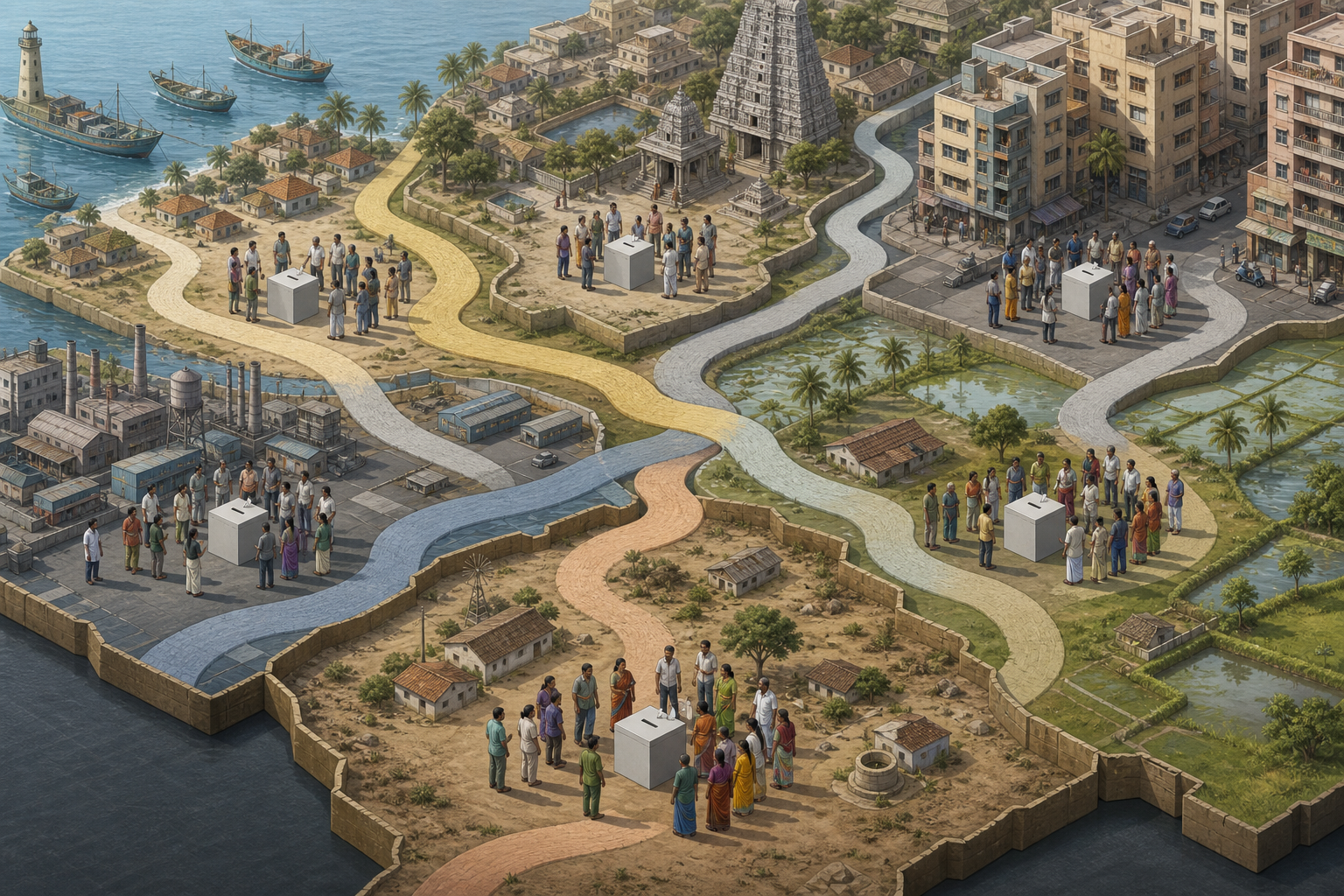
Tamil Nadu elects its Assembly constituency by constituency. Statewide vote share does not translate mechanically into seats. A party with concentrated support can win more constituencies than a rival whose larger-looking vote is spread too thinly. A new entrant can also change the winner without winning the seat itself.
This creates three effects that you should keep in mind when you encounter a poll or television projection:
- Fragmented dissatisfaction can protect the incumbent. If voters seeking a change divide among AIADMK, TVK and BJP candidates, the DMK may retain a constituency even after losing some support.
- A modest statewide movement can overturn several close seats. The location of a swing matters more than its dramatic presentation as a single state-level number.
- A popular face can influence the result before building a large legislative presence. TVK may draw votes from more than one established party, so the crucial question is not merely how much it wins but where its votes come from.
When you read a poll, therefore, look for constituency samples, regional patterns and alliance assumptions. Be cautious if a forecast gives a precise seat figure but does not explain how support is distributed among Chennai, urban-fringe areas, semi-urban belts and districts where the older parties retain deeper networks.
Organisation becomes decisive when margins are narrow. Polling agents, ward-level volunteers, accurate voter lists, candidate recognition and lawful polling-day assistance rarely dominate online discussion, but they determine whether general sympathy becomes a counted vote. Social media can establish a mood. It cannot replace a functioning booth committee.
The AIADMK’s internal condition deserves particular scrutiny. Its prolonged leadership struggle has encouraged cadre fatigue and created openings for competitors. The situation changed again when former Chief Minister O. Panneerselvam publicly aligned with the DMK on 27 February 2026. Do not assume that every supporter will automatically follow a leader across party lines, but do watch candidate defections, local office-bearer movements and signs that campaign workers are withholding effort. Those details reveal more than a leader’s stage appearance.
Judge the DMK on outcomes, not the volume of the campaign
An incumbent asks to be judged twice: first on what it delivered, and then on whether its next promises are credible. DMK supporters can point to welfare delivery, urban infrastructure and social-justice measures. Critics raise allegations involving corruption, law and order, and uneven treatment of religious institutions. You do not have to accept either side’s complete narrative. You can test the record against the parts of government you actually encounter.
Use this six-part constituency scorecard:
- Employment and the school-to-work transition: Ask what has changed for young people seeking their first stable job. Separate investment announcements from jobs that became accessible to local applicants, and ask whether training programmes led to placements rather than certificates alone.
- MSME conditions: Look beyond large industrial projects. Ask local traders and small manufacturers whether credit, approvals, power reliability and basic infrastructure have become easier to navigate. A development claim that bypasses small employers will not solve the employment problem.
- Cost of living and welfare: Judge a scheme by the pressure it removes from the household budget, not by its campaign branding. Also ask whether the benefit is delivered predictably and whether access depends on political intermediaries.
- Water, drainage and flooding: Inspect the work visible in your own ward. A completed project, maintained drain or more reliable supply carries more weight than a fresh announcement made shortly before voting.
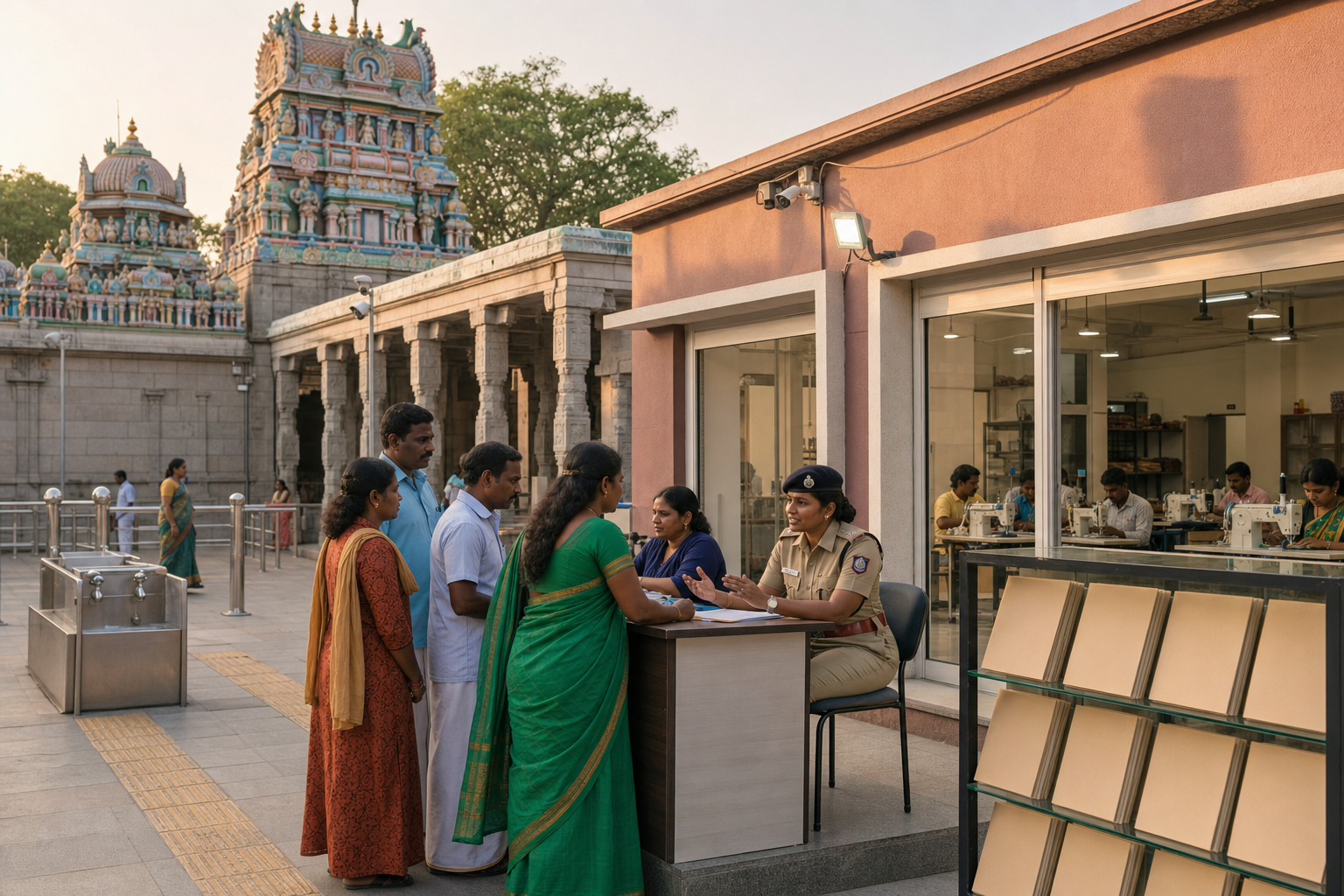
- Public safety and narcotics: Anti-trafficking enforcement has intensified since the pandemic, while some cases have involved allegations of transnational connections. Demand firm policing, but also ask how the parties will provide rehabilitation and skills pathways for affected young people. Arrest figures alone do not show whether neighbourhood harm is declining.
- Temple administration: Ask whether decisions are transparent, accounts can be scrutinised, heritage is protected and devotees are treated as stakeholders rather than obstacles. A party that invokes either secularism or faith without explaining its administrative standards has not answered the question.
Apply the same test to opposition promises. It is easy for a challenger to list every failure because it has not yet had to reconcile competing budgets and interests. Ask each candidate to identify the first local problem to be addressed, the responsible authority, the proposed action and the way residents will verify completion. If the answer returns immediately to a statewide slogan, you have learned something important about that candidate’s readiness.
The opposition contest is really a test of organisation
TVK must show that a fan network can become a public institution
Joseph Vijay enters politics with recognition that most new leaders spend years trying to acquire. TVK also appears to have an early opening among voters aged 18 to 30 in urban-peripheral and semi-urban areas, supported by an existing fan-club network. There are also indications of favourable interest among parts of the Christian community. These are possible foundations for a coalition, not proof that one already exists.
A fan club can gather a crowd and circulate a message. A political party must select credible candidates, settle disputes, train polling agents, maintain voter contact between rallies and provide constituency service after an election. Before treating TVK as ready to govern, look for five pieces of evidence: identifiable local leadership, written policies, a method for screening candidates, disciplined event management and workers present below the district level.
Leadership under pressure is part of that assessment. A reported stampede at a Karur rally in 2025 was described in contemporaneous accounts as causing multiple fatalities. The electoral question is not whether opponents can exploit a tragedy. It is whether TVK demonstrates empathy, accepts institutional responsibility where warranted, improves crowd-safety systems and shows that lessons have changed its conduct. Administrative readiness is revealed most clearly when an event stops following the script.
TVK’s ideological caution also needs to become policy clarity. Avoiding a direct collision with Dravidianism or E.V. Ramaswamy Naicker’s legacy may reduce early resistance, but voters still need to know what the party would do about jobs, centre-state relations, temple administration, education, public safety and industrial development. Being new is not a programme.
AIADMK must prove that the party still moves as one body
AIADMK’s symbol, history and surviving regional strength keep it relevant. Yet nostalgia cannot coordinate workers who no longer trust one another. Watch whether rival camps accept candidate selections, whether recognisable local organisers appear together and whether the party offers a forward plan rather than relying only on dissatisfaction with the DMK.
The practical question is not whether AIADMK retains a vote bank in theory. It is whether those voters can be protected from three forms of leakage: demoralised supporters staying home, younger voters moving to TVK, and voters seeking a clearer ideological alternative moving towards the BJP. A recovered organisation will show itself in joint campaigning and booth preparation before it appears in a statewide survey.
BJP must make a Tamil case for national coherence
The BJP challenges assumptions about language, culture and centre-state relations that have shaped Tamil Nadu politics for decades. Its emphasis on national integration, infrastructure and investment gives it a recognisable position. But ideological visibility is not the same as an electoral constituency.
The party must answer the persistent claim that it is socially narrow or culturally external to Tamil Nadu. It cannot do that by dismissing every critic as hostile. It needs respected Tamil leaders from different communities, candidates with local records and a development argument tied to district needs. National coherence becomes persuasive when voters can see how it improves transport, investment, employment and security without treating Tamil language or cultural dignity as a concession.
Dharmic voters should be especially careful here. Sympathy for the BJP’s civilisational language should not excuse a weak candidate, just as suspicion of the BJP should not be allowed to erase a serious local record. Judge the person, organisation, alliance and programme together.
Use a Dharmic civic test before making the final choice
A Dharmic political outlook should produce sharper standards, not automatic party loyalty. Hindu, Buddhist, Jain and Sikh traditions differ in doctrine and practice, but their long coexistence within Bharatiya civilisation offers a basis for cultural confidence without civic hostility. Respect for all faiths does not require silence about temple governance, biased administration or threats to public order. It requires that the same standards be applied consistently.
Put these questions to the party or candidate asking for your vote:
- Will temple administration be transparent, professionally accountable and respectful of devotees and inherited traditions?
- Will places of worship and religious communities receive equal protection under the law, without selective enforcement or campaign-time favouritism?
- Does the public-safety plan combine strong action against trafficking with rehabilitation, family support and useful skills for vulnerable youth?
- Can the candidate defend Tamil language and cultural inheritance while cooperating with the Union government where infrastructure, security and investment require it?
- Does the party teach cultural literacy and social confidence, or does it rely on humiliation, historical caricature and permanent communal suspicion?
Do not substitute displays of piety for administrative detail. A temple visit does not answer who will publish accounts, protect heritage, consult communities or correct misconduct. Likewise, the vocabulary of social justice does not answer whether religious institutions are treated evenly. Ask for the rule, the mechanism and the person accountable for applying it.
Key takeaways
- Judge DMK first on verifiable delivery in your constituency, then on the credibility of its next promises.
- Do not confuse TVK’s reach with organisational readiness; look for candidates, local workers, safety discipline and a written programme.
- Measure AIADMK’s recovery through cadre cooperation and vote retention, not through its historical standing alone.
- Ask whether BJP has built a locally rooted, socially broad Tamil coalition capable of winning actual constituencies.
- Treat statewide polls cautiously because fragmented opposition votes, regional concentration and close local contests can produce unexpected seat results.
- Apply the same Dharmic civic standards to every party: transparent temple governance, equal law, cultural confidence, public safety and respect for all communities.
Your final decision should move from the ground upward: assess the local record, examine the candidate, test the party’s organisation, inspect the alliance and only then weigh the chief-ministerial face. Tamil Nadu does not need another personality cult. It needs voters who can distinguish fame from capacity, welfare from dependence, ideology from caricature and cultural confidence from communal opportunism.