
If the Rohtak video reached your phone with a caption naming a culprit, a community, and a motive, stop at the caption. A recording may show an act. It does not automatically prove who committed it, what preceded it, or why it happened.
You do not have to choose between condemning desecration and demanding verified facts. The responsible Dharmic position does both: reject the burning of sacred texts without reservation, refuse collective blame, preserve genuine evidence, and leave punishment to lawful process.
What is known, and still unknown, about the Rohtak video
The defensible factual baseline is narrow. A video associated with Rohtak, Haryana, allegedly shows copies of the Bible and the Quran being set on fire. Its circulation produced public outrage and concern about communal tension.
At the reported stage, local authorities were reviewing the incident, while the identities involved, the motive, and the complete sequence of events remained unverified. That uncertainty is not a minor footnote. It determines what you can responsibly say.
Separate the controversy into three levels of confidence:
- Reported: a disturbing recording linked to Rohtak was circulating and was said to depict the burning of Christian and Islamic scriptures.
- Not yet established: who performed the act, whether others directed it, what happened outside the visible segment, and what motive drove it.
- Unsafe to infer: that an unidentified individual represents all Hindus, that an entire religious community bears responsibility, or that a circulating allegation explains the act.
This distinction matters especially when claims about religious conversion become attached to the video. Concerns about deceptive, coercive, or exploitative conversion practices can be raised firmly, but each allegation needs its own evidence. A clip of burning books cannot substitute for proof about a separate alleged wrong. At the reported stage, the motive behind the Rohtak incident was still unsettled.
Words such as alleged, reported, and unverified are therefore not evasions. They mark the boundary between what is visible, what has been claimed, and what an investigation may eventually establish. Removing those words for rhetorical force turns uncertainty into misinformation.
Condemning desecration is a Dharmic position, not surrender
You need not accept another religion’s theology to respect the people who hold its scripture sacred. Civic respect is not doctrinal agreement. A Hindu can reject Christian or Islamic truth claims, debate missionary activity, defend Hindu institutions, and still say plainly that burning a Bible or Quran as a public provocation is wrong.
Ahimsa is not passivity in the face of wrongdoing. It disciplines the means by which wrongdoing is opposed. Satya requires accurate claims. Dharma requires conduct proportionate to the facts. Restraint prevents anger at one alleged offence from licensing another offence against people who did not commit it.
The same standard should protect the Bhagavad Gita, the Vedas, the Guru Granth Sahib, Buddhist scriptures, Jain Agamas, the Bible, and the Quran. A society that accepts sacred books as props for public vengeance will not be able to confine that permission to someone else’s books. The precedent will eventually be used against every tradition.
Sarva dharma sambhava does not mean pretending that all doctrines are interchangeable. It means that disagreement need not become humiliation or violence. Likewise, interfaith cooperation during a tense incident is not theological syncretism. It is a practical agreement that nobody’s place of worship, family, livelihood, or scripture should become a target of retaliation.
This also preserves space for legitimate Hindu advocacy. If you have evidence of coercion, deception, intimidation, or targeted hostility in a particular case, document the specific conduct and take it through appropriate legal and civic channels. Do not attach unverified names to the Rohtak recording or present the burning itself as proof of another allegation. Weak evidence does not become stronger when paired with a more inflammatory image.
What to do before you share or comment

The greatest preventable danger is often not the existence of one recording but the chain of confident captions built around it. Each forward strips away context while adding accusation. If the video is in front of you now, use this sequence:
- Do not forward it immediately. Outrage creates pressure to act before thinking. Refusing to amplify an unverified caption is an action, not indifference.
- Separate observation from interpretation. Write down what the recording appears to show, what the audio actually contains, what the accompanying caption claims, and what you are merely inferring. Do not merge those categories.
- Look for an attributable update. Check statements from local police or the district administration and reporting that names its evidence. A screenshot with no original link, speaker, or date is not confirmation.
- Preserve evidence without republishing it. Keep the original message, URL, file, sender details, and surrounding context if they may help investigators. Do not crop, subtitle, edit, or add music before submitting relevant material privately to authorities.
- Remove collective labels. Unless an organisation’s involvement has been established, do not convert an unidentified person’s act into a claim about Hindus, Muslims, Christians, or any other community.
- Correct the record if you already shared too much. State exactly what you cannot verify and ask recipients not to forward your earlier claim. Quiet deletion leaves the false caption alive in every chat that received it.
A responsible public message can be short: a disturbing video linked to Rohtak is circulating and allegedly depicts copies of the Bible and Quran being burned; the identities, motive, and full sequence were not verified at the reported stage; there should be no retaliation or collective blame. That formulation condemns the apparent act without manufacturing conclusions.
Do not publish faces, phone numbers, home addresses, vehicle details, or speculative identifications in the hope that a crowd will investigate. A mistaken identification can expose an uninvolved person to threats and can contaminate useful evidence. Send credible material to law enforcement instead. If you see an immediate threat, a gathering moving toward violence, or danger to a person or place of worship, contact local emergency services and move to safety rather than approaching the scene yourself.
How communities can prevent a second injury
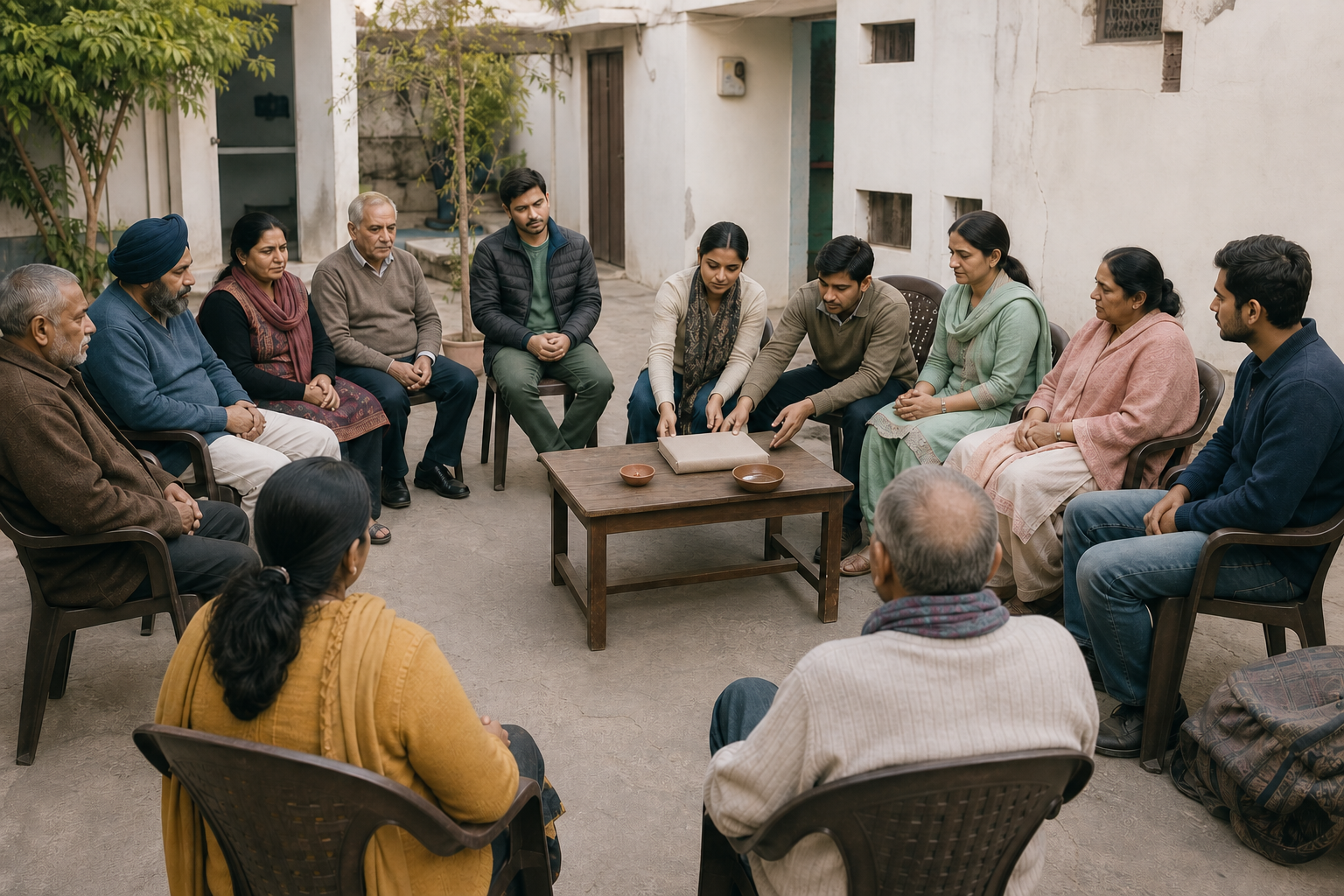
The first injury is the alleged desecration. The second begins when uncertainty is filled with communal accusation, businesses close out of fear, families feel exposed, or someone retaliates against an uninvolved neighbour. Community action should therefore pursue accountability and de-escalation at the same time.
A useful peace meeting is operational, not ceremonial. Hindu, Buddhist, Jain, Sikh, Christian, and Muslim representatives can agree on a compact public position:
- Condemn the burning of sacred texts without excuses or reciprocal accusations.
- State which facts remain unverified and promise to update the public when attributable information appears.
- Reject punishment, threats, or boycotts aimed at a whole community.
- Ask residents to send evidence privately to authorities instead of circulating it through public groups.
- Provide named local contacts who can receive reports of threats, rumours, or fears about spillover tension.
The value lies in visible coordination. When religious leaders, market representatives, neighbourhood elders, and youth volunteers repeat the same factual boundary, a rumour has fewer places to acquire false legitimacy. Families and shopkeepers also receive a concrete signal that responsible people are communicating across community lines.
Peace committees should maintain a simple rumour log: the exact claim, where it appeared, whether it contains a threat, what verification was attempted, and which authority received it. This prevents several volunteers from circulating the same inflammatory content while trying independently to check it. It also distinguishes a tasteless comment from a credible warning that needs immediate escalation.
Youth outreach should focus on behaviour, not slogans. Ask participants to identify cropped clips, anonymous captions, recycled footage, communal generalisations, and demands for instant retaliation. Then give them a replacement action: pause the forward, retain the original privately, check an attributable update, and report a direct threat.
An interfaith gathering can include separate prayers, meditation, a shared silence, or a joint civic statement. No participant needs to blur doctrinal boundaries. The immediate purpose is narrower and more urgent: protect conscience, prevent retaliatory harm, and make clear that lawful accountability belongs to institutions rather than crowds.
Key takeaways and the standard to carry forward
- The Rohtak recording was reported as allegedly showing copies of the Bible and Quran being burned, but identity, motive, and the complete sequence remained unverified at the reported stage.
- You can condemn sacred-text desecration immediately without endorsing an unverified explanation of who committed it or why.
- Respect for another community’s scripture does not require agreement with its doctrine or silence about substantiated conversion-related concerns.
- Do not forward inflammatory captions, publish speculative identities, or assign collective guilt. Preserve potentially useful evidence and submit it privately.
- Effective community action combines a clear condemnation, shared factual boundaries, rumour control, youth outreach, and direct contact with authorities.
- Ahimsa and satya are forms of disciplined strength: they protect the innocent while leaving room for evidence-based accountability.
If the video is still on your phone, make your next action concrete. Stop an unverified forward, correct a claim you cannot support, preserve genuine evidence without broadcasting it, or send a calm factual message into the group where anger is rising. The controversy will not be made safer by the fastest reaction. It will be made safer by people who can defend Dharma without abandoning truth.
References
