
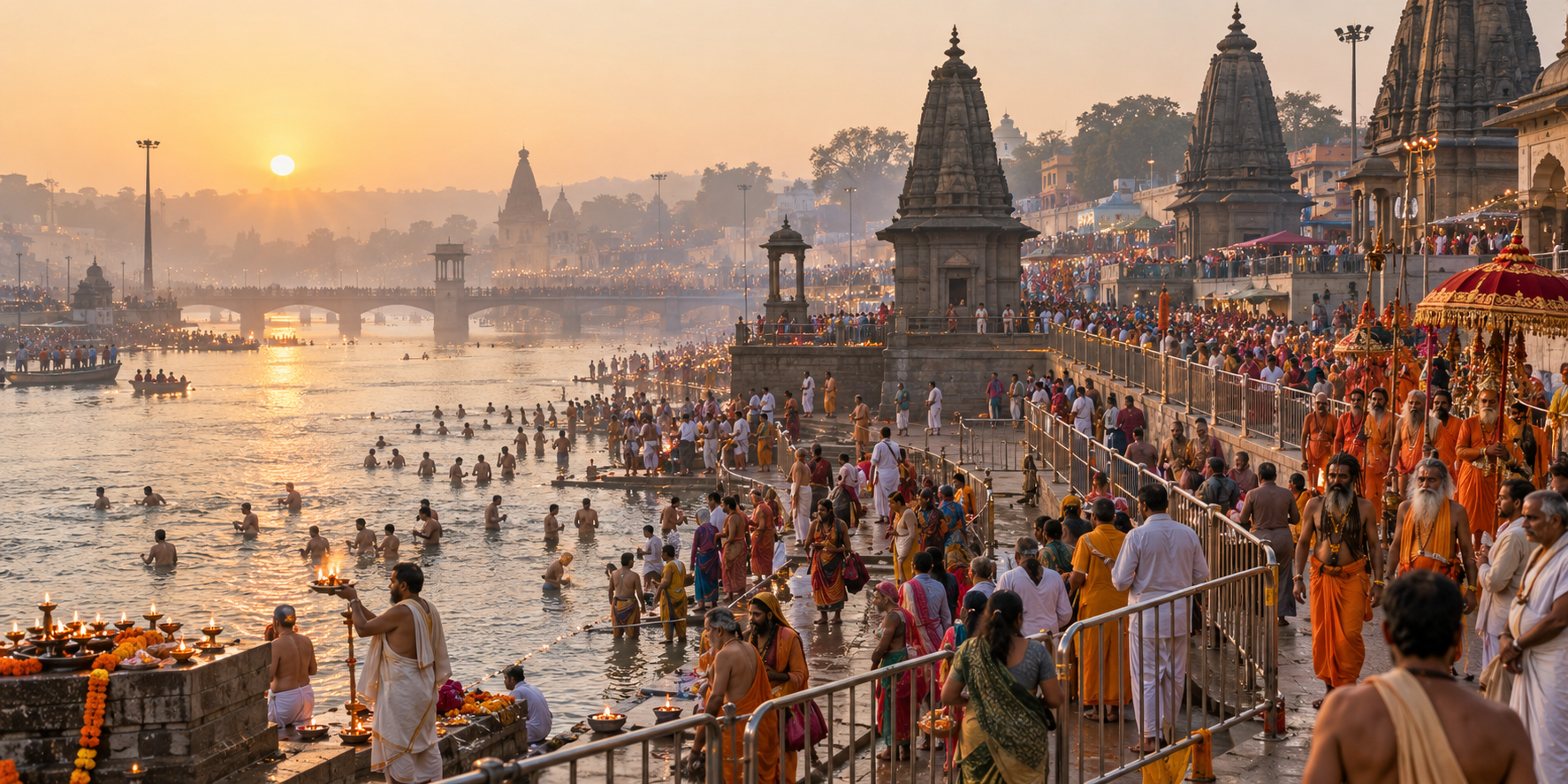
If you are trying to work out whether non-Hindus have already been barred from the Nashik Simhastha Kumbh, begin with one essential distinction: a religious demand is not the same thing as an operative government order. Confusing the two can mislead pilgrims, expose traders to avoidable losses, and turn an important Dharmic question into a contest of rumours.
The religious character of the Kumbh deserves serious protection. That principle still has to be translated into precise rules: who may enter which space, who may participate in rituals, who may trade, what exceptions apply, and which authority will enforce the decision. Those details determine whether a proposal becomes a workable safeguard or an arbitrary restriction.
First identify the decision actually before the government
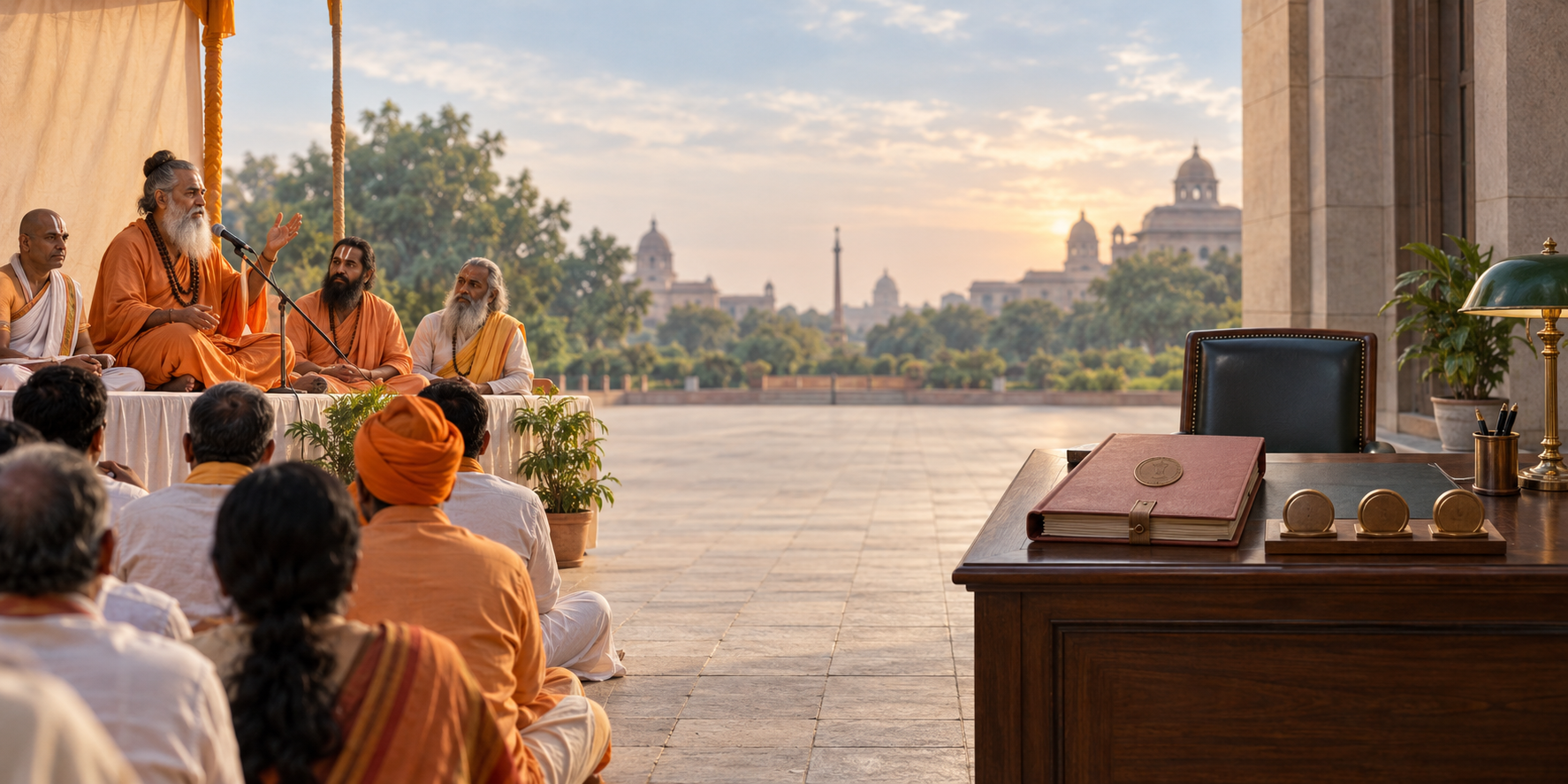
A Dharmadesh adopted at Dnyan Kumbh 2026 and submitted to the Maharashtra Government calls for two measures at the Nashik Simhastha Kumbh: restricting the entry of non-Hindus and preventing shops run by followers of other religions.
Those are related but separate demands. One concerns physical access to the Kumbh. The other concerns eligibility to conduct business there. Each would require its own scope, definitions, procedures, and enforcement arrangements.
The act of submitting the Dharmadesh establishes that the position has been formally placed before the state government. It does not, by itself, establish that the government has accepted the demand, issued an enforceable direction, fixed a territorial boundary, named an implementing authority, or specified exceptions. Unless an official direction supplies those elements, accurate language is that the Dharmadesh calls for or seeks restrictions, not that the restrictions have already been imposed.
When you encounter a claim about access, ask for the actual operative notice. Check its date, issuing authority, geographical scope, affected classes of people, effective period, and enforcement procedure. A headline, speech, resolution, or forwarded message cannot substitute for those details.
Key takeaways
- The Dharmadesh seeks restrictions; a submission to the Maharashtra Government is not automatically an enforceable rule.
- Entry, ritual participation, employment, and permission to operate a shop are different questions and should not be collapsed into one category.
- Protecting the Hindu purpose of the Kumbh requires clearly defined sacred spaces, conduct standards, and administrative responsibility.
- Pilgrims and traders should rely on dated directions from the competent authority, especially before making travel arrangements or financial commitments.
- Any religion-based restriction must explain how identity, boundaries, exceptions, enforcement, and review will work in practice.
The Hindu character of the Kumbh is the starting point
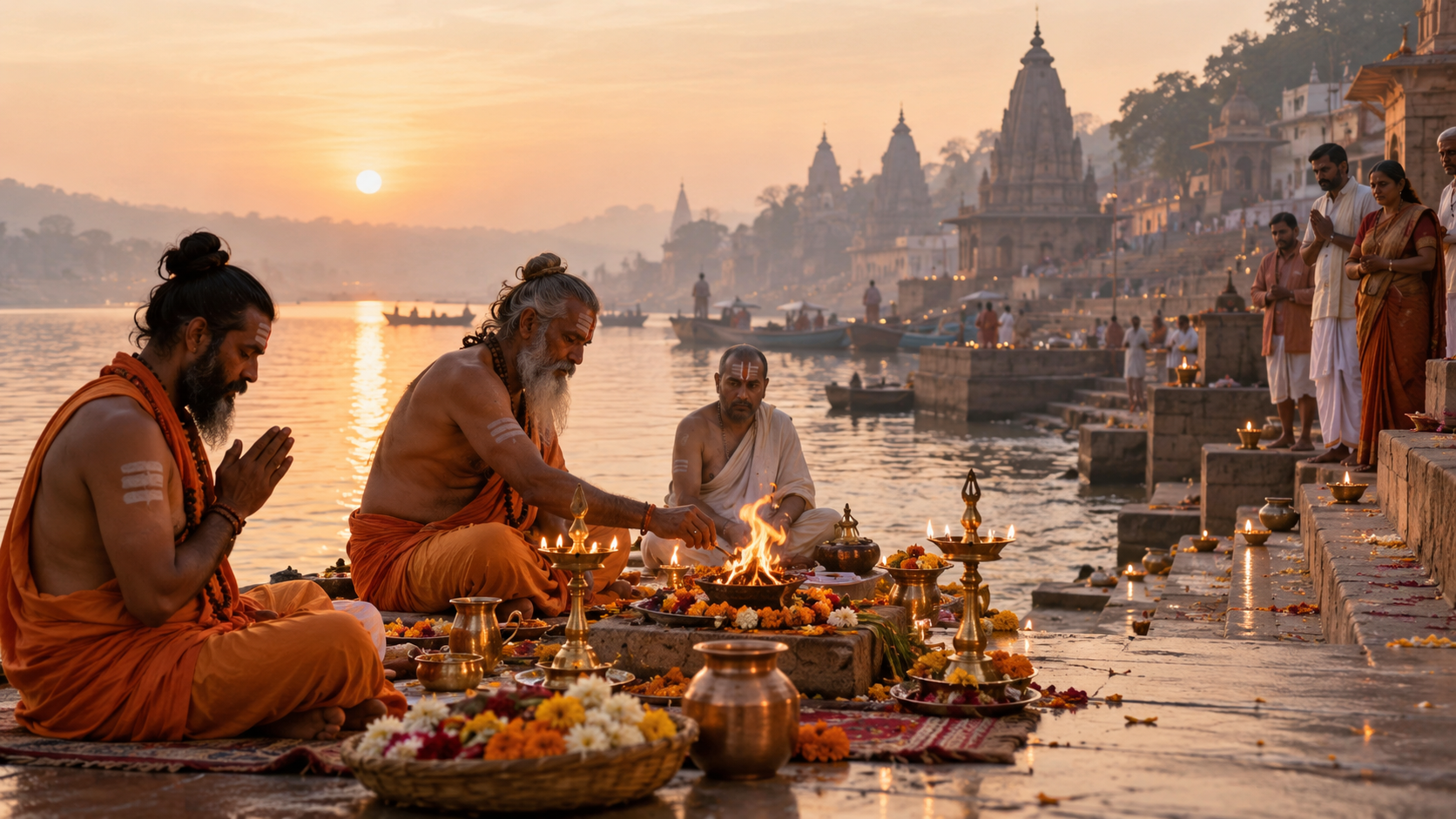
The Kumbh is not an ordinary exhibition onto which a religious theme has been added. Its reason for existing is Hindu pilgrimage, ritual observance, spiritual discipline, and collective religious life. Management decisions should therefore begin with the needs of pilgrims and the integrity of the sacred occasion, not with the assumption that every part of the event is religiously interchangeable public entertainment.
That gives Hindu religious custodians and devotees a legitimate reason to demand protection from disruption, hostile activity, deceptive commerce, interference with rites, or the displacement of the gathering’s Dharmic purpose. A supposedly neutral arrangement that makes the Hindu purpose secondary would fail the event it is meant to serve.
But recognition of a sacred purpose does not answer every administrative question. An inner ritual area, a controlled festival facility, a transport route, an emergency service point, and the surrounding city do not all perform the same function. A rule appropriate to one may be excessive or unworkable in another. The government therefore has to identify where religious custodianship ends, where civic administration begins, and how the two will cooperate.
A strong pro-Dharma policy does not have to choose between sacredness and precision. Precision protects sacredness. It allows organizers to reserve genuinely religious spaces and functions without forcing police officers, volunteers, or vendors to improvise religious tests at ground level.
Entry, ritual participation, and trade need separate rules

The central weakness in any broad access slogan is that the word entry can hide several different activities. Before supporting, opposing, or attempting to follow a restriction, you need to know which activity is actually being regulated.
Physical access
Entering a protected ritual space is not the same as travelling along a road, reaching accommodation, obtaining medical help, reporting for authorized work, or passing through a wider managed area. A usable direction must identify the controlled perimeter and explain whether access is prohibited, screened, accredited, or limited by purpose.
A zone-based arrangement would be easier to understand and enforce than an undefined restriction covering the entire idea of the Kumbh. The relevant authority could distinguish the sacred core, controlled service areas, licensed commercial areas, and ordinary civic space. Whether it chooses that model or another, a published map is more useful than a broad phrase that different officials may interpret differently.
Ritual participation
Permission to be physically present is also different from permission to perform a rite, enter a tradition-governed enclosure, exercise a religious role, or present oneself as representing a Hindu institution. Religious authorities can maintain the discipline of rites and spaces under their care. Public administration should not blur that authority into an unspecified test governing every person in the wider area.
This distinction matters because the sacred character of a gathering can be protected more directly through rules about purpose, role, accreditation, and conduct. If the concern is disruption or misrepresentation, the policy should name the prohibited conduct and give organizers a clear way to act against it.
Commercial permission
The proposed restriction on shops raises a different set of questions. What counts as a shop, and what does run by mean? The permit holder, legal owner, manager, stall operator, employee, or supplier may not be the same person. A direction would also need to say whether it applies only to temporary stalls within a designated Kumbh market or to permanent businesses in a wider part of Nashik.
The policy objective must be stated plainly. Reserving designated opportunities for Hindu religious institutions, traditional practitioners, or vendors supplying ritual needs is different from excluding every business associated with a non-Hindu person. Those approaches have different consequences and require different justifications. If protection from deceptive or hostile commerce is the concern, licensing rules can directly address misrepresentation, prohibited conduct, incompatible goods, and breaches of the event’s religious discipline.
Ambiguity will not remain theoretical. It will reach the permit counter, the checkpoint, and the individual worker asked to make an immediate decision. Unless the terms are written down, similar people may receive different treatment based on names, appearance, language, or assumption. That outcome would weaken both administrative credibility and the legitimate effort to preserve the Kumbh’s Hindu character.
Test any access claim before you rely on it

Whether you are a pilgrim, organizer, trader, volunteer, or commentator, use the following test for any claimed restriction:
- Status: Is this a demand, recommendation, administrative plan, or final direction? Look for operative language from the authority responsible for implementation.
- Authority: Who issued it, and does the notice identify the officials responsible for permissions and enforcement?
- Place and time: Which gates, roads, ritual areas, markets, or facilities are covered, and during what period?
- Affected activity: Does the rule govern physical entry, ritual participation, employment, volunteering, media access, service delivery, or commercial licensing?
- Eligibility test: What evidence, declaration, accreditation, or conduct standard will be used? A rule is not operational merely because it names a category.
- Exceptions and review: How will authorized workers, essential services, emergencies, disputed cases, and mistaken denials be handled?
If even one of those elements is missing, do not fill the gap with a social-media claim or your own assumption. Seek the full notice and any attached map, schedule, permit condition, or implementation circular.
- If you are travelling as a pilgrim: verify the requirements for the exact site you intend to enter. Carry only the registration, pass, or identification actually required by an official direction.
- If you plan to trade: obtain written eligibility information from the authority issuing the relevant permit before paying non-refundable stall, transport, stock, or accommodation costs.
- If you are organizing or volunteering: brief workers from one written protocol. Do not leave identity, access, or removal decisions to improvised judgments at a gate.
- If you are discussing the issue publicly: preserve the distinction between seeks and imposes. Update your wording only when an authorized government direction changes the status.
- If access or a licence is actually denied: request the reason and authority in writing, preserve the relevant notice, and obtain qualified legal advice for the individual case rather than escalating an argument at the checkpoint.
We should defend two things at once: the unmistakably Hindu purpose of the Nashik Simhastha Kumbh and rules precise enough to prevent arbitrary enforcement. The immediate constructive demand is therefore clarity. The Maharashtra Government should publish the exact perimeter, affected activities, vendor criteria, exceptions, responsible authorities, and review process for whatever decision it ultimately makes.
Until you have that operative wording, treat the Dharmadesh as a serious religious intervention placed before the government, not as a self-executing ban. Find the direction that applies to your exact place, role, and date; then act on what it actually requires.
References
- Hindu Jagruti Samiti – Nashik Simhastha Kumbh: Dharmadesh calls for entry restrictions on non-Hindus

Leave a Reply
You must be logged in to post a comment.