

If your state legislature says it has adopted NeVA, don’t stop at the announcement. Ask whether questions now reach departments through a traceable digital route, whether you can follow a bill through its legislative journey, and whether the daily business of the House is easy to retrieve.
The real test is not the disappearance of paper from legislators’ desks. It is whether the new system makes public business more timely, intelligible and accountable. You can test that without being a technology specialist.
Near-national sign-on is not complete adoption
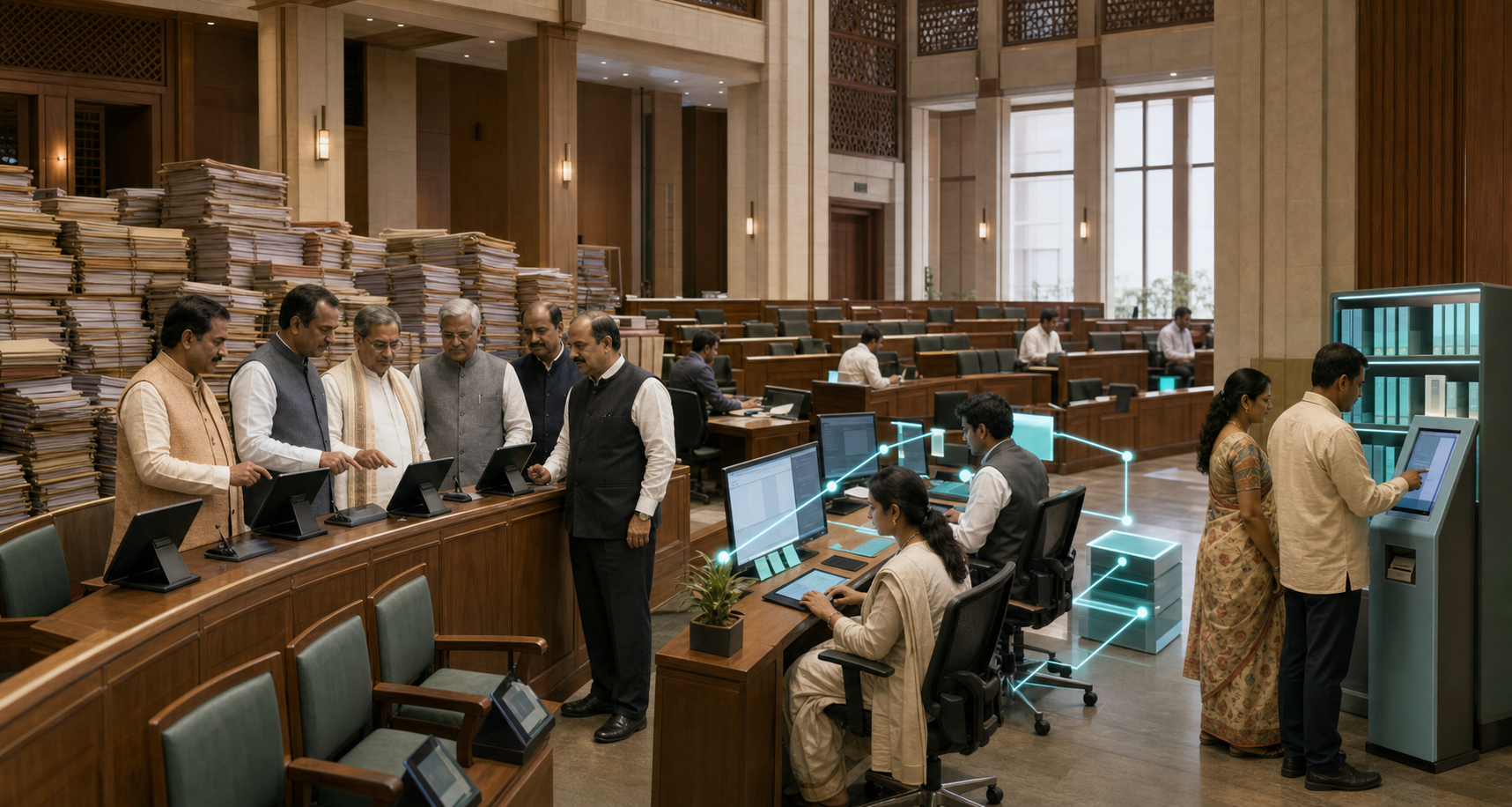
As of July 27, 2026, 33 of Bharat’s 37 state and Union Territory legislative bodies had signed on to the National e-Vidhan Application, while 21 legislative houses were conducting fully paperless floor proceedings. Those are substantial milestones, but they describe different kinds of progress.
Signing on shows institutional participation. Paperless floor proceedings show that a House has crossed a more demanding operational threshold. Neither figure, by itself, tells you how complete the underlying workflows are or how useful the resulting records are to the public.
It is therefore better to think about NeVA adoption in four layers:
- Participation: Has the legislative body formally joined NeVA?
- Workflow activation: Are questions, departmental responses, bills and daily business actually moving through the system?
- Floor operation: Is the House conducting its proceedings without relying on paper?
- Public usefulness: Can a citizen find, understand, download and revisit the legislative record?
The national totals directly measure the first and third layers. They should not be treated as a complete score for the other two. Nor should you subtract one headline figure from the other and assume that every remaining House has the same problem. A signed legislature may be migrating records, activating modules in stages, changing internal procedures or addressing local implementation issues. You need state-level evidence before assigning a cause.
When a government or secretariat describes its legislature as NeVA-enabled, ask which layer it means. A dated status page showing each major workflow would answer more than the word adopted ever can.
Follow the legislative chain, not the hardware

NeVA is an attempt to rebuild the administrative chain behind a sitting, not merely to put screens in a chamber. Its One Nation, One Application model is intended to replace fragmented state-specific systems with a standard platform covering legislative work from the filing of questions to the passage of bills.
The scale is significant: the programme has an outlay of Rs 673.94 crore over a decade and contains 11 modules. Those modules include member dashboards, ministerial question routing, bill tracking and the daily Order Paper. This breadth matters because legislative delay often occurs at the handoffs between offices, not on the floor itself.
Consider a legislator’s question. The useful digital journey begins when the question is filed, continues when responsibility is assigned, and reaches the relevant executive department for a response. NeVA connects legislative workflows with state executive departments so that questions can be routed electronically instead of travelling through the physical courier networks that historically slowed the process.
That makes a question one of the best items with which to examine implementation. Don’t look only for the final answer. Check which stages are visible, whether they carry dates, whether the responsible department is identifiable, and whether the answer remains attached to the question after the sitting ends. If some stages are meant to remain internal, the public record should still make the final status clear.
Apply the same logic to a bill. A status label is useful, but it is not a substitute for the text being considered. Look for a stable route from the bill’s listing to its available text, subsequent stage information and final outcome. If a bill can be tracked internally but the public cannot locate its documents, the administrative workflow may be digital while legislative transparency remains incomplete.
A common national backbone should create a dependable minimum standard without flattening Bharat’s federal and linguistic plurality. State procedures and languages need not become identical. Navigation, stage names, document relationships and archival practices should nevertheless be clear enough that a person does not have to relearn the meaning of digital access in every legislature.
A practical audit of your state’s NeVA implementation

You can assess the public-facing result by tracing one recent sitting. The aim is not to award a sweeping pass or fail. It is to identify the exact point at which the legislative record becomes difficult to follow.
- Identify the claim and its date. Find the latest status statement from the legislature or government. Record whether it says signed, implemented, live or fully paperless. These terms should not be treated as interchangeable.
- Start with one sitting day’s Order Paper. Check whether it is easy to locate by date and whether its links lead to the listed business. A document that exists but cannot be reached through predictable navigation is still difficult public infrastructure.
- Trace one listed question. Look for the question, the department or ministry concerned, the response status and the answer where it is public. Record which parts of the journey are visible instead of assuming that an absent page means no official action occurred.
- Trace one bill. Begin with the available bill entry and follow its displayed progress. Check whether the text and outcome remain associated with that entry. If only a current status is shown, note that status transparency and document transparency are not yet the same thing.
- Test retrieval outside your usual path. Search by title, date, member name and an obvious keyword. Try the principal state language as well as English where appropriate. Open a copied link in a fresh browser session and check whether the document can be downloaded without an unexplained login.
- Repeat the test on another sitting date. One successful page can be an exception; one missing page can be a temporary fault. Two dated checks give you a more responsible basis for raising a specific problem.
Keep a small record containing the House, sitting date, item examined, last visible stage, missing element and stable URL. This turns a vague complaint such as the portal does not work into an actionable report: the Order Paper for a named date is available, but the linked question has no publicly visible answer status, or the bill entry loses its document connection after a stage change.
Be equally precise about what your audit cannot prove. A missing public answer does not necessarily prove that a department failed to answer. It proves that you could not verify the answer through the public route you tested. A broken link does not invalidate the proceeding, but it does expose a discoverability or archival failure. That distinction keeps demands for accountability credible.
Digital rajadharma requires measurable public value

Rajadharma is not fulfilled simply because a legislature has stopped moving paper files. Public authority must remain answerable, and its record must remain intelligible. Technology serves that duty when responsibility is traceable, delays can be located, documents are preserved and citizens can see what happened without depending on privileged access.
The Rs 673.94 crore decade-long outlay makes outcome-based evaluation necessary. The outlay alone does not prove either savings or waste. A paperless label also does not establish faster answers, lower costs or better public access. Those claims require their own measurements.
A credible implementation dashboard would separate and report four kinds of evidence:
- Coverage: which legislative bodies have signed on, which workflows are live, and which Houses conduct paperless floor proceedings.
- Timeliness: how long visible stages take, including routing, response and publication where timestamps can appropriately be disclosed.
- Completeness: whether the Order Paper, questions, available answers, bill records and outcomes remain connected across a sitting.
- Usability: whether records are searchable, accessible in relevant languages, downloadable through stable links and preserved after the immediate session.
This separation protects the programme from two unhelpful reactions. Uncritical celebration treats enrolment as completion. Blanket dismissal ignores the administrative value of replacing fragmented systems and electronically connecting legislatures with departments. A serious pro-Bharat position should support capable national infrastructure while insisting on evidence of local delivery.
Key takeaways
- Thirty-three of 37 legislative bodies had signed on by July 27, 2026, but only 21 houses had reached fully paperless floor proceedings; participation and operation are different milestones.
- NeVA matters most at the handoffs among legislators, legislative secretariats and executive departments, where a traceable digital route can replace slow physical movement.
- A citizen should test one Order Paper, one question and one bill across at least two sitting dates before judging the public-facing result.
- Missing online material should be described as a verifiability or access gap unless there is separate evidence that the underlying legislative action did not occur.
- Nationwide success should be judged through coverage, timeliness, completeness and usability, not by a paperless label alone.
On the next sitting day, trace one question and one bill in your own legislature. Send any failure to the secretariat or your representative with the date, item and working URL path. A precise request for a missing stage, document or status is far more difficult to ignore than a general demand to improve the portal.
References
