
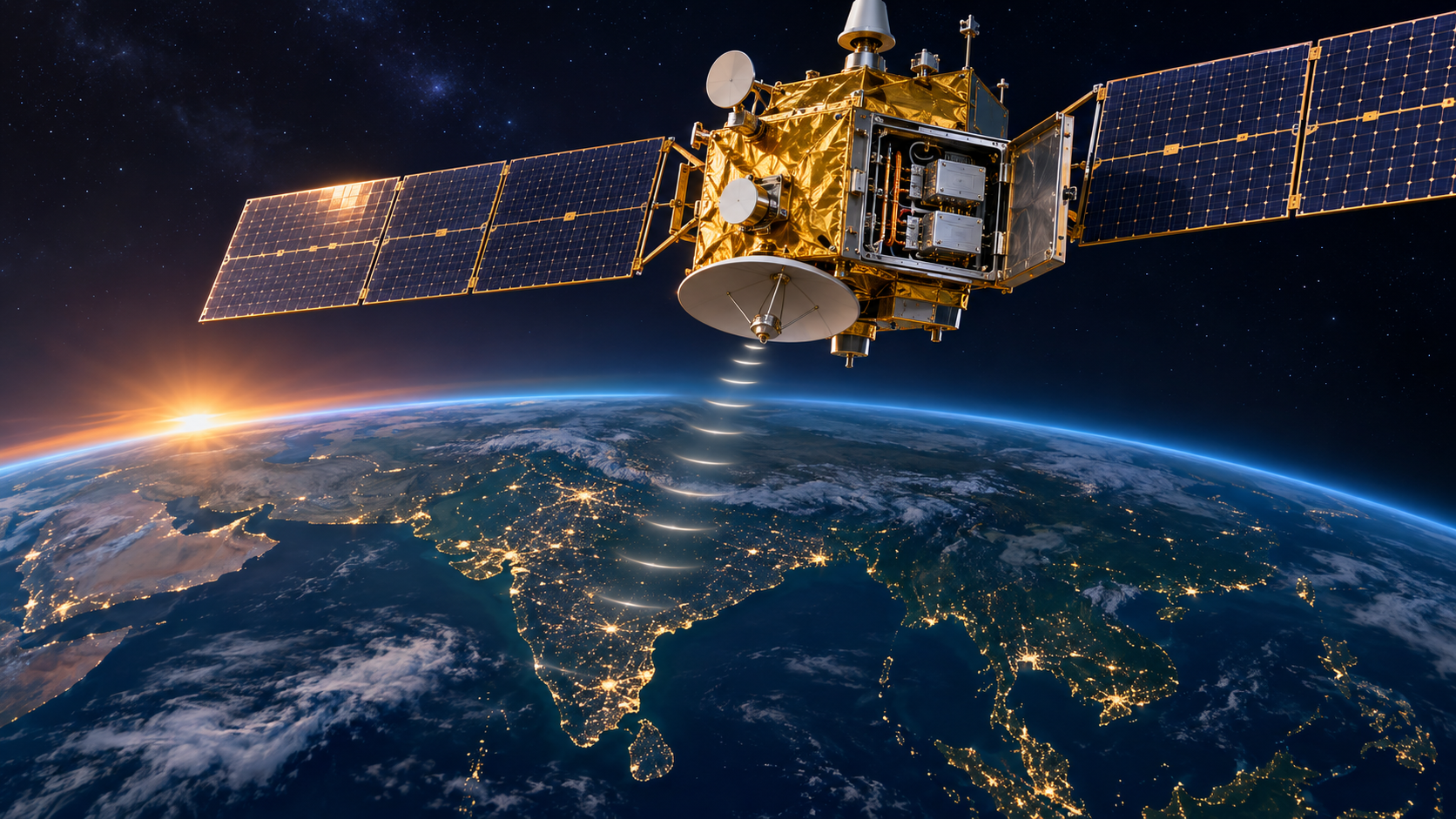
If you saw NVS-03 described as NavIC’s revival, the important question is not whether the rocket completed its job. GSLV-F18 did place the 2,250 kg satellite into geosynchronous transfer orbit after a flight of about 18 minutes. The question is whether Bharat can now keep enough precise clocks operating in space to make that recovery durable.
That distinction changes how you should read the milestone. The four-satellite minimum has been restored at the launch-and-deployment level, but NVS-03 still has orbit-raising and operational work ahead of it. Four spacecraft also provide no spare capacity. This is a serious advance, not yet a finished recovery.
Why NavIC’s central challenge is keeping time

A navigation satellite is useful because it broadcasts two closely connected facts: where it was when it transmitted a signal, and when that signal left. Your receiver compares the arrival times of signals from several satellites. Because radio signals travel at a known speed, tiny timing differences can be converted into distances.
The receiver must solve for its position as well as the error in its own ordinary clock. That is why four usable satellite signals form the familiar minimum for a three-dimensional navigation solution: three position coordinates and one receiver-clock correction. The calculation works only when the satellite timestamps themselves are exceptionally stable.
An onboard atomic clock supplies that stability. A rubidium atomic clock uses an atomic transition as a highly consistent frequency reference, allowing the satellite to maintain the precise timing needed for ranging. If that clock becomes unreliable, the satellite can remain powered, communicate with the ground and look healthy in many engineering respects while becoming unusable for accurate navigation measurements.
This is why clock reliability matters more than the raw number of objects in orbit. NavIC was designed to provide position accuracy better than 20 metres and timing accuracy better than 50 nanoseconds. Those are system objectives, not benefits produced by a successful launch alone. They depend on healthy clocks, known satellite orbits and enough usable signals being available together.
The indigenous rubidium clock is the real capability gain
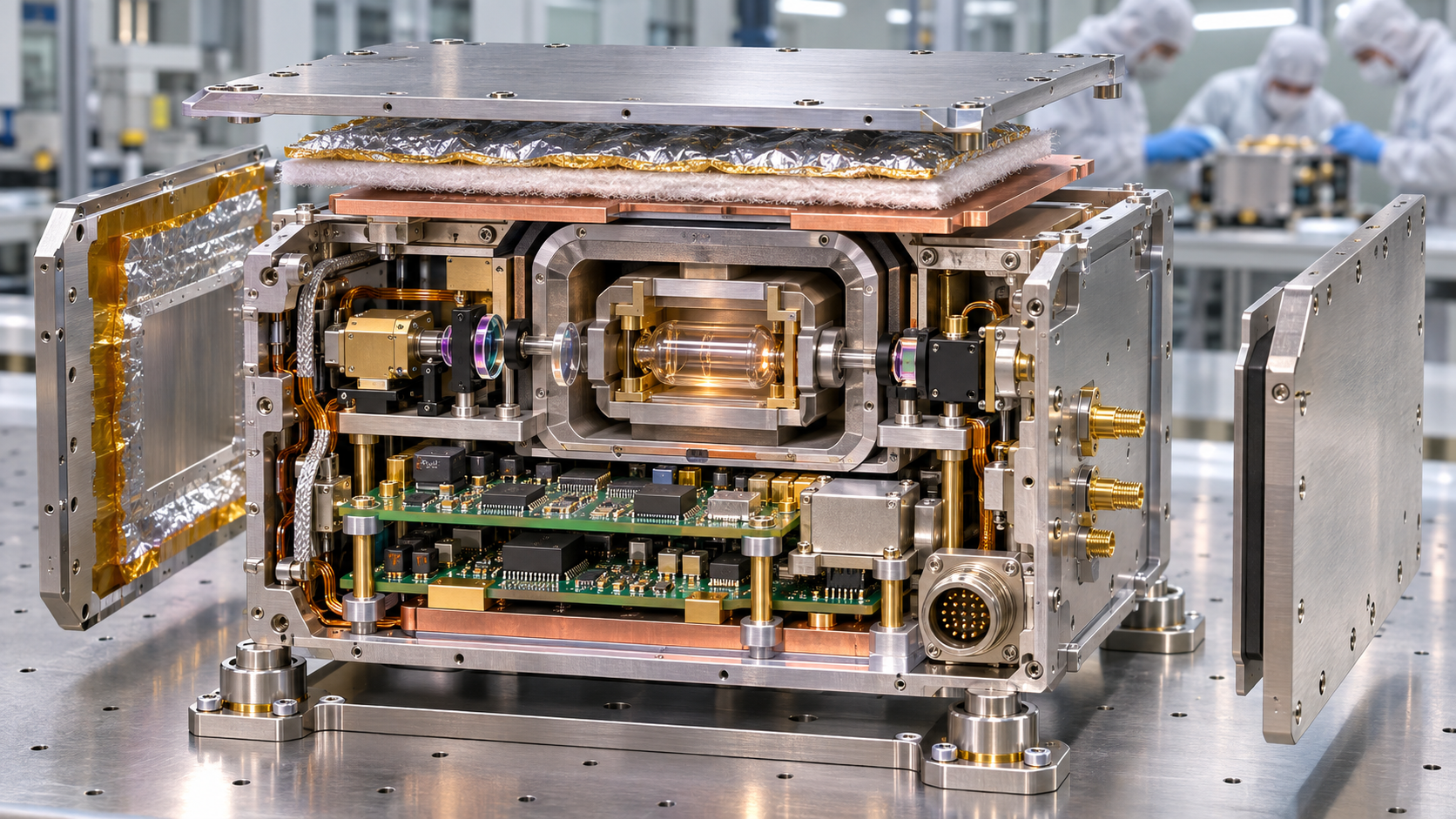
The first generation of NavIC satellites, launched between 2013 and 2016, suffered repeated atomic-clock failures. Several spacecraft also moved beyond their intended operational lives. That history explains why NVS-03 should not be judged merely as another satellite added to a manifest. Its most consequential payload is the first indigenous rubidium atomic clock developed by the Space Applications Centre in Ahmedabad, flying alongside imported clocks.
For Bharat, this moves indigenisation into one of the most demanding parts of the navigation chain. A country does not possess an autonomous navigation capability merely because it can build a satellite bus, launch a rocket or operate ground stations. It must also control the components that determine whether the transmitted position and time can be trusted.
But you should distinguish an indigenous prototype in orbit from a mature, repeatable national capability. The clock now has to demonstrate performance in the environment for which it was built. The meaningful tests come in sequence:
- Deployment: NVS-03 must complete the required orbit-raising manoeuvres and reach its assigned operational orbit.
- Commissioning: Controllers must check the spacecraft and navigation payload before treating the satellite as a normal contributor to the service.
- Timing performance: The indigenous clock must maintain the stability required for dependable ranging rather than merely switch on successfully.
- Endurance: Performance must persist in orbit. A short period of healthy operation cannot answer the long-term reliability problem exposed by the earlier fleet.
- Repeatability: The capability must be reproducible across later satellites. Strategic autonomy rests on a production and replenishment system, not on one exceptional unit.
This is the right standard because a launch proves that hardware reached space; it does not, by itself, prove how that hardware will behave through its service life. The indigenous clock milestone deserves recognition precisely because the difficult part begins after launch.
Four satellites restore service but leave no safety margin

The figure of four can sound reassuring until you separate minimum capacity from resilient capacity. If four usable satellites are required and only four are available, the loss or temporary unavailability of one can pull the constellation below that minimum. A clock anomaly, spacecraft fault, planned maintenance period or delay in bringing a replacement into service can therefore have system-wide consequences.
NVS-03 also entered a transfer orbit, not its final operational station. Orbit-raising burns remain part of the mission. Treating transfer-orbit insertion as equivalent to full service would collapse several distinct milestones into one headline. Until the spacecraft reaches its intended orbit and completes its checks, its contribution remains conditional.
The next satellites matter for the same reason. NVS-04 and NVS-05 are not simply opportunities to expand the constellation; they are the path toward operational margin. Yet launch-rate constraints limit how quickly they can follow. Constellation resilience therefore depends on three things moving together: spacecraft reliability, clock reliability and timely replenishment.
When you encounter a future claim that NavIC is fully restored, check what the number actually counts. A satellite can be launched, located in orbit, communicating with the ground or commissioned for navigation service. Those are not interchangeable states. The useful count is the number of spacecraft whose navigation payloads and clocks are healthy and operational.
Strategic autonomy requires continuity, not isolation
NavIC exists so Bharat does not have to rely entirely on foreign systems for position and time. That objective has a civil as well as a strategic dimension. Precise navigation supports movement and location services, while precise time is an enabling input for communications, power networks, transport and other synchronised infrastructure.
Foreign navigation signals can still be useful, and receivers can benefit from using more than one constellation. Strategic autonomy does not require refusing every external signal or component. It means preserving the ability to provide an essential service when access to another country’s system, policies or supply chain cannot be assumed.
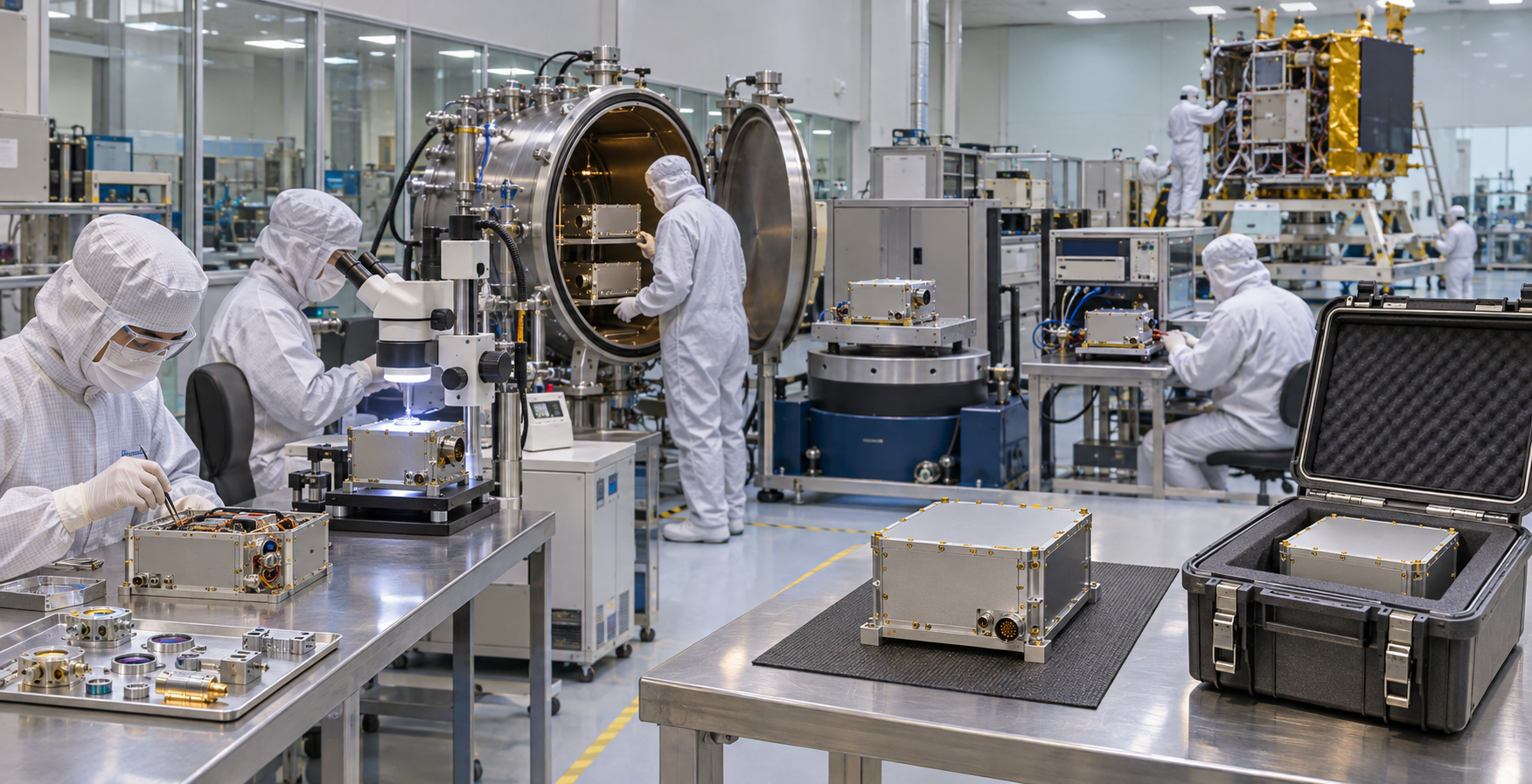
Seen in that light, an indigenous atomic clock closes an important dependency inside the satellite itself. It also creates a domestic base from which failures can be investigated and later designs improved. Imported clocks flying beside the indigenous unit do not erase the achievement, but they do remind us that autonomy is being built in stages.
The strongest evidence of success will not be a patriotic label attached to one payload. It will be boring continuity: multiple healthy satellites, clocks that remain stable, replacements launched before the constellation becomes fragile, and indigenous units becoming repeatable rather than exceptional. That is what turns technological possession into dependable national capacity.
Key takeaways for judging NavIC’s next milestones
- Do not equate launch with operational service. NVS-03 reached transfer orbit but must still complete orbit raising and spacecraft checks.
- Count usable navigation satellites, not merely satellites in space. A spacecraft with an unreliable clock cannot provide dependable ranging.
- Treat four as a minimum, not a comfortable fleet. With no spare satellite, one failure can again leave the system below its minimum configuration.
- Watch the clock over time. Initial operation is encouraging, but sustained stability is the test that matters after the failures of the first-generation fleet.
- Look for repeatability. One indigenous clock is a breakthrough; a dependable series of indigenous clocks is a sovereign capability.
- Follow replenishment as closely as reliability. NVS-04 and NVS-05 matter because a constellation needs margin before the next failure or retirement, not after it.
For now, the sound judgement is neither sceptical dismissal nor premature celebration. NVS-03 has put Bharat’s own atomic-clock technology where it can begin proving itself. Watch the orbit-raising, commissioning, long-term timing performance and arrival of additional satellites. If those pieces hold together, NavIC’s revival will become more than a narrow return to the minimum: it will mark a durable advance in Bharat’s control over position and time.
References

Leave a Reply
You must be logged in to post a comment.