

If you are trying to decide whether a prayer meeting in Madhya Pradesh is protected religious activity or an unlawful conversion exercise, do not begin with the name of the gathering or the religion of its organizers. Begin with the person’s freedom to choose. Then ask what was promised, concealed, threatened, or made conditional on that choice.
That distinction has immediate consequences. The Madhya Pradesh Freedom of Religion Act, 2021 creates serious criminal exposure, while Article 25 protects conscience, worship, religious teaching, and propagation within constitutional limits. You need a method that can recognize predatory conversion without treating every sermon, prayer, charitable service, or voluntary change of belief as a crime.
Key takeaways
- Article 25 protects freedom of conscience and the right to profess, practice, and propagate religion, subject to public order, morality, and health. It does not protect conversion obtained through force, fraud, allurement, or comparable improper means.
- The decisive question is usually not whether religious influence existed. It is whether a person’s decision was manipulated through deception, coercion, undue influence, a conditional material benefit, or another prohibited method.
- The 2021 Act carries substantial consequences. Basic offenses can attract imprisonment ranging from one to five years, while cases involving certain vulnerable groups or mass conversion can receive enhanced treatment.
- Open religious teaching and unconditional charity are generally different from offering money, treatment, education, employment, marriage, or another benefit in exchange for conversion.
- An allegation should be supported by exact words, messages, financial records, independent witnesses, and the sequence of events. Rumor, religious identity, or an edited clip is not a substitute for proof.
Start with conscience: what Article 25 protects

Article 25 of India’s Constitution protects freedom of conscience and the right to profess, practice, and propagate religion. Those guarantees are subject to public order, morality, and health. They protect a Hindu who rejects evangelism, a Christian who prays publicly, a Sikh who shares the teachings of the Gurus, a Buddhist who teaches the Dhamma, a Jain who explains ahimsa, and any individual who accepts, refuses, or reconsiders a religious claim without improper pressure.
The Supreme Court established an important boundary in Rev. Stanislaus v. State of Madhya Pradesh in 1977. The constitutional right to propagate a religion does not amount to a right to convert another person through force, fraud, or allurement. State laws may restrain those methods because coercing one person’s conscience interferes with that person’s religious freedom.
This means the legal inquiry cannot stop at the presence of persuasion. Religions make claims, invite commitment, and offer communities of practice. A person may find those claims convincing. The problem begins when persuasion is replaced or distorted by a prohibited method.
- Identify the act: Was this prayer, teaching, charity, a personal declaration of faith, or a formal conversion ceremony?
- Identify the offer: Was money, employment, schooling, medical treatment, marriage, housing, or another advantage discussed?
- Test conditionality: Would the person have received the service or benefit after refusing to convert?
- Test informed choice: Was the religious purpose disclosed clearly, or was it concealed or misrepresented?
- Test freedom to refuse: Could the person leave, disagree, consult family or counsel, and retain the offered service without retaliation?
- Check procedure separately: If a formal conversion occurred, were the required notices and declarations handled correctly?
Consider two very different situations. A clinic run by a faith-based charity may treat everyone and also make voluntary prayer available. That does not become an unlawful inducement merely because religion is visible. But if treatment is withheld until a patient changes faith, the medical need has become leverage. The first situation leaves conscience intact; the second demands investigation.
Religious freedom therefore has two directions. It protects Hindu families and other communities from coercive or deceptive conversion. It also prevents the state, a crowd, or a local majority from criminalizing an individual’s voluntary belief merely because that choice causes social disagreement.
What the Madhya Pradesh law puts at risk
The Madhya Pradesh Freedom of Religion Act, 2021 prohibits conversion through misrepresentation, coercion, undue influence, allurement, and marriage undertaken with the intent to convert. These terms direct attention to the method used to obtain a religious change, not simply to the existence of religious activity.
- Misrepresentation: Look for a materially false description of the event, organizer, religious purpose, promised result, or document a participant was asked to accept.
- Coercion: Look for threats, force, intimidation, or a penalty imposed for refusing religious change.
- Undue influence: Examine whether authority, dependency, illness, distress, isolation, or another vulnerability was deliberately used to overpower a person’s independent judgment.
- Allurement: Ask whether a material benefit was offered in exchange for conversion. A benefit offered to everyone without a religious condition presents a different legal question.
- Marriage connected to conversion: Establish the purpose and sequence with evidence. An interfaith marriage is not proved unlawful merely by the spouses’ different religions; the statutory concern is marriage used with the intent to secure conversion.
These are indicators for inquiry, not shortcuts to guilt. Poverty does not make a person’s religious decision automatically involuntary. Illness does not eliminate agency. A theological claim that one path is true may offend another community without itself proving coercion. The concern grows when vulnerability or religious disparagement is combined with deception, threats, isolation, or a benefit made conditional on conversion.
The consequences require care from the start. Basic offenses under the Act can carry imprisonment of one to five years. Enhanced consequences may apply when the case involves minors, women, members of Scheduled Castes or Scheduled Tribes, or mass conversion. The mass-conversion framework can apply to the simultaneous conversion of two or more people, so organizers should not assume that only a very large event can enter that category.
Offenses are generally cognizable, and important categories are non-bailable. Cognizable status gives police substantial power to register and investigate a case and, subject to legal safeguards, make an arrest without first obtaining a warrant. Non-bailable does not mean that bail is impossible; it means release is not automatic and must be considered by a court. The precise charge, evidence, need for custodial interrogation, and proportionality remain important.
The Act also contains procedural duties. In many conversion scenarios, the person officiating and the individual intending to convert must provide prior intimation to the District Magistrate and submit post-event declarations within prescribed timelines. A procedural failure may create exposure even when no force or allurement is proved.
Keep two files in your mind. The first concerns substance: was the decision genuinely voluntary? The second concerns procedure: were the required notices and declarations completed? Evidence of free consent does not necessarily cure a missed statutory form, just as a completed form cannot legitimize coercion. Because the applicable form, timing, and responsibility can depend on the event, anyone planning or officiating a formal conversion should obtain current Madhya Pradesh legal advice and written administrative guidance before proceeding.
A field test for prayer and faith-healing gatherings
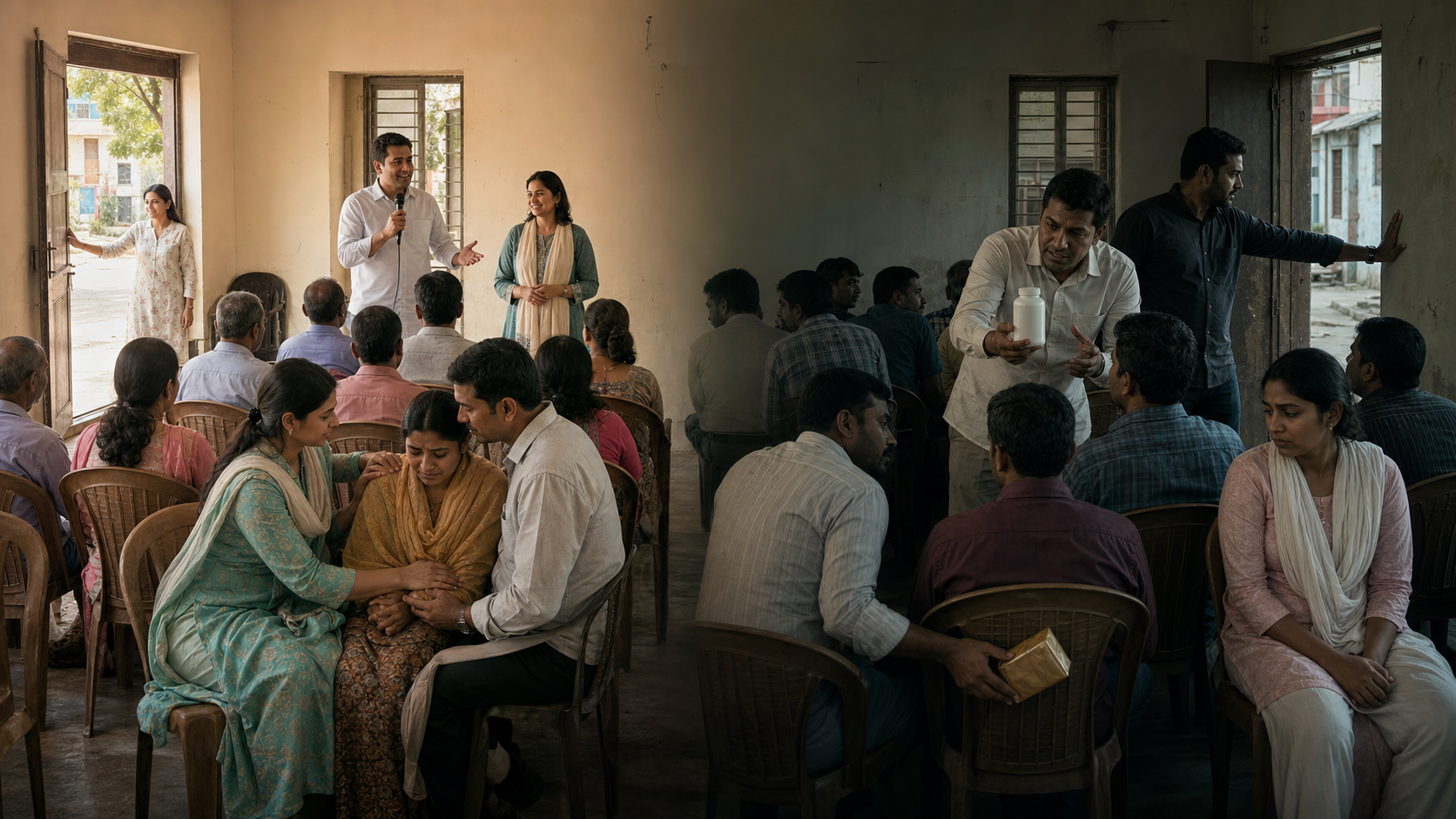
A ‘Changai’ gathering is commonly understood as a faith-healing meeting where people seek relief through prayer and spiritual counsel. The name does not establish illegality. People also seek solace in satsang, bhajan, kirtan, ardas, seva, pravachan, and other forms of collective religious life. The same evidentiary standard should apply across traditions: examine conduct, conditions, representations, and consent.
| Observed situation | What it may indicate | What to check next |
|---|---|---|
| Open prayer or religious teaching, with no demand for conversion | Ordinary profession, practice, or propagation of religion | Whether attendance and participation were voluntary |
| Food, education, medical help, or other charity offered regardless of belief | Unconditional service rather than allurement | Whether anyone who refused prayer or conversion lost access |
| Cash, employment, schooling, treatment, property, or marriage promised in exchange for conversion | A serious allurement concern | The exact promise, who made it, and whether records or independent witnesses confirm it |
| A guaranteed cure tied to accepting a religion | Possible deception or undue influence, as well as a health risk | Whether medical care was discouraged and whether religious change was made a condition |
| The religious purpose or identity of the organizer was concealed | Possible misrepresentation | Invitations, messages, registration forms, announcements, and what participants were told before arrival |
| Threats, repeated pressure, family isolation, or retaliation after refusal | Possible coercion or undue influence | The sequence, exact words, witnesses, and the participant’s ability to leave or seek advice |
| Two or more people converted at the same event | Possible mass-conversion classification and procedural scrutiny | Whether each decision was voluntary and whether statutory notices and declarations were completed |
No single row proves an offense. A free meal followed by a sermon is not the same thing as a meal available only after conversion. A prayer for healing is not the same thing as a guaranteed cure used to stop treatment or secure religious change. Timing and conditionality often reveal the difference.
Evidence that can withstand scrutiny
If you believe a line was crossed, preserve facts that allow another person to test the allegation. Concentrate on evidence connected to a statutory element:
- The exact words used to offer a benefit, make a threat, claim a cure, or request conversion.
- The date, location, speakers, intended audience, and sequence of the relevant events.
- Complete invitations, messages, forms, recordings, or digital communications, retained in their original context rather than reduced to a clipped social-media extract.
- Independent witness accounts that distinguish what each person directly saw or heard from what they later inferred.
- Financial records showing who funded the service, how money was distributed, and whether a payment was linked to religious change.
- Medical disclaimers, treatment records, or statements showing whether professional care was supported, discouraged, or replaced by a guarantee of spiritual healing.
- Copies or official acknowledgements of any required pre-conversion intimation and post-conversion declaration.
Foreign funding can add a separate compliance question under the Foreign Contribution (Regulation) Act, 2010. Relevant records may include the purpose for which funds were received and how they were spent. Foreign funding is not, by itself, proof of unlawful conversion; an inconsistency between declared charitable objectives and the actual use of funds may justify closer examination.
What to do when you attend, organize, or report an event
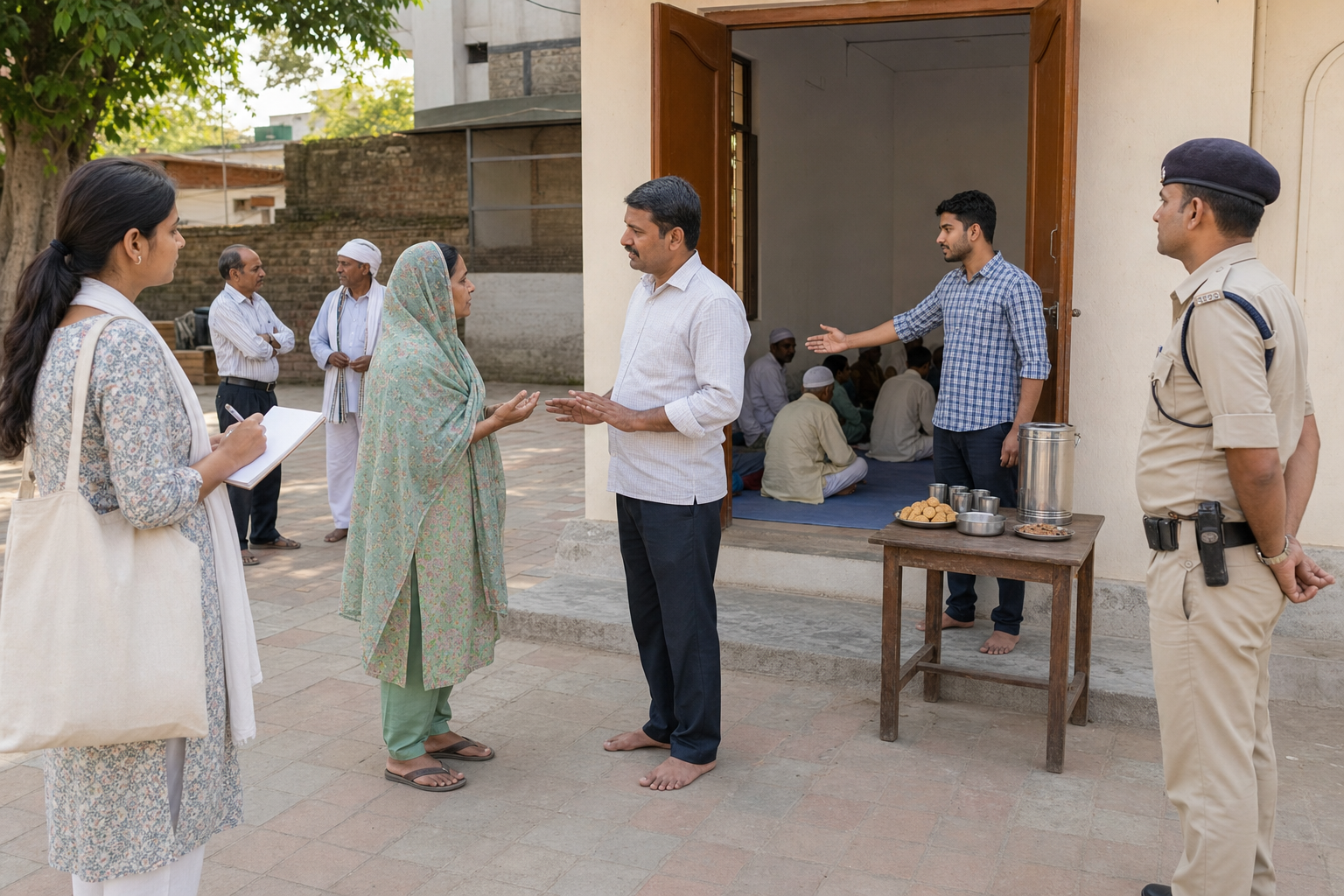
If you attend or are concerned about a family member
- Protect health first. Do not stop prescribed or qualified medical care because someone guarantees a spiritual cure. Prayer may accompany treatment; it should not be used to conceal risk or block access to care.
- Ask the conditionality question directly. Say: ‘Will this food, treatment, schooling, employment help, or financial support remain available if I do not change my religion?’
- Ask what action is being requested. Listening to a prayer, joining a devotional practice, signing a declaration, and undergoing a formal conversion are not interchangeable acts.
- Slow the decision down. Ask for a copy of any form and consult a trusted person or qualified lawyer before making a formal declaration, especially when you are ill, distressed, financially dependent, or under family pressure.
- Record facts without provoking a confrontation. Note the exact promise or threat, who made it, who heard it, and what happened after acceptance or refusal. Preserve original communications lawfully.
- Seek individual help when the risk is real. Threats, restraint, fraud, forced isolation, or the withholding of essential care warrant prompt contact with police and a lawyer. If you are named in a complaint or FIR, obtain criminal counsel rather than trying to resolve the matter through a public argument.
If you organize religious or charitable work
- State the organizer’s religious identity and the event’s purpose plainly in invitations, announcements, and registration materials.
- Put in writing that food, medical help, education, relief, or other material assistance is available without a requirement to pray, attend teaching, renounce a faith, or convert.
- Prohibit organizers, volunteers, and visiting speakers from offering personal benefits in exchange for a religious declaration.
- Use a clear medical disclaimer at healing events. Do not guarantee cures or tell participants to abandon qualified medical care.
- Keep transparent donation, program, and expense records. If foreign contributions are involved, maintain timely FCRA compliance and ensure spending matches the declared charitable purpose.
- Preserve complete event communications. A written code of conduct, full program, financial trail, and unedited recordings can protect participants as well as organizers when an allegation arises.
- Before officiating any formal conversion, have a Madhya Pradesh lawyer verify the current District Magistrate intimation, declaration, and timing requirements. Do not assume that voluntary consent removes procedural duties.
- Do not use denigration of another religion as leverage against a vulnerable person. Explain your own beliefs openly and allow a participant to decline without humiliation or loss of assistance.
If you complain, investigate, or comment publicly
Describe the alleged conduct before assigning a label. ‘A speaker offered a specified payment after a declaration of conversion’ is an allegation that can be tested. ‘A conversion racket was operating’ is a conclusion that still requires proof. This discipline helps investigators find the relevant records and prevents an entire religious community from being blamed for the alleged acts of particular people.
Police and administrators should compare witness statements, audit documents, review complete digital communications, trace relevant financial flows, and examine medical representations where healing claims were made. Independent evidence matters most when local tension makes every witness appear aligned with one side.
Protect the identities and dignity of patients, economically distressed families, minors, and others whose vulnerability is central to an allegation. Publishing their images or names can expose them to pressure from multiple directions and make reliable testimony harder to obtain.
The accused retain the presumption of innocence, the right to counsel, and the right against self-incrimination. Courts still have to assess bail, the need for custodial interrogation, evidentiary sufficiency, and proportionality. Defending those safeguards does not weaken an anti-conversion law; it makes enforcement more credible.
On April 12, 2026, a ‘Changai’ gathering in Guna prompted the arrest of two pastors and an investigation into allegations of a wider conversion network. Arrest opened the legal process; it did not settle the allegations. The sound way to follow that case is to examine the sections recorded in the FIR, the specific witness accounts, any forensic review of event communications, financial evidence, and the courts’ observations on bail and evidentiary sufficiency.
A dharmic standard for firm and fair enforcement

A pro-Hindu position does not require a choice between vigilance and constitutional discipline. It can insist that no family should be separated from its inherited tradition through deception, manufactured dependency, a false cure, or material pressure. It can also insist that accusation, arrest, and punishment rest on evidence rather than religious hostility or crowd judgment.
Hinduism, Buddhism, Jainism, and Sikhism are not interchangeable traditions, but each gives us ethical reasons to reject coercion, dishonesty, and cruelty. Ahimsa rules out intimidation. Truthful conduct rules out fraudulent conversion and knowingly false allegations alike. Compassion requires special care when illness, poverty, grief, or isolation makes a person easier to influence.
Community leaders can make that standard practical. Establish legal-aid referrals for anyone who feels pressured to convert or renounce a religion. Ask district administrations for clear, accessible conversion-compliance procedures. Encourage charities of every faith to publish their conditions of service and funding purposes. Use interfaith channels to verify facts before a dispute becomes a communal confrontation.
The next time a disputed gathering occurs, ask three questions before forwarding a claim: What exactly happened? Was any benefit, threat, deception, or exercise of authority tied to religious change? What evidence proves that connection? Those questions protect vulnerable Hindus and other citizens, preserve lawful spiritual service, and give the 2021 Act the evidence-based enforcement that a serious law requires.