
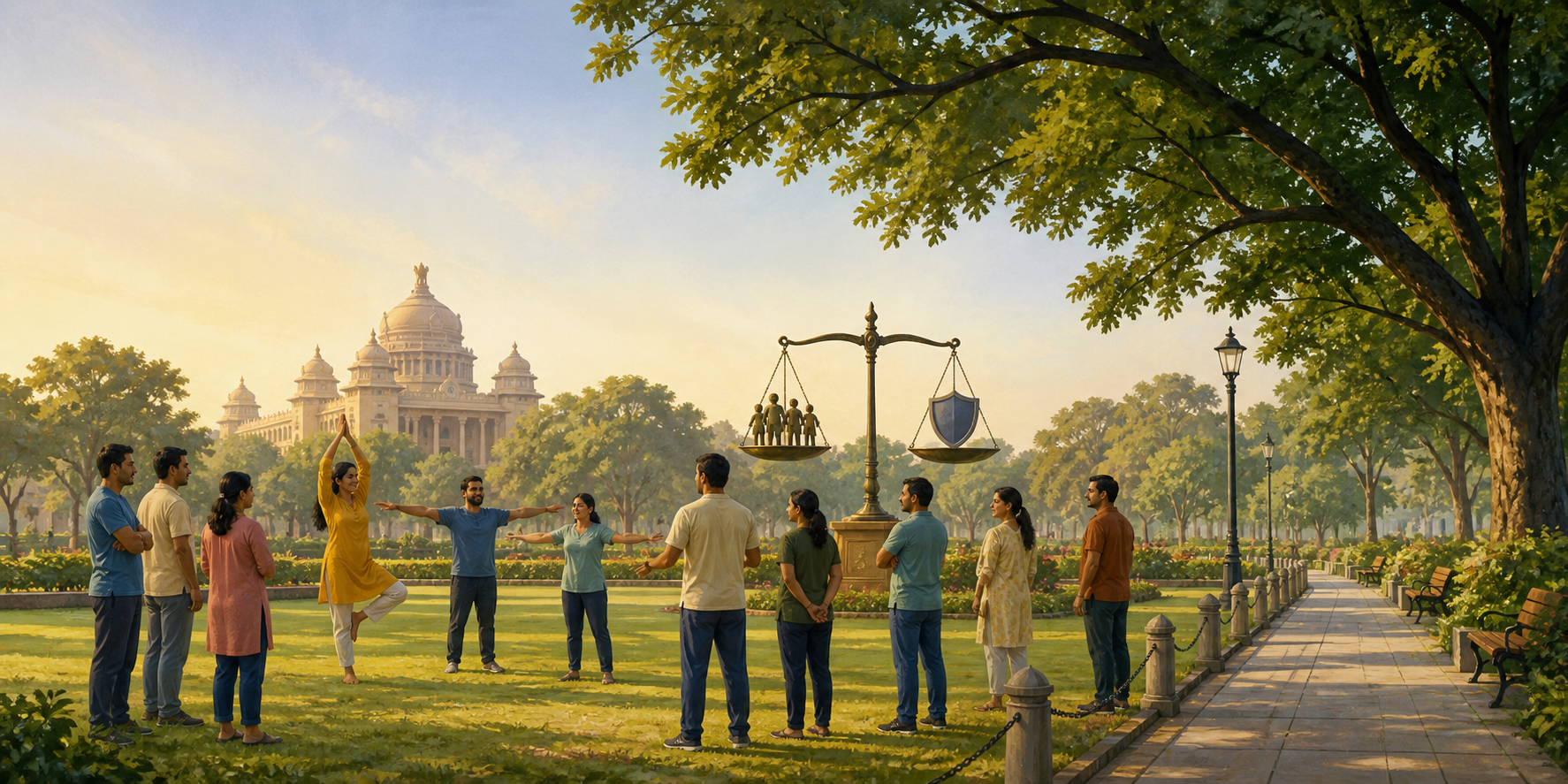
If you organize, attend, or support an RSS shakha in Karnataka, the immediate question is practical: can the government stop the gathering, and what should you do if permission is refused? The answer depends less on political slogans than on the place, activity, written order, stated reason, duration, and treatment of comparable groups.
You do not have to choose between defending constitutional freedom and respecting public order. You do need to separate a march from a stationary shakha, a public park from government premises, and a temporary safety condition from a selective prohibition. Those distinctions determine whether a restriction looks reasonable or discriminatory.
Start with the order, not the political argument

The Karnataka dispute that surfaced on 19 October 2025 involved a restriction on an RSS march and a reported bar on shakha activities in public places and government institutions. The BJP characterized the action as Sanghphobia, while its defenders invoked public order and institutional neutrality.
Neither label decides the constitutional question. Sanghphobia is a political allegation, not proof of unequal administration. Public order is a constitutional ground for restriction, but merely repeating those words does not establish that a broad ban is necessary. Evidence has to connect the proposed activity to the asserted concern.
Before you support, oppose, or challenge the measure, obtain the operative order or written denial and answer these questions:
- Who issued it, under what rule or authority, and on what date?
- Does it govern one proposed march, all processions, recurring shakhas, or several kinds of gatherings?
- Does the phrase public places mean roads, parks, playgrounds, or every space accessible to the public?
- Which government institutions are covered, and does the rule apply only during working hours or at all times?
- Is the restriction temporary, event-specific, or open-ended?
- What concrete reason was recorded: traffic, competing events, security, noise, institutional discipline, or something else?
- What review, appeal, or request for reconsideration is available?
Until those points are clear, do not describe the measure as either a total statewide ban or a routine permission condition. An imprecise description can turn a manageable administrative dispute into a confrontation over a restriction that may be narrower, broader, or legally different from what people assume.
The Constitution protects assembly but permits limited restrictions
Article 19 is the starting point for a peaceful gathering
Article 19(1)(b) protects peaceful assembly, while Article 19(3) permits reasonable restrictions in the interests of public order. This means an administration may regulate matters such as a procession route, time, use of a road, or conflict with another event. It does not follow that officials may exclude an organization from civic space simply because its ideas are politically contested.
The word reasonable matters. A restriction should correspond to the actual risk and burden. If changing the route or time would address the problem, a complete prohibition requires a stronger explanation. If the concern arises on one date or at one location, an indefinite restriction across unrelated places is harder to justify on that reason alone.
Peaceful conduct is equally important. Constitutional protection for assembly is not permission to obstruct indefinitely, intimidate others, disregard lawful safety arrangements, or convert a shared venue into an exclusive space. Organizers strengthen their position when they give officials a concrete plan for maintaining access, discipline, and non-violence.
Article 25 may matter, but it is not the only argument
Article 25 protects freedom of conscience and the freedom to profess and practise religion, subject to public order, morality, and health. It can be relevant when a gathering includes religious observance or spiritual practice.
But an RSS event should not automatically be forced into a religious-freedom argument. A shakha may include physical exercise, discipline, cultural education, service-oriented activity, prayer, or several of these together. For an ordinary peaceful gathering, the assembly guarantee may provide the clearer constitutional frame. If a particular religious element is restricted, identify that element precisely instead of making an undifferentiated claim about the whole programme.
A public park and government premises are not the same setting
Government institutions have a legitimate interest in remaining neutral and functioning without partisan or organizational capture. A uniform rule limiting private organizational activities inside offices or institutional premises may therefore rest on a different basis from a restriction in a public park.
A park, road, or other shared civic space serves a broader public function. Shakhas, yoga groups, study circles, processions, prayer meetings, and cultural gatherings may all seek access. The sensible administrative response is usually an equal-access system with clear schedules and conduct rules, not an assumption that institutional neutrality requires civic space to become culturally empty.
When you assess the Karnataka measure, keep the two settings separate. A defensible rule for activities inside a government office does not automatically justify excluding peaceful gatherings from every public venue.
Five questions reveal whether a restriction is reasonable

You can test the administration’s reasoning without pretending to decide a court case. Work through these questions in order.
- Is the scope intelligible? The order should identify the activity, place, period, and people or organizations covered. Vague language invites inconsistent enforcement and leaves ordinary participants unable to know what conduct is permitted.
- Is there a specific connection to public order? Look for a reason tied to the proposed route, time, venue, traffic conditions, competing use, or identifiable security concern. Opposition to an organization’s viewpoint is not interchangeable with a public-order assessment.
- Could a narrower condition solve the problem? An alternative route, defined time window, non-obstruction requirement, shared schedule, or venue-specific code may protect the public while preserving the gathering. If officials reject workable alternatives, ask them to explain why.
- Are comparable groups treated alike? The comparison must be genuine. Check how the same authority handled similar processions or recurring gatherings at the same kind of venue under similar conditions. A large road march is not automatically comparable to a small park meeting, and a government-office programme is not the same as an event in an open civic space.
- Does the restriction end or receive review? A temporary response to a defined situation is different from an open-ended exclusion. The order should state its duration or provide a practical opportunity for reconsideration.
This method also prevents a common mistake: treating every rejected permission request as proof of discrimination. Unequal treatment becomes a stronger claim when you can show a close comparator, the same decision-maker, materially similar conditions, and no credible explanation for the difference.
What organizers should do after a refusal
If your march or shakha is affected, build a factual record before escalating politically. A careful record gives administrators a chance to correct the decision and gives a lawyer something concrete to assess if formal review becomes necessary.
- Request the exact written decision. Preserve the application, acknowledgement, denial, order, attachments, and communications. Record when each item was received.
- Describe the proposed activity on one page. State the venue or route, start and finish time, expected attendance, recurring or one-time character, use of sound, effect on traffic or other users, and arrangements for volunteers and discipline.
- Ask for the precise reason and governing rule. A written explanation is more useful than an oral statement that permission cannot be given.
- Offer narrower alternatives. Propose another route, another time, a shorter duration, shared use of the park, reasonable noise limits, or another condition directly related to the stated concern. Make the offer in writing.
- Document close comparisons. If similar groups received access, record the venue, activity, date, conditions, and authority involved. Do not circulate an allegation based on unrelated events.
- Use the stated review channel. Ask for reconsideration or appeal promptly, especially when the proposed event date is near. Keep the request focused on scope, reasons, equal treatment, and workable alternatives.
- Get qualified legal advice before defying an order. Proceeding with a prohibited march can expose participants to avoidable legal consequences and physical confrontation. A constitutional lawyer familiar with the actual order can assess remedies and urgency; a general discussion of rights cannot replace that advice.
Throughout the process, keep public statements accurate. Say that permission was refused for a named activity at a named place if that is what happened. Do not call it a ban on Hindu practice unless the text and operation of the measure support that conclusion. Precision protects credibility.
A durable policy should protect access without favouritism

Karnataka can reduce future conflict by replacing ad hoc decisions with a visible permission system. The same framework should be usable by RSS shakhas, yoga groups, dharmic associations, study circles, service organizations, and other peaceful civic bodies.
A workable policy should publish the applicable criteria, distinguish roads and parks from institutional premises, provide decisions within a defined process, give written reasons for restrictions, offer routes or time windows where appropriate, and maintain an accessible review mechanism. Standard conduct rules should address actual effects such as obstruction, noise, safety, duration, and exclusive occupation rather than an organization’s popularity or ideology.
Community liaison committees can help before a dispute hardens. Representatives of Hindu, Buddhist, Jain, Sikh, and other civic communities can identify scheduling conflicts, communicate conditions, and keep local disagreements from becoming statewide identity battles. Such dialogue should supplement transparent administration, not replace written reasons or constitutional review.
Key takeaways
- Article 19 protects peaceful assembly, but reasonable public-order conditions remain possible.
- Article 25 may apply to religious elements of an activity, subject to public order, morality, and health.
- A march, a recurring park shakha, and an activity inside government premises require separate analysis.
- The strongest objections identify the exact order, a close comparator, and a less restrictive alternative.
- Public order must be supported by a specific reason; constitutional freedom must be exercised peacefully.
- Do not defy an operative order without advice from a qualified lawyer who has reviewed it.
Ahimsa does not require silence about unequal treatment, and satya does not permit exaggerating what an order says. A strong pro-Hindu constitutional response combines peaceful firmness with documentary accuracy and asks for the same transparent rule for every community. If you are affected, your next move is simple: obtain the written decision, define the precise restriction, propose a narrower solution, and use the available review process.
References
