
Reports from Sihora in Jabalpur, Madhya Pradesh, indicate a tense incident near Azad Chowk in which stone pelting was alleged during or shortly after Aarti at a local Mandir. In response, members of Hindu organisations gathered outside Sihora Police Station, recited Hanuman Chalisa, and called for swift, lawful action. The episode has understandably stirred public emotion, yet it also underscores a broader civic imperative: protect religious freedom, uphold law and order, and prevent communal polarization.
Eyewitness statements circulating on social media and in local forums claim the stone pelting was pre-planned to disrupt communal harmony. Some accounts allege that stones, sticks, and even swords were found inside a mosque, and that women were harassed as the temple’s railing was reportedly targeted. These are serious allegations. At this stage, they remain allegations requiring police verification, forensic corroboration, and due process. The credibility and chain of custody for any recovered materials must be rigorously established before conclusions are drawn.
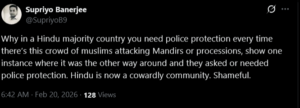
Polarizing online commentary has framed the episode in combative terms that demean communities and inflame tempers. Such language neither represents the constitutional ethos nor reflects the shared dharmic valuesahimsa, karuna, and sevacherished by Hindus, Buddhists, Jains, and Sikhs. A principled response focuses on individual accountability for violence, not collective blame, and on ensuring safety for all worshippers, irrespective of faith.
India’s constitutional framework offers a clear baseline: Articles 25–28 protect freedom of religion, while Article 19(1)(b) protects peaceful assembly, subject to reasonable restrictions to preserve public order. Authorities have a duty to secure sacred spaces, safeguard processions and congregational prayers, and enforce the law without fear or favor. Citizens, in turn, retain the right to worship and the responsibility to reject provocations and misinformation.
Several legal provisions are typically engaged in incidents of this nature. Depending on verified facts, relevant sections may include: IPC 141–149 (unlawful assembly/rioting), 153A (promoting enmity), 295 (injuring or defiling a place of worship), 295A (deliberate acts intended to outrage religious feelings), and 427 (mischief causing damage), among others. If weapons are recovered, the Arms Act, 1959, applies. Damage to public property may invoke the Prevention of Damage to Public Property Act, 1984. For crowd control and dispersal, CrPC Sections 129–131 provide a graduated framework of police response, while any viral media relied upon in court requires compliance with Section 65B of the Indian Evidence Act to establish admissibility.
A professional investigation typically proceeds along clear, auditable lines. Scene-of-crime management includes securing the area, photographing vantage points (especially rooftops and terraces), and cataloguing debris. Investigators often map trajectories and vantage lines to determine the directionality of projectiles, retrieve CCTV footage from public and private cameras, and preserve digital evidence. Medical-legal certificates substantiate injuries, while statements are recorded under procedural safeguards. If allegations include stockpiling of weapons within a house of worship, searches must follow warranting protocols, and any seizures documented with panchnamas and video for transparency.
Transparent, regular communication by the district administration reduces rumor-driven escalation. Periodic public briefings, a single verified information channel, and prompt clarification of false claims serve community trust. When tensions risk spillover, police sometimes constitute a special investigation team (SIT) to signal neutrality and speed. Equally important are visible protection measures for all places of worship in the affected zone, demonstrating impartiality and deterring retaliatory acts.
Experience from similar disturbances nationwide highlights proven prevention tools. Pre-event risk assessments by the district authorities, route rationalization for yatras and processions, and coordinated time windows for overlapping religious activities reduce friction in mixed localities. Crowd management plans often include rooftop access control in sensitive stretches, pre-emptive debris clearance from terraces and lanes, rapid response pickets, and designated safe corridors for women, children, and elders.
Sound management and public address systems also matter. Permissions for loudspeakers and compliance with the Noise Pollution (Regulation and Control) Rules, 2000, should be coupled with locally negotiated time slots when prayers or Aarti coincide with other congregations. Such micro-level coordinationoften brokered by peace committeesminimizes inadvertent provocations and helps sustain calm.
Given the volume of video clips and posts that emerge after such incidents, a prudent approach to information hygiene is vital. Citizens can reduce harm by checking geolocation markers, comparing visuals to verified landmarks, and consulting official updates before forwarding content. Reverse image searches, metadata checks where available, and skepticism toward sensational claims without corroboration all help counter disinformation. When safe, preserving original footage without editsalong with time and location notescan aid investigators.
Community-led healing is most effective when it is local, consistent, and inclusive. “Aman Committees” and mohalla-level peace groups that include temple trusts, mosque committees, gurdwara sevadars, and Jain/Buddhist sanghas can mediate schedules, negotiate routes, and respond quickly to simmering complaints. Youth volunteers trained in de-escalation and rumor control, women’s safety watch-groups, and interfaith service projects (joint cleanliness drives near sacred spaces, community kitchens during festivals) reinforce trust at the street level.
For public institutions, a balanced response pairs accountability with restorative measures. That includes prompt registration of FIRs, impartial arrests based on evidence, witness protection where intimidation is likely, and time-bound updates to the community. Fast-tracking compensation for the injured and for any verified damage to religious property communicates that the state recognizes harm and is acting to repair it. In parallel, periodic audits of CCTV coverage, street lighting, and emergency access points in mixed neighborhoods address structural vulnerabilities that can be exploited during flashpoints.
Across dharmic traditions, there is a shared insistence on dignity, non-violence, and the protection of sacred spaces. Ahimsa in Jainism and Buddhism, seva in Sikhism, and a dharma-centred ethic in Hindu thought converge on the same civic lesson: uphold justice without hatred, protect worship without provocation, and prioritize dialogue over denunciation. In practice, that means condemning every act of violencewhoever commits itwhile refusing the slide into collective blame that endangers neighbors and weakens the social fabric.
The events at Sihora merit careful, thorough investigation and lawful accountability. Equally, they call for citizens and institutions to lean into proven peacebuilding: disciplined communication, neutral policing, early mediation, and visible protection for all shrines. Justice and harmony are not competing goals; they are mutually reinforcing. When pursued togetherfirm on facts, compassionate in tone, and faithful to constitutional and dharmic valuesthey can turn a moment of fear into a durable commitment to coexistence.
Inspired by this post on Hindu Human Rights Blog.
