
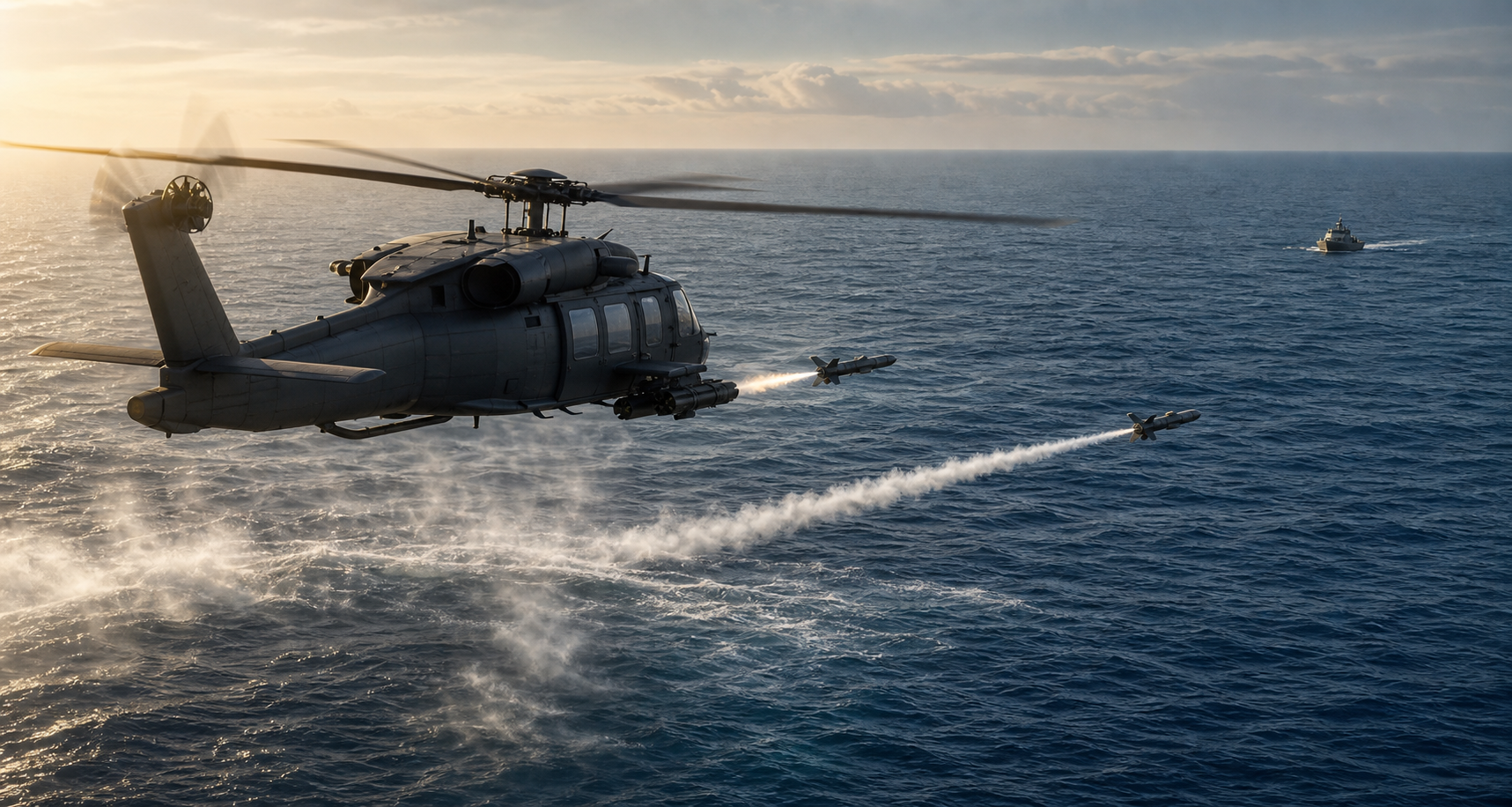
The reported NASM-SR salvo test is best understood not as an isolated missile milestone, but as a test of whether several parts of a naval strike system can work together under a demanding launch sequence.
That distinction matters. Indigenous naval strike capability depends on more than producing a weapon domestically: it requires reliable guidance, platform integration, targeting, trained operators, tactical doctrine and a support base able to sustain and improve the system.
What the salvo demonstration actually established
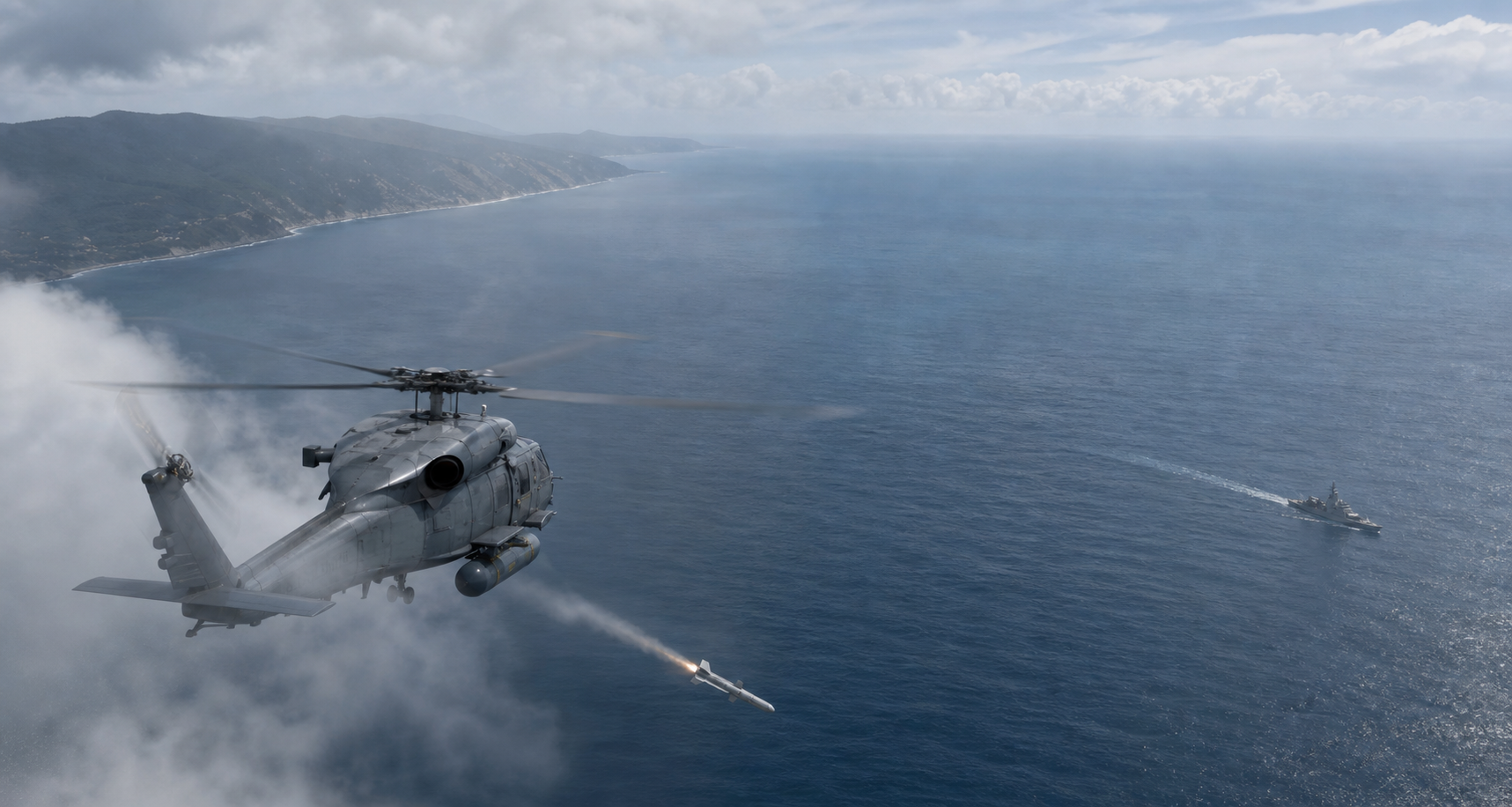
The DharmaRenaissance Blog source reports that the Defence Research and Development Organisation and the Indian Navy launched two Naval Anti-Ship Missile Short Range weapons in quick succession from a naval helicopter over the Bay of Bengal, off the Odisha coast. It identifies the event as an April 2026 demonstration and reports successful waterline strikes.
Those reported features make the firing sequence more informative than a single launch. One missile can demonstrate basic functions such as separation from the aircraft, propulsion, navigation and terminal attack. A rapid pair additionally tests whether the launch platform, crew procedures, mission software and range coordination can handle closely spaced engagements without one launch disrupting the other.
A salvo also has direct tactical relevance. A defending warship may use surveillance radar, electronic warfare, decoys, interceptor missiles, close-in weapons and manoeuvre against an incoming threat. Multiple missiles approaching within a compressed period force its defensive system to detect, classify and assign responses quickly. The test does not establish how NASM-SR would perform against every modern defensive suite, but it shows that a firing pattern designed to complicate shipboard defence is being validated.
A helicopter adds reach without moving the parent ship forward
The launch platform is central to the capability. As the source explains, a shipborne helicopter can operate ahead of its parent vessel, change direction more readily than a surface combatant and approach a target from a less predictable bearing. Its altitude also gives it a different sensor horizon from that of a ship operating near the sea surface.
This changes the geometry of an engagement. A surface ship need not move as close to a hostile patrol vessel, fast attack craft or other surface target before bringing an anti-ship weapon to bear. In coastal waters, near islands or around maritime choke points, that flexibility may be especially valuable because geography can restrict movement and create concealed or rapidly changing approaches.
The advantage is conditional, however. A helicopter must receive a sufficiently accurate target picture, reach a viable launch position and remain connected to the wider force as required by the mission. Its usefulness therefore depends on the relationship among sensors, communications, command decisions and weapons rather than on the missile alone. NASM-SR should consequently be viewed as one component of an anti-surface warfare network, with naval aviation extending the fleet’s striking options.
The difficult part is completing the entire engagement chain
The source describes NASM-SR as an indigenous, short-range, air-launched anti-ship missile and reports a sea-skimming flight profile supported by inertial navigation, radar-altimeter-assisted low-altitude flight and terminal seeker technology. It also notes reports of imaging infrared guidance and data-link-enabled retargeting in related trials. Because these details come from the supplied article rather than independently reviewed test data, they should be read as reported programme features.
Taken together, the reported features illuminate the engineering problem. Inertial navigation can carry a missile through the portion of flight before its terminal sensor takes over. A radar altimeter helps it remain close to the sea, where surface clutter and the radar horizon can delay detection. The terminal seeker must then find and discriminate a moving ship in a complex environment. If a data link is available in an operational configuration, it could help address changes in target position or permit updated targeting information during flight.
None of those functions is sufficient by itself. A missile may navigate accurately but fail to distinguish its intended target; a capable seeker may still be undermined by poor initial targeting; and a sound weapon may have limited utility if it cannot be safely carried, maintained and launched from the fleet’s helicopters. The meaningful measure of maturity is completion of the chain from detection and identification to launch, low-altitude flight, terminal acquisition and impact.
The reported waterline hit is relevant within that chain. A precise impact near the waterline can threaten buoyancy and compartment integrity, potentially causing flooding or impairing a ship’s ability to manoeuvre and continue its mission. It does not follow that every such hit would sink a vessel: damage would depend on the target, the impact and the effectiveness of onboard damage control. The more defensible conclusion is that the reported result indicates attention to aim-point precision and mission-disablement, not merely contact with a large surface target.
Indigenisation is a lifecycle capability, not a label
The source places NASM-SR within India’s effort to reduce dependence on imported weapons, spares and externally controlled upgrade schedules. The strategic case is broader than domestic assembly. Genuine autonomy grows when design knowledge, testing, production, maintenance, software control and the authority to modify a weapon remain within the national ecosystem.
Close cooperation between the developer and the naval user is therefore consequential. A helicopter-launched maritime weapon must tolerate vibration, salt, humidity and constrained storage while remaining safe for shipboard handling. It must also fit actual launch envelopes and operating procedures. Repeated interaction between DRDO and the Indian Navy can convert operational feedback into design changes and help align the weapon with fleet doctrine.
At the same time, a successful trial should not be treated as proof of full-scale operational availability. The supplied source reports a test event, not production quantities, deployment status, fleet-wide integration, maintenance performance or readiness rates. Those are separate stages in turning a demonstrated design into a dependable wartime capability. The distinction does not diminish the test; it identifies what must follow for its promise to become durable naval power.
Key takeaways
- The source reports that two NASM-SR missiles were launched in quick succession from a naval helicopter, making the event a test of coordinated firing as well as missile flight.
- Air launch allows a helicopter to alter the fleet’s engagement geometry while permitting the parent ship to remain farther from the immediate target area.
- Sea-skimming flight, navigation, terminal sensing and impact accuracy form an interdependent engagement chain; no single feature establishes effectiveness on its own.
- The reported waterline hits indicate a focus on precise, mission-relevant damage, although the consequences of any real strike would depend on the target and circumstances.
- Strategic autonomy requires domestic control across design, integration, production, maintenance and upgrades, followed by evidence of reliable operational deployment.
What will show that the capability has matured
Future evidence of maturity would come from continued testing across realistic conditions, reliable integration with naval helicopters and targeting networks, repeatable production, and a support system capable of sustaining the weapon at sea. Public information may not reveal every measure relevant to an operational missile, but the distinction between demonstration and dependable service remains essential when assessing progress.
The salvo test, as reported, advances an important part of that progression. Its longer-term significance will depend on whether India can connect the missile, aircraft, sensors, crews and industrial base into a resilient system that can be fielded, maintained and adapted as maritime threats evolve.


References
- DharmaRenaissance Blog – NASM-SR Salvo Test: Powerful Boost to Bharat’s Indigenous Naval Strike Edge