
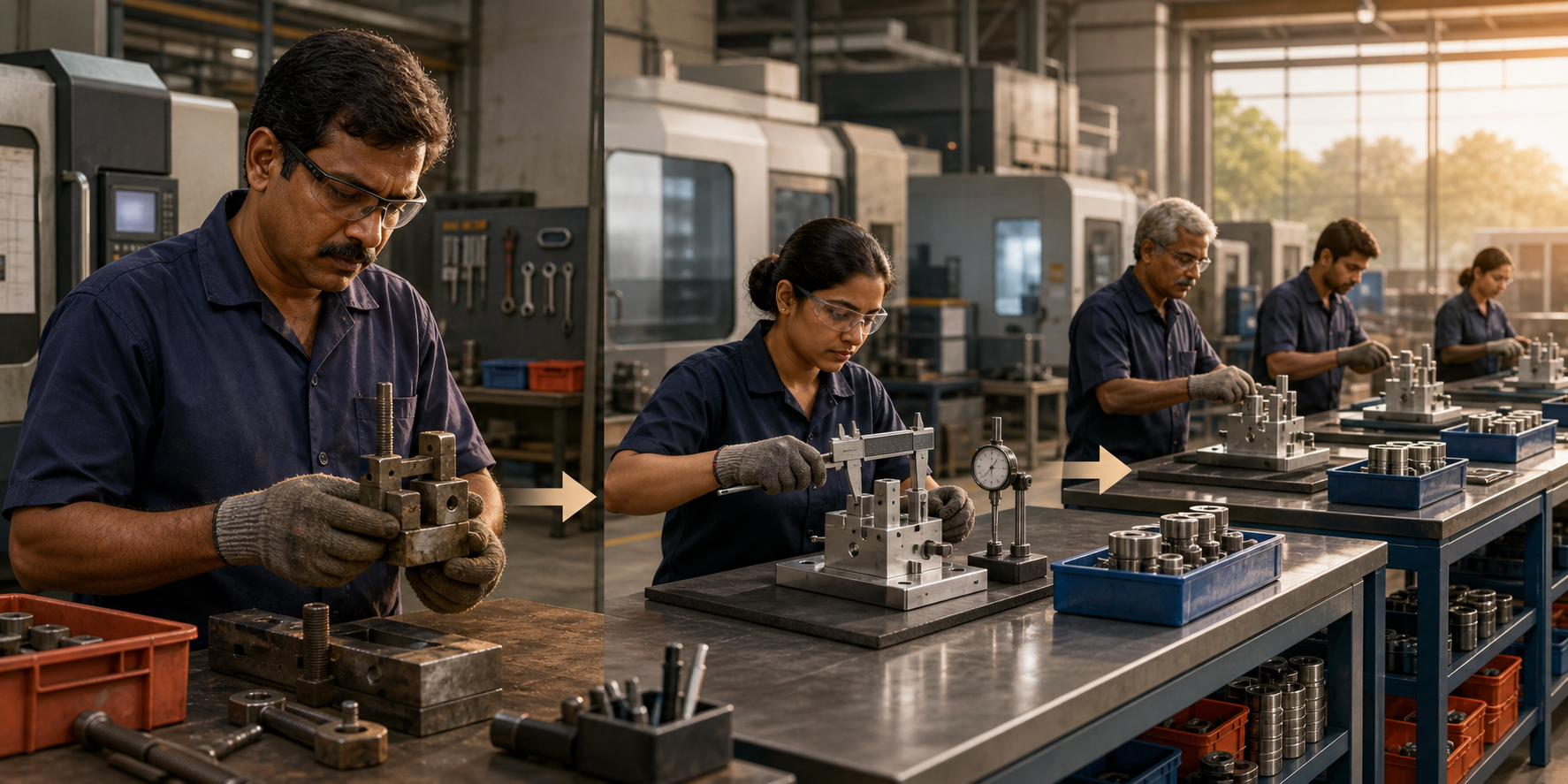
If you manufacture in India, you probably don’t lack clever people. The harder problem is getting the same good result when the experienced technician is absent, the supplier changes a material, demand rises, or a customer uses the product in conditions the factory did not anticipate.
You do not have to eliminate jugaad to solve that problem. Use improvisation to discover a way forward, then subject the discovery to measurement, validation, documentation, and training. Japan’s industrial transformation accelerated when methods associated with W. Edwards Deming and Joseph Juran were adapted alongside the work of Kaoru Ishikawa, Taiichi Ohno, and Genichi Taguchi. The transferable lesson is not that India should imitate a Japanese factory. It is that a country becomes excellent by joining sound methods to its own cultural strengths.
Treat every workaround as a temporary hypothesis
Jugaad is valuable when a team faces a real constraint and needs to restore motion. The danger begins when a successful batch is treated as proof that the improvised method is stable. A fix that works in the hands of its inventor may fail when the material, machine, operator, environment, or production rate changes.
Give every workaround a defined status. Four distinctions prevent a temporary success from becoming a hidden production standard:
- Containment isolates affected material and protects the customer while the problem is investigated.
- Correction repairs, reworks, or rejects the nonconforming units already found.
- Corrective action changes the condition that allowed the defect to arise or escape.
- Standardization converts a validated improvement into tooling, instructions, inspection, training, and process controls that others can repeat.
When a technician improvises a solution, record the original failure, the products or batches affected, the operating conditions under which the fix was tried, and the evidence used to accept it. Assign an owner and a review point. If nobody can say when the workaround will be reviewed, it has already started becoming an unofficial standard.
Test the change across the normal range of materials and operating conditions. Confirm the characteristics that matter to the customer, not merely whether the line runs again. Check that the solution has not shifted the defect into a later operation, weakened reliability, or made inspection more difficult. When safety or regulatory conformity is uncertain, segregate the affected material and obtain the appropriate technical or regulatory review; shipping the product is not a valid experiment.
This is how ingenuity becomes institutional knowledge. The creative act remains valuable, but the factory no longer depends on memory, heroics, or the availability of one gifted person.
Make the operator the first engineer of quality
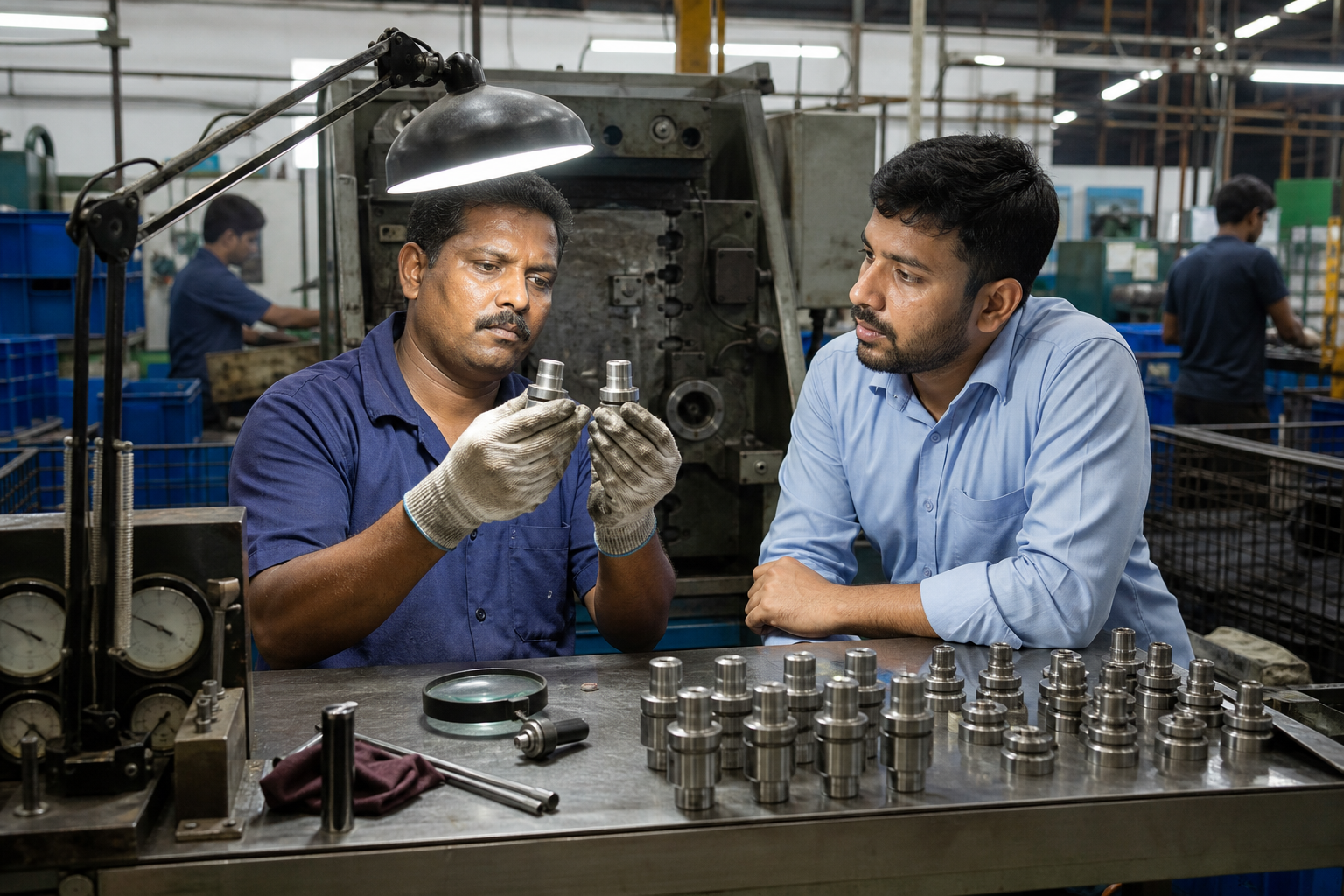
Final inspection can separate some visibly nonconforming units. It cannot make an unstable process capable. Quality improves faster when the person performing the work can recognize an abnormal condition, protect the product, and trigger a response before more defects are produced.
The most important cultural change is to treat operators as skilled participants in problem-solving. Japan’s model advanced by turning operators into craftspeople who could connect the shop floor with engineering and design. Indian firms can build their own version through modern apprenticeships, clear standards, and autonomy joined to accountability.
At each workstation, make the following information usable without searching through a distant manual:
- The current approved method, including the tool, fixture, material, and process setting that matter.
- The characteristics that are critical to fit, function, safety, appearance, or reliability.
- The approved measurement or test method, with accepted and rejected examples where visual judgement is involved.
- The action to take when a result falls outside the standard: stop, segregate, adjust within an authorized range, or escalate.
- The route for reporting an abnormality and the name or role responsible for responding.
- The outcome of earlier concerns, so workers can see whether raising a problem changed the process.
Autonomy without boundaries creates uncontrolled variation. Boundaries without autonomy encourage workers to keep producing while they wait for permission. A mature system states what an operator may adjust, what requires engineering approval, and what condition requires production to stop.
Apprenticeship should also test demonstrated workmanship rather than mere attendance. A learner should be able to perform the operation under normal conditions, recognize common abnormalities, use the prescribed measurement method, explain the escalation path, and teach the method back. Qualification records should identify the operations for which a person has shown competence.
Use Kaizen and statistical quality control as working disciplines, not as posters or award programmes. Track first-pass yield, rework, escaped defects, and recurrence by the factors that can explain variation, such as product, material lot, equipment, fixture, process condition, and shift where relevant. A dashboard is useful only when an abnormal result leads to an owner, an investigation, and a verified change.
Management behaviour determines whether this system produces truth. If a worker is punished for revealing a defect but rewarded for meeting an output target, the rational response is silence. Hold people accountable for knowingly ignoring standards or concealing risk. Thank them for surfacing a genuine problem, then require disciplined participation in solving it.
Close the loop across design, suppliers, and the field
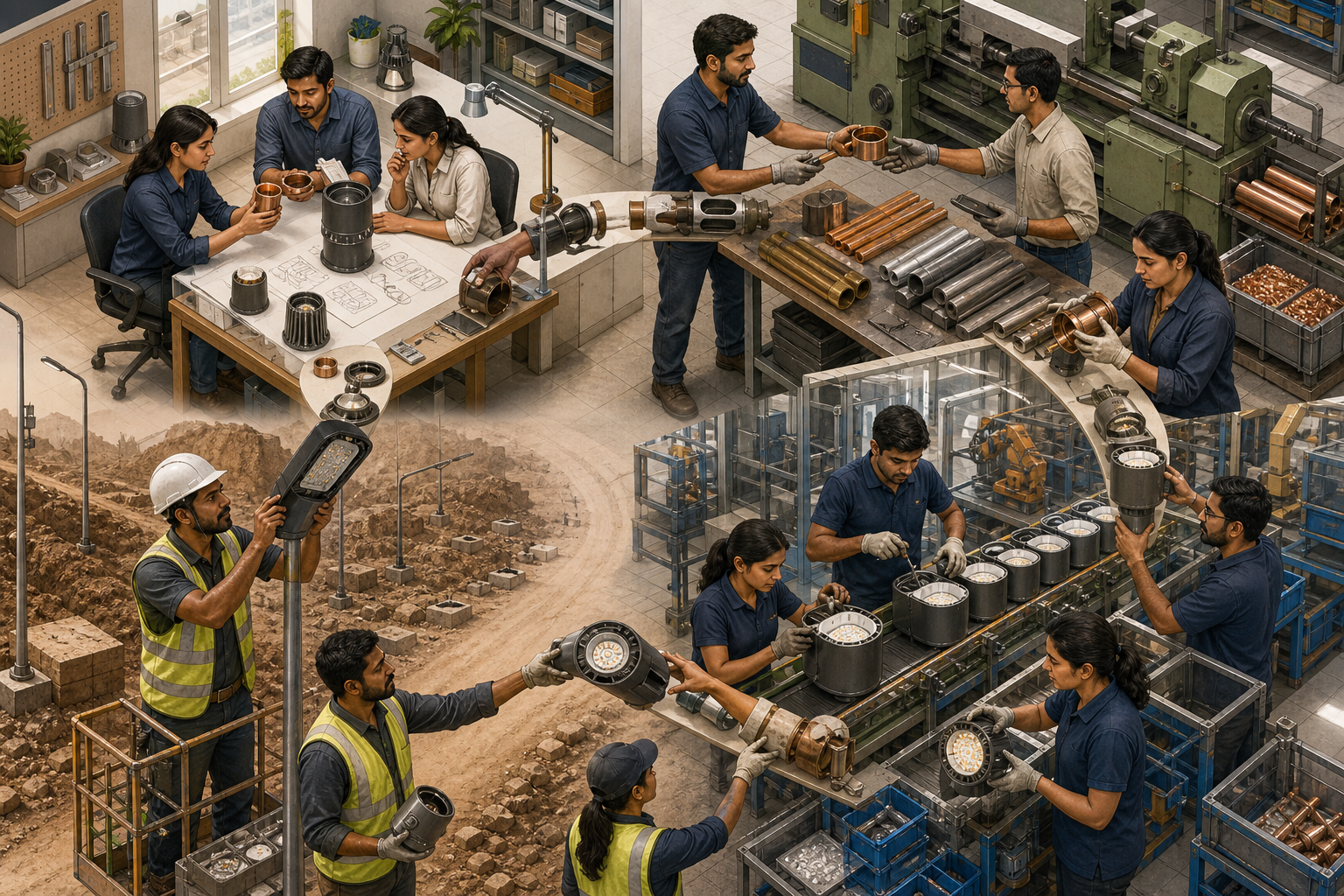
Many factory defects are born before production begins. A tolerance may exceed the capability of the chosen process. An assembly may permit two visually similar parts to be reversed. A test point may be inaccessible after a component is enclosed. A supplier specification may omit the material property that actually controls performance.
That is why design, engineering, and operations must work together from concept through production ramp. Quality cannot remain a department that inspects decisions made elsewhere.
Before releasing a design
Put the proposed product in front of the people who must make, inspect, package, service, and procure it. Ask concrete questions:
- Can the required tolerance be held with the intended process, tooling, access, and material?
- Can the product be assembled incorrectly, or does its geometry make the correct orientation obvious?
- Can a defect be measured at the operation where it is created, before more value is added?
- Which supplier characteristics affect function even if they are not visible during receiving inspection?
- Could packaging, transport, installation, or normal field use create a failure that the factory test does not reveal?
- What traceability will be needed if a customer reports a problem?
A drawing that is technically complete can still be difficult to manufacture reliably. Resolve those difficulties while changes remain relatively easy, rather than turning production workers into permanent compensators for a fragile design.
While developing suppliers
Incoming inspection is a filter, not a substitute for supplier capability. Share the functional reason behind critical requirements, agree on measurement methods, and require notice before relevant material or process changes. Review supplier performance through conformance, containment response, corrective-action closure, defect recurrence, change control, and delivery reliability rather than price alone.
When a defect occurs, the buyer and supplier should examine the same evidence and trace the failure to a process condition. Repeated sorting may protect the next shipment, but it does not remove the cause. A durable supplier-quality partnership develops capability and shares feedback instead of relying entirely on penalties after failure.
After the product leaves the factory
Connect complaints, returns, service findings, and warranty failures to the conditions under which the product was made. Useful traceability may connect the finished unit or batch to its input lot, equipment or fixture, process conditions, test result, disposition, and corrective action. Collect only data that the team is prepared to define consistently and use.
Digital systems make this loop faster, but software cannot rescue unclear defect codes, unreliable gauges, or missing ownership. Begin with a stable definition of the problem and a disciplined response. Digitize the flow after the organisation knows what the data means.
Once reliability becomes routine, teams have more room to improve efficiency, design, appearance, and even packaging. That progression matters: quality provides the foundation on which operational refinement and design ambition can grow.
Give dharmic values an operational meaning
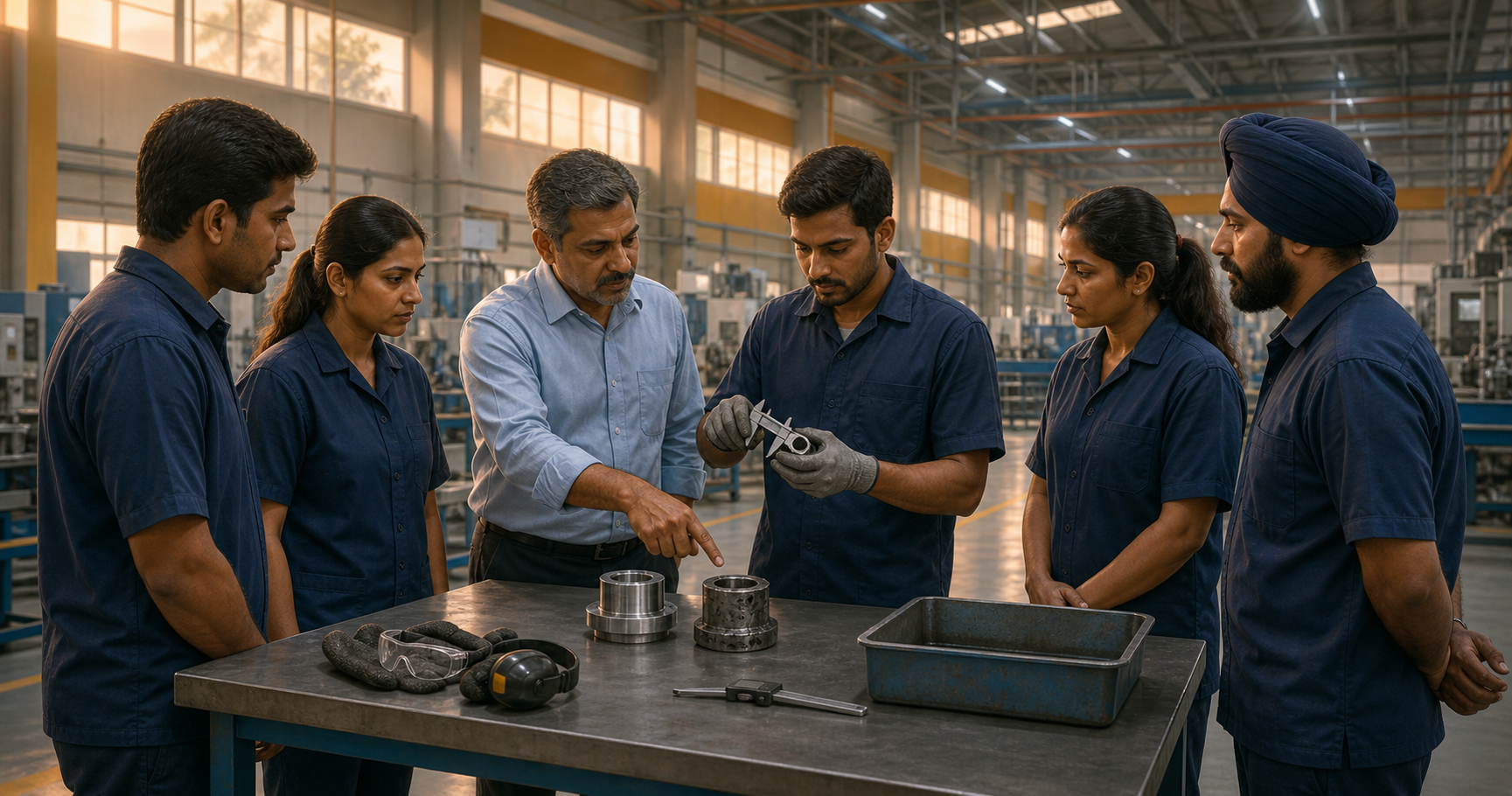
Indian manufacturing does not need a borrowed cultural vocabulary to care about excellence. Hindu, Buddhist, Jain, and Sikh traditions are not identical, but shraddha, tapas, ahimsa, and seva offer a shared ethical language for disciplined workmanship. Their value on a shop floor depends on turning them into observable conduct.
- Shraddha means devoted attention to the work. Do not sign a check that was not performed, accept an ambiguous result, or treat a customer’s requirement casually.
- Tapas means disciplined effort sustained after the novelty has passed. Follow the approved method during a production rush, maintain equipment, repeat the measurement correctly, and finish corrective actions.
- Ahimsa means refusing to pass avoidable harm downstream. A defect can waste material, consume a customer’s time, damage equipment, or create a safety risk. Do not knowingly transfer uncertainty to the next operator, supplier, or user.
- Seva means remembering that the product serves someone. Meeting a drawing while ignoring usability, reliability, repair, packaging, or field conditions is incomplete service.
These principles should strengthen professional standards, not become religious tests. In a plural workplace, the expected behaviours must be universal, relevant to the work, and open to every employee. A worker does not need to share a theology to understand careful attention, disciplined practice, non-harm, and service to the user.
Values also fail when incentives contradict them. A company cannot preach quality while rewarding shipment at any cost, discouraging line stoppages, or hiding rework from performance reports. Leaders should ask what condition allowed the defect, who owns the corrective action, and how the new standard will be verified. Personal accountability remains necessary, but blame must not replace causal investigation.
A ceremonial pledge, quality slogan, or factory puja may express aspiration. None can substitute for a capable process, a trustworthy measurement, a trained operator, and the courage to stop questionable work. Dharma becomes industrial strength when conduct and systems point in the same direction.
Key takeaways: the sequence that changes a factory
- Choose a recurring defect that customers notice or that repeatedly consumes rework.
- Map where the defect is introduced, where it is first detectable, and how it escapes.
- Contain affected material without confusing containment with a permanent solution.
- Bring the operator, quality function, engineer, designer, and relevant supplier around the same physical evidence and process data.
- Test the suspected cause and proposed change under the actual range of production conditions.
- Confirm that the change protects fit, function, safety, reliability, and downstream operations rather than merely restoring output.
- Update tooling, instructions, inspection, training, and traceability before calling the improvement complete.
- Watch for recurrence and apply the verified lesson to other products or processes that share the same risk.
If you are deciding where to invest, do not begin with a slogan, an award application, or a larger dashboard. Select the recurring defect that most damages trust and run this sequence to completion. Then make the changed standard visible where the work happens. Repeating that discipline across products is how Indian ingenuity becomes Indian reliability, and how reliability earns lasting export confidence.
References
