

If you have seen a 2050 chart and wondered whether Hindus are growing, shrinking, or becoming less secure, the honest answer is that those are three different questions. The global Hindu population is projected to grow substantially, its share of humanity is expected to remain broadly stable, and India is expected to remain Hindu-majority.
Those headlines are important, but they do not tell you whether a community will be youthful or ageing, politically secure or vulnerable, culturally confident or unable to pass its traditions to the next generation. To understand what 2050 means, you need to separate population count, population share, age structure, migration, and institutional strength.
Read a projection as a scenario, not a prophecy

Pew Research Center’s widely cited religious projections use a cohort-component model. It begins with a population divided by age and sex, then carries those groups forward using assumptions about fertility, mortality, and migration. This is a standard demographic method, but its result is still conditional: change the assumptions or improve the baseline data, and the 2050 outcome can change.
This matters especially where censuses do not record religion consistently or where migration is difficult to measure. A projection for such a country should be read as a structured mid-range scenario, not an exact headcount waiting to happen.
Before accepting any claim about Hindu demography, attach four labels to the number:
- Count or share: Is it the number of Hindus, or the percentage of the country’s population that is Hindu?
- Baseline and horizon: What starting population is being carried forward, and is the claim about the present or 2050?
- Geographic level: Is it a global, national, state, district, or diaspora figure?
- Main mechanism: Is the projected change driven chiefly by fertility, age structure, immigration, or emigration?
The count-share distinction prevents the most common error. A Hindu community can increase in number while declining as a percentage if the rest of the country grows faster. Conversely, a stable percentage can conceal major changes in age, location, and community life. When a headline says the Hindu share is falling, ask whether the Hindu count is also falling. When it celebrates a rising count, ask whether the community is keeping pace with the wider population.
Age structure adds another layer. A large younger generation can keep population numbers rising for years after fertility has fallen, because more people are entering the ages at which families are formed. That population momentum is one reason a low or declining fertility rate does not translate immediately into population contraction.
India’s central challenge is shifting from scale to capability
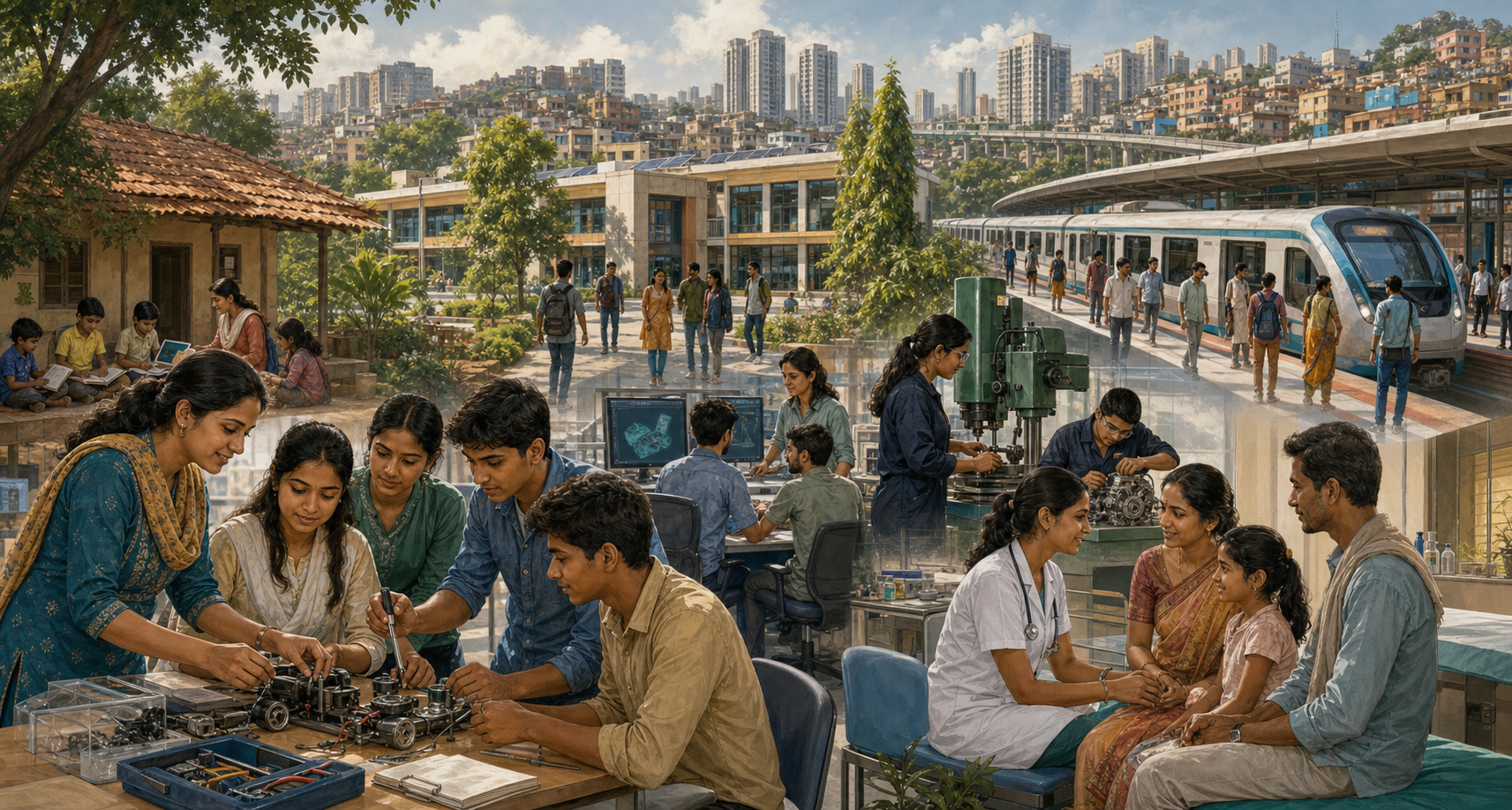
India remains the indispensable centre of Hindu demography. Through the 2050 horizon, it is projected to remain the primary home of Hindus worldwide, a Hindu-majority nation, and the world’s most populous country. Globally, Hindu numbers are expected to add hundreds of millions even while the Hindu percentage of the world population remains broadly steady.
The more consequential change inside India is the demographic transition. NFHS-5, conducted in 2019-21, placed India’s total fertility rate near 2.0. Fertility among dharmic communities is already at or below replacement level in many states. At the same time, fertility differences across communities have been narrowing.
This pattern is better explained by education, child survival, income, urban employment, maternal health, and access to family planning than by theology alone. That correction is vital. If you misdiagnose a structural demographic change as a purely religious one, you will choose policies that generate heat without improving family life.
A national fertility average also hides substantial differences among states and districts. Local age profiles, women’s education, employment conditions, health services, and migration patterns can produce very different futures within the same religious community. National claims should therefore lead to district-level questions, not nationwide panic.
As fertility falls, India’s median age rises and population growth gradually slows. The practical priority consequently moves from accumulating numbers to building human capability. For a Hindu family, that means whether children are healthy, educated, economically secure, and able to learn their traditions. For public policy, it means measuring school completion, maternal health, child survival, skills, youth employment, and local opportunity alongside population totals.
A serious pro-Dharmic response should make it easier for young adults to form stable families, raise children without sacrificing economic security, and transmit dharma without cutting those children off from modern education or employment. A fertility slogan detached from housing, health, education, and work cannot accomplish that.
South Asia does not have one Hindu demographic story
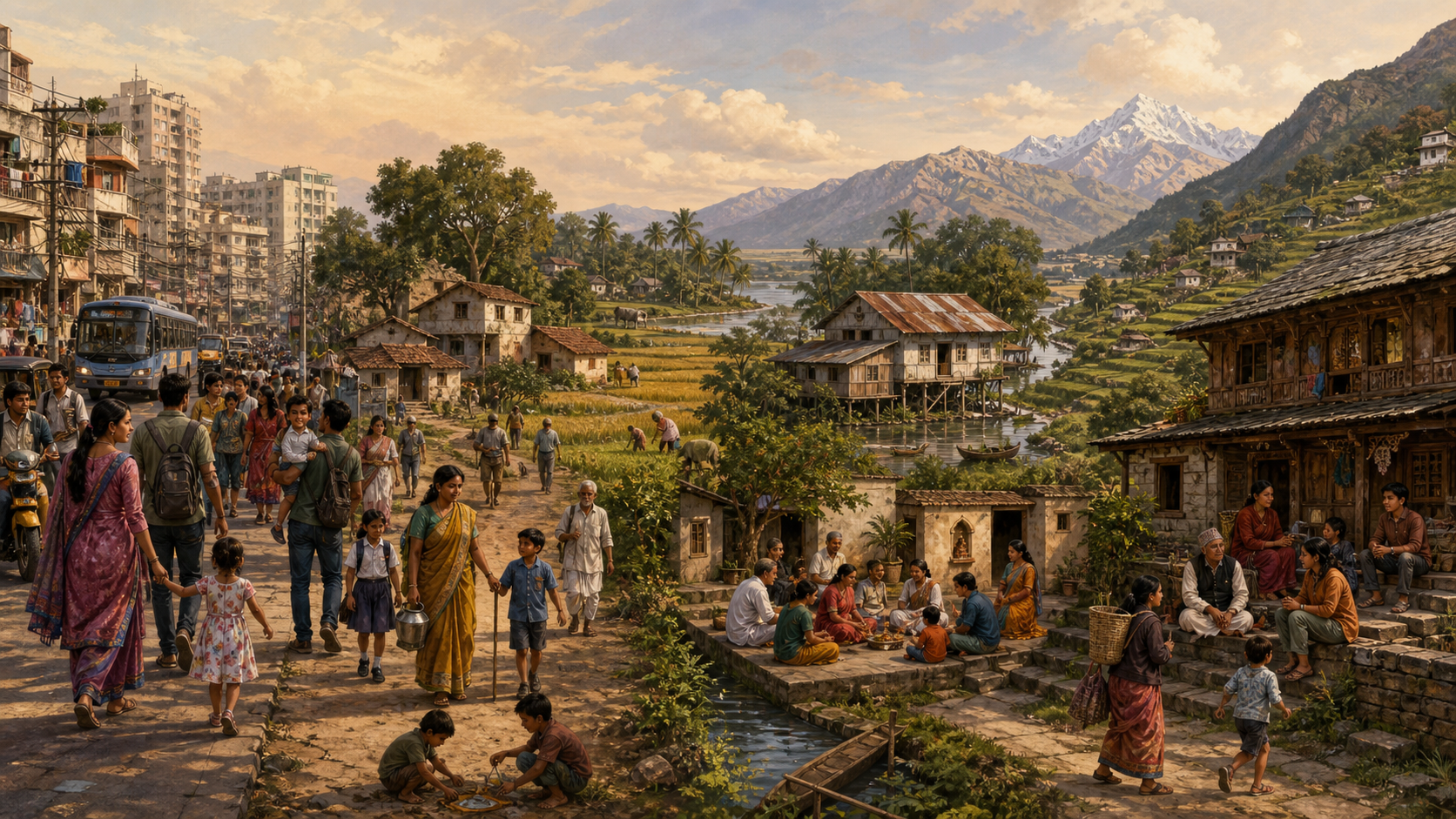
The countries surrounding India belong to a connected civilizational region, but their demographic situations differ sharply. The right response in a Hindu-majority society is not automatically the right response for a small, geographically concentrated minority.
Majority status can soften without disappearing
Nepal is expected to remain Hindu-majority in 2050, although the Hindu share may soften slightly as fertility declines. Mauritius is also expected to retain one of the world’s highest Hindu proportions, with a possible modest decline associated with low fertility. Neither trajectory supports a claim of imminent demographic disappearance.
In these settings, the useful question is not merely whether Hindus remain a majority. It is whether institutions are preparing for smaller families, an older population, and a generation whose education and work may take it farther from ancestral communities. Cultural education, temples, family networks, and civic participation must adapt to that transition.
Minority resilience depends on more than fertility
Bangladesh’s Hindu share is projected to be lower in 2050 than it was in 2010. That does not necessarily mean the Hindu headcount must fall. The community may grow more slowly than the national population while losing proportional weight. Differential fertility, out-migration, and age structure all contribute to that pattern.
Pakistan’s Hindus are expected to remain a small share of the national population, with important concentrations in Sindh. Sri Lanka’s Hindu community remains a culturally significant minority closely connected to Tamil heritage, while post-conflict economic conditions and migration continue to shape its future. Bhutan retains a predominantly Buddhist character alongside a longstanding Hindu minority. Afghanistan and the Maldives have very small Hindu populations after historical emigration and limited migration corridors.
For minorities, a demographic percentage is not an adequate measure of security. You also need to watch whether families are leaving, whether young adults can find opportunity without abandoning their communities, whether temples and cultural organisations can operate, and whether minority rights are protected in practice. A community can be numerically stable yet institutionally weakened; it can also lose percentage share while strengthening education, representation, and civic organisation.
When assessing a South Asian country, therefore, track three things separately: the Hindu headcount, the Hindu share, and the conditions under which Hindus can remain. The third is not reducible to a fertility rate.
Diaspora growth must be converted into durable institutions

Outside South Asia, migration is the main force expanding Hindu populations. Skilled work, international education, family reunification, and circular labour migration are creating a more visible Hindu presence in North America, Europe, Oceania, the Gulf, and parts of Southeast Asia.
Not all migration produces the same demographic future. A temporary worker population in the Gulf can raise the local Hindu count substantially without creating a permanent multigenerational community, because many migrants have no path to permanent residence or citizenship. Settlement countries such as the United States, Canada, the United Kingdom, Australia, and New Zealand offer a different trajectory: immigration can be followed by family formation, a second generation, and lasting institutions.
The Hindu share in the United States has hovered near 1 percent in recent surveys. Canada recorded a notable increase in its Hindu share in the 2021 census. The United Kingdom remains a major centre shaped by migration from India and East Africa. The Netherlands has a distinctive Surinamese Hindu stream, while Italy, Germany, and Spain have received communities from India, Sri Lanka, and other South Asian origins. Australia and New Zealand have experienced some of the fastest proportional Hindu increases, supported by education and skilled-migration routes.
A fast growth rate can be misleading when it begins from a small base. Do not judge diaspora strength from percentage growth alone. Ask whether the population has legal permanence, a balanced age structure, family formation, places of worship, language and cultural education, and leadership drawn from the generation growing up in the country.
The institutional test is especially important because many newer diaspora communities are professionally concentrated in technology, healthcare, and entrepreneurship. Economic success can help finance temples and community centres, but it does not automatically produce teachers, youth programmes, language continuity, or informed public representation. Those require deliberate work.
Dharmic cooperation can increase the reach of that work. Hindu temples, Sikh gurdwaras, Buddhist viharas, Jain organisations, language schools, and community centres often face similar questions about second-generation identity and civic participation. Collaboration need not erase theological differences. It can provide scale for education, service, heritage preservation, and a confident dharmic voice in plural societies.
By 2050, diaspora success should be measured not only by how many people select Hindu on a census form, but by whether their children can understand the tradition, participate in community life, and speak about dharma accurately in the societies they call home.
Key takeaways for reading the road to 2050
- Global growth is not the same as global share growth. Hindu numbers are projected to rise substantially while the Hindu share of the world’s population remains broadly stable.
- India is not projected to cease being Hindu-majority by 2050. Its deeper challenge is an ageing, lower-fertility society in which health, education, skills, and cultural transmission matter more than raw scale.
- A lower percentage does not automatically mean fewer Hindus. The community can grow in absolute terms while the rest of a country grows faster.
- South Asian minority outcomes require more than fertility analysis. Out-migration, age structure, economic opportunity, institutional continuity, and minority rights all affect whether a community remains resilient.
- Diaspora growth becomes durable only when migration becomes community. Permanent settlement, second-generation participation, cultural education, and functioning institutions matter more than an impressive short-term growth rate.
The next time a 2050 claim crosses your screen, do not react to the headline number. Label it as count or share, national or local, majority or minority, and temporary or permanent migration. Then match the response to the mechanism: build human capability in India, defend rights and local continuity for vulnerable minorities, and turn diaspora growth into institutions that can outlast the first generation. That is how demography becomes a practical roadmap rather than a politics of fear.