
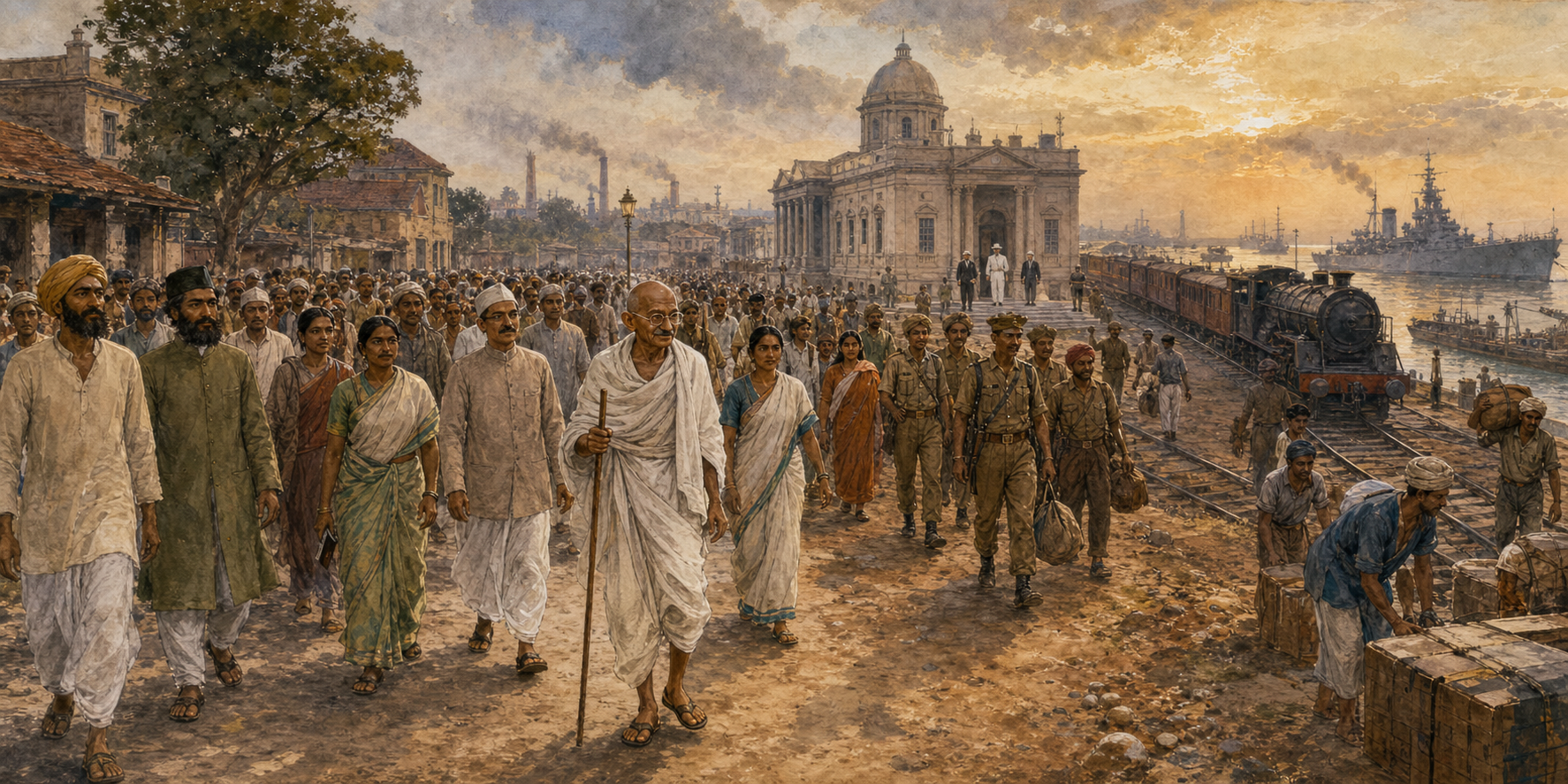
If you came here because one side told you Gandhi single-handedly freed India and another told you ahimsa had almost nothing to do with freedom, you do not have to accept either story. Both turn a long national struggle into a slogan.
The defensible answer is more useful: Gandhi made resistance morally compelling, nationally accessible, and politically difficult to ignore. But Britain transferred power only when that mass movement converged with imperial exhaustion, international change, unrest within the Raj’s coercive apparatus, and political negotiation. Ahimsa was indispensable to the shape of India’s freedom struggle. It was not its only cause.
Separate the moral victory from the imperial decision
The question “Did Gandhi’s ahimsa win independence?” hides three different questions. Unless you separate them, the debate becomes a contest between reverence and resentment.
- Who transformed freedom from an elite political demand into a mass obligation? Gandhi was central. Satyagraha gave ordinary people a disciplined way to withdraw cooperation from imperial rule.
- What weakened Britain’s ability and willingness to retain India? World War II, financial strain, changing international attitudes, the Indian National Army, unrest in the armed services, and political priorities in London all mattered.
- What made a negotiated transfer politically possible? A movement with national reach and moral legitimacy could claim to speak for Indian freedom, even though fierce disagreements remained over strategy, representation, and the future state.
This distinction immediately corrects two common mistakes. The first credits Gandhi with every pressure bearing on Britain. The second notices pressures he did not create and concludes that his contribution was therefore negligible. Historical causes do not cancel one another merely because several operated at once.
Key takeaways
- Gandhi was a central leader of the independence movement, not its solitary author.
- Ahimsa and satyagraha changed who could participate, how resistance was organized, and whether imperial rule could still claim legitimacy.
- Britain’s wartime exhaustion and the rising risk of unrest within the Raj changed the practical cost of remaining.
- Non-violence works through discipline, moral leverage, organization, and negotiation. It is not an automatic answer to every form of aggression.
- The strongest explanation is cumulative: mass politics weakened consent while war, military unease, and international change weakened imperial capacity.
What Gandhi’s method actually changed
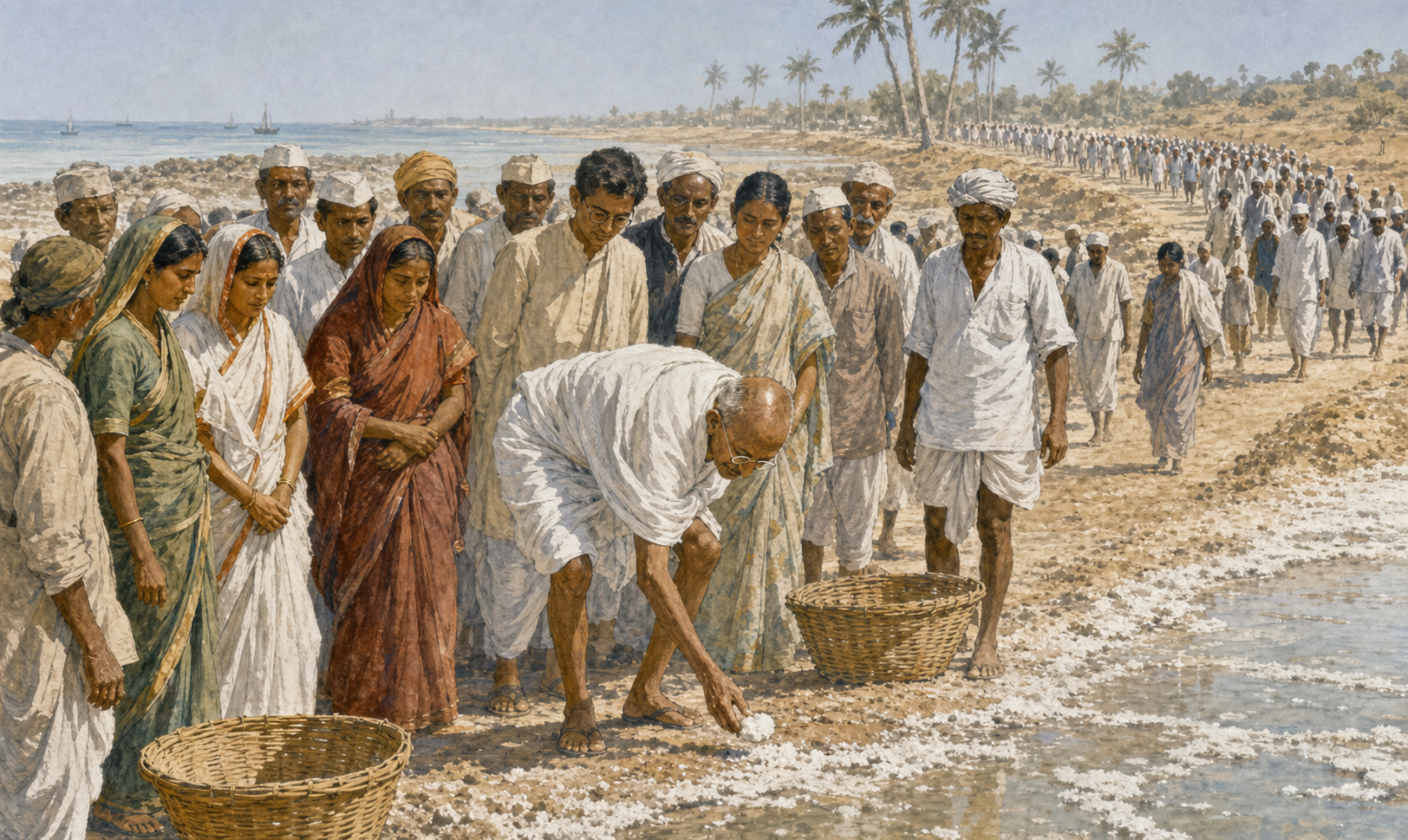
Gandhi did not introduce India to ahimsa. The idea had deep and varied roots across dharmic traditions. His political innovation was to join ahimsa with satya, disciplined self-restraint, public non-cooperation, and a willingness to accept suffering without answering repression in kind. Satyagraha turned an ethical commitment into a method of mass politics.
That method changed the freedom struggle in four concrete ways.
- It widened participation. The Non-Cooperation Movement, Civil Disobedience Movement, Salt March, and Quit India Movement gave students, workers, rural households, and people outside established political elites recognizable forms of action. Freedom became an ethical duty that could be practiced, not merely a constitutional question discussed by specialists.
- It attacked the appearance of normal rule. An empire depends on more than soldiers. It also depends on routine compliance, functioning institutions, social deference, and the belief that its authority will endure. Organized non-cooperation exposed how much colonial government relied on Indian participation.
- It shifted the burden of justification. When disciplined protesters accepted punishment without retaliatory violence, repression became harder to present as ordinary administration. The confrontation moved from a simple test of force to a dispute over the moral right to rule.
- It created political legitimacy for negotiation. A movement capable of recurring national mobilization could not easily be dismissed as a narrow faction. Its reach made an eventual settlement more credible, even though the Indian political field remained plural and contested.
The campaigns did not all perform the same job. Non-cooperation challenged the habit of lending consent to imperial institutions. The Salt March and civil disobedience made obedience to an unjust law the point at issue. Quit India made British departure the organizing demand. Treating these campaigns as one undifferentiated expression of saintly protest misses their political design.
This is also why “the British would have left anyway” is not a sufficient rebuttal. Even if imperial weakness made departure increasingly likely, someone still had to create national political pressure, sustain a claim to self-rule, and make continued government without Indian consent visibly untenable. Gandhi’s movements supplied moral authority and mass scale that military and financial weakness alone could not provide.
Where ahimsa worked, and where it reached its limits
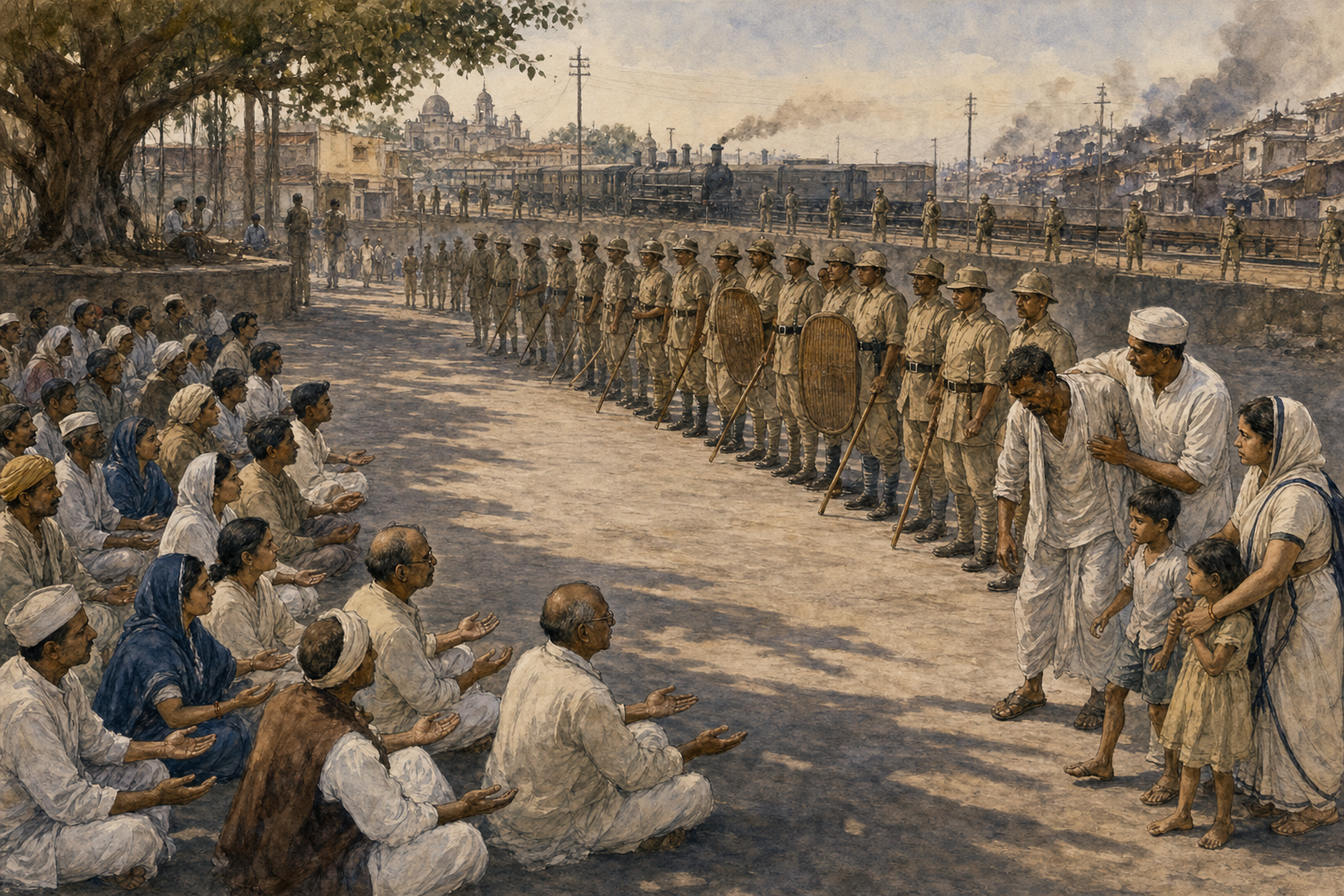
Ahimsa should not be judged as magic. It is a demanding political discipline whose effectiveness depends on identifiable conditions. A movement must coordinate large numbers of people, prevent provocation from dictating its conduct, endure punishment, communicate its purpose, and preserve a path toward negotiation.
Chauri Chaura exposed the fragility of that discipline. A movement organized around non-violence can be strategically transformed by one violent episode because the means are part of its claim to legitimacy. This is not a minor operational problem. It means leaders must maintain moral restraint across people, places, and circumstances they cannot fully control.
Participation also varied by region and class. Communal tension repeatedly fractured solidarity, with colonial policies often worsening division. The existence of a national moral vocabulary did not erase conflicting interests, local fears, or competing visions of India’s future.
The difference between campaigns such as Champaran or Bardoli and the spiraling violence surrounding Partition reveals another boundary. Non-violent pressure can be powerful when an opponent is vulnerable to political isolation, reputational cost, administrative disruption, or negotiation. It is much less reliable when armed actors are prepared to prey on civilians and feel no obligation to answer moral suasion.
You can test whether ahimsa is being discussed seriously by asking four questions:
- What leverage does restraint create? Does it withdraw cooperation, raise the political cost of repression, divide the opponent’s supporters, or open negotiation?
- Who enforces discipline inside the movement? Moral intention is not enough when one violent incident can change the character of a campaign.
- Is the opponent responsive to public legitimacy? A government seeking orderly administration is not the same kind of adversary as a predatory mob attacking vulnerable families.
- Who protects people when persuasion fails? Civic restraint must be joined to impartial justice, accountable policing, and community peacebuilding when there is an immediate threat to life.
This does not diminish ahimsa. It keeps the principle from being turned into a demand that the vulnerable accept unlimited harm. Proactive peace combines restraint with the responsible protection of the innocent. Ahimsa can guide the purpose and limits of power without pretending that every aggressor can be stopped by moral appeal alone.
The pressures Britain could no longer absorb
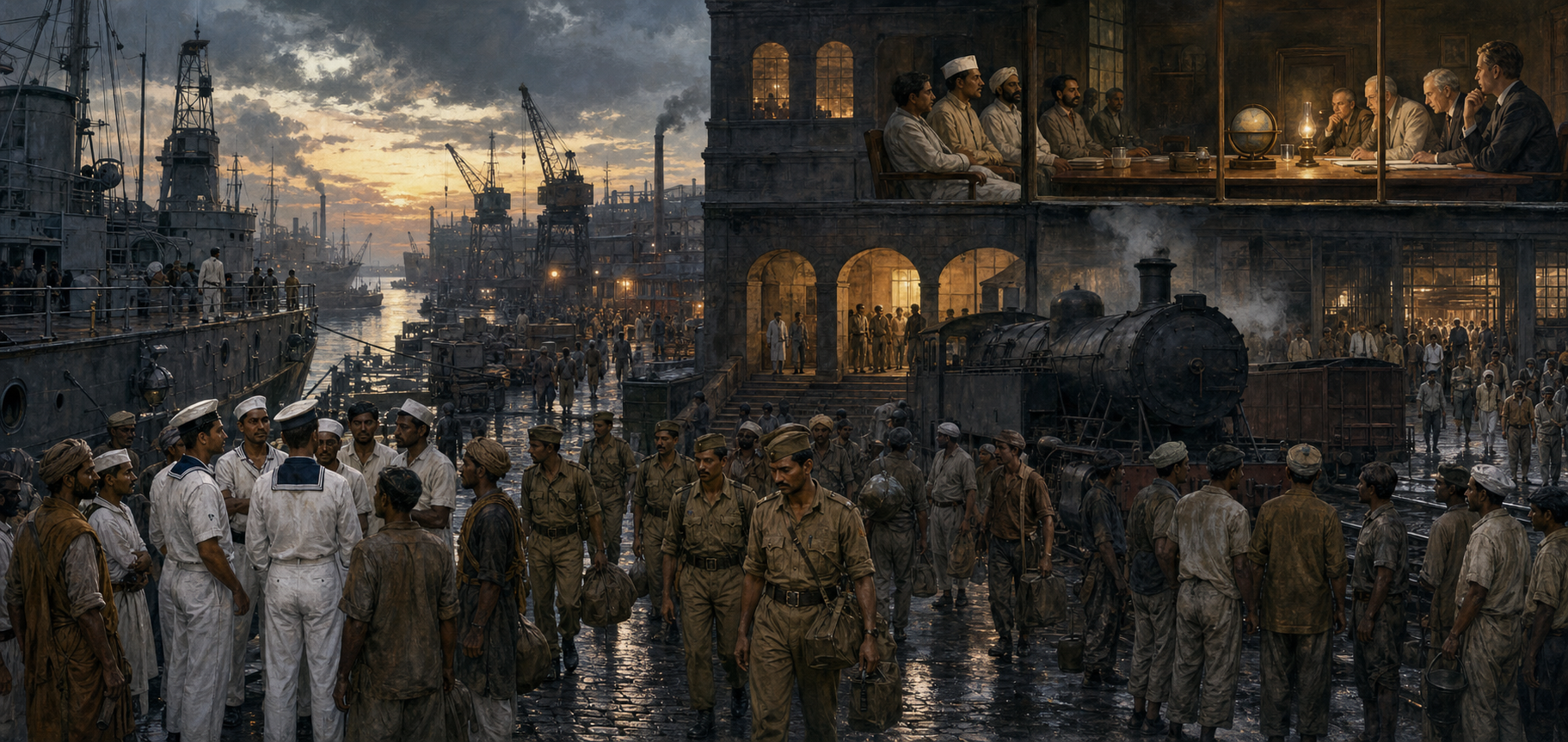
By the end of World War II, Britain was financially strained, indebted, militarily overextended, and preoccupied with reconstruction. Global anti-colonial momentum and changing international attitudes weakened the ideological defense of empire. A Labour government in London faced the cost of maintaining imperial control while urgent domestic priorities competed for attention.
At the same time, the reliability of coercion could no longer be treated as a permanent certainty. Subhas Chandra Bose’s Indian National Army suffered battlefield setbacks, but its political effect extended beyond those outcomes. The INA trials intensified patriotic feeling. The Royal Indian Navy mutiny of 1946 indicated that unrest could spread through services and cities, raising a question no empire could ignore: if control required wider coercion, could the personnel needed to impose it be relied upon indefinitely?
These forces performed different causal jobs. That is why they should be combined rather than forced into a contest for exclusive credit.
| Force | Direct effect | What it helps explain |
|---|---|---|
| Satyagraha and mass politics | Withdrew cooperation, widened participation, and eroded colonial legitimacy | Why British rule increasingly lacked credible Indian consent |
| World War II and financial strain | Reduced Britain’s resources and increased the cost of overseas commitments | Why maintaining the Raj became materially harder |
| INA trials and the Royal Indian Navy mutiny | Raised doubts about unrest within the coercive apparatus | Why relying on force carried growing political and security risk |
| Global anti-colonial momentum and politics in London | Weakened the case for empire and redirected attention toward reconstruction | Why a relatively rapid exit became politically conceivable |
| Political negotiation | Converted pressure into an organized transfer of power | Why independence cannot be described simply as either a gift or a sudden imperial collapse |
The interaction matters. Gandhi’s politics helped make India difficult to govern legitimately without Indian consent. Wartime exhaustion made it harder to govern at acceptable cost. The INA’s symbolism and service unrest made intensified coercion riskier. Negotiation then translated this altered balance into a transfer of power, while the horror of Partition showed how much remained unresolved.
When someone offers you a one-cause explanation, use the table as a diagnostic. Ask which row can be removed without changing the path to independence. If removing a factor leaves a major part of the outcome unexplained, that factor belongs in the history even if it was not sufficient by itself.
Read ahimsa through dharma, not as a political slogan

Equating all dharmic thought with Gandhi’s particular practice of non-violence creates a second historical distortion. Ahimsa is a shared civilizational value, but it is not interpreted identically in Hinduism, Buddhism, Jainism, and Sikhism.
- Jain traditions press the discipline of non-harm toward an especially exacting ethical ideal.
- Buddhist traditions place compassion, or karuna, alongside skillful means, or upaya. Right action therefore requires attention to conditions and consequences.
- Hindu traditions honor ahimsa while also recognizing duties of protection and the possibility of dharma-yuddha when life and order must be defended.
- Sikh tradition joins spiritual discipline, seva, courage, and the sant-sipahi ideal of the saint-soldier. Compassion and the defense of others are not treated as opposites.
The practical lesson is not to dilute ahimsa until it means whatever we want. It is to distinguish non-harm from passivity. Restraint should reduce needless suffering, govern the use of power, and keep justice from becoming vengeance. The duty to protect should prevent moral language from abandoning those who face immediate violence.
A similarly mature standard belongs in historiography. R.C. Majumdar foregrounded wartime exhaustion, revolutionary currents, and service unrest that a Gandhi-only narrative can obscure. D.V. Gundappa worried that charismatic mass politics reconfigured a public culture once more open to argument. Their questions direct attention to both the mobilizing power and the institutional consequences of moral authority.
You do not have to choose between treating Gandhi as infallible and treating him as irrelevant. Use this five-minute test whenever you encounter a sweeping claim about independence:
- Rewrite the claim precisely. Replace “Gandhi gave India freedom” with a testable statement about mass participation, legitimacy, imperial cost, coercive risk, or negotiation.
- Name the mechanism. Ask how the action changed British choices. Admiration, sacrifice, and symbolism matter historically only when you can explain what they caused.
- Place other pressures beside it. Add the war, global politics, the INA, the Royal Indian Navy mutiny, politics in London, and negotiations. Do not treat context as background decoration.
- Check the method’s limits. Chauri Chaura, uneven participation, communal fracture, and Partition prevent a successful campaign in one setting from becoming a universal theory of political action.
- Distribute agency. Leave room for Gandhi, other national leaders, revolutionaries, service personnel, workers, students, rural households, community organizers, and families whose everyday acts sustained the struggle.
The next time you hear a simple verdict, draw two columns. In the first, list what reduced the Raj’s legitimacy. In the second, list what reduced its capacity to remain. Then ask what converted both into a political settlement and who bore the cost when that settlement failed to protect unity. If either column is empty, you are being given a legend, not a sufficient explanation.
That habit lets you honor Gandhi’s moral achievement without erasing Bose, the INA, service unrest, wartime change, political negotiation, or the victims of Partition. It also gives ahimsa the respect it deserves: not worship as an all-purpose formula, but disciplined use as one of Bharat’s most consequential contributions to political action.
References
- DharmaRenaissance Blog — Discover R.C. Majumdar’s Unsparing, Evidence-Based Assessment of Gandhi’s Legacy
- DharmaRenaissance Blog — Did Satyagraha Alone Free India? A Complete, Evidence-Based Breakdown of a Historic Triumph
- DharmaRenaissance Blog — Discover the Complete, Evidence-Based Reassessment of Gandhi’s Ahimsa and India’s Transformation
