
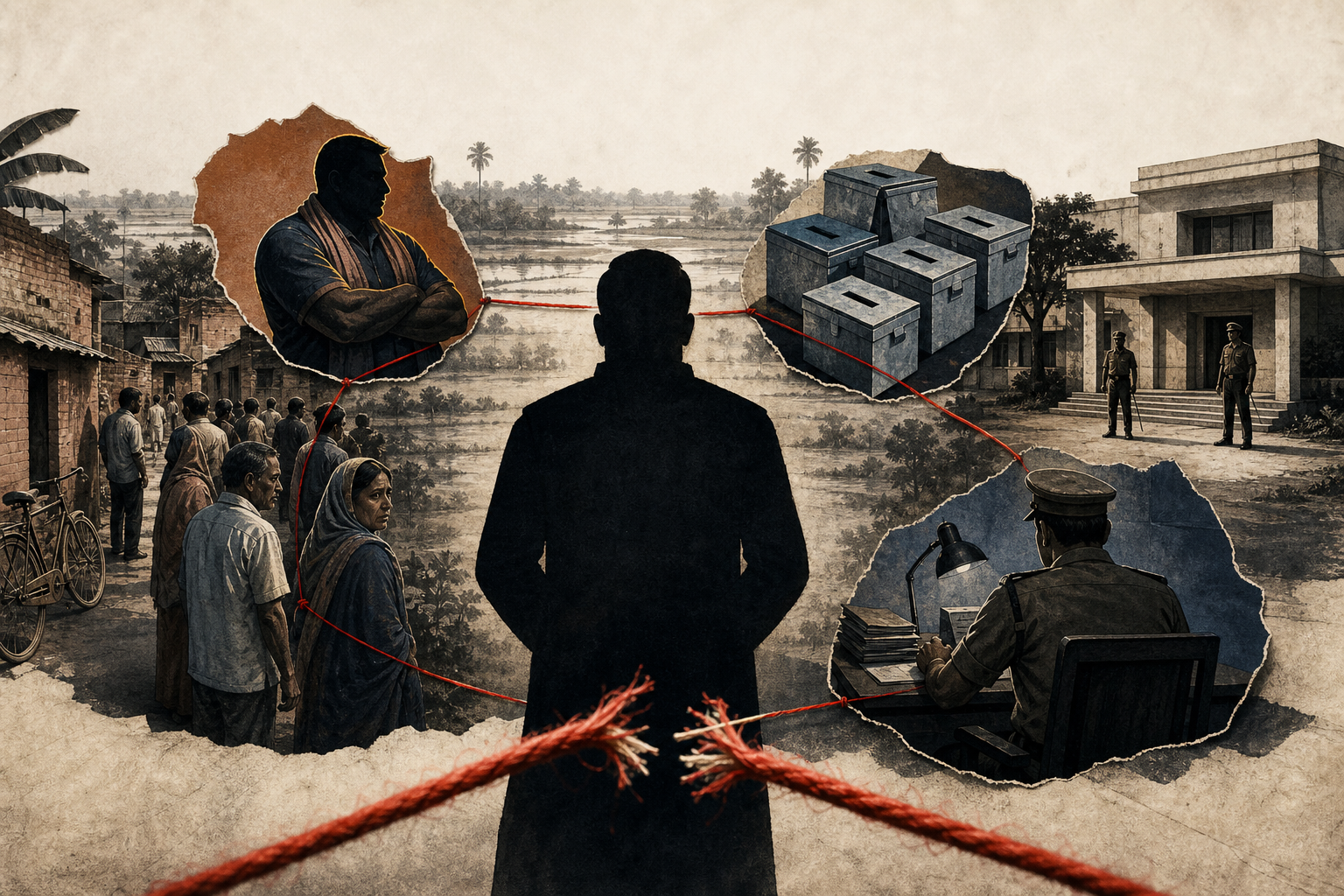
If you are trying to decide whether Bihar has moved beyond criminalized politics, do not begin with a party’s slogans or with the label Jungle Raj. Ask a harder question: can a powerful person still turn fear into votes, votes into political protection, and that protection into obedience from public institutions?
That question helps you distinguish a candidate with allegations from a political system organized around coercion. It also gives you a practical way to judge every party by the same standard.
The problem is larger than a candidate’s criminal record
Criminalized politics is often reduced to the number of candidates facing cases. That number can matter, but it cannot tell you whether an allegation is minor or grave, politically motivated or well-supported, isolated or part of a continuing pattern. An accusation is not a conviction, and due process cannot be discarded merely because an accused person is unpopular.
The deeper danger appears when coercive power and state power begin to reinforce each other. A local strongman supplies votes, money, muscle, or control over a constituency. Political patrons then provide access, status, protection, or influence over enforcement. Officials learn which cases are dangerous to pursue. Witnesses learn that speaking may carry a cost. Citizens learn that ordinary rules do not apply equally.
You can separate the problem into three levels:
- Criminality within politics: an individual politician is accused or found guilty of an offence.
- Political protection of criminality: a party retains a strongman because he can deliver electoral advantage.
- Criminalization of governance: fear, patronage, and selective enforcement shape how police, administrators, witnesses, businesses, and voters behave.
The third level is the real institutional emergency. Replacing one notorious person will not solve it if the bargain that empowered him remains available to the next aspirant.
This distinction also corrects a common electoral mistake. Winning an election proves that a person possesses electoral power; it does not prove ethical fitness. A frightened voter, a dependent voter, and a voter seeking protection in a weak state may all cast a formally valid ballot. The result cannot, by itself, tell you whether the conditions surrounding that ballot were just.
Bihar’s warning came from an ecosystem, not one man

The 1990s became Bihar’s defining reference point because disorder was no longer experienced as an occasional failure. Violence, kidnapping, intimidation, administrative weakness, and political patronage came to be understood as parts of a mutually supporting order. Public jokes about Bihar made the dysfunction sound almost harmless, but the people paying the price were families, witnesses, traders, students, and ordinary citizens who could not rely on equal protection.
Mohammad Shahabuddin’s rise in Siwan showed how that order could work at its most concentrated. By October 2001, PUCL investigators were describing a history-sheeter associated with murder, attempted murder, kidnapping, armed offences, and intimidation. Political protection and compliant officials were said to have helped turn Siwan into a personal domain in which witnesses could be frightened into silence. The legal merits of every individual case still required due process; the governance danger lay in the reported pattern of violence, fear, and institutional deference.
By 1999, Shahabuddin was being portrayed in intelligence assessments as a mafia don backed by an armed cadre operating across districts and implicated in political killings, ransom kidnapping, extortion, and illicit trade. An especially brutal acid attack and murder of two young men became emblematic of the terror associated with his name. He nevertheless contested and won a parliamentary election from prison in 2004.
That victory reveals why a prison cell is not the same thing as political defeat. If a party organization, patronage network, loyal cadre, and intimidated constituency continue to function, physical custody may restrict a person without dismantling his influence. In 2017, recorded conversations surfaced that appeared to indicate that Lalu Prasad Yadav was receiving instructions from Shahabuddin after the political celebrations that followed the 2015 Bihar Assembly election. The recordings were alarming precisely because they suggested that formal confinement had not necessarily severed informal command.
The failure was not confined to a constituency. In 1998-1999, the Union Cabinet twice backed President’s Rule after the breakdown of law and order in Bihar, and presidential endorsement followed. The measure ultimately failed in one House of Parliament as opposition to the BJP-led Union government took precedence over intervention in Bihar. Whatever position you take on President’s Rule as a constitutional remedy, the episode demonstrates how national coalition calculations can determine whether a state-level crisis receives institutional action.
Lalu Prasad Yadav and Shahabuddin therefore matter as more than personalities. Their relationship represents a political incentive: a strongman becomes valuable when he can consolidate support or suppress resistance, while the patron becomes valuable because he can soften the consequences of law. Break only one side of that exchange and the network can reorganize.
This history should not be misused to dismiss the demand for social justice. Bihar’s historically disadvantaged communities had legitimate claims to representation, dignity, and access to power. But representation and public safety are not rival goods. No claim of historical injury can authorize a new class of victims, and no community gains durable dignity when its supposed protector stands above the law.
The same rule applies to secularism. When secularism means equal citizenship and equal protection, it is a safeguard for everyone. When it is reduced to coalition arithmetic, and a local enforcer is protected because he can deliver a voting bloc, the word becomes cover for unequal enforcement. Criticizing that bargain is not an accusation against a religious community. It is a demand that no citizen’s safety be traded for electoral convenience.
A five-part test for judging parties and candidates

You do not need to accept every campaign accusation or become an investigator to recognize the risk. Apply the same five tests to allies and opponents alike.
Key takeaways
- Examine the nature and pattern of the allegations. Do not treat a protest-related case as equivalent to murder, kidnapping, extortion, or armed intimidation. At the same time, do not look at each serious allegation in isolation when the same name repeatedly appears alongside the same methods, associates, and territory. The relevant question is not merely how many cases exist, but whether they describe a coherent machinery of coercion.
- Look for power over other people’s choices. Criminalized politics is visible when witnesses are silenced, voters are intimidated, businesses face extraction, opponents cannot campaign freely, or officials appear unable to act without permission. A leader who settles disputes through fear is not providing efficient governance. He is creating a parallel sovereignty in which rights depend on proximity and obedience.
- Judge the party’s conduct, not only the candidate’s defence. Ask whether party leaders reward the person’s family or network, celebrate his influence, rely on him to manage a constituency, or minimize grave accusations because he delivers votes. A party cannot credibly promise rule of law while treating coercive capacity as an electoral asset.
- Watch what happens after arrest, defeat, or removal. Does the network continue issuing instructions, influencing nominations, frightening witnesses, or negotiating with senior leaders? Shahabuddin’s electoral and political reach while incarcerated is a reminder that removing the visible leader may leave the operating system intact.
- Test institutions through ordinary cases. A dramatic police action before an election tells you less than whether a shopkeeper can report extortion, a witness can testify, an opponent can hold a meeting, and an officer can pursue evidence without political retaliation. Rule of law is credible when it protects an ordinary person against a connected one.
Use evidence discipline while applying these tests. Separate allegation, charge, conviction, and political association. Record the date and status of a claim when that information is available. Do not forward an edited clip, anonymous message, or communal rumour as proof. Criminalized politics thrives not only on silence but also on confusion; unreliable accusations make genuine evidence easier to dismiss.
Personal safety matters as well. If you encounter credible evidence of intimidation or violence, do not confront an alleged enforcer yourself. Preserve the information without circulating private details recklessly, and take it to lawful authorities, a trustworthy lawyer, or an established civil-society organization able to assess the risk. Civic courage does not require avoidable exposure to retaliation.
Reform must dismantle the bargain, not just the strongman

A durable response begins before polling day and continues after a notorious figure leaves the scene. Bihar’s history points to several pressure points that citizens, parties, and governments should insist on protecting.
- Candidate selection must carry a political cost. Parties should have to explain why a person facing a pattern of grave allegations is indispensable. The explanation should address public interest, not merely electability. Substituting a relative or lieutenant while preserving the same network is succession, not reform.
- Police action must be insulated from partisan convenience. Enforcement loses credibility when it accelerates against opponents and stalls around allies. Transfers, investigations, and operational decisions should not become rewards or punishments in a patronage system.
- Prosecutors and witnesses need practical independence. A case file is useless if testimony can be bought, frightened, delayed, or abandoned. The real measure is whether a witness can participate without being left alone against a political network.
- Custody must interrupt command. The appearance that an imprisoned politician can direct allies or negotiate with senior leaders destroys public confidence. Lawful monitoring, disciplined prison administration, and investigation of unauthorized communications must focus on the network rather than produce a temporary spectacle.
- Public services must replace private protection. Citizens become dependent on strongmen when police access, dispute resolution, contracts, welfare, or basic administrative help appears to require a patron. Roads and electricity matter, but so does the ability to approach the state without an intermediary who demands loyalty.
- Media coverage must center consequences. A don’s swagger, entourage, nickname, or cinematic image should not displace the people harmed by his methods. Prakash Jha’s 2005 film Apharan reflected public recognition of the legislator-don, but political reporting must do more than turn that figure into an entertaining archetype. It should follow cases, institutions, victims, and the patrons who make impunity possible.
Development cannot be used as a substitute for these reforms. A new road does not compensate a frightened witness, and a welfare benefit does not restore a citizen’s right to oppose the local power broker. Nor should the demand for order become permission for arbitrary punishment. If police can bypass law against a notorious accused today, the same unchecked power can be used against an innocent or inconvenient person tomorrow.
This is why better governance needs two commitments at once: the state must be strong enough to defeat coercive networks and restrained enough to remain accountable to law. Strength without restraint merely changes who is feared.
Nyaya, ahimsa, and satya set a practical civic standard
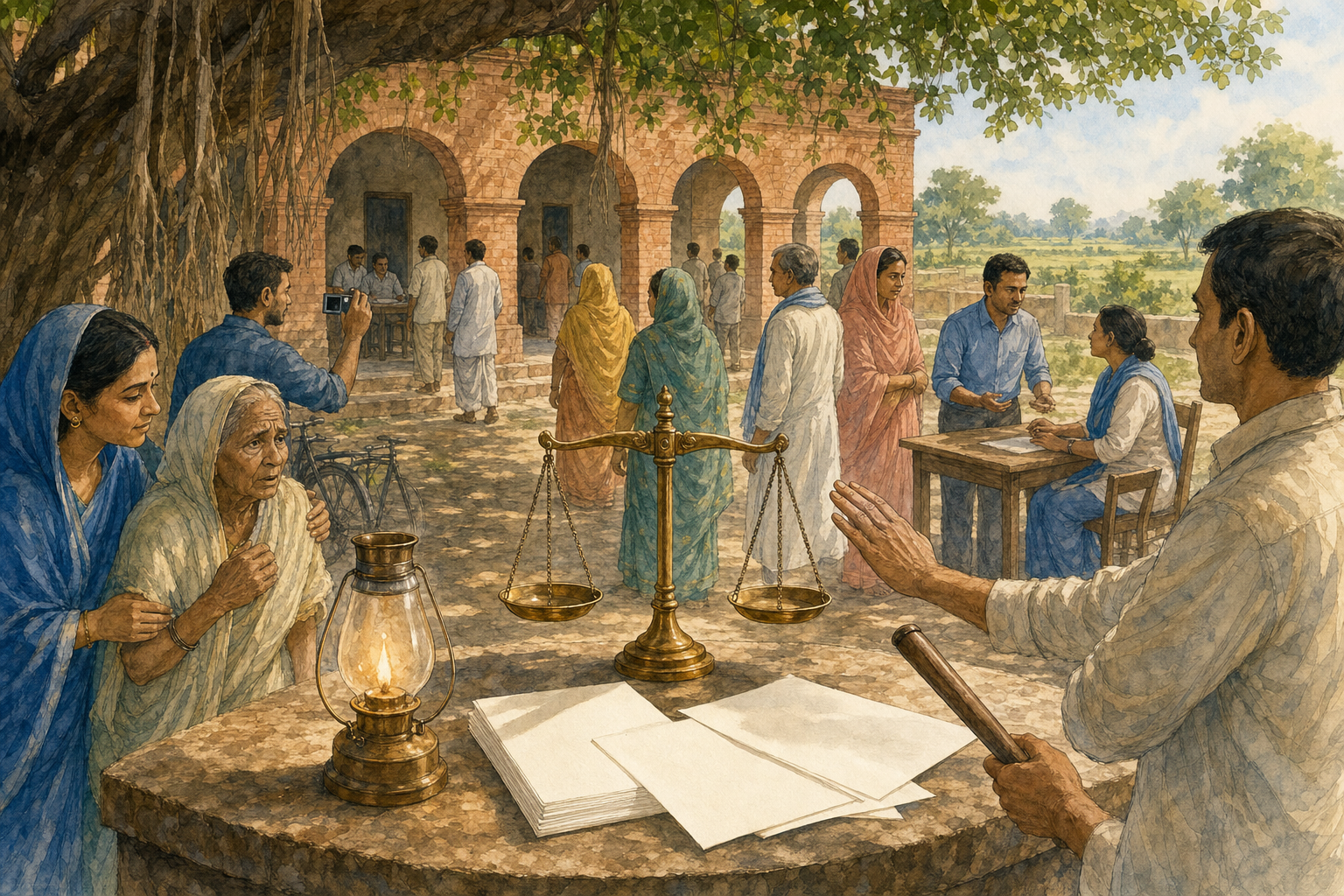
A Dharmic response to criminalized politics cannot stop at preferring one electoral coalition. Hindu, Buddhist, Jain, and Sikh traditions are not interchangeable, but they meet on an ethical ground that gives public life a demanding standard: coercion degrades human dignity, truth cannot be optional, and justice must not depend on identity or political usefulness.
Ahimsa requires more than personal non-violence. In civic life, it means refusing to normalize intimidation as leadership. Satya requires you to distinguish substantiated facts from convenient rumours, including rumours directed at people you oppose. Nyaya requires equal protection for the politically weak and due process even for the widely feared. These principles work together; discard any one of them and accountability becomes selective.
Before the next election you follow, make a one-page scorecard. Record the seriousness and status of allegations, evidence of coercive reach, the party’s response, the independence shown by institutions, and whether influence survives arrest or defeat. Apply it to every coalition without changing the standard. Share verified facts, ask candidates how witnesses and officers will be protected, and refuse the claim that a strongman is acceptable because he is our strongman.
Bihar moves beyond criminalized politics when electoral usefulness no longer purchases impunity. You can help move that boundary by judging power through the safety of its weakest critic, not the confidence of its loudest leader.
References
