
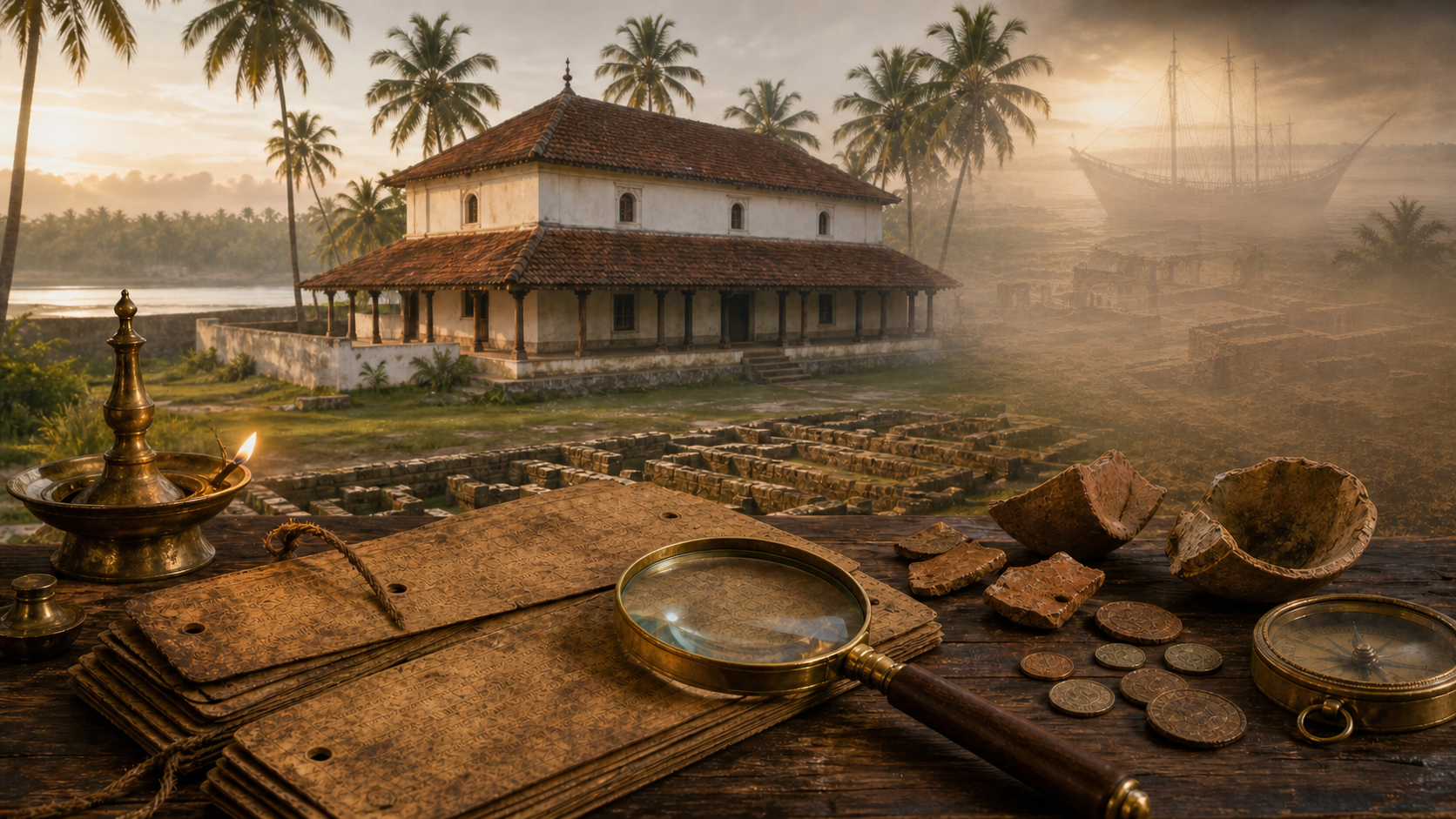
If you are trying to decide whether the Cheraman Perumal Juma Masjid was founded during Prophet Muhammad’s lifetime, don’t let the question collapse into a contest between reverence and scepticism. The historical issue is narrower: which event is being dated, and what evidence carries that date?
The claim deserves careful testing because its implications are enormous. A foundation during the Prophet’s lifetime would place Kodungallur among the earliest mosque sites outside Arabia and China, earlier than the dates associated here with Iraq in 639 CE, Egypt in 642 CE, Tunisia in 670 CE, and Syria in 715 CE. A place in that chronology cannot rest on the age of a tradition alone.
The candid answer is that the surviving chronology does not securely establish a seventh-century foundation at Kodungallur. Several strands point to a real memory of a Kerala ruler departing by sea and perhaps embracing Islam, but the historical dates attached to that memory fall later. The strongest epigraphic cluster lies around 1122–1124 CE, and even that cluster does not directly date the Kodungallur mosque.
First separate the four events hidden inside one claim
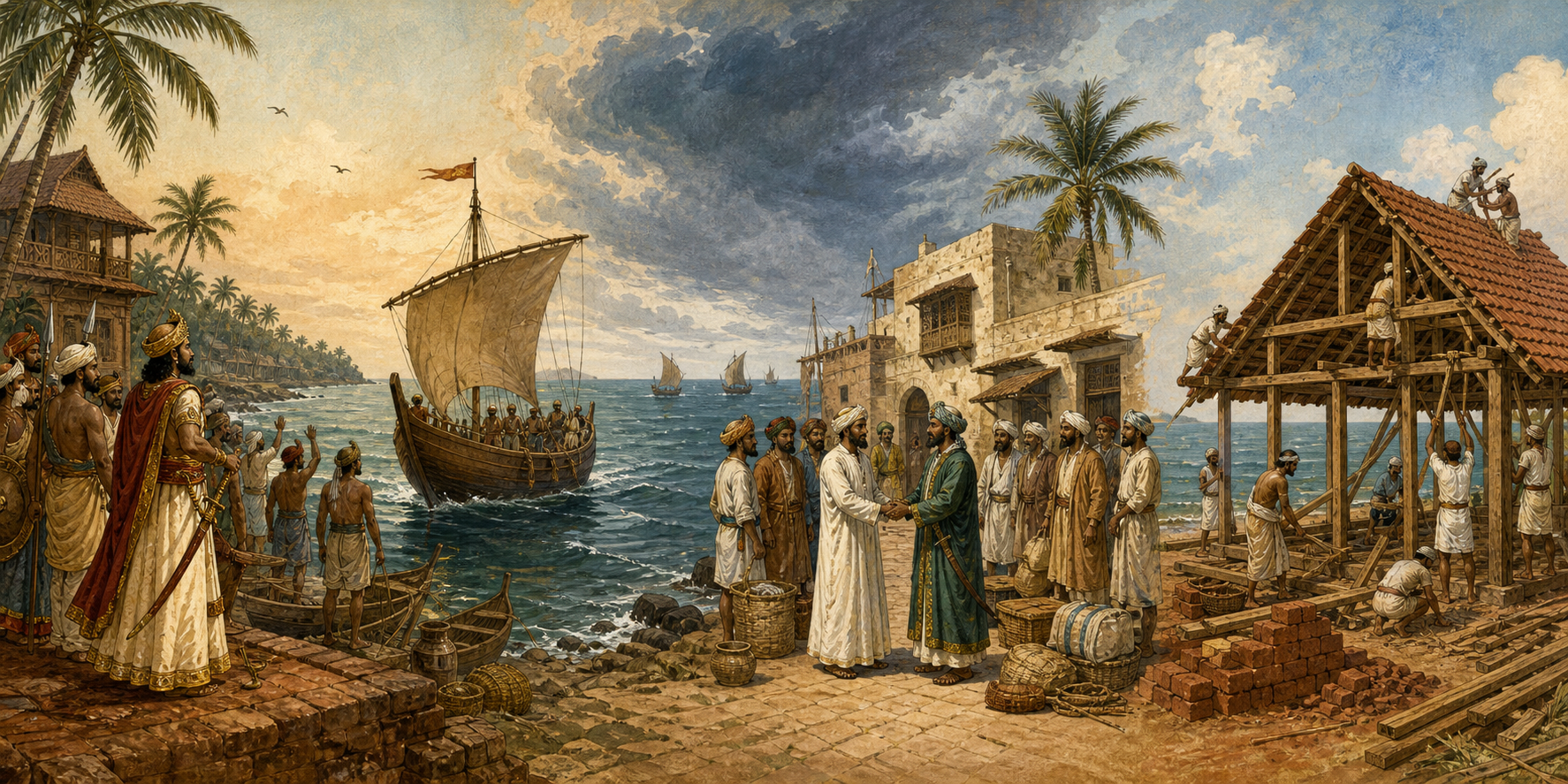
People often ask, “When was the mosque founded?” as if every element of the Cheraman story happened at the same moment. It did not necessarily happen that way. Before accepting or rejecting any date, separate these four questions:
- When did the ruler live? This concerns the identity and reign of the Cheraman Perumal associated with the story.
- When did the alleged conversion and Arabian voyage occur? A date for the ruler’s departure is not automatically a date for a mosque.
- When did returning companions or envoys establish a Muslim institution? The tradition places several mosques in this phase, at different locations.
- When was the structure at Kodungallur built, rebuilt, or renovated? A religious institution can remain on one site while its physical buildings change repeatedly.
Evidence for one of these events cannot silently migrate to another. A record of a ruler going to sea does not prove that he converted. A dated inscription at one mosque does not date every mosque attributed to the same mission. An old community tradition does not identify the construction phase of the building now standing.
The name itself requires care. Cheraman denoted the Chera dynasty, while Perumal was a title meaning “the great one”; it was not the personal name of a single, uniquely identifiable king. If you treat every Cheraman Perumal reference as a reference to the same man, separate rulers and separate centuries can be fused into one artificial biography.
Read the dates as an evidence ladder, not a single timeline
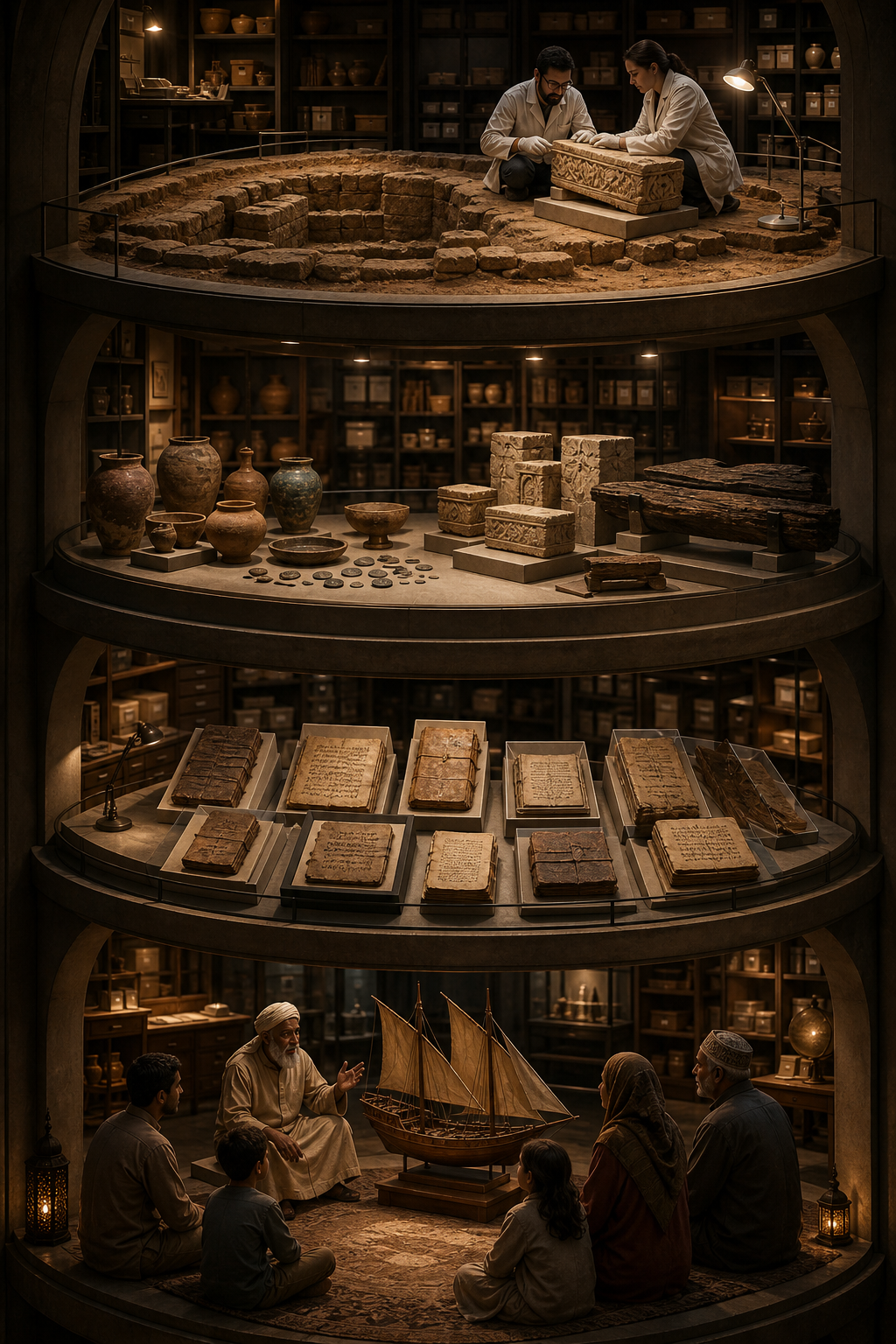
The main chronological anchors differ sharply in what they can support. The useful question is not merely whether a date exists, but whether it belongs to the ruler, the voyage, a tomb, a particular mosque, or a much later retelling.
| Date or period | What carries the date | What it can establish |
|---|---|---|
| Prophet Muhammad’s lifetime | The Kodungallur signboard and the familiar legend of the moon-splitting, conversion, voyage, and returning companions | They establish a powerful community tradition. They do not supply contemporary seventh-century evidence for the mosque’s foundation. |
| 212 AH, or 827–828 CE | A reported tomb inscription at Zafar naming Abdul Rahman al-Samiri, described as a king of Malabar | It may preserve the memory of a Malabar dignitary in Arabia. The identification of al-Samiri with the Cheraman Perumal is unproven. |
| Approximately the ninth or tenth century | Duarte Barbosa wrote in 1510 that the ruler’s departure had occurred about 600 years earlier | His estimate places the episode well after the Prophet’s lifetime. Because it is a retrospective estimate recorded centuries later, it is a broad horizon rather than an exact event date. |
| About two centuries after the Prophet | Sheikh Zeinuddin placed the ruler’s encounter with Arab Muslims and subsequent voyage in this later period | This is another explicitly post-seventh-century chronology, but it still comes from a later narration rather than a contemporary inscription. |
| 1122 CE | A Vikrama Chola inscription refers to the Cheras going to sea, while a temple record from the same year mentions Cheramar Rama | The pair supplies a strong chronological setting for the last Chera Perumal and a possible maritime departure. Neither record states that he met the Prophet or founded the Kodungallur mosque. |
| 1124 CE | An inscription at the Matayi mosque | It gives a close, site-specific date for Matayi within the larger mosque-founding tradition. Matayi is not Kodungallur, so this date cannot simply be transferred to the Cheraman Perumal Juma Masjid. |
Two common errors become visible in this ladder. The first is identifying Abdul Rahman al-Samiri with the Cheraman ruler because al-Samiri resembles Samuthiri, or Zamorin. No confirmed record places a Zamorin abroad as a convert, so resemblance between titles is not enough. The second is presenting the Matayi inscription as if it were an inscription from Kodungallur. It is relevant to the larger tradition, but it belongs to a different mosque.
The dates also have different levels of proximity to the events they describe. The 1510 estimate is valuable because it is the earliest surviving European version and because Barbosa knew Kerala’s commercial society well. It still looks backward by roughly six centuries. The chronology attributed to Zeinuddin is locally significant and explicitly rejects a lifetime-of-the-Prophet setting, but it too was preserved long after the alleged voyage. These witnesses can show that a narrative circulated and how its tellers dated it; they cannot perform the work of a contemporary foundation inscription.
Why the 1122–1124 sequence is the crucial guardrail
The early twelfth-century evidence matters because several independent chronological details converge there. The 1122 Chola inscription has been interpreted as referring to the last Chera Perumal, Rama Kulasekhara, departing by sea. A temple record from that same year mentions a garland offered for Cheramar Rama’s benefit, placing him alive in 1122. Inscriptions associated with Udaya Varman of Koluttunadu and Kavi Alupendra of the Tulu country also fit the early-to-mid-twelfth-century political setting linked with the last Perumal.
The mosque tradition then places envoys or companions in Kerala after the ruler’s Arabian journey and attributes a network of mosques to them. The 1124 inscription at Matayi falls only two years after the 1122 references. That proximity makes an early-twelfth-century horizon historically coherent for the last-Perumal departure and mosque-mission cycle.
Coherence is not the same as proof of every detail. The 1122 evidence does not say that Rama Kulasekhara accepted Islam. It does not say that he dispatched Malik bin Dinar or other named founders. It does not mention a foundation at Kodungallur. The 1124 inscription belongs to Matayi and cannot establish the date of another site merely because both appear in one later chain of memory.
This gives you the safest historical judgement: the strongest dated setting for the Perumal episode is post-Prophetic, with an especially important cluster in the early twelfth century. It does not justify replacing the traditional seventh-century claim with “1124 CE” as the proven Kodungallur foundation date. That would exchange one unsupported precision for another.
Kerala’s memory may preserve a voyage better than a calendar
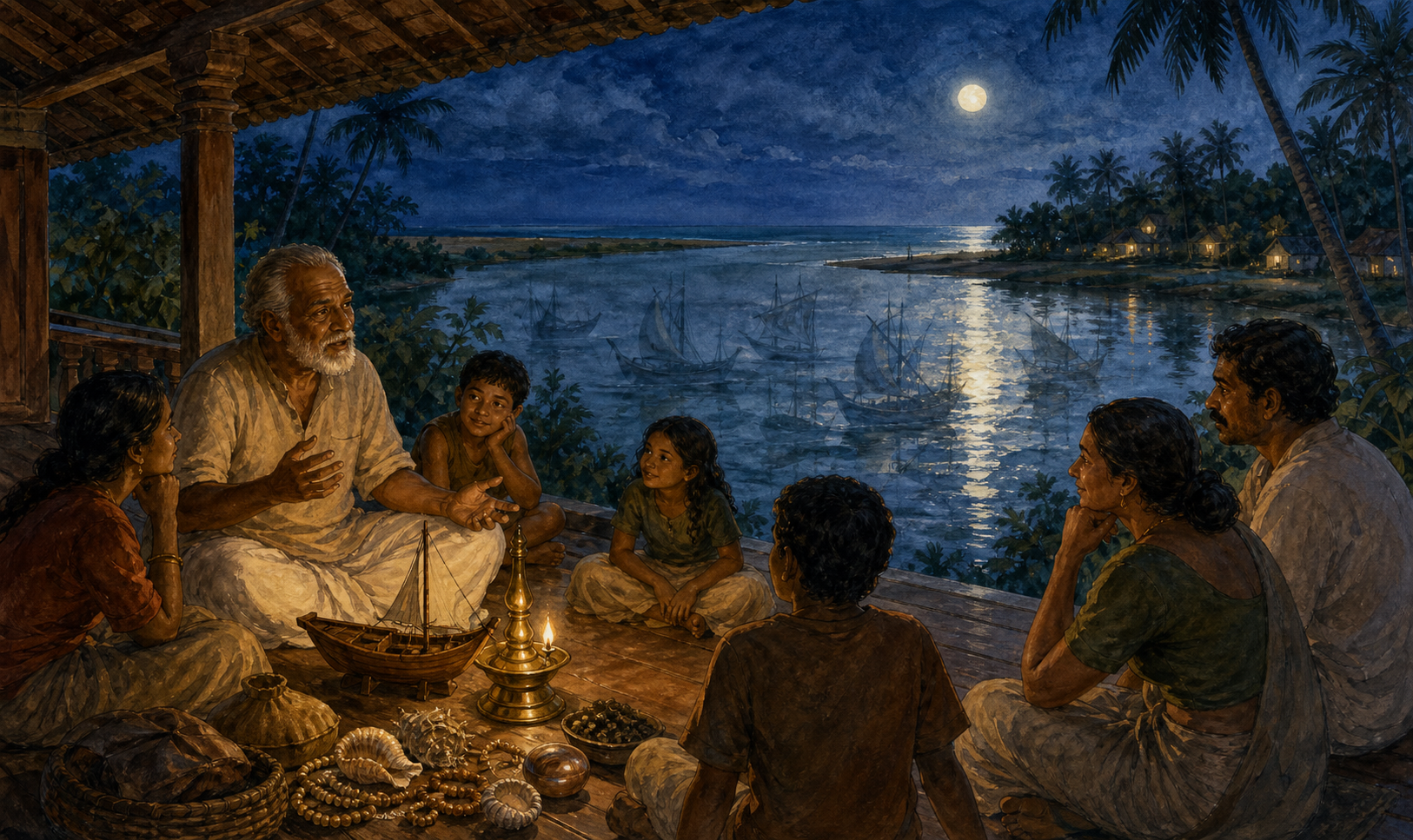
Rejecting an unproven date does not require treating the entire tradition as fiction. Muslim, Portuguese, Dutch, Brahminical, and Kerala court memories repeatedly retain a recognisable core: a powerful ruler had close relations with overseas merchants, left Kerala, and became connected with the division of his realm. A Malabar notable may indeed have adopted Islam and travelled toward Arabia. The exact identity and century remain harder to establish.
The changing endings reveal where memory was being reshaped. A Portuguese version completed in 1610 includes both an Islamic voyage and a competing Christian ending in which the ruler accepted Christianity and died in Mylapore. In 1723, Canter Visscher recorded alternatives involving either a journey to the Ganges or a voyage to Arabia to embrace Islam. The story appeared again in Dutch and British-era accounts from 1781 and 1801, as well as in Keralolpathi and Granthavari.
When the departure remains stable but the destination and conversion change, the stable element deserves more confidence than the variable one. The ruler’s disappearance, voyage, and partition may preserve political memory; the precise confessional conclusion may reflect the religious and mercantile rivalries of later communities.
Kerala’s political circumstances make that reading plausible. Chera authority faced Chola and Pandya pressure while coastal power depended heavily on Jewish, Christian, and Muslim commercial networks. Regional rulers were gaining autonomy, and the partition attributed to the departing Perumal could encode the breakdown of central authority and the emergence of successor polities. This is an interpretation of the legend’s historical function, not direct proof that every narrated event occurred.
Keralolpathi belongs to this layer of cultural memory. Compiled in the seventeenth or eighteenth century, it describes Perumals governing under a twelve-year convention and gives the departing ruler a morally charged place in Kerala’s political order. It is valuable for understanding how later Kerala remembered kingship. Its late compilation prevents it from serving as eyewitness confirmation of a seventh-century mosque.
This distinction matters for a Dharmic understanding of history. Respect for inherited memory does not demand that legend, inscription, political symbolism, and architectural history be treated as interchangeable. Giving each kind of evidence its proper weight protects Kerala’s civilisational memory from both careless dismissal and careless exaggeration.
Key takeaways for judging the founding claim
- The lifetime-of-the-Prophet date is traditional, not epigraphically secured. None of the dated anchors considered here is a contemporary seventh-century Kodungallur foundation record.
- The Perumal episode is consistently older than its surviving narrations but later than the signboard chronology. Barbosa’s estimate and Zeinuddin’s chronology both place it after the Prophet’s lifetime.
- The strongest dated cluster is 1122–1124 CE. It supports an early-twelfth-century setting for the last Perumal and the associated mosque mission more strongly than it supports any seventh-century claim.
- The 1124 inscription belongs to Matayi. It must not be presented as a Kodungallur inscription or as direct proof of the Cheraman Perumal mosque’s foundation year.
- Cheraman Perumal is a dynastic title. Establish the ruler’s personal identity before joining references from different places or centuries.
- A historical core can survive inside a chronologically unstable legend. A ruler’s maritime departure may be plausible even when the moon-splitting episode, conversion date, destination, and mosque list cannot all be independently verified.
If you need a defensible caption, lecture note, or social-media description, use wording at this level of certainty: The Cheraman Perumal Juma Masjid is associated with a long Kerala tradition about a ruler who embraced Islam and with the early Muslim presence on the Malabar coast. Surviving chronology does not prove that the mosque was founded during Prophet Muhammad’s lifetime; the strongest dated evidence connected with the Perumal cycle is later, and the 1124 inscription is at Matayi rather than Kodungallur.
When you encounter a more precise claim, ask three questions before repeating it. Is there a contemporaneous inscription from Kodungallur itself? Does the cited date refer to this mosque, another mosque, a ruler’s journey, or a later retelling? Does it date an original foundation, or only a subsequent structure, repair, or inscription? Unless those questions receive site-specific answers, the exact Kodungallur foundation year should remain open.
That position leaves room for new epigraphy or archaeology to sharpen the chronology. Until such evidence appears, describe the Prophet-era foundation as tradition, keep Matayi’s 1124 date attached to Matayi, and present the early twelfth century as the strongest historical horizon rather than a verdict the records do not actually deliver.
References
