
Five countries form the visible outline of a larger diplomatic argument. An excerpt carried by Hindu Post contends that Bharat’s engagements with South Korea, Japan, Indonesia, Australia and New Zealand should be read as a connected Indo-Pacific sequence rather than as isolated visits.
That is a strategic interpretation, not proof that New Delhi has formally described its policy as a Mandala strategy. Separating the reported calendar from the analytical framework makes it possible to see both the significance of the argument and the limits of the available evidence.
The diplomatic calendar behind the argument
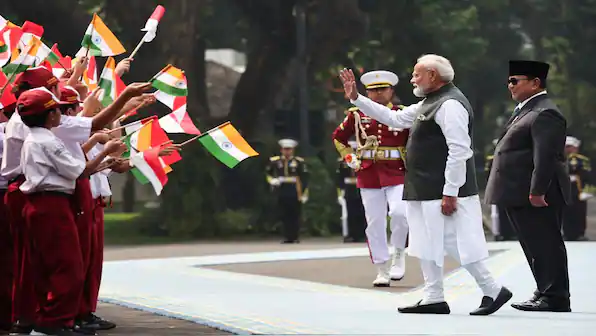
According to the material presented by Hindu Post, South Korean President Lee Jae-myung arrived in Bharat on April 19 for the first state visit by a Korean president in eight years. Japanese Prime Minister Sanae Takaichi followed on July 1 for the 16th annual summit and her first visit to Bharat after taking office. The excerpt then places Prime Minister Narendra Modi’s six-day journey through Indonesia, Australia and New Zealand, from July 6 to 11, within the same arc.
The source emphasizes the compressed timing: Modi reportedly began the three-country journey within 72 hours of the Japanese prime minister’s departure. On that basis, the underlying Firstpost commentary interprets the period from the third week of April to the second week of July as concentrated diplomatic activism. The calendar supports examining the engagements together, although timing alone cannot establish their outcomes or prove that every meeting served one coordinated design.
What a Mandala lens adds to the picture
Mandala thinking is associated with classical Bharatiya statecraft. In broad terms, it treats foreign relations as a changing arrangement of powers whose interests, capabilities and positions must be assessed in context. It is therefore more useful as a method of mapping relationships than as a rigid formula dividing the world into permanent friends and enemies.
Applied to the reported sequence, this lens shifts attention from individual ceremonies to the network they may create. South Korea and Japan are approached as part of the same wider field as Indonesia, Australia and New Zealand. The relevant question becomes whether different relationships can reinforce Bharat’s room for action across the Indo-Pacific, even when the partners do not have identical priorities.
This remains analysis rather than confirmation of official doctrine. The supplied excerpt does not cite a government statement adopting the Mandala label, and it does not provide the agreements or measurable outcomes needed to demonstrate a completed strategic recalibration.
Key takeaways
- The reported calendar shows a concentrated period of engagement with five Indo-Pacific countries.
- The close sequencing makes a connected reading plausible, but it does not by itself prove common policy outcomes.
- Mandala statecraft offers an interpretive framework for flexible, interest-aware relationships rather than a verified description of official policy here.
- The value of the diplomatic arc will ultimately depend on sustained cooperation and institutional follow-through, not travel optics alone.
Civilizational confidence with strategic discipline
A civilizationally confident Bharat need not choose between realism and values. Dharma emphasizes conduct appropriate to responsibility and circumstance, a principle compatible with clear-eyed attention to national interest. Its political use should nevertheless remain disciplined: an inherited concept can sharpen judgment, but it cannot substitute for capabilities, negotiation or reciprocal commitments.
Hindu, Buddhist, Jain and Sikh traditions are distinct, yet each gives serious place to disciplined action, ethical restraint and obligations extending beyond individual ego. That shared Dharmic grammar offers a constructive model for engaging diverse partners without demanding sameness. In diplomacy, unity is strongest when it respects different paths while building cooperation around practical interests.
Such a perspective also guards against romanticism. Civilizational memory may deepen cultural confidence, but neither historical affinity nor symbolic language guarantees present-day alignment. Dharma-informed statecraft must therefore unite principle with prudence.
How to judge whether recalibration becomes durable
The excerpt does not report specific trade results, defence commitments, joint projects or institutional mechanisms. Any claim about success must consequently remain provisional. Durability would be demonstrated by continuity after the visits, substantive cooperation beyond summit declarations, reciprocal investment by partner governments and preservation of Bharat’s strategic autonomy.
Coherence will matter as much as activity. A genuine Indo-Pacific recalibration would connect separate relationships without forcing every partner into one bloc or making Bharat dependent on a single external power. If the reported diplomatic momentum develops into repeated, practical cooperation, the Mandala reading will gain explanatory force; if it ends with the travel calendar, it will remain an evocative interpretation rather than a proven strategy.
Inspired by this post on Hindu Post.
