

If national pride has started to feel like a choice between slogans and cynicism, reject the choice. You can celebrate Bharat without exaggerating it. Ask what was achieved, how it was measured, who made it possible, and what duty follows for you.
Pride becomes credible when it rests on truth, gratitude, and service. That is also what makes it Dharmic: achievement is neither denied nor appropriated for personal display. It is understood, honoured, and carried forward through responsible action.
Key takeaways for credible civic pride
- State every achievement with its period, place, unit, and scope intact.
- Credit the performer, the coach or teacher, and the institution or community that enabled the result.
- Distinguish a completed outcome from a promising experiment whose impact still needs to be measured.
- Give achievements prominence according to their national significance, not merely their emotional or geopolitical appeal.
- Turn one achievement you admire into one defined civic action within the next 30 days.
Start with claims that can survive a skeptical question

A strong claim tells you what happened and where its boundaries lie. Consider Bharat’s trade performance. Exports in FY26 reached Rs. 76.27 lakh crore, or US$863 billion. Merchandise contributed Rs. 39.06 lakh crore, or US$442 billion, while services contributed Rs. 37.21 lakh crore, or US$421 billion. Keeping that split matters because a total without its components can conceal what is actually driving it.
The time frame matters just as much. Exports grew by roughly 73% over six years, with growth of 15% recorded in the first four months. Those percentages are not interchangeable. One describes a multi-year trajectory; the other captures a much shorter window. If you share either number, carry its period with it.
These figures provide substantial evidence of Bharat’s growing trade scale and help explain confidence in Make in Bharat. They do not, by themselves, prove that every region, enterprise, worker, or household benefited equally. Saying that boundary aloud does not weaken the achievement. It prevents a defensible fact from being burdened with a claim it cannot support.
Before forwarding an achievement, put it through this four-part check:
- Name the period precisely: financial year, calendar year, tournament, award cycle, or inauguration date.
- Keep the original unit and relevant components. Do not detach a percentage from its base period or combine rupees and dollars carelessly.
- Match the conclusion to the measurement. Export value can show trade scale; it cannot answer every question about the distribution of prosperity.
- Preserve uncertainty. If a project has opened but has not yet published results, call it an institutional experiment rather than a proven transformation.
This habit gives you something more useful than a patriotic talking point: a fact that remains true even when repeated by someone who does not share your politics.
Credit the civic chain behind the visible achievement

National progress is usually produced by a chain of effort. The most visible person may complete the act, but teachers, coaches, administrators, families, religious institutions, and local communities often make completion possible.
In Sasaram, Bihar, Mahavir Temple provides free coaching to government-job aspirants. Rohtas District Magistrate Deepak Kumar Mishra and Superintendent of Police Raushan Kumar have also offered guidance. The responsible claim stops there: learners are receiving coaching and access to experienced officials. It does not leap to unsupported claims about examination pass rates.
The arrangement is still worth noticing. A temple is serving an educational need, public officials are making their knowledge accessible, and aspirants are doing the sustained work of preparation. Civic pride should recognise all three parts. If the students alone are praised, the enabling institutions disappear. If only the officials or temple are praised, the agency of the students disappears.
Sport reveals the same pattern. The 2025 National Sports Awards honoured 17 Arjuna Award recipients and five Dronacharya Award recipients. The Arjuna honorees included Tejaswin Shankar, Divya Deshmukh, Vidit Gujrathi, Treesa Jolly, Gayatri Gopichand, and Lalremsiami. The five recognised coaches were Parveer Singh, Chhote Lal Yadav, Neha Nandkumar Chavan, Dharmendra Singh Yadav, and Virender Kumar.
Use a three-credit rule whenever you celebrate a result. Name the performer or beneficiary. Name the teacher, coach, mentor, or official when that contribution is known. Then name the institution or community that supplied the opportunity. This takes only one additional sentence, but it teaches younger readers that excellence is cultivated rather than magically produced.
Measure each achievement on the right scoreboard

An export total, a hockey score, a public award, and a new educational facility are all achievements of different kinds. Treating them as interchangeable produces shallow praise. Each needs its own test.
Let sporting significance outrank rivalry
In the FIH Hockey World Cup 2026, Bharat’s men’s team defeated Pakistan 5-3, while the women’s team defeated South Africa 6-1. The men’s result carries the emotional charge of a Bharat-Pakistan contest. The women’s result established a different and arguably more instructive benchmark: it was their biggest World Cup victory.
A mature national sporting culture can honour both without allowing rivalry to consume the story. Report the score, opponent, competition, and record status. Then ask what the result reveals about the team’s own development. A historic internal benchmark deserves attention even when the opponent does not generate a geopolitical spectacle.
This also changes what you share. Do not circulate only the result most likely to provoke a reaction. Give space to the performance that expands Bharat’s sporting imagination, especially when it helps young athletes see excellence outside the narrow set of events that usually dominates public attention.
Treat an inauguration as a capability, not yet an impact
On 16 August, Indore inaugurated a facility described as Bharat’s first virtual zoo. Developed through a public-private partnership at a cost of Rs. 4.5 crore, it includes a 14-D cinema, hologram-based wildlife experiences, and a virtual jungle safari. Its basic proposition is significant: visitors can encounter representations of global fauna without animals being held captive for display.
The opening demonstrates technological and institutional capability. Claims about improved environmental awareness, education, tourism, or operating efficiency remain outcomes to be measured. Confusing those two stages is one of the easiest ways for civic enthusiasm to outrun evidence.
Once operating data become available, judge the facility through four questions:
- Learning: can school groups demonstrate greater understanding of wildlife and conservation after a visit?
- Access: are the experiences usable across languages, age groups, and disability needs?
- Reliability: do the cinema, holograms, and virtual safari work consistently, and is maintenance responsibility under the partnership clear?
- Public value: do visitor use and educational outcomes justify the cost, and do the expected tourism benefits materialise?
These questions do not diminish the inauguration. They define the path by which a novel attraction can become a durable public institution.
Turn pride into a disciplined civic practice
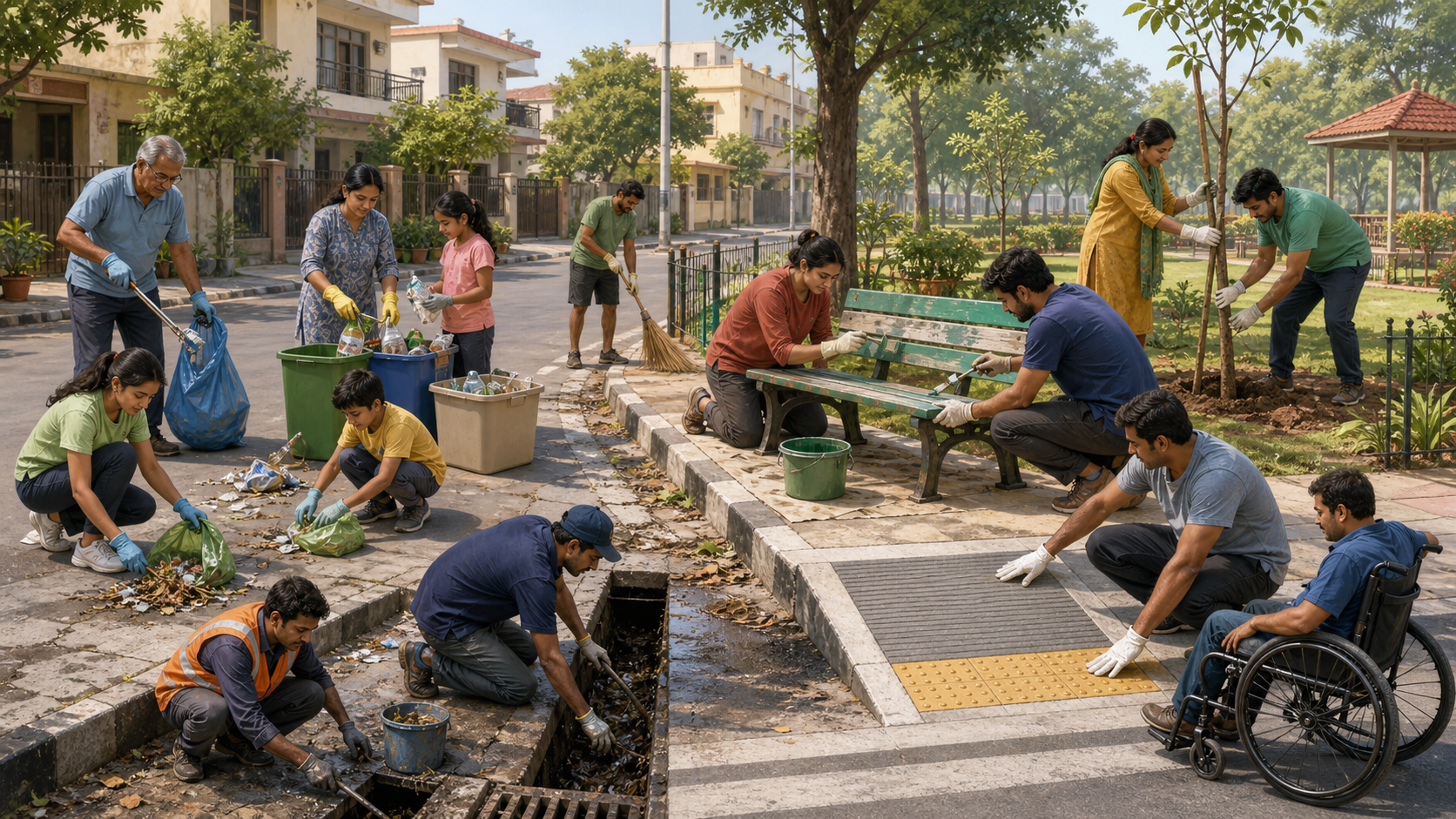
Civic pride becomes Dharmic when satya, gratitude, and seva remain joined. Satya keeps the claim honest. Gratitude remembers the full chain of contributors. Seva asks what you will do with the inspiration instead of treating another person’s work as material for your own display.
Use a two-sentence test when you speak about national progress. In the first sentence, state the achievement with its period and measure. In the second, name either the next unanswered question or the next institution that needs support. If the second sentence seems to destroy your pride, the pride is too brittle. If you never permit the first sentence, your criticism may have become just as automatic as propaganda.
You can put this into practice over the next 30 days:
- Week one: choose one achievement that matters to you. Save its link and write down the exact claim, date or period, place, unit, and one limitation. Do not rely on a screenshot with its context removed.
- Week two: identify the civic chain. Find the performer or beneficiary, the coach or teacher, and the institution or community. If a contribution is not documented, do not invent it.
- Week three: take one adjacent action. Accurately share a free educational opportunity, mentor an aspirant only if you are competent and invited, attend a local team’s event, or help an educational institution assess a clearly defined need. Ask before volunteering; unwanted help is not seva.
- Week four: check what your action changed. Correct any factual error you repeated, record what remains unknown, and decide whether the activity deserves another month of effort.
If you live outside Bharat, the method does not change. Preserve the original units and time periods when explaining an achievement. Then find the nearest responsible link in the civic chain, whether it is a student association, temple, gurdwara, Jain sangh, Buddhist centre, sports club, or educational group. Support a defined need rather than using a community as a backdrop for patriotic performance.
The next time a national achievement reaches your screen, do three things before moving on: verify one bounded fact, name the people and institutions behind it, and choose one nearby action worthy of it. That is how pride stops being a passing mood and becomes civic character.
References
