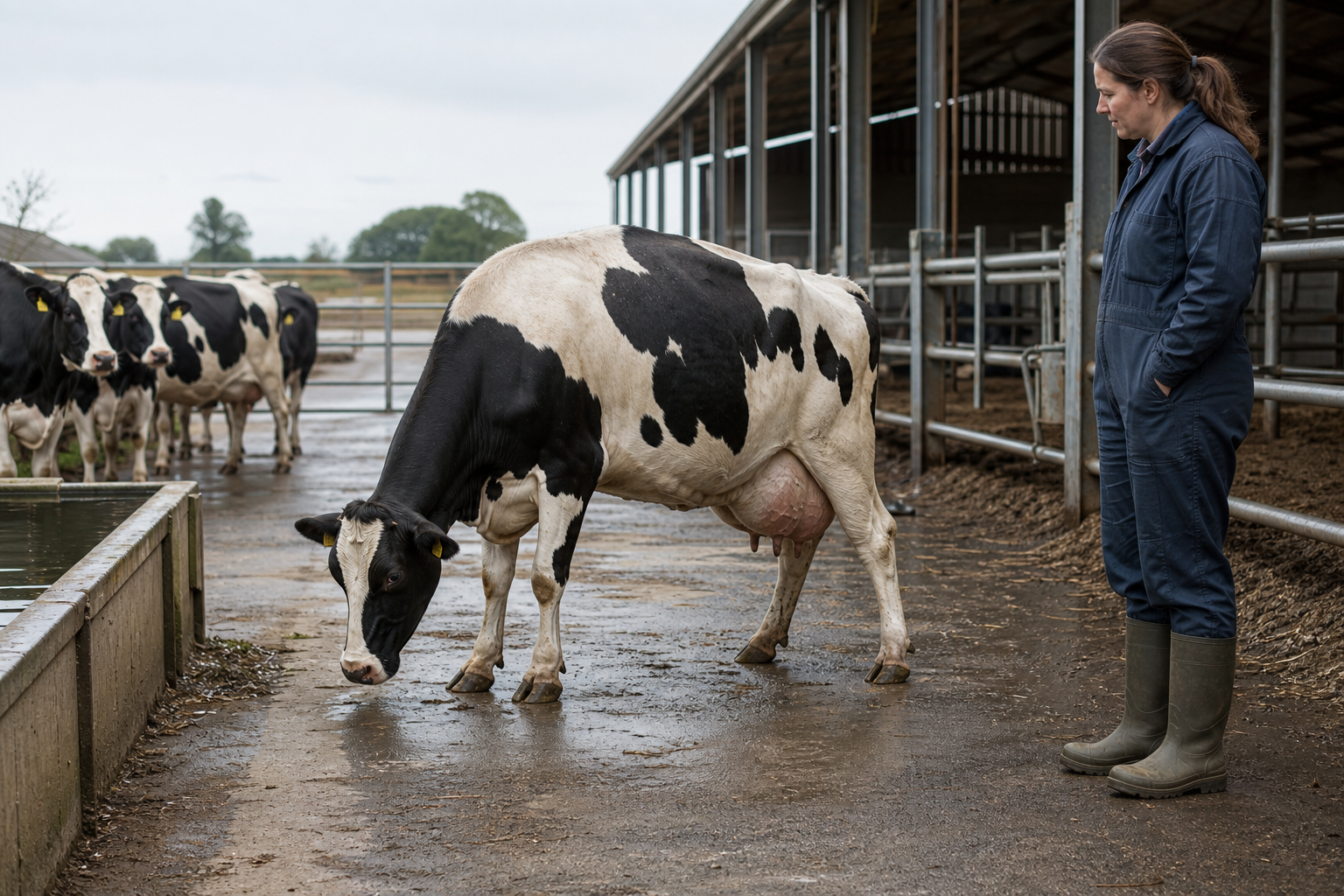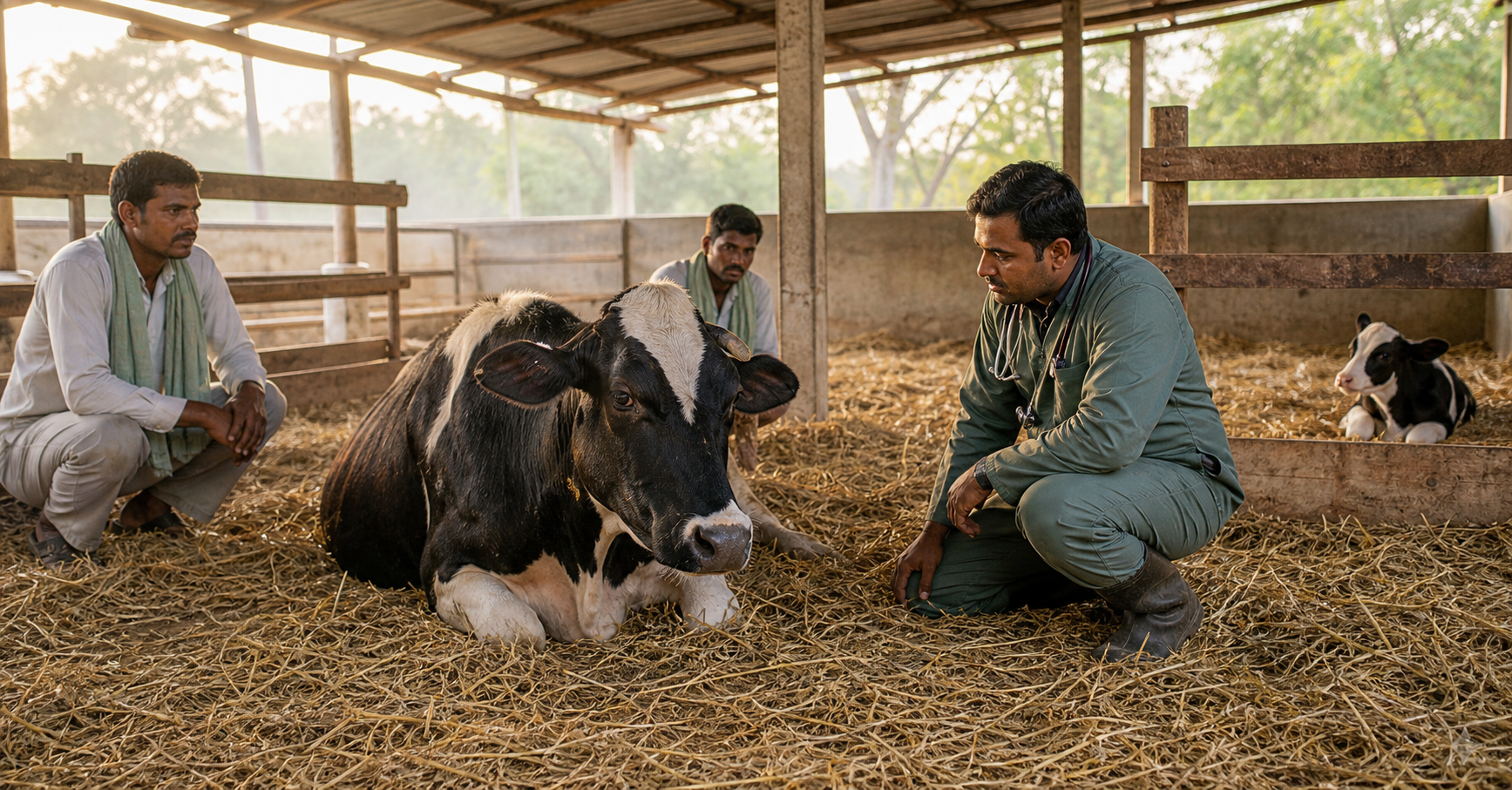
Your cow calved yesterday, seemed well, and now will not come for milking. She is weak, lying flat, breathing hard, or beginning to bloat. Call a veterinarian immediately. In a recently calved cow, those signs can mark a life-threatening calcium crisis, and the safe response is measured in prompt action rather than home remedies.
This is where dharmic reverence becomes practical goseva. Compassion means protecting the cow while qualified help is coming, knowing which interventions can save her, and avoiding well-meant actions that can cause aspiration, injury, or fatal delay.
Key takeaways
- Suspect milk fever when a cow becomes weak, unsteady, recumbent, poorly responsive, bloated, or unable to hold up her head during the first 24-48 hours after calving, especially if she is an older, multiparous, high-producing cow.
- Call a veterinarian as soon as serious signs appear. Postpartum collapse has several possible causes, so a plausible suspicion is not a complete diagnosis.
- Keep a down cow in sternal recumbency – upright on her chest with her legs tucked safely – whenever this can be done without endangering people or injuring the cow. Lying flat on her side worsens breathing, bloat, and aspiration risk.
- Intravenous calcium is the central veterinary treatment for moderate-to-severe hypocalcemia. It must be given slowly with cardiac monitoring, not improvised by an untrained caretaker.
- Never force oral calcium, water, or another substance into a cow that cannot control her head or swallow reliably. Material entering the airway can turn one emergency into another.
- A response to calcium is the beginning of recovery, not the end. Prolonged recumbency can damage muscles and nerves even after the calcium deficit has been corrected.
Recognize the pattern before the cow is fully down
Milk fever is the common name for periparturient hypocalcemia: an acute shortage of circulating calcium around calving. The name can mislead you because the central problem is not fever. The abrupt demand for colostrum and milk can exceed the cow’s ability to mobilize and absorb calcium quickly enough.
Calcium supports nerve signaling as well as skeletal and smooth-muscle contraction. When calcium falls too far, weakness is only the most visible result. The rumen can lose motility, the esophagus may function poorly, gas accumulates, and the cow becomes less able to protect her airway. Severe cases progress to lateral recumbency, depressed responsiveness, labored breathing, and death without timely treatment.
The timing matters. Risk is highest around the sudden start of heavy calcium demand, often in the first day or two after birth. A cow that looked vigorous several hours earlier has not necessarily passed the danger period. Do not dismiss reluctance to walk, delayed arrival at milking, unusual stillness, or repeated difficulty rising as ordinary postpartum tiredness.
You do not need every textbook sign before calling. Treat the following cluster as an emergency warning:
- Recent calving followed by a rapid change in behavior or mobility.
- Reluctance to walk, hind-limb weakness, staggering, or repeated failed attempts to stand.
- Recumbency with the head drooping or lying flat.
- Lying fully on the side with the legs extended.
- Reduced responsiveness or an inability to remain alert.
- Abdominal distension consistent with bloat.
- Labored breathing, especially while laterally recumbent.
Milk fever should remain a working suspicion until a veterinarian evaluates the cow. A difficult birth, internal postpartum injury, infection, or another metabolic problem can produce overlapping signs. More than one complication can also be present. The responsible choice is to report the whole picture rather than fitting every symptom into a preferred explanation.
Protect the cow while veterinary treatment is arranged
What to do while help is coming
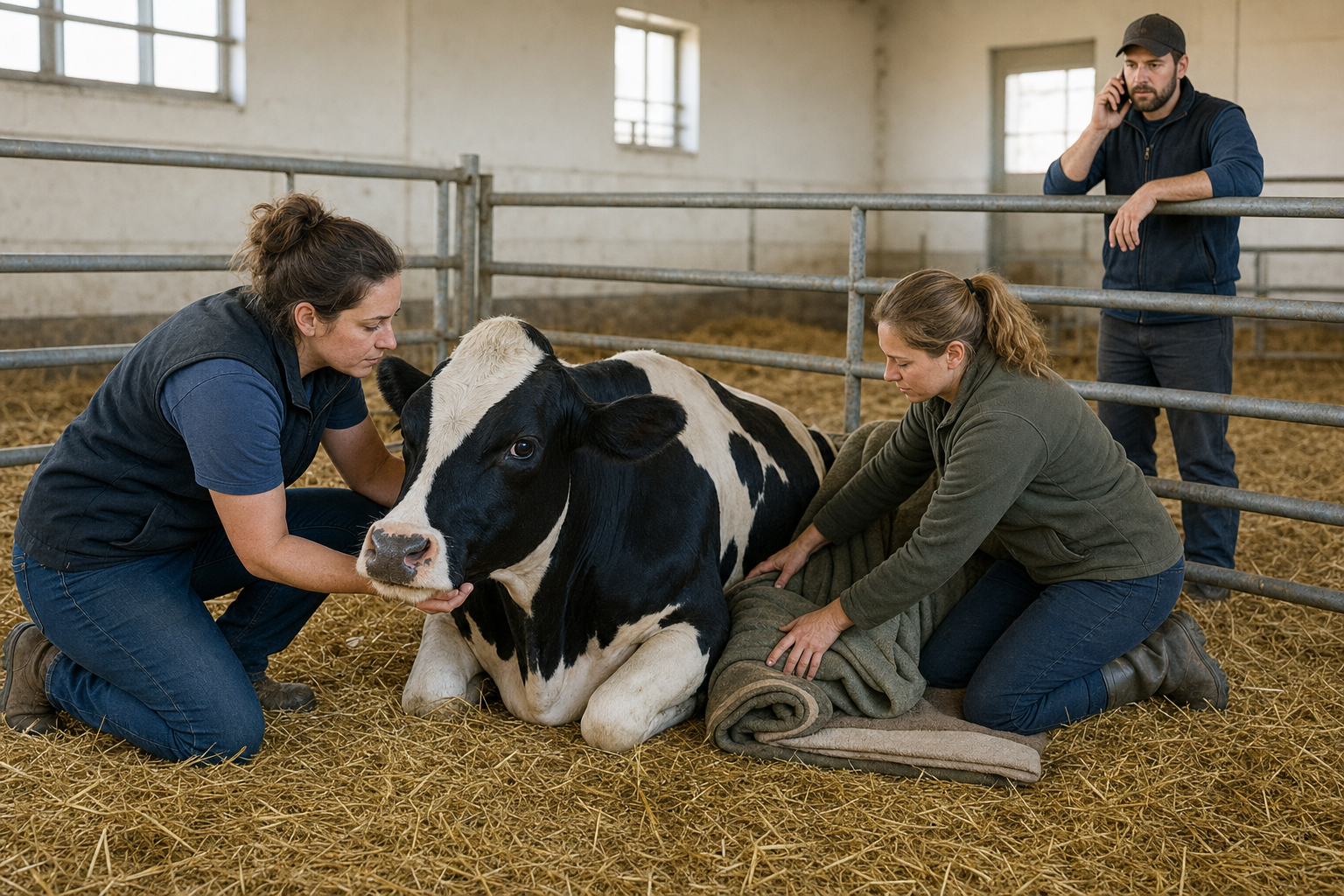
- Call the veterinarian first. Give the calving time, whether assistance was required, the cow’s parity if known, when she was last seen normal, whether she can rise, which position she is lying in, and whether her abdomen or breathing has changed. Mention any calcium already administered, including the product, route, amount, and time.
- Put one person in charge of communication. That person should record changes, relay the veterinarian’s instructions, find supplies, and keep conflicting directions from reaching the people handling the cow.
- Correct lateral recumbency when it is safe. Bring the cow upright onto her chest with her legs positioned so that she is stable. Sternal posture gives the lungs more room, helps her protect the airway, and reduces the tendency toward ruminal gas accumulation. A trapped head, fence, steep slope, or machinery can make repositioning hazardous; use experienced handlers and suitable equipment rather than strength alone.
- Remove immediate environmental hazards. Keep her away from an incline, open ditch, fence opening, vehicle route, and slick concrete. A weak cow may roll, slide, or injure herself during an attempt to stand. Clear a safe working area before bringing in a tractor, loader, rope, harness, or hip lifter.
- Offer; do not force. Place hay and water where an alert cow can reach them while remaining sternal. Do not pour liquid into her mouth, drench her, or force feed her. A cow with poor head control or impaired swallowing can aspirate what you give.
- Use oral calcium only under safe conditions. An oral calcium product may serve as a bridge or follow-up when the cow is alert enough to hold her head and swallow normally, and when its use agrees with the product directions and veterinary advice. Do not give oral paste to a flat, dull, or poorly swallowing cow. Do not copy a dose from someone else’s emergency; formulations and circumstances differ.
- Make a temporary calf and milking plan with the veterinarian. Uncoordinated nursing can endanger a down cow and calf, but indiscriminate separation or abrupt changes in milking can create other problems. Keep the calf safe and warm, and ask how nursing, udder relief, and reunion should be managed during treatment.
- Prepare access. Open gates, light the route, move unnecessary vehicles, and send someone to meet the veterinarian if directions, weather, mud, or poor phone reception could waste time.
Do not repeatedly pull a heavy cow around simply to make her look more upright. Ropes, tractor buckets, pulleys, harnesses, and hip lifters can help in trained hands, but each creates crushing, entanglement, and limb-placement hazards. Before any mechanical movement, decide who controls the equipment, who watches the legs, where the cow will be placed, and how the lift will stop if she struggles.
What definitive calcium treatment involves
For a moderately or severely affected cow, slow intravenous calcium – commonly a calcium borogluconate preparation – is the cornerstone of treatment. The heart must be monitored because calcium delivered too rapidly can disturb cardiac function. That is why an IV bottle is not a do-it-yourself substitute for veterinary attendance, even when the diagnosis seems obvious.
A cow may show a striking improvement in alertness, head position, limb movement, or willingness to stand after calcium. That response is encouraging, but it does not prove that every postpartum problem has been resolved. The veterinarian may need to investigate other causes, direct follow-up oral calcium to reduce relapse risk, and decide how closely the cow should be observed during the next phase.
Do not respond to early improvement by immediately forcing the cow to walk. Give her secure footing, room to organize her legs, and controlled assistance if the veterinarian recommends it. A metabolic correction can occur faster than injured muscles and nerves recover.
After calcium, prevent a second emergency in the down cow
Once the calcium deficit is corrected, prolonged recumbency may become the main threat. The cow’s weight compresses large muscles and peripheral nerves, especially in the hindquarters. Damage can begin after roughly 24 hours down, and the risk of degeneration becomes much more serious by about 72 hours. Waiting passively because “the medicine has been given” can therefore cost a cow the ability to rise.
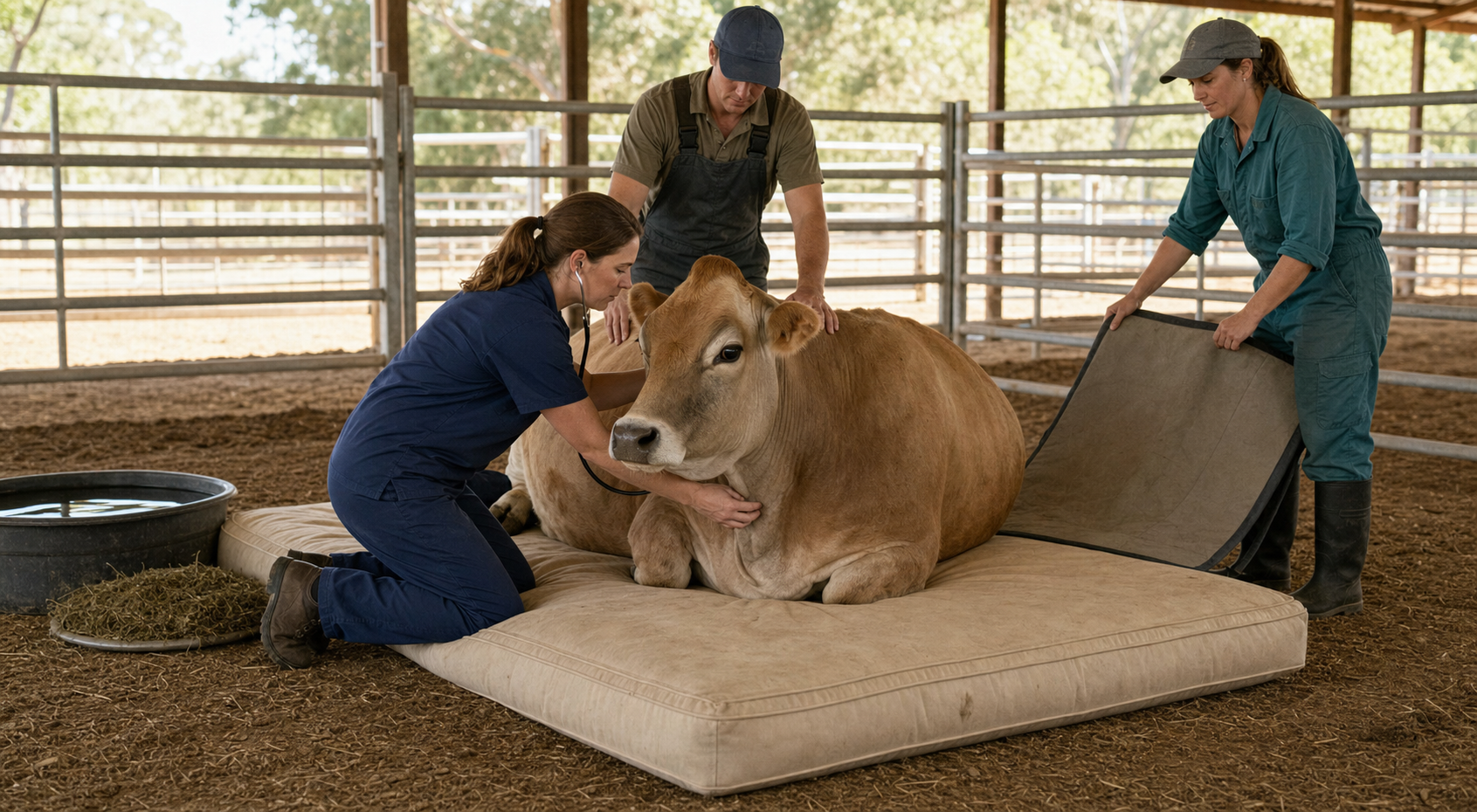
Footing often decides whether returning strength becomes an independent stand. Smooth concrete defeats weak hind limbs even when the cow is trying hard. Prepare a dry, well-bedded, non-slip area before moving her. Firm outdoor ground may offer better purchase than a slick barn floor, but it must be level, sheltered, and free of mud, ice, slopes, fences, and traffic hazards.
Build the recovery plan around observable functions rather than optimism:
- Can she remain sternal without props, or does she repeatedly roll onto her side?
- Is breathing easier, and is abdominal distension staying down?
- Can she hold up her head, stay responsive, and swallow safely?
- Is she moving both hind limbs, placing them normally, and making coordinated attempts to rise?
- Are swelling, abrasions, pressure injuries, or friction sores developing?
- Can she rise without the lifter, remain standing, take controlled steps, and lie down safely?
- Is she eating and drinking voluntarily, and has the veterinarian approved the calf and milking arrangement?
- Are weakness, recumbency, or bloat returning after the initial response?
Keep a written watch record. Note posture, breathing, bloat, responsiveness, feed and water intake, attempts to stand, treatments, and the time of every change. A shift change should not erase the clinical timeline. If she becomes duller, lies flat again, bloats, breathes harder, cannot swallow, or loses function she had regained, contact the veterinarian again immediately.
Assisted standing can be useful, but the goal is supported weight-bearing, not suspension for its own sake. A hip lifter must be fitted and used by people who understand the device, while others control leg placement and keep feet clear of wheels and chains. The cow needs secure footing under her feet and continuous observation. The meaningful milestones are independent rising, stable standing, coordinated walking, safe lying down, and the ability to repeat those actions.
Make goseva a system before the next calving
Ahimsa in an emergency is not passive non-interference. It is the disciplined reduction of suffering. Seva is not measured by how many people gather around the cow, but by whether the right person calls the veterinarian, the airway is protected, the equipment is used safely, and someone stays responsible through the night.
Before the next expected calving, put a one-page protocol in the barn:
- Veterinary contacts: the primary veterinarian, an after-hours number, a backup practitioner, and clear directions to the farm.
- Calving record: the cow’s identity, parity, expected date, actual birth time, delivery difficulty, and the time she was last observed behaving normally.
- Named postpartum checks: assign people to observe appetite, movement, alertness, posture, abdominal distension, and willingness to come for milking through the first 48 hours. Do not assume somebody else looked.
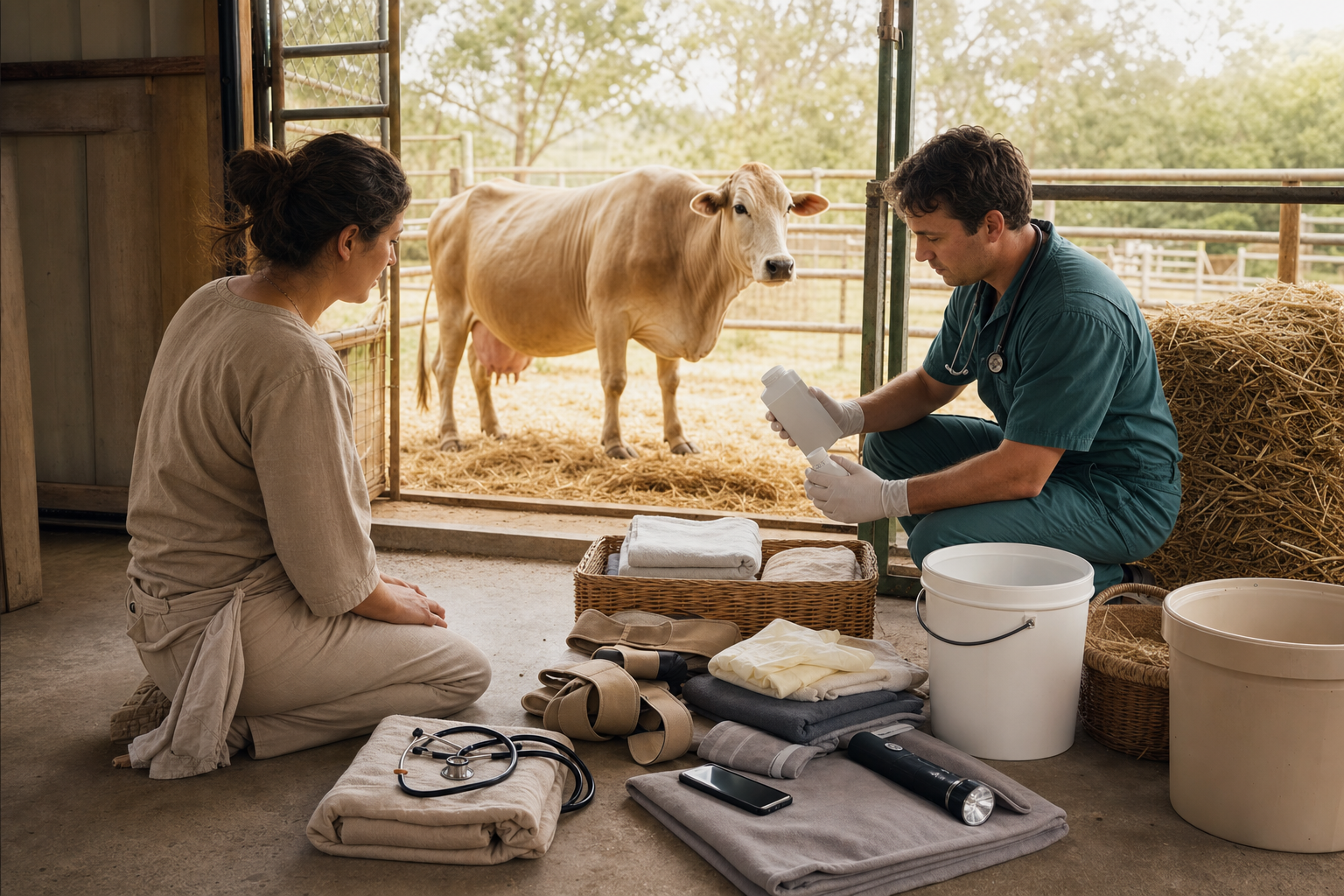
- Emergency supplies: in-date oral calcium intended for cattle, clean handling equipment, adequate bedding, lighting, and a written inventory. Storage in the barn does not authorize unsafe administration; label directions and veterinary instructions still govern use.
- A safe recovery pen: dry shelter, deep bedding, non-slip footing, enough room for repositioning, and no nearby slope or structure that can trap the head or legs.
- Handling roles: designate the equipment operator, cow-side lead, limb observer, note keeper, and person responsible for the calf. Practice communication before an animal is down.
- Access planning: know whether a veterinarian or tractor can reach the calving and recovery areas in darkness, mud, snow, or poor weather. A treatment plan that cannot physically reach the cow is incomplete.
- Night continuity: when a cow is critically ill, use a written rotation with explicit handoffs. Record who checks her, when the next check is due, and which change requires another veterinary call.
Devotional presence, prayer, chanting, and gentle companionship can accompany care. They must never postpone veterinary examination, calcium treatment, airway protection, or safe repositioning. Dharmic care respects both the cow’s sacred significance and the physical laws governing her body.
Put the veterinarian’s number, recovery-pen location, equipment roles, and first-response checklist on the barn wall before the next calf arrives. When every minute feels confused, that preparation lets your community express karuna through competent action.