
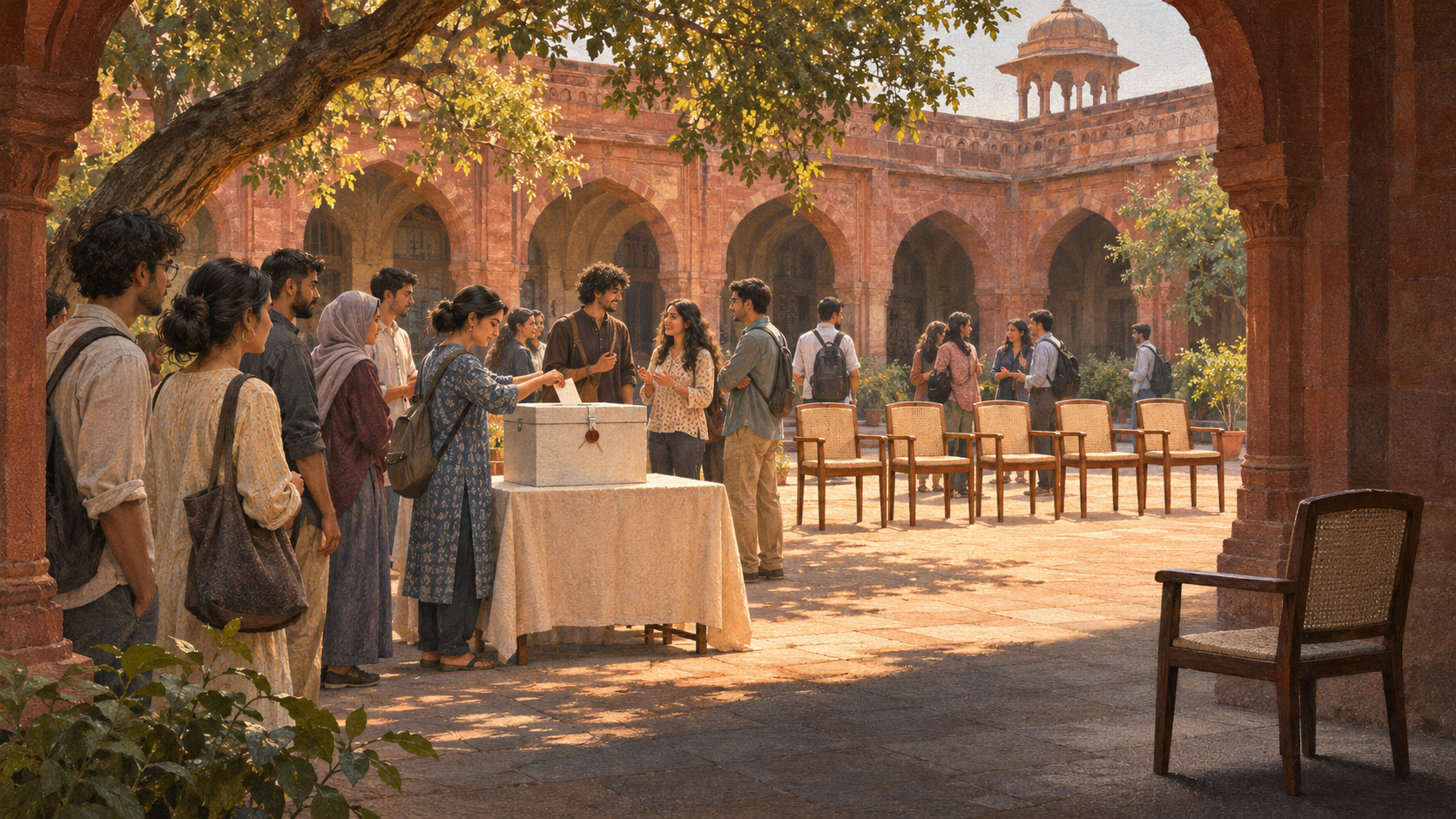
If you are looking at Aligarh Muslim University’s latest student election and asking whether a Hindu student has a fair path to leadership, the result deserves more than a shrug. No non-Muslim won any of the 28 positions contested across the Students’ Union, Women’s College union and University Court in November 2026.
You should take that absence seriously without claiming more than the evidence can carry. The useful question is not simply whether the winners were Muslim. It is whether rules, campaign customs, organised bloc voting or intimidation make religious identity a practical qualification for office. That distinction tells students, alumni and citizens what to document and what reform to demand.
What the 28-seat result establishes – and what it does not
The immediate fact is stark: all 28 successful candidates were Muslim, although Hindus were reported to constitute at least one-fifth of the student population. That establishes a serious representation gap in this election cycle. It justifies scrutiny because the result spans three representative bodies rather than a single close contest.
The tally alone does not prove that a formal rule barred Hindus, that every Muslim voter acted as part of a religious bloc, or that each winning candidate was hostile to non-Muslims. Where offices are decided separately, a group can form a substantial minority and still lose every contest because its votes are dispersed, its candidates are weak, or the majority coordinates more effectively. Mathematical possibility, however, is not a democratic answer. It identifies what must be investigated next.
Use three distinct terms when discussing the result:
- Under-representation describes the outcome: a community present on campus won no position.
- Political exclusion describes a durable mechanism: candidates may be formally eligible, yet religious bloc formation or a hostile culture leaves them with no realistic path to office.
- Institutional discrimination requires evidence that rules, officials or enforcement treated candidates differently because of religion.
At present, the first description is established and the second is a credible concern. The third requires records of nominations, complaints and official decisions. Keeping those categories separate makes the case for Hindu equality harder to dismiss.
The warning signs lie in the campaign culture as well as the tally
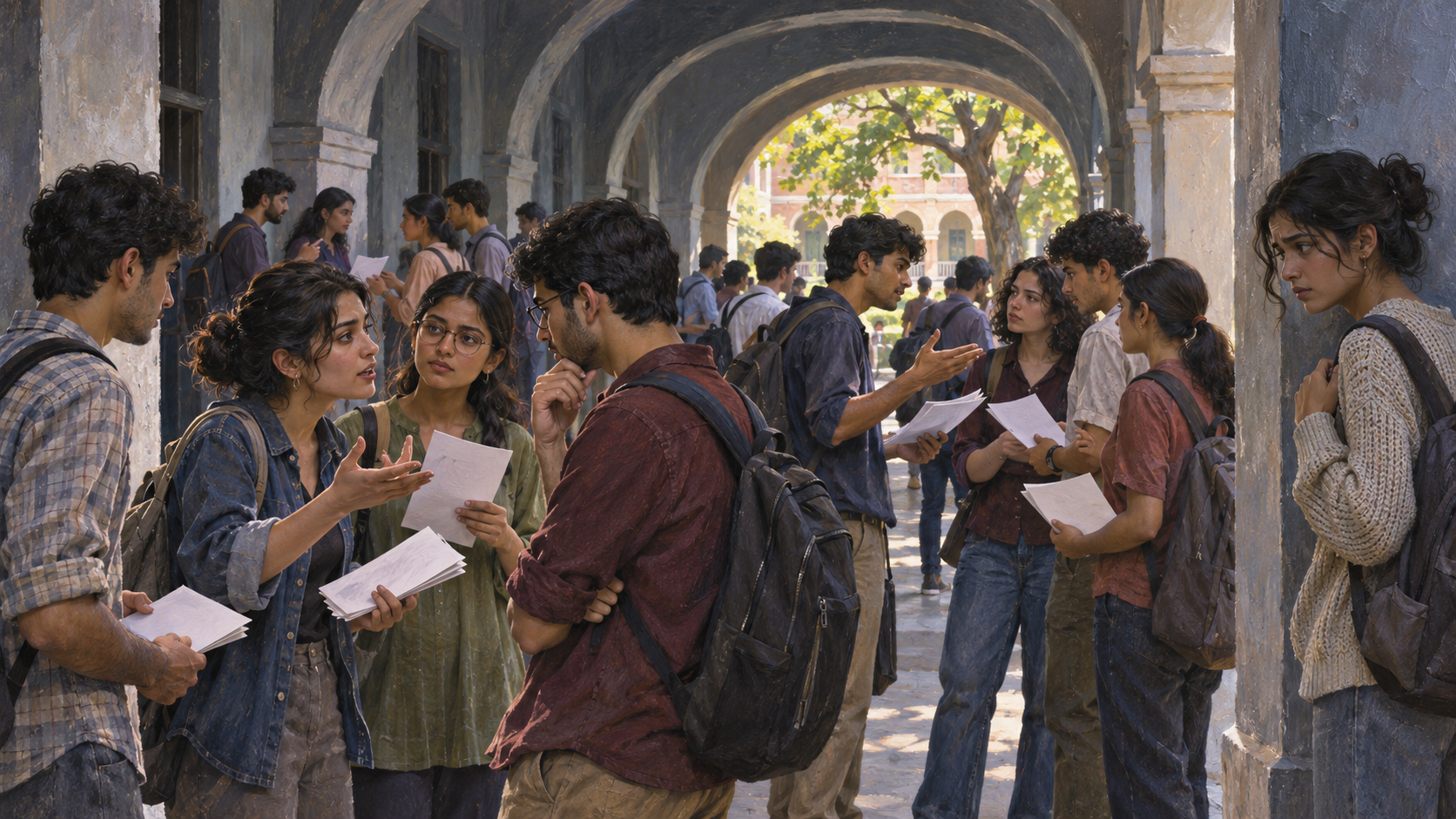
The victorious candidates did not present religion as a private matter detached from student politics. The elected president invoked the Ababil of Islamic tradition while speaking about victory for Muslims in Palestine, Iran and Sudan. The vice-president, wearing a keffiyeh, opened with Surah Muhammad 47:7. The secretary led cries of Nara-e-Takbeer. These religious and pan-Islamic appeals placed Muslim identity near the centre of the public political performance.
Religious expression is not itself proof of exclusion. A Muslim candidate does not become unfit for office by quoting the Quran, just as a Hindu candidate should not become unfit by invoking the Gita, Saraswati or Bharat Mata. The democratic test is symmetry: could a Hindu, Sikh, Jain or Buddhist candidate speak from a Dharmic tradition and still be accepted as a legitimate representative of the entire student body?
If Islamic symbolism is treated as natural campus leadership while Dharmic symbolism is treated as alien, communal or disqualifying, the problem is not faith in politics. It is an unequal licence to express faith. Students evaluating AMU’s political culture should therefore record how comparable expressions are received, regulated and reported, rather than merely count how often religious words are spoken.
Historical claims deepen the concern but must be handled with precision. A reported episode from the 1990-91 election alleges that Muslim contenders swore on the Quran at the campus Jama Masjid to unite behind one candidate and prevent a Hindu victory. If Hindu candidates are also expected to canvass in a sherwani and Jinnah cap, as reported, the relevant question is whether this is a neutral campus custom or an assimilation test imposed on an outsider.
Neither allegation should be casually converted into a claim about every present-day Muslim student. The 1990-91 episode needs contemporaneous records or corroborated testimony, and a clothing convention needs evidence of how it is enforced. Its significance lies in the possible mechanism: religious coordination can preserve formal eligibility while making actual competition futile.
The label “dhimmi” may express anger at unequal political standing, but it cannot identify whether the barrier is coercion, coordination, social conformity or ordinary electoral defeat. Modern democratic language is more exact. Ask who was permitted to stand, who withdrew, what pressure was applied, how votes were distributed and what officials did when complaints arose.
Do not collapse three separate arguments into one
AMU’s student elections, its constitutional status and the treatment of Muslims elsewhere in India are connected politically, but they are not interchangeable evidence.
First, the dispute over AMU’s minority character affects questions such as the application of SC/ST reservation. In November 2024, a seven-judge Supreme Court bench overruled the approach taken in the 1967 Azeez Basha judgment and left the determination of AMU’s status to a regular bench. That constitutional dispute does not decide whether the 2026 student election was socially inclusive. Nor can a claimed minority character excuse discriminatory conduct in a student contest.
Second, AMU receives central government funding. Public funding strengthens the demand for transparent procedures and equal civic standing, but it does not turn an all-Muslim result into automatic proof of an unlawful act. The accountability case should rest on accessible election records, equal enforcement and documented conduct.
Third, Muslim candidates have won student leadership at institutions such as JNU, TISS and Allahabad University. That contrast matters because it shows that a candidate from a religious minority can win within a Hindu-majority society. It supplies a fair reciprocity test for AMU: if Muslim students can seek and receive cross-community support elsewhere, Hindu and other non-Muslim students should have the same practical opportunity on a Muslim-majority campus.
Reciprocity is not collective retaliation. A Hindu voter elsewhere should not discriminate against a Muslim candidate because Hindu candidates appear excluded at AMU. That would reproduce the very rule being challenged. The Dharmic position worth defending is equal political dignity: judge candidates on conduct and programme, protect every community’s right to participate, and expose any institution that applies that standard selectively.
A five-part election audit can turn suspicion into a case

If you want a trustworthy answer before the next election, begin collecting evidence when nominations open. Waiting until the winners are announced leaves the most revealing part of the process undocumented.
- Obtain the complete official returns. Record every office, candidate, vote total, turnout figure, rejected ballot and applicable election rule. A list of winners cannot show whether non-Muslim candidates narrowly lost, received negligible support or never reached the ballot.
- Map the candidate pipeline across several cycles. Record who sought nomination, who passed scrutiny, who withdrew and who remained on the final ballot. Use only a candidate’s voluntary or public religious identification; do not classify students by their names. Repeated absence at the nomination stage points to a different problem from repeated defeat at the ballot box.
- Document equal access to campaigning. Compare access to hostels, halls, debates, posters, endorsements and student organisations. For each claimed obstruction, preserve the date, place, rule invoked, witnesses and any written order. Distinguish ordinary political hostility from threats, religious pressure or selective rule enforcement.
- Test claims of coordinated exclusion. Look for public appeals, recordings, meeting decisions or testimony showing that candidates were told to unite specifically to block a non-Muslim. The alleged 1990-91 pact is a reason to examine present organisation, not proof that the same pact existed in 2026.
- Examine the institutional response. Request the number and nature of election complaints, the authority that decided them, the written rulings and any penalties. Apply the same test to Islamic and Dharmic slogans. Neutral rules matter less if officials enforce them selectively.
Different findings lead to different remedies. If few non-Muslims seek nomination, investigate the social cost of standing and build a candidate-support network. If candidates stand but cannot access important campaign spaces, demand an enforceable equal-access rule. If documented threats or forced withdrawals occur, the election authority must address the specific incidents and protect complainants. If candidates campaign freely but repeatedly receive little cross-community support, the problem is political sectarianism, best challenged through issue-based and cross-community slates.
You do not need to violate the secrecy of the ballot or demand a religious register of voters. Public candidate information, aggregate returns, nomination records, campaign access and complaint decisions can reveal where the barrier operates. When vulnerable students describe pressure, obtain their consent before publishing identifying details and preserve the underlying evidence securely.
A concerned student or alumnus can make the first request concrete. Send the election authority a numbered representation seeking the official results for all 28 positions, the nomination and withdrawal totals, the governing rules, the complaints received and the written decisions. A precise request is more difficult to evade than a general accusation of bias.
Key takeaways
- Zero non-Muslim winners across 28 positions is a substantial representation warning, especially when Hindus reportedly form at least one-fifth of the student body.
- The result alone does not prove a formal ban or coordinated conspiracy; nomination, vote, access and complaint records are needed to identify the mechanism.
- Islamic campaign rhetoric becomes an equality issue when equivalent Dharmic expression would not receive the same political or institutional tolerance.
- AMU’s minority-status litigation and central funding strengthen demands for scrutiny, but neither decides what occurred in a particular student election.
- The strongest response is a multi-cycle, evidence-based audit paired with support for candidates who can seek votes across religious lines.
Before the next nominations open, create a public tracker for candidates, access disputes, complaints, rulings and final vote totals. Use voluntary identity information only, and make conduct-specific claims rather than accusations against an entire community. If the zero-seat pattern recurs, you will then have more than an alarming outcome: you will know where exclusion enters the process and what AMU must change.
References
- Hindu Post – AMU’s Islamist Order: ‘Dhimmi’ Hindus Shut Out of Student Polls as Victors Invoke Jihad Verse, Quranic Bird Army
- ThePrint – A Hindu can’t win in AMU student polls. JNU, TISS, Allahabad University Muslims do win (20 November 2026)

Leave a Reply
You must be logged in to post a comment.