
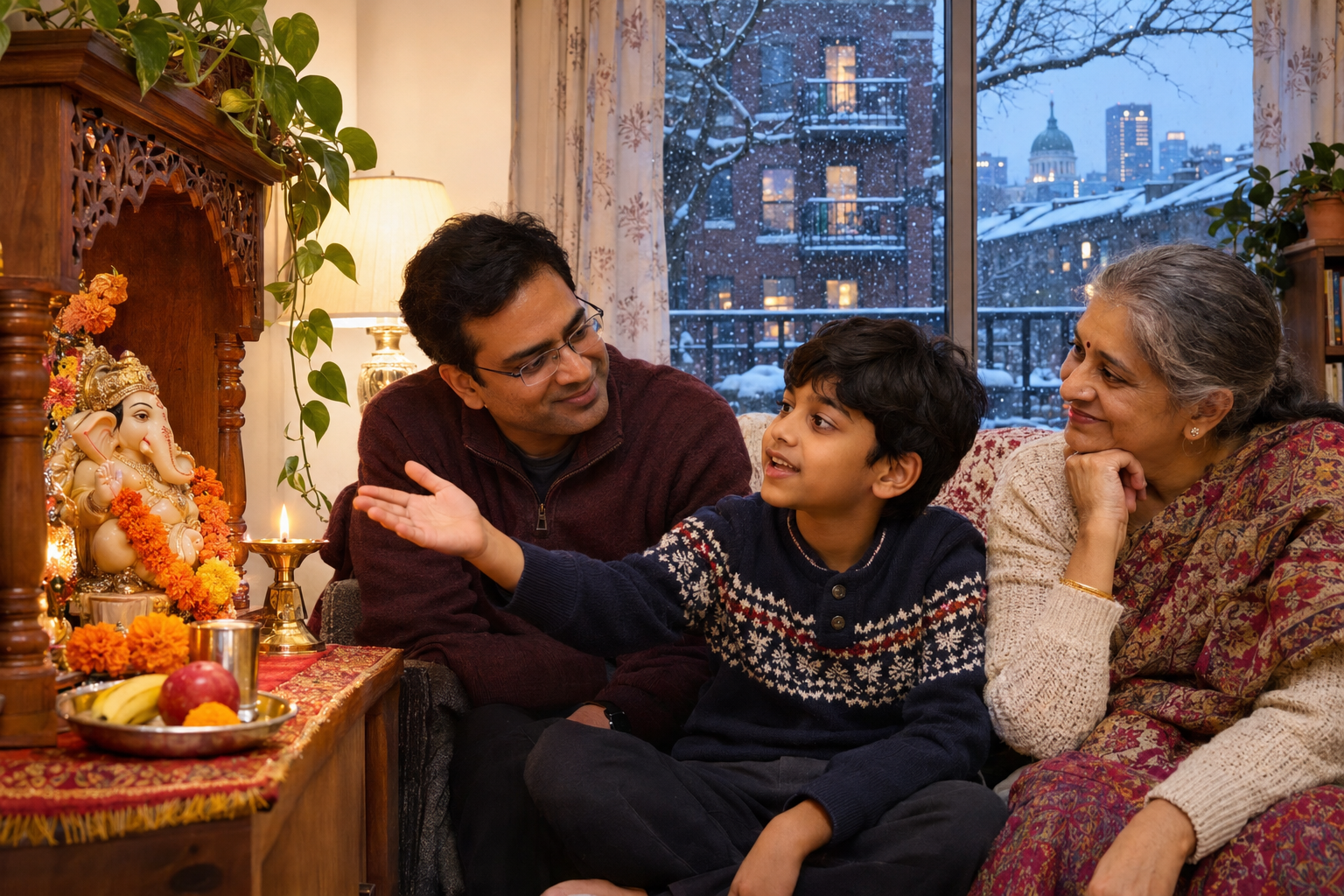
If your child recognises Ganesha but goes quiet when a classmate asks what the murti means, the problem is probably not a lack of festivals. The missing piece is a bridge between inherited practice, personal understanding and the confidence to speak about both.
You can build that bridge without turning family life into a religious syllabus. The workable approach is to connect four settings that children already inhabit: home, mandir, community and school. Give your child something to practise, someone to practise it with, a story that makes it meaningful and words they can use outside the Hindu community.
Key takeaways
- Give each child a recurring role in a home practice. Participation forms a stronger memory than observation alone.
- Treat mandirs, classes and cultural groups as partners. Bring one lesson from each gathering back into family life.
- Choose one sustained path into Dharma, such as Ramayana storytelling, bhajan, dance, language or seva, instead of collecting disconnected activities.
- Rehearse simple answers to school questions before a misunderstanding occurs, and address inaccuracies with a specific, calm request.
- Preserve the route by which your family reached Montreal, including Caribbean, Mauritian, European or other chapters. Adaptation is part of that history, not an embarrassment to erase.
Make the home the anchor and the community the amplifier
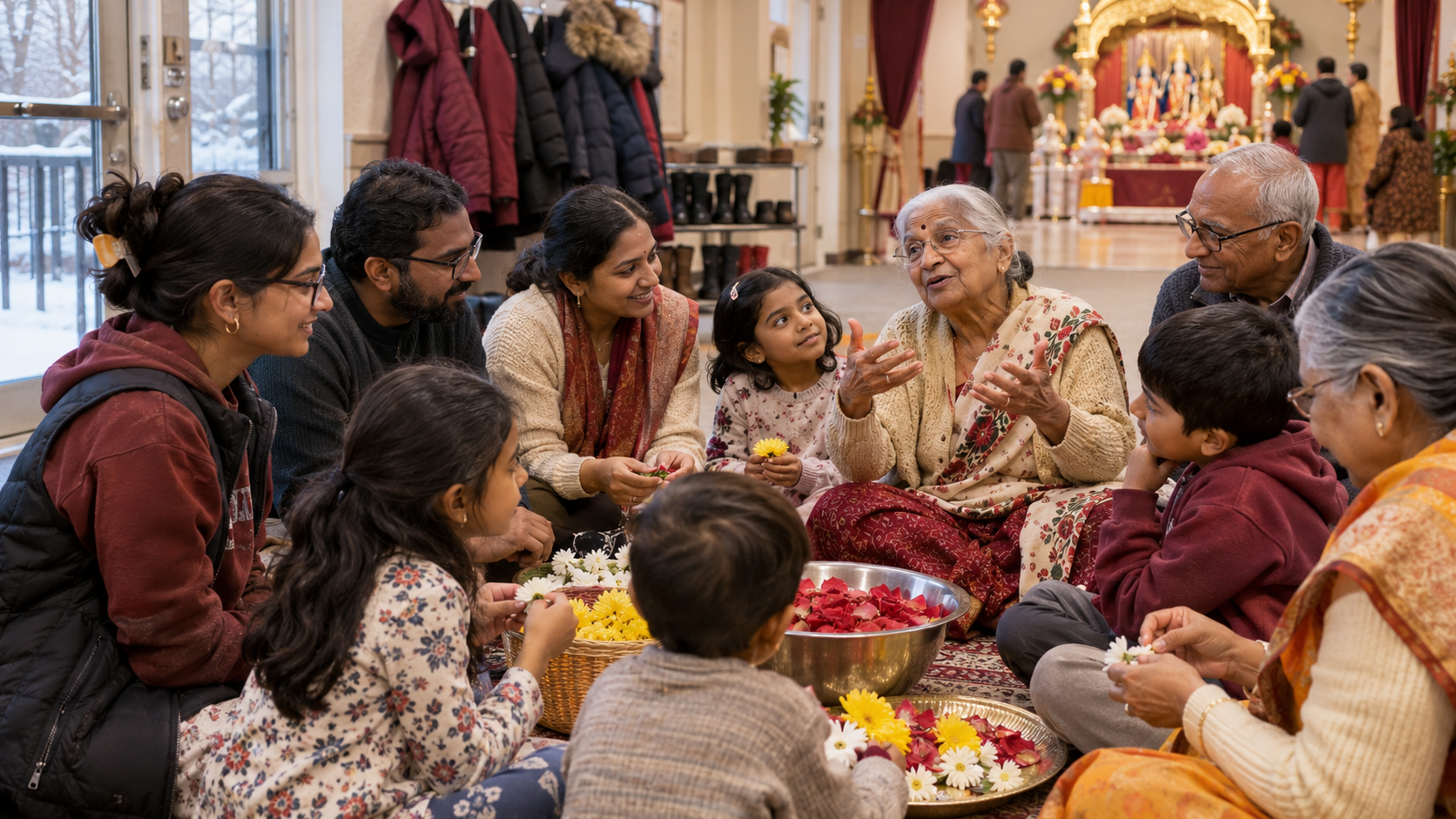
Hindu continuity has rarely depended on ideal conditions. Families descended from Indian indentured labourers in the Caribbean maintained religious identity despite pressure to change their names, languages and practices. Some of their descendants later moved to Canada and built mandirs and communities again. Mauritian Hindu families similarly retained memories of ancestors carrying the Ramayana and Puranas across the ocean.
The practical lesson is not that your household must reproduce an earlier time perfectly. It is that Dharma survives when people carry it as a repeatable way of life. A festival attended once a year can be memorable, but it cannot bear the entire weight of heritage transmission. Children need to see what Hindu practice changes on an ordinary day: how the family begins an undertaking, expresses gratitude, serves others, handles disagreement or remembers those who came before.
If you want your children to be Hindu, get the parents to be Hindu first.
Gowree T. Singh Gobin
This does not require parents to become Sanskrit scholars or ritual specialists. It does require visible sincerity. If adults treat puja, satsang or seva as obligations arranged for children, children learn that Hindu practice belongs to childhood. If adults participate, ask questions and admit what they are still learning, children see Dharma as a lifelong path.
Create a small household Dharma charter
Sit down as a family and choose one item in each of the following areas. Keep the first version modest enough to sustain when school and work become busy:
- One recurring home practice, such as a short aarti, shared prayer, quiet reflection or reading.
- One story or text cycle to explore over time, rather than unrelated stories chosen at random.
- One festival responsibility for the child, such as preparing the puja place, learning the meaning of an offering, helping with food or explaining one custom to a guest.
- One form of seva the family will perform together or support consistently.
- One sentence each family member can use to explain what being Hindu means personally.
Assign ownership, not just attendance. A young child can place flowers or learn a refrain. An older child can select a passage, lead a simple prayer, research a symbol or organise part of a festival. Correct mistakes gently, but do not take the task back merely because an adult can do it faster. The responsibility itself is part of the inheritance.
Use the language your child genuinely understands. Preserve important Sanskrit or heritage-language terms, but explain them in the language in which the child thinks and asks questions. A memorised word without meaning is fragile; a meaningful concept can later support deeper study of its original vocabulary.
Use the mandir as a partner, not a subcontractor
Mandirs, Sunday classes and seva have helped Hindu children in Quebec understand their religion and become more confident in their identity. Their effect is strongest when home and community reinforce one another. Dropping a child at a class while the parents remain disconnected creates two separate worlds.
Before committing to a programme, ask questions that reveal what the child will actually experience:
- Will children discuss and perform tasks, or mainly watch and memorise?
- How are stories connected to ethics, worship and daily decisions?
- Are parents expected to reinforce anything at home?
- Can children take age-appropriate seva or leadership roles?
- Will your child meet the same peer group regularly enough to form friendships?
After each gathering, ask for one idea rather than a full report: What surprised you? What did you disagree with? What should we try at home? Then act on one answer. That small follow-through tells the child that the class belongs to family life rather than sitting outside it.
Choose one living medium and stay with it
Hindu communities have carried memory through Ram Lila, Bhagavata Katha, Kathak, Bharatanatyam, bhajans and kirtans. These forms work because they let the body, voice, imagination and peer group participate. They do more than deliver information.
Choose one medium that suits your child and give it time. A child drawn to music may enter through bhajan; a child who loves movement may respond to dance; an avid reader may prefer a sustained story cycle; a child attracted to making things may learn through festival preparation and visual symbolism. Do not force every available activity into the calendar. Depth in one form creates a foundation from which other forms make sense.
Modern bhajans and new media can widen the doorway, especially when traditional presentation feels remote. Use them as an invitation to inquiry: ask which story, deity, teaching or practice lies behind the performance. The aim is not to keep a child consuming Hindu-themed material. It is to move from watching to asking, practising and eventually contributing.
Prepare your child for school before a problem arises
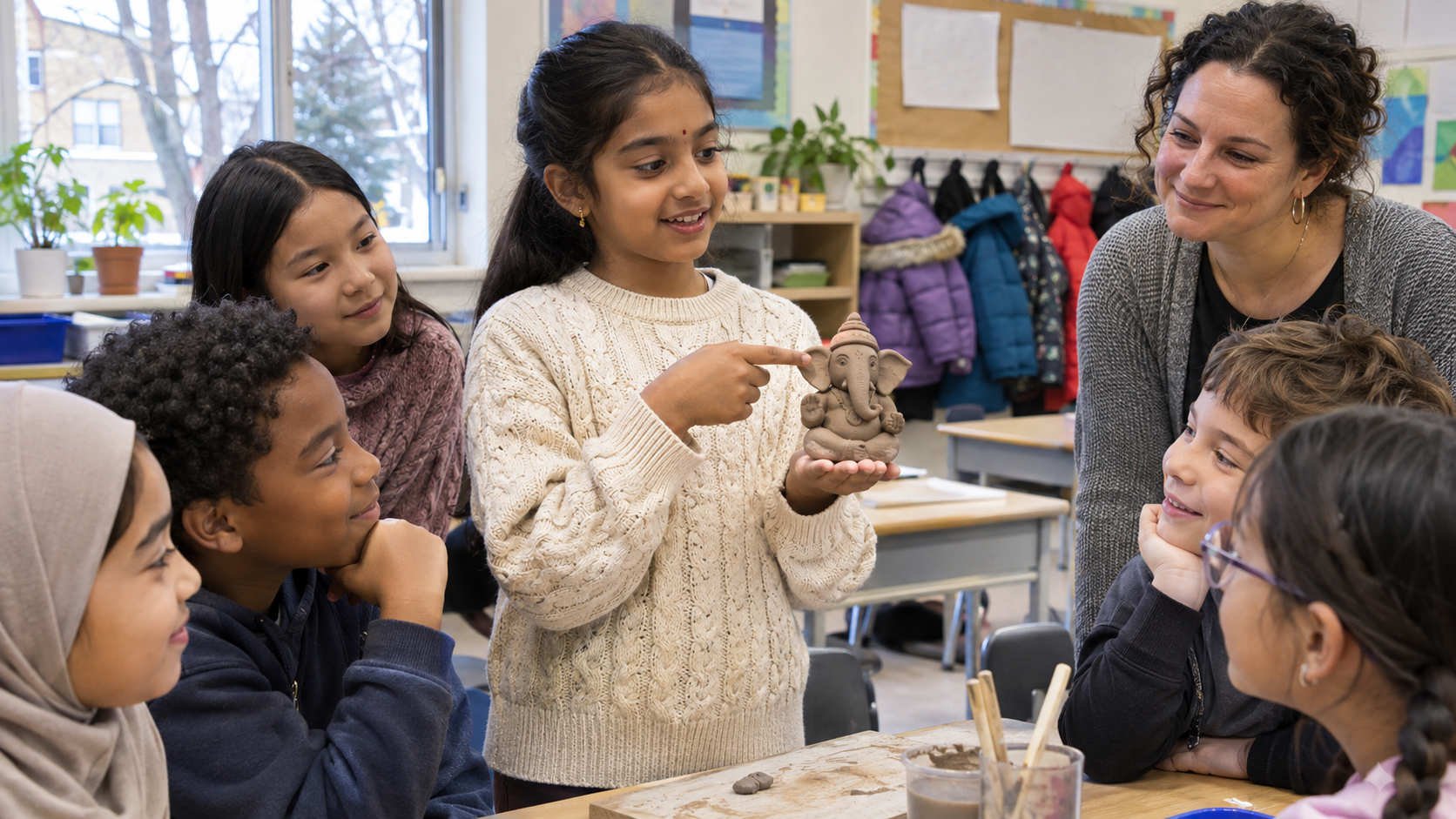
Children often face two pressures at once. They may be unsure how to explain a practice, and they may fear that a parent’s intervention will make them more visible. In one Quebec family, a daughter discouraged her mother from approaching a teacher who had spoken condescendingly about Hinduism because she did not expect other Hindu parents to support them. That experience shows why school confidence cannot begin only after something goes wrong.
Start by rehearsing ordinary questions at home. Do not give your child a speech. Help them build short answers in their own voice:
- What is that? This is part of a practice my family follows. It means…
- Why do you do it? In our tradition, we do it because…
- Do all Hindus do the same thing? Hindu traditions differ, and this is how my family understands it.
- Can you explain that word? The original word is…, and a simple way to understand it is…
The final answer matters less than the child’s ability to speak without pretending that one household represents every Hindu. If the child cannot complete a sentence, you have found a learning opportunity at home, not a failure to hide.
Positive visibility can also reduce the burden of explaining Hinduism only during conflict. One family introduced Diwali at their son’s school when he was in junior kindergarten. If your school welcomes family participation, offer something focused and age-appropriate: the meaning your family gives the festival, one story clearly identified as belonging to a particular tradition, and a simple practice or activity. Avoid presenting a vast and diverse civilisation as a collection of exotic objects.
Use a calm escalation ladder for inaccuracies
- Ask your child what was said, where it appeared and how the class responded. Separate the exact wording from the child’s interpretation of the teacher’s intent.
- Save the assignment, slide, reading or message when possible. A precise example is easier to correct than a general complaint about bias.
- Ask your child what outcome would help: a factual correction, a private conversation, a replacement resource or an opportunity to explain the tradition.
- Contact the teacher with one narrow concern. Identify the wording, explain the inaccuracy or dismissive framing, and request a concrete correction.
- If the response does not resolve the issue, seek help from a mandir educator, parent network, Hindu student organisation or another person able to provide clear context.
A useful message has three parts: what appeared, why it is inaccurate or unfair, and what change you are requesting. Keep the focus on educational accuracy. Speak with your child before copying a large group or making the dispute public; an intervention meant to defend Hindu identity should not leave the child feeling that control over their school life has been taken away.
Begin this preparation before university. Montreal teenagers as young as 13 have already raised questions about navigating Hindu beliefs at school, while Hindu students in Canadian academic settings continue to encounter misconceptions and negative portrayals. At the university level, stronger Hindu student organisations can provide peers, study and a collective response to misrepresentation. Help an older student look for such a group before a controversy occurs. If none exists, a small reading circle, festival gathering or discussion group can be a realistic beginning.
Preserve your family’s whole diaspora route
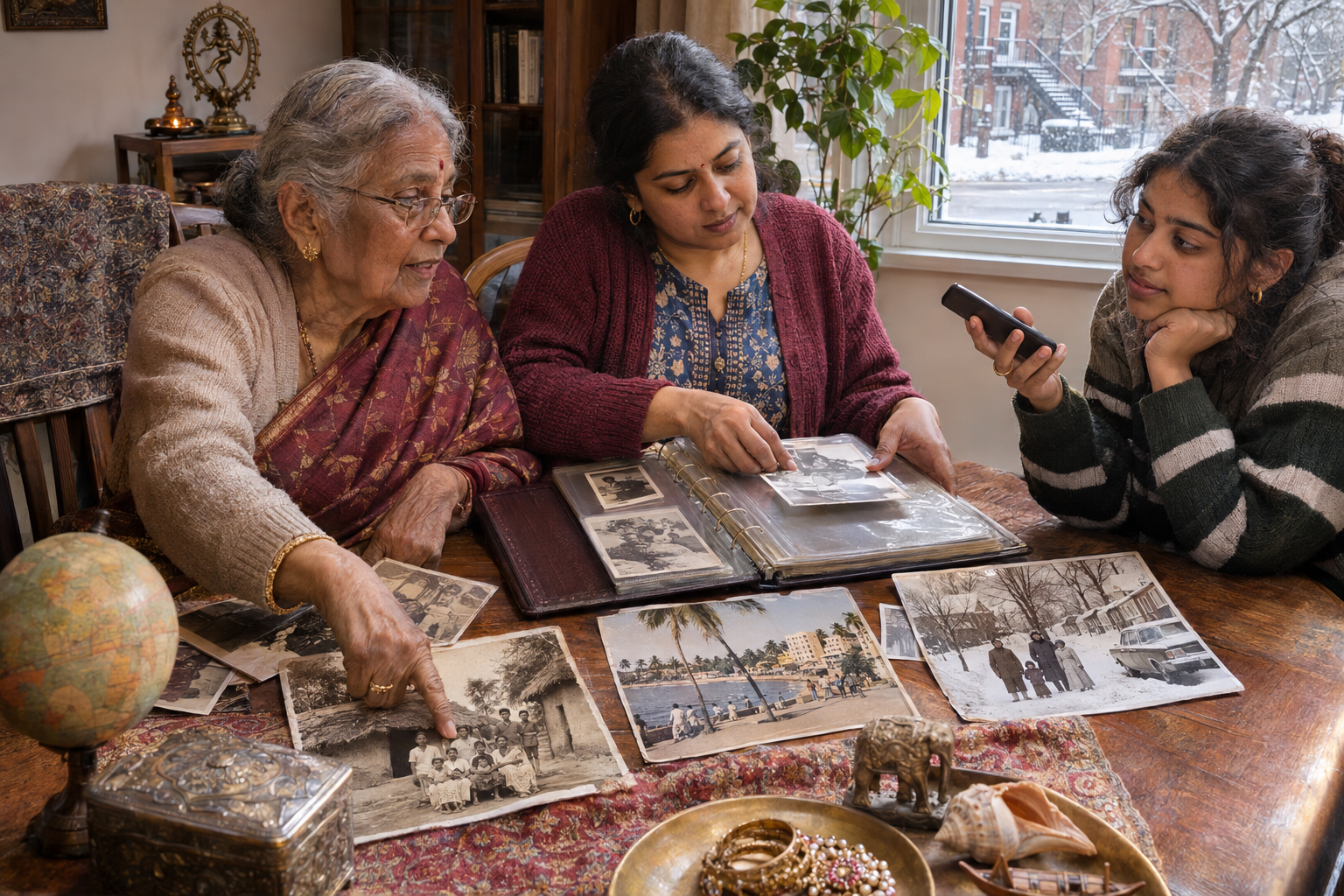
Hindu heritage in Montreal is not one direct journey from Bharat to Canada. For a Caribbean Hindu family, the route may pass through indenture, colonial pressure, cultural reconstruction and a second migration to Canada. This has been described as a double-diaspora experience. A Mauritian family’s route may include the preservation of texts and practices across Mauritius, England and Quebec. Treat those places as chapters of Hindu history, not detours from it.
Ancestry is not the only doorway into Dharma either. German-born Miriam Grimm encountered Hindu philosophy at 12, then studied Indology, learned Hindi and Sanskrit, spent time in Kashi and continued her work in Quebec. Her path is a reminder that a healthy community needs room both for inherited belonging and for people who arrive through philosophy, practice and disciplined learning.
Create a one-page family heritage record before attempting a large archive. Include:
- The places through which your family travelled, in the order family members remember them.
- Names, pronunciations and relationships that may be lost if they remain only in one elder’s memory.
- A text, deity, song, festival, food or practice that travelled with the family.
- A custom that changed after migration and the reason people give for that change.
- A mandir, teacher, relative or community group that helped sustain the family.
- Questions for which the family does not yet have a reliable answer.
Then record a conversation with an elder, with permission. Ask what Hindu life looked like in childhood, which practices were difficult to maintain, what was adapted and what they most want younger relatives to retain. Save the person’s name, the date and the places discussed with the recording. Do not silently edit uncertainty out of the account. If two relatives remember an event differently, preserve both memories as memories.
Do not teach children that every adaptation represents decline. A changed melody, a local festival custom or an explanation moving between languages can reveal how a community survived. The useful question is whether the adaptation still carries meaning and invites participation. If it does not, investigate the practice together rather than discarding it or defending it automatically.
A 30-day plan for beginning without overwhelming the family
You do not need to design a complete heritage programme before starting. Use one month to establish a small cycle, learn where resistance appears and decide what the household can sustain.
Week one: find the actual gap
Ask every family member to name one Hindu practice that matters to them, one thing they do not understand and one thing they would like to learn. Compare the answers. Choose one shared gap rather than allowing the most knowledgeable adult to choose the entire agenda.
Set one recurring home practice and assign each person a role. Put it on the household calendar. If the plan cannot survive a busy school week, reduce its size before beginning.
Week two: make one community connection
Contact a mandir, parent network, Sunday class, arts teacher or youth group. Ask for the actual schedule, language used, parent expectations and opportunities for children to participate. Attend or arrange one introductory conversation. The purpose is to identify a relationship you can continue, not to sample every institution in Montreal.
Week three: connect practice, story and public language
Let the child lead one part of the home practice. Explore the story or principle behind it through your chosen medium. Then ask the child to explain it as if speaking to a curious classmate. Notice which ideas are clear and which are still memorised phrases.
Use the same week to begin the family heritage record. Add one migration route, one remembered practice and one question for an elder. This keeps religious learning connected to the people who carried it.
Week four: review participation, not performance
Ask what the family wants to keep, stop and change. A useful first-month result is not perfect ritual performance. Look for these signs of continuity:
- The child has one recurring responsibility rather than merely being present.
- The child can explain one practice in their own words.
- The family knows which community relationship it wants to continue.
- A parent and child have discussed how to handle a school question or inaccuracy.
- One family memory has been preserved with its context.
Tonight, ask your child which part of Hindu life feels meaningful and which part feels inherited but unexplained. Choose one unexplained part. Give the child one role, find one person or community that can help, and place the next practice on the calendar. Heritage moves forward when the next generation is trusted to carry it, question it and make it present in Montreal.
References

Leave a Reply
You must be logged in to post a comment.