
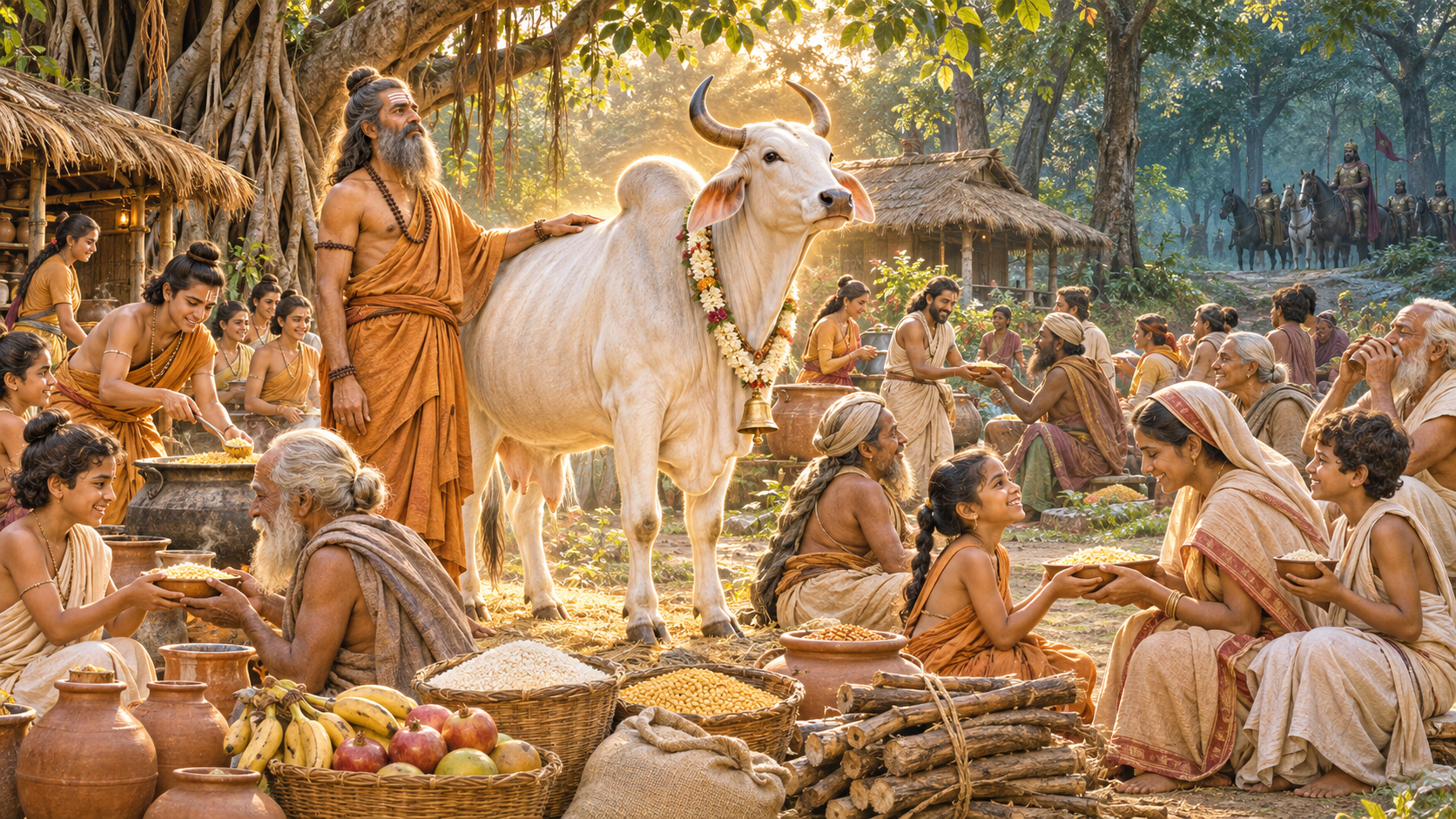
If you have wondered why the theft of Jamadagni’s cow carries such moral weight, the answer is not simply that Nandini was valuable. The deeper issue is what kind of value she embodied, how that value was used, and why taking control of its visible source violated dharma.
Read the episode carefully and it becomes a practical lesson in recognizing abundance without reducing it to property. It can help you think more clearly about wealth, land, animals, institutions, knowledge, and every other resource whose real worth depends on the purpose it serves.
Nandini’s abundance becomes sacred through service
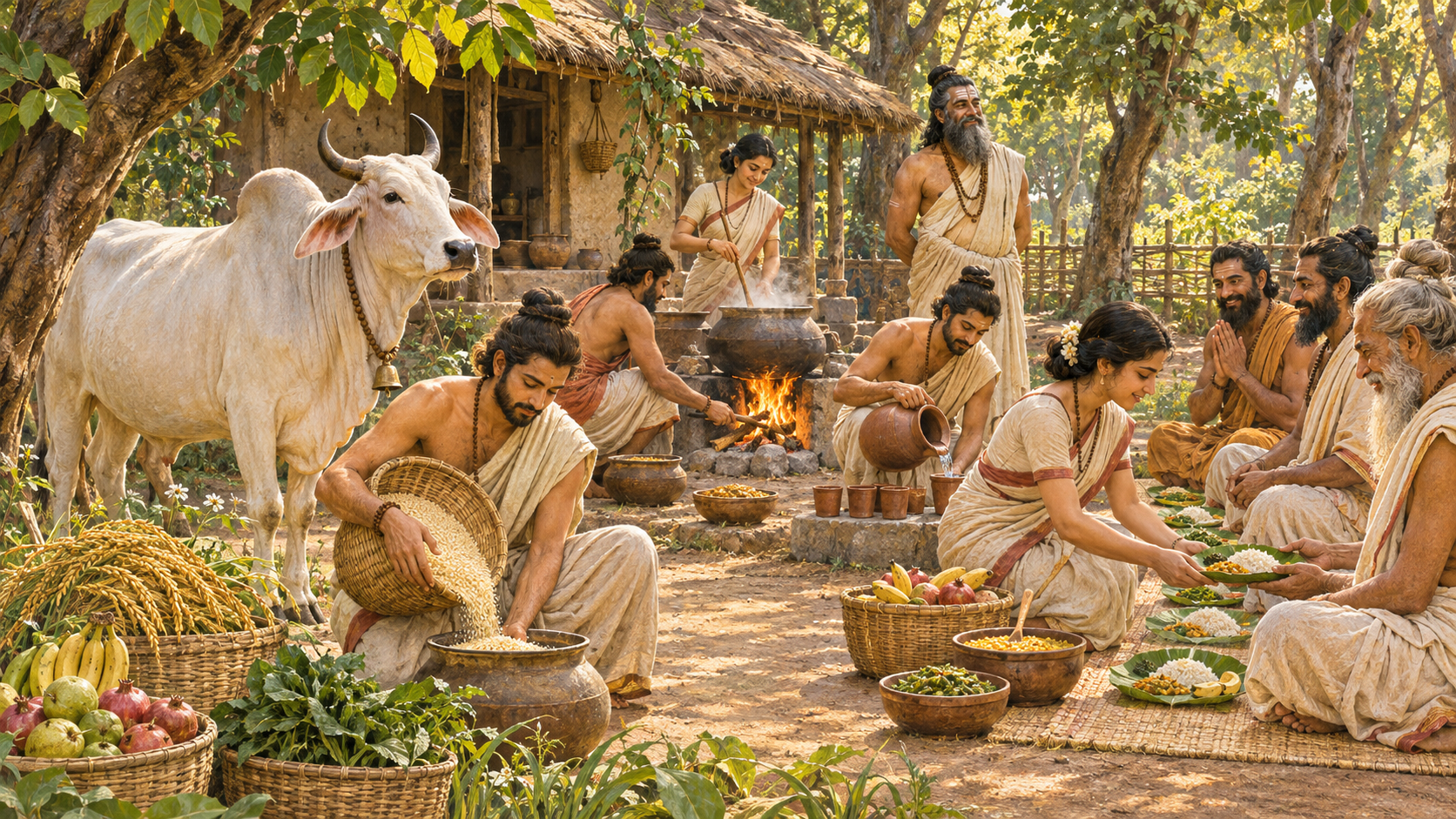
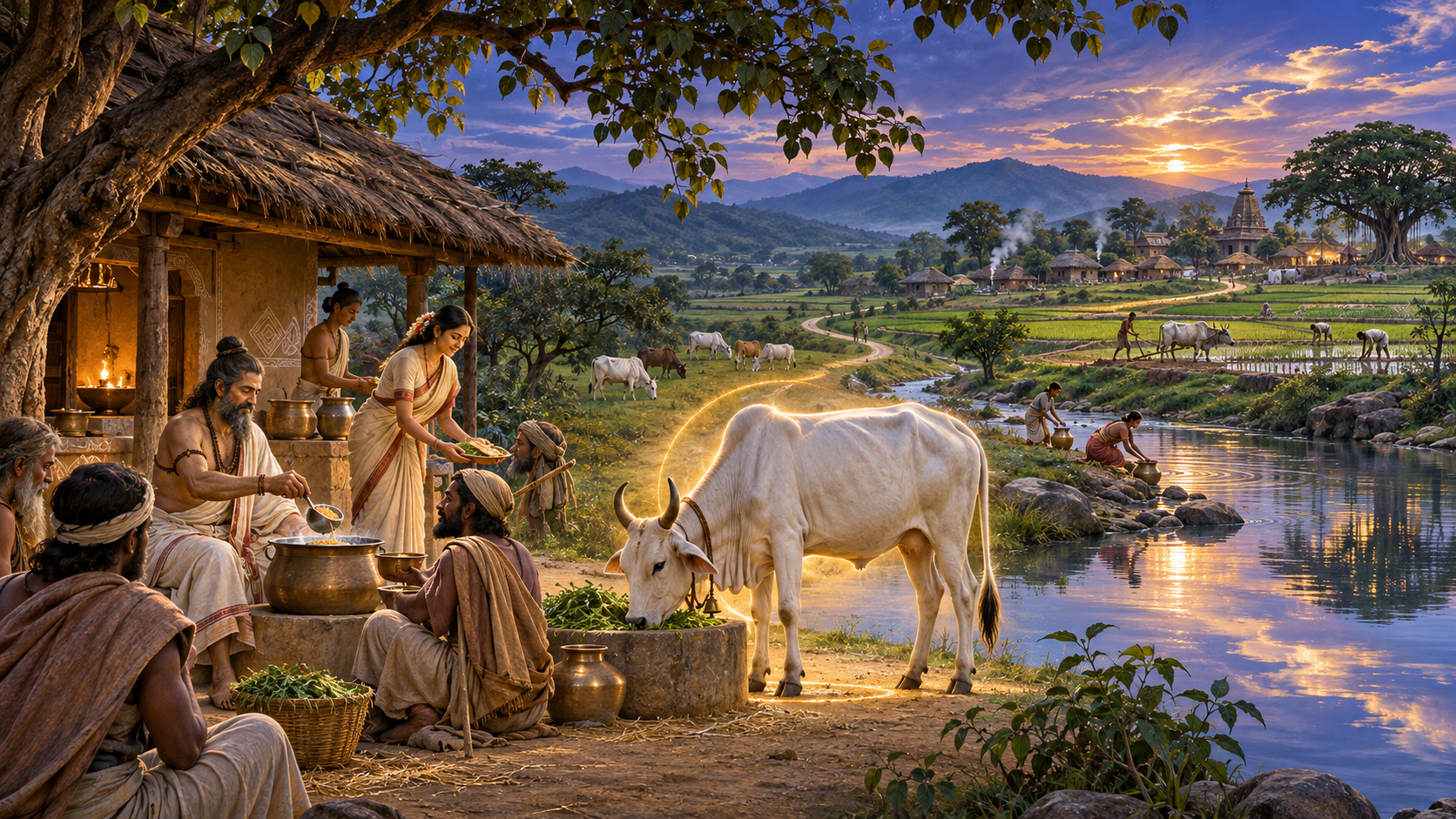
Nandini is no ordinary possession. She has the divine capacity to provide abundance, and Jamadagni uses that capacity to feed and serve people. That detail supplies the key to the symbolism: the gift does not terminate with its custodian. It passes through him to others.
This is a distinctly Dharmic way of measuring prosperity. The first question is not merely, “How much does this produce?” It is also, “What does its abundance make possible, and who benefits?” Nandini’s power is visible in provision, hospitality, and care. Her sacredness cannot be separated from that outward movement.
That does not mean material productivity is unimportant. The story takes productivity seriously enough to make it extraordinary. But it refuses to treat output as the final measure of worth. A resource can be productive and still be misused. It becomes aligned with dharma when its use sustains life and enables rightful service.
This distinction gives you a concrete way to examine wealth. When you evaluate a fertile field, a family inheritance, a community institution, or specialized knowledge, look beyond its market value. Ask what relationships it supports. Ask which duties accompany it. Ask whether its benefits circulate or stop with the holder. Those questions reveal dimensions of value that a price cannot capture.
The theft exposes a mistaken theory of wealth
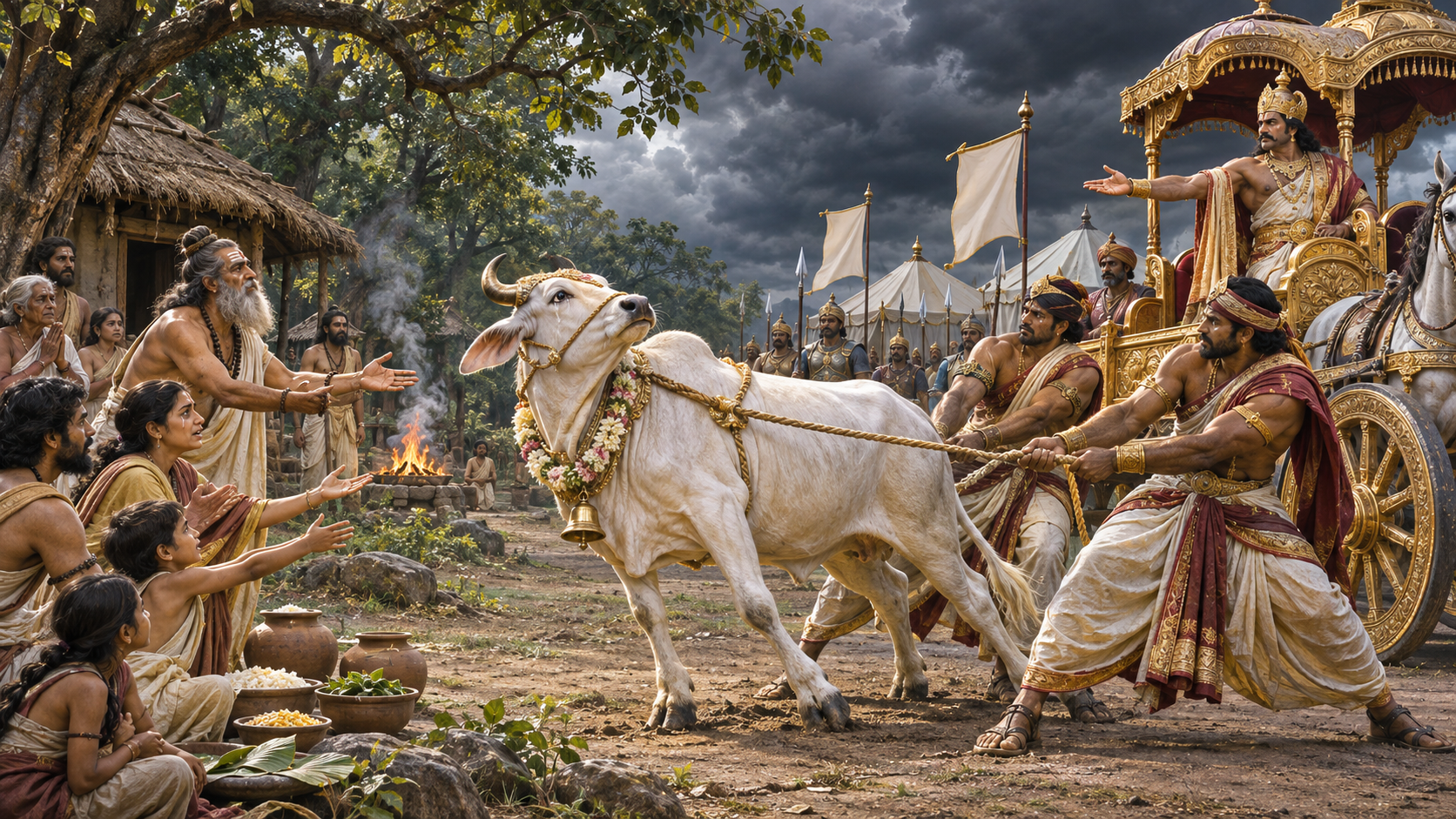
Kartaviryarjuna sees something capable of producing abundance and responds by taking it. His greed is therefore more than excessive desire. It is a failure of understanding. He identifies the visible bearer of abundance, but not the moral purpose that gives the abundance its proper direction.
The theft rests on a familiar mistake: if a thing creates desirable results, controlling the thing must transfer the whole of its value. That reasoning treats possession as mastery. It assumes that obtaining the asset is equivalent to inheriting the relationship, discipline, responsibility, and rightful use surrounding it.
The episode does not require us to claim that Jamadagni produces Nandini’s divine power. Its moral contrast lies in what each person does in relation to that power. Jamadagni’s role is custodial and service-oriented. Kartaviryarjuna’s act is acquisitive. One receives abundance as a responsibility; the other treats its source as an object to be captured.
This is why the conflict cannot be reduced to a quarrel over ownership. Theft breaks more than control over an asset. It breaks the connection between gift and duty. The thief wants the fruit while disregarding the order in which that fruit has been placed at the service of others.
You can notice the same error whenever someone measures a resource only by what can be extracted from it. Land becomes acreage without ecology or obligation. An animal becomes output without care. A temple or community institution becomes influence without seva. Knowledge becomes an advantage to hoard rather than an ability to guide. These are applications of the story’s moral pattern, not claims that every modern dispute is a literal repetition of it.
Why a cow carries this meaning so effectively
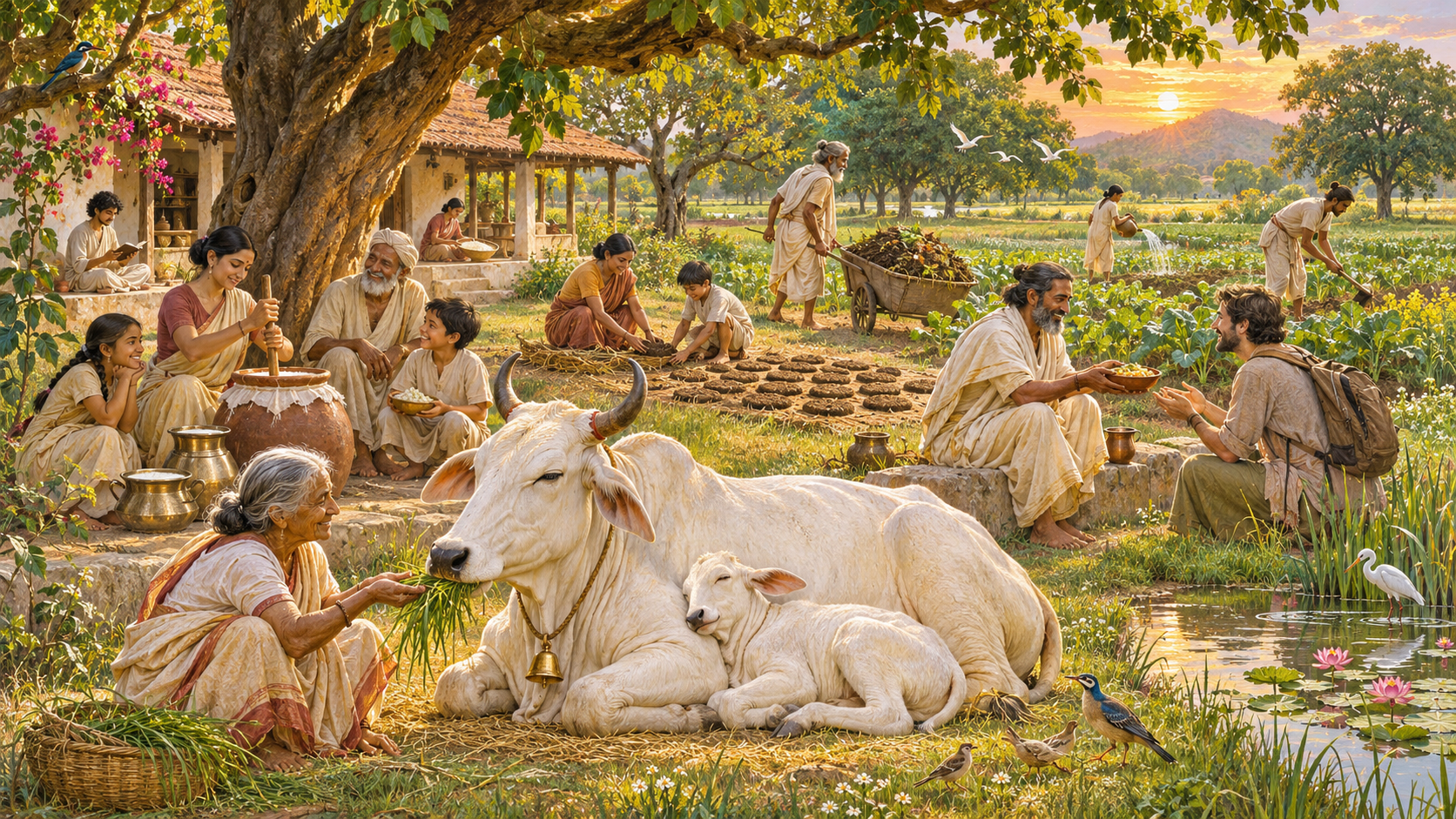
A cow is a living giver, not an inert container of wealth. She must be protected, fed, and treated with care even as she supports human life. That reciprocity makes the symbol especially precise. It joins material sustenance to moral restraint.
If the story used a heap of treasure, the central question might appear to be who owns a fixed stock of riches. Nandini represents something more dynamic: a continuing capacity to nourish. Such a capacity cannot be understood fully through possession alone. It exists within relationships of dependence, care, gratitude, and use.
This also corrects a common misunderstanding of sacredness. Calling the cow sacred does not make her irrelevant to material life. It means that usefulness does not cancel moral status. The more a being contributes to life, the stronger the obligation not to reduce that being to a disposable instrument.
Nandini can therefore help you hold two truths together. Abundance is good: people can be fed and served through it. Yet abundance does not authorize unlimited appetite. The power to provide must remain governed by dharma. Otherwise, reverence gives way to extraction, and the desire to benefit from a gift becomes the urge to dominate its source.
The symbolism can extend cautiously to productive land and other life-supporting resources. The comparison works where a resource requires stewardship while providing continuing benefit. It stops working when the analogy erases the fact that Nandini is a living being in the narrative. A useful interpretation preserves that distinction rather than turning her into a generic symbol for anything valuable.
Read the episode at four levels without flattening it
A Dharmic story can carry more than one level of meaning, but that does not make every interpretation equally sound. Keep the named characters and actions in view, then move outward only as far as the pattern supports. The following method prevents both a merely literal reading and an uncontrolled allegory.
- Begin with the action. Jamadagni has Nandini and uses her abundance in service. Kartaviryarjuna steals her. Do not replace these facts with symbolism before you have understood their moral contrast.
- Identify the relationship. Ask how each person relates to the same source of abundance. The difference between stewardship and seizure is more revealing than the bare fact that both recognize Nandini’s value.
- Name the principle. The episode distinguishes receiving a productive gift under duty from claiming it through greed. This is the level at which the story becomes applicable beyond its immediate setting.
- Test an analogy before using it. A modern example should include abundance, responsibility, and an attempt to detach benefit from rightful care. If it shares only the feature of ownership, it is too weak to illuminate the story.
This method matters because symbolic readings can easily become slogans. One reader may turn Nandini into nothing but economic capital. Another may make her stand for every political cause. Both approaches risk erasing the specific feature that gives the episode force: a living source of nourishment is being used for service and then seized through greed.
You should also resist using the story merely to condemn someone else. Its sharper use is diagnostic. It asks whether you can recognize a gift without immediately asking how to control it. It asks whether you accept the obligations that arrive with access to productive power. It asks whether your idea of prosperity includes beneficiaries beyond yourself.
Key takeaways
- Nandini symbolizes abundance whose proper direction is nourishment and service, not accumulation for its own sake.
- Jamadagni represents custodianship: he holds a powerful resource and directs its benefit outward.
- Kartaviryarjuna’s theft represents greed as a failure of perception. He recognizes productive capacity but disregards its rightful purpose and relationships.
- The sacred cow unites usefulness with moral status. Her ability to sustain life creates an obligation of care rather than a license for exploitation.
- The episode can illuminate land, wealth, institutions, and knowledge when the comparison preserves the link between productive power and stewardship.
- A sound symbolic reading begins with the actual action in the story, identifies its moral structure, and only then applies that structure elsewhere.
Put this teaching to work by choosing one resource you influence: money, land, knowledge, an organization, or a family inheritance. Write down what it produces, who presently benefits, what care keeps it productive, and which duty would be violated if it were treated as a prize to seize. If you can answer only the first question, you are still seeing the resource as Kartaviryarjuna saw Nandini: recognizing its output without yet recognizing its full value.
The next time you encounter the episode, do not stop at “the sacred cow was stolen.” Follow the flow of abundance. Notice who turns it toward service, who tries to capture it, and which relationships the act of taking destroys. That is where the symbolism becomes a practical education in dharma.
References

Leave a Reply
You must be logged in to post a comment.