
You may have encountered Vaikuntha in a prayer, a temple discourse, or an image of Vishnu and wondered what you are meant to understand. Is Vaikuntha a place, the destination of a liberated soul, or a sacred way of speaking about divine presence?
The most faithful answer does not force Vaikuntha into only one of those categories. Begin with the form in which the tradition presents it. Then distinguish the cosmological, theological, and devotional meanings carried by that form. This approach lets you take scripture seriously without turning sacred cosmology into either physical astronomy or a disposable metaphor.
Begin with the core image, not a modern theory
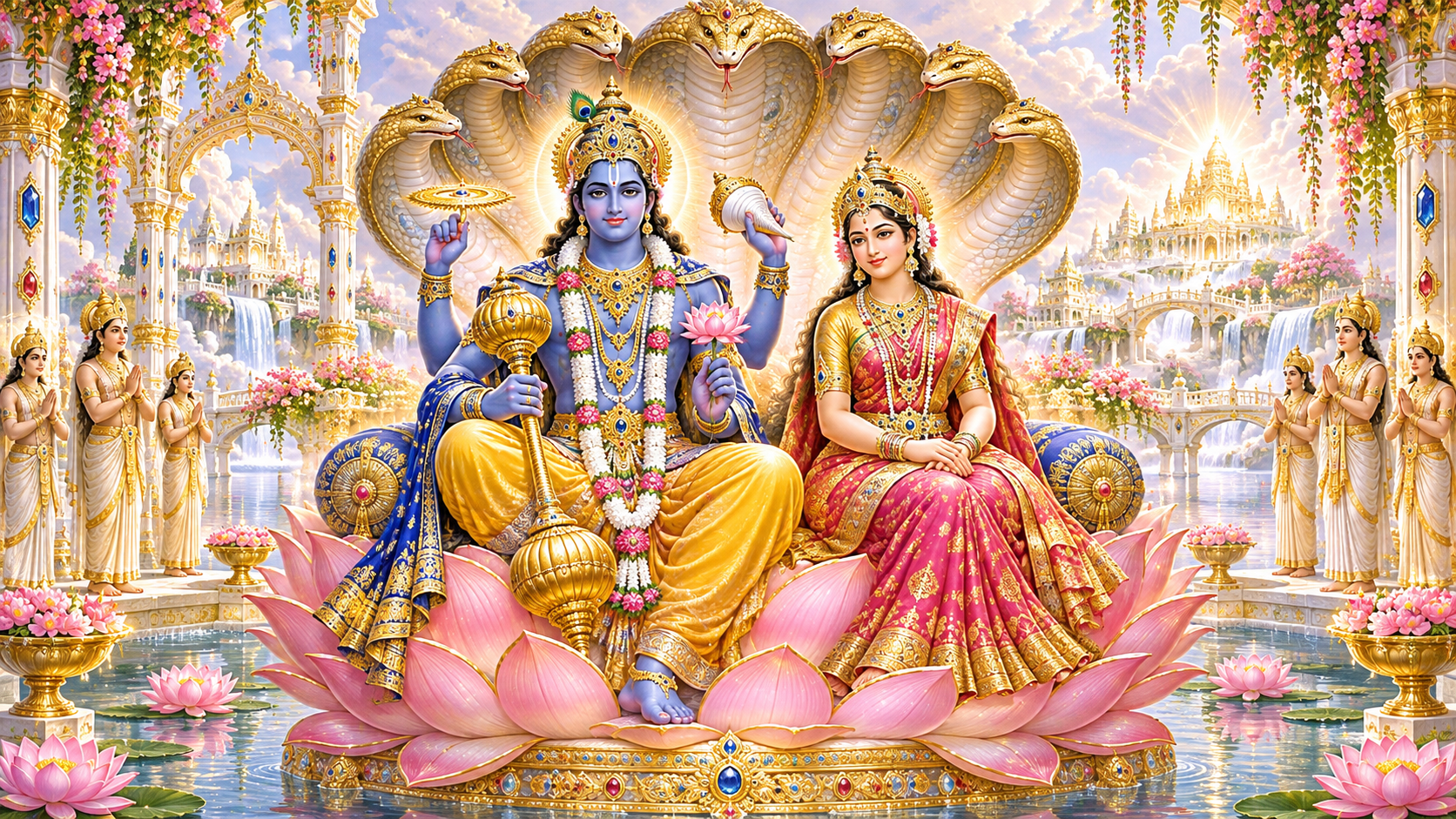
The central depiction presents Vaikuntha as the abode of Vishnu, where he is present with Lakshmi in an oceanic setting. Vishnu appears with four arms, the blue color of water-filled clouds, and four recognizable attributes: the lotus, mace, conch, and discus.
Do not hurry past these details as if they were decorative scenery. They tell you how to enter the subject:
- Vishnu is the center. Vaikuntha is identified by divine presence, not merely by beauty, pleasure, or distance from earthly suffering.
- Lakshmi is present with Vishnu. The abode is relational rather than an image of solitary power.
- The four-armed form marks transcendence. You are not being shown an ordinary human ruler living in an unusually splendid palace.
- The lotus, mace, conch, and discus identify Vishnu. Their presence keeps the image theologically specific; Vaikuntha is not a generic paradise that could belong to any deity.
- The cloud-blue color and oceanic setting shape the mood. They evoke a divine reality that should be contemplated, not reduced to a set of earthly coordinates.
These features establish the identity and sacred character of Vaikuntha. They do not, by themselves, answer every later question about its dimensions, location, accessibility, or relationship to other realms. A careful reader stops where the description stops instead of filling every silence with speculation.
Read Vaikuntha on three connected levels
Discussions about Vaikuntha often become confused because one person is speaking cosmologically, another metaphysically, and a third devotionally. You can avoid that confusion by identifying the level of the claim before deciding whether you agree with it.
Vaikuntha as a realm in sacred cosmology
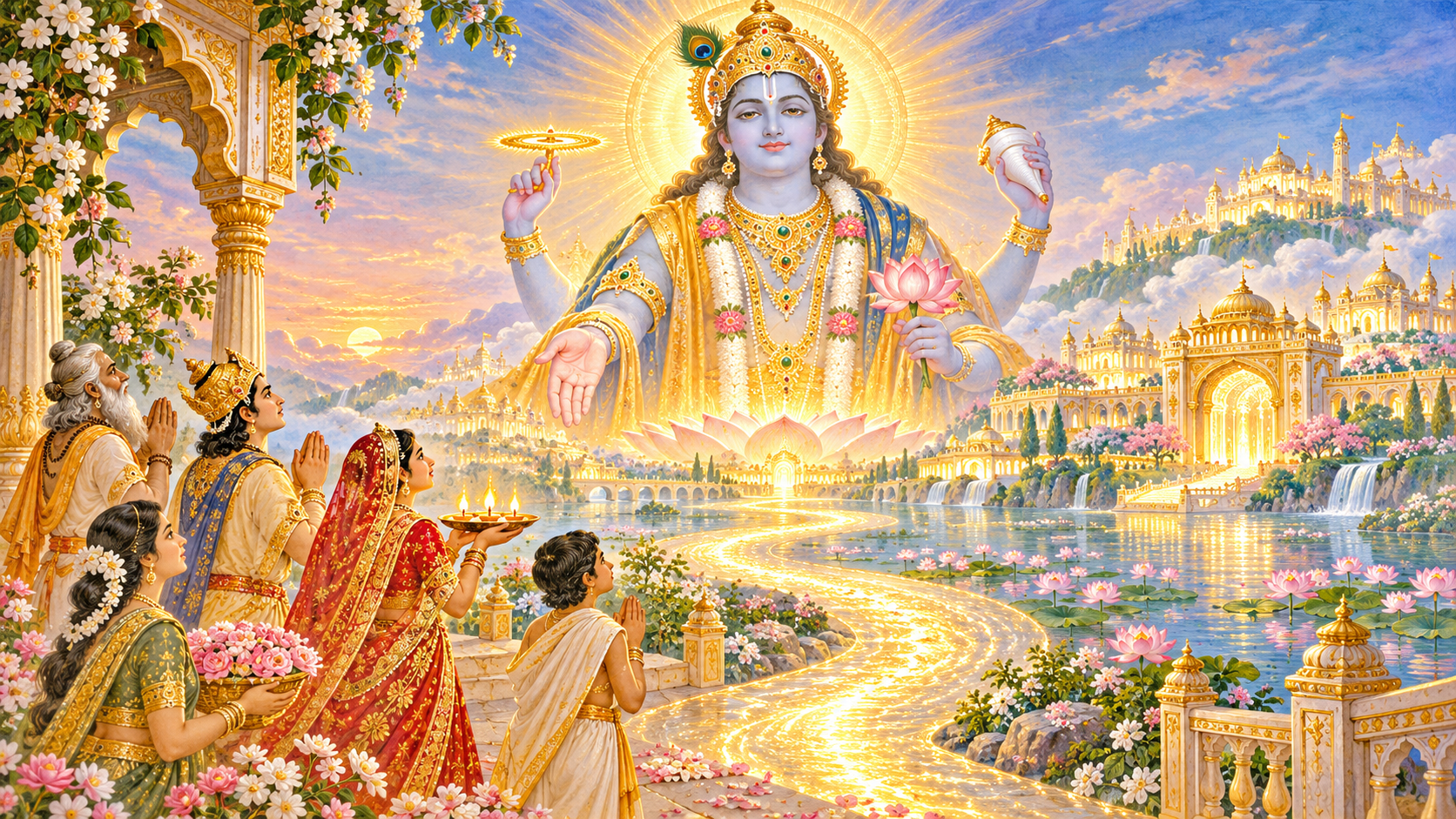
At the cosmological level, Vaikuntha is spoken of as Vishnu’s abode. Calling it an abode gives it reality and particularity within the sacred account of existence. You should not automatically translate that language into the measurements of physical geography. A realm can be real within a scriptural cosmology without functioning like a country that can be plotted on a terrestrial map.
This distinction matters whenever someone demands astronomical proof for Vaikuntha or, at the opposite extreme, dismisses it because no telescope has located it. Both reactions assume that scripture must be doing modern physical science. First ask what kind of reality the passage intends to describe.
Vaikuntha as a theological statement
At the theological level, Vaikuntha tells you something about who stands at the center of ultimate reality. Its identity comes from Vishnu and Lakshmi, not from an inventory of pleasures available there. The divine residents are therefore more important than the surroundings.
That changes the question you bring to the image. Instead of asking only, “What would I receive there?” ask, “Whose presence makes this Vaikuntha?” The first question can turn liberation into spiritual consumption. The second directs attention toward relationship with the divine.
Vaikuntha as the horizon of devotion
At the devotional level, Vaikuntha gives form to the devotee’s longing for nearness to Vishnu. Its imagery can guide remembrance because it provides a definite object of contemplation: Vishnu with Lakshmi, bearing the lotus, mace, conch, and discus.
You do not have to discard the cosmological meaning to receive the devotional one. Nor must you reduce devotion to an argument about spatial location. The levels can remain nested: Vaikuntha is spoken of as a divine realm, reveals a Vishnu-centered understanding of ultimate reality, and directs the devotee’s attention toward divine presence.
Avoid four shortcuts that distort Vaikuntha
Several familiar explanations sound convenient but settle more than the sacred image itself establishes. Watch for these shortcuts when you read or hear a discourse.
- Do not treat Vaikuntha as celestial real estate. Questions about its physical direction, distance, or material composition can distract from the divine presence that defines it. If a passage gives no measurement, do not manufacture one.
- Do not translate Vaikuntha simply as “heaven.” In Hindu thought, heavenly enjoyment and liberation are not automatically the same thing. The English word can be useful as an initial analogy, but it carries assumptions that may hide Vaikuntha’s specifically Vishnu-centered character.
- Do not declare it “only symbolic.” Many devotees understand divine realms as realities, not merely mental states. A symbolic reading can disclose meaning, but the word “only” dismisses a traditional claim before examining it.
- Do not make one painting answer every textual question. Sacred art can gather Vishnu, Lakshmi, the ocean, divine attributes, attendants, and architectural imagery into one composition. Use the image for contemplation, but return to the wording and context of a passage when making a scriptural claim.
There is also no need to erase differences among Hindu schools. One tradition may emphasize Vaikuntha’s objective transcendence, another the soul’s eternal relationship with Vishnu, and another the contemplative meaning of the imagery. A responsible explanation identifies its interpretive tradition instead of presenting one school’s vocabulary as the only possible Hindu reading.
Use this method when you encounter a Vaikuntha passage
If you want more than a vague definition, work through the passage in a fixed order. This prevents a familiar commentary or devotional picture from silently replacing what the passage actually says.
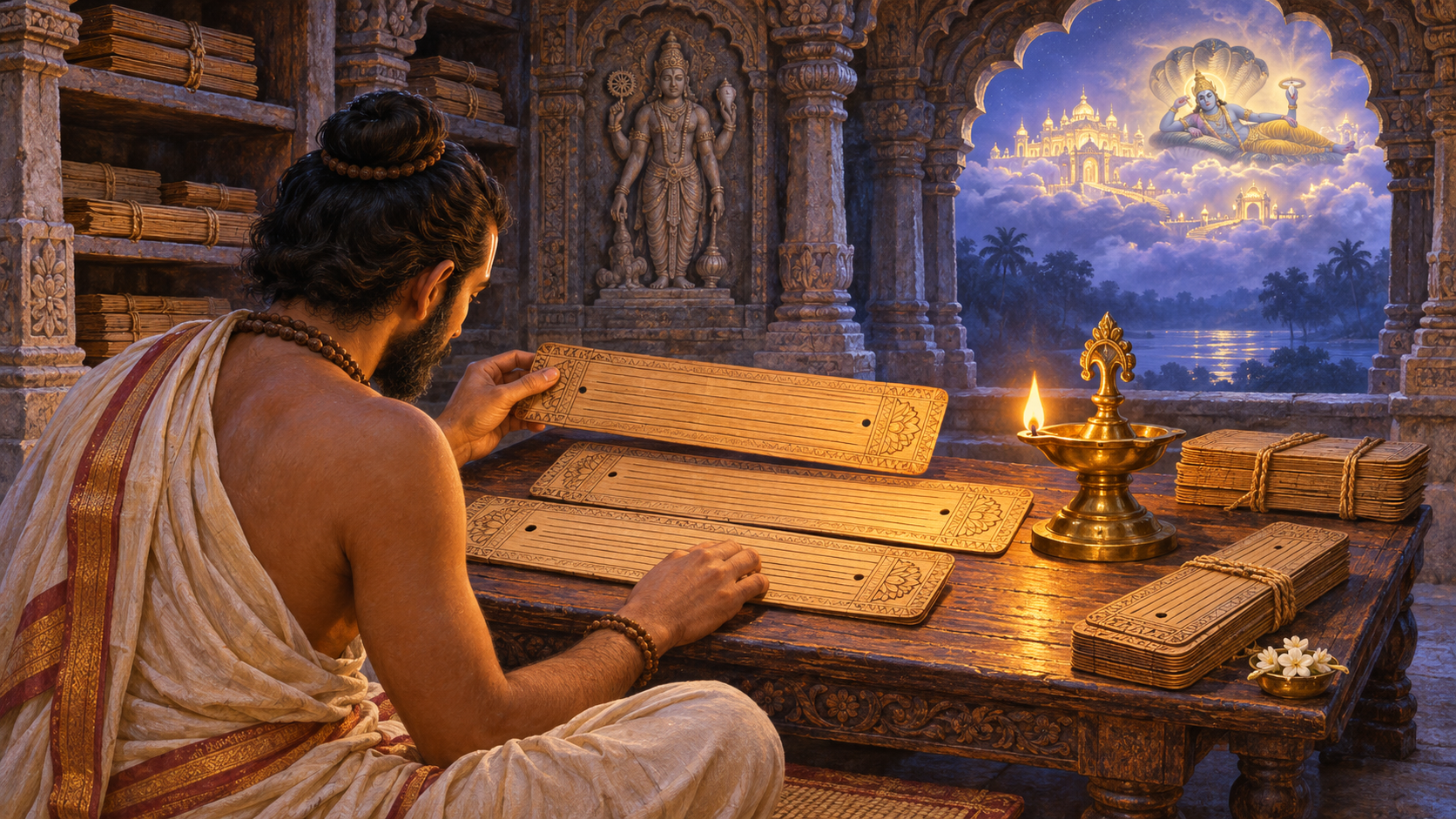
- Identify the kind of text. Is this scripture, commentary, hymn, temple narration, or a modern retelling? A hymn of praise and a cosmological description can use similar imagery for different immediate purposes.
- Record the stated details. Note who is present, how Vishnu is described, which objects appear, and what is said about the setting. Keep this list separate from what you think the details mean.
- Mark every inference. “Vishnu is shown with Lakshmi” is a description. A claim about the precise physical nature of the surrounding ocean is an interpretation unless the passage explains it. This small distinction prevents confident overreading.
- Ask what the passage is doing. Is it describing a realm, praising Vishnu, encouraging devotion, presenting a vision, or teaching about liberation? The function helps determine how literally each element is being used.
- Check the interpretive lineage. When reading a commentary, identify the tradition and commentator where possible. Do not silently combine distinct Vaishnava interpretations into an artificial consensus.
- Carry one detail into practice. Rather than trying to visualize an entire cosmic map, begin with Vishnu’s recognizable form or one of the four attributes. Let that detail stabilize your remembrance during prayer, recitation, or quiet contemplation.
A simple note with three headings – “stated,” “interpreted,” and “unresolved” – is often enough. Under “stated,” you might place Vishnu, Lakshmi, the four arms, and the four attributes. Under “interpreted,” record what your tradition teaches those features disclose. Under “unresolved,” keep questions the passage does not answer. This method respects both faith and textual discipline.
Key takeaways
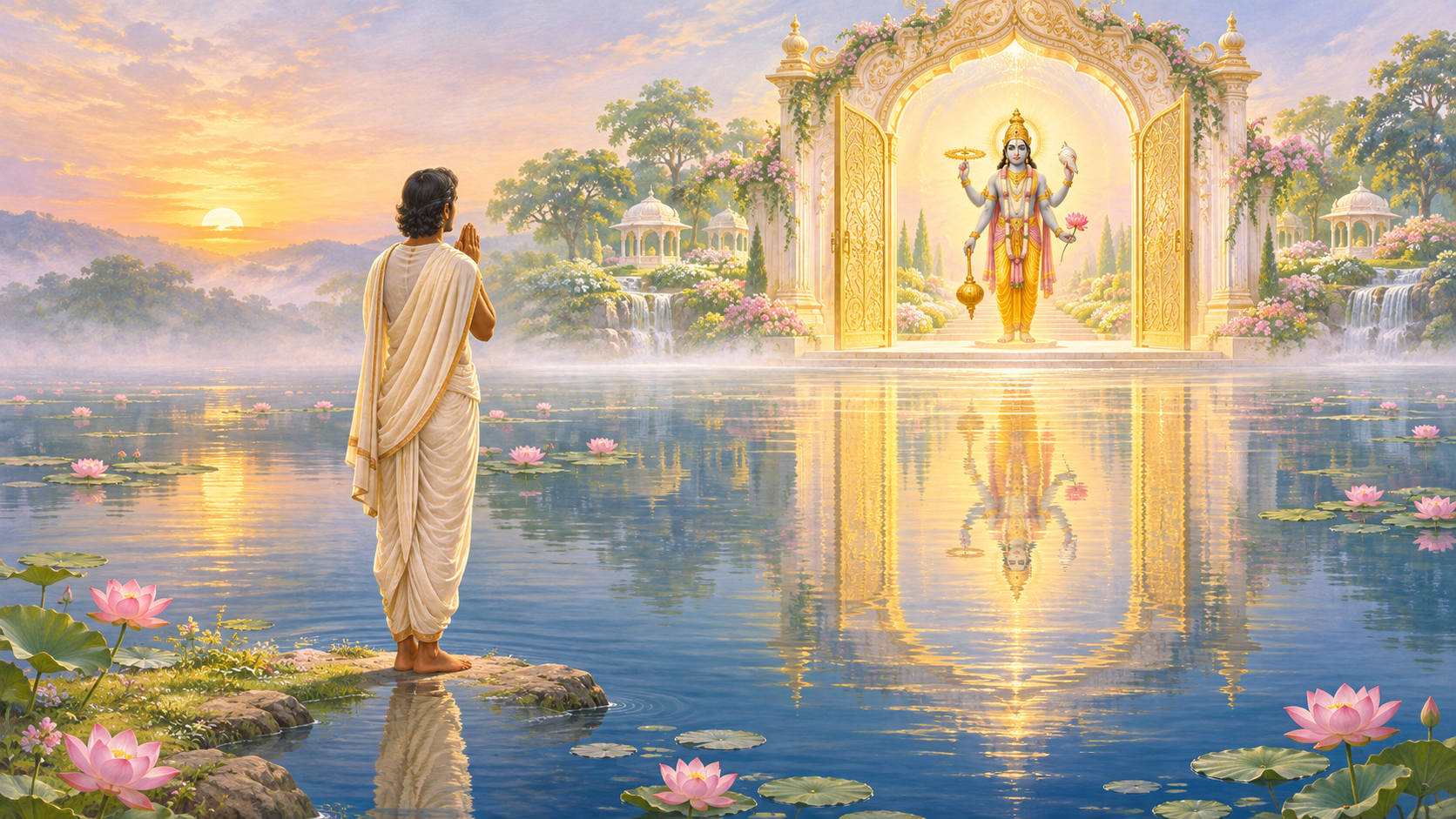
- Vaikuntha is best approached first as Vishnu’s divine abode, defined by his presence with Lakshmi.
- The four-armed, cloud-blue Vishnu bearing the lotus, mace, conch, and discus gives the abode its specifically Vaishnava identity.
- Cosmological, theological, and devotional readings can complement one another; you do not have to reduce Vaikuntha to only one level.
- “Heaven,” “physical planet,” and “mere metaphor” are all incomplete when used as total explanations.
- A sound reading separates what a passage states from what a commentary, artistic image, or reader infers.
The next time you meet the word Vaikuntha, pause before replacing it with a familiar English category. Mark the divine persons, the attributes, the setting, and the purpose of the passage. Then let your tradition’s interpretation deepen those details without pretending that unanswered questions have already been settled. That discipline will make both your study and your devotion more attentive.
References

Leave a Reply
You must be logged in to post a comment.