

You may feel sincere gratitude for Srila Prabhupada yet still wonder what it means to follow him when the initial inspiration fades. Reading about him can move you, but admiration alone doesn’t decide how you will chant, study, serve, or respond when spiritual life becomes inconvenient.
Keep the answer practical. Let his teachings govern your choices, maintain regular contact through chanting and reading, and use remembrance of his life to renew your willingness to serve. The aim isn’t to collect devotional feelings. It is to let what you hear and read change what you do.
Following begins where admiration becomes obedience
Admiration asks how remarkable Srila Prabhupada was. Following asks what must change in you because you accept his guidance. That distinction matters. You can listen to many recollections, feel affection, and still leave your habits untouched.
Approach his legacy through two connected paths: authoritative teaching and living remembrance. His books provide the standard by which you understand the path. Recollections of his conduct show how conviction, compassion, discipline, dependence on Krishna, and concern for others can appear in an actual life. The teachings steady remembrance; remembrance makes the teachings harder to treat as abstractions.
Whenever you encounter an instruction, ask how it should appear in your conduct. Whenever you hear a memorable pastime, ask which instruction or devotional quality it brings into view. This turns hearing from consumption into discipleship.
- Identify what is actually being asked. Separate a direct instruction from your own inference about it.
- Name the obstacle honestly. Is the difficulty lack of time, divided attention, reluctance, confusion, or attachment to a competing habit?
- Choose an expression of obedience. Connect the teaching to a decision, conversation, service, or practice already in front of you.
- Mark unresolved questions. Don’t fill a gap in understanding with a confident guess. Carry the question to a mature practitioner who can help you read it in context.
Read for instruction, not merely for completion

The simplest counsel is also the most demanding: chant and read Srila Prabhupada’s books. Its simplicity removes a common escape. You don’t need to wait for a rare mood, a retreat, or the perfect study plan before returning to the practices that keep his voice present in your life.
Reading becomes transformative when you stop treating page count as the main result. A short passage understood, remembered, and acted upon can shape you more than hurried reading that leaves no trace. Your immediate task is not to finish everything. It is to become teachable.
- Settle before opening the book. Put the phone out of reach and state your purpose plainly: you are reading to receive guidance, not merely to acquire information.
- Read slowly enough to notice an instruction. Pay attention to what is being affirmed, rejected, required, or explained. If the passage is difficult, keep the difficulty visible instead of rushing past it.
- Restate the point in your own words. This exposes the difference between recognizing a sentence and understanding it.
- Connect the point to present conduct. Ask where it touches your chanting, speech, work, family responsibilities, use of time, association, or service.
- Carry the teaching beyond the reading period. Return to it before the day is absorbed by fresh input. An instruction remembered during a real decision has begun to function as guidance.
Place reading beside chanting rather than postponing it until every other duty is finished. If your schedule changes often, attach the practice to an event that already happens: after waking, after worship, before opening messages, or when the household becomes quiet. A dependable cue is more useful than a vague promise to read later.
Give chanting the same undivided attention. Sit where you can hear, remove avoidable distractions, and return to the sacred sound whenever the mind wanders. Don’t turn a distracted session into a reason to abandon the next one. The recovery itself is part of discipline.
Let remembrance reveal a principle you can practise

Hearing Srila Prabhupada’s pastimes can protect spiritual practice from becoming impersonal. A remembered encounter, decision, response, or act of service gives the mind something concrete to contemplate. It helps you see that teachings were not merely spoken; they were carried through difficulty, relationship, responsibility, and mission.
Yet remembrance needs discernment. The purpose isn’t to imitate every surface detail or use an anecdote as a substitute for instruction. Circumstances differ. The enduring value usually lies in the devotional principle disclosed by the event.
- Notice the context. What responsibility, difficulty, or human need was present?
- Name the quality. Was the remembrance showing steadiness, compassion, courage, urgency, humility, carefulness, or dependence on Krishna?
- Find the principle beneath the action. Ask why that response served guru, Krishna, or others in that setting.
- Translate the principle into your circumstances. Resolve can mean finishing a promised service. Compassion can mean giving a difficult person patient attention. Humility can mean accepting correction without immediately defending yourself.
This distinction keeps remembrance honest. Following Srila Prabhupada doesn’t mean performing an imitation of his personality. It means allowing the qualities visible in his service to expose your excuses and guide your own service according to your capacity and duty.
Don’t use a remembered incident to bypass his written teachings or to win an argument. Recollections may be abbreviated, differently emphasized, or detached from their original setting as they circulate. If a retelling appears to conflict with a clear teaching, pause. Check the wording and context available to you, and seek help from a trustworthy senior Vaishnava rather than building a conclusion on the fragment alone.
Build a practice that can survive an ordinary week
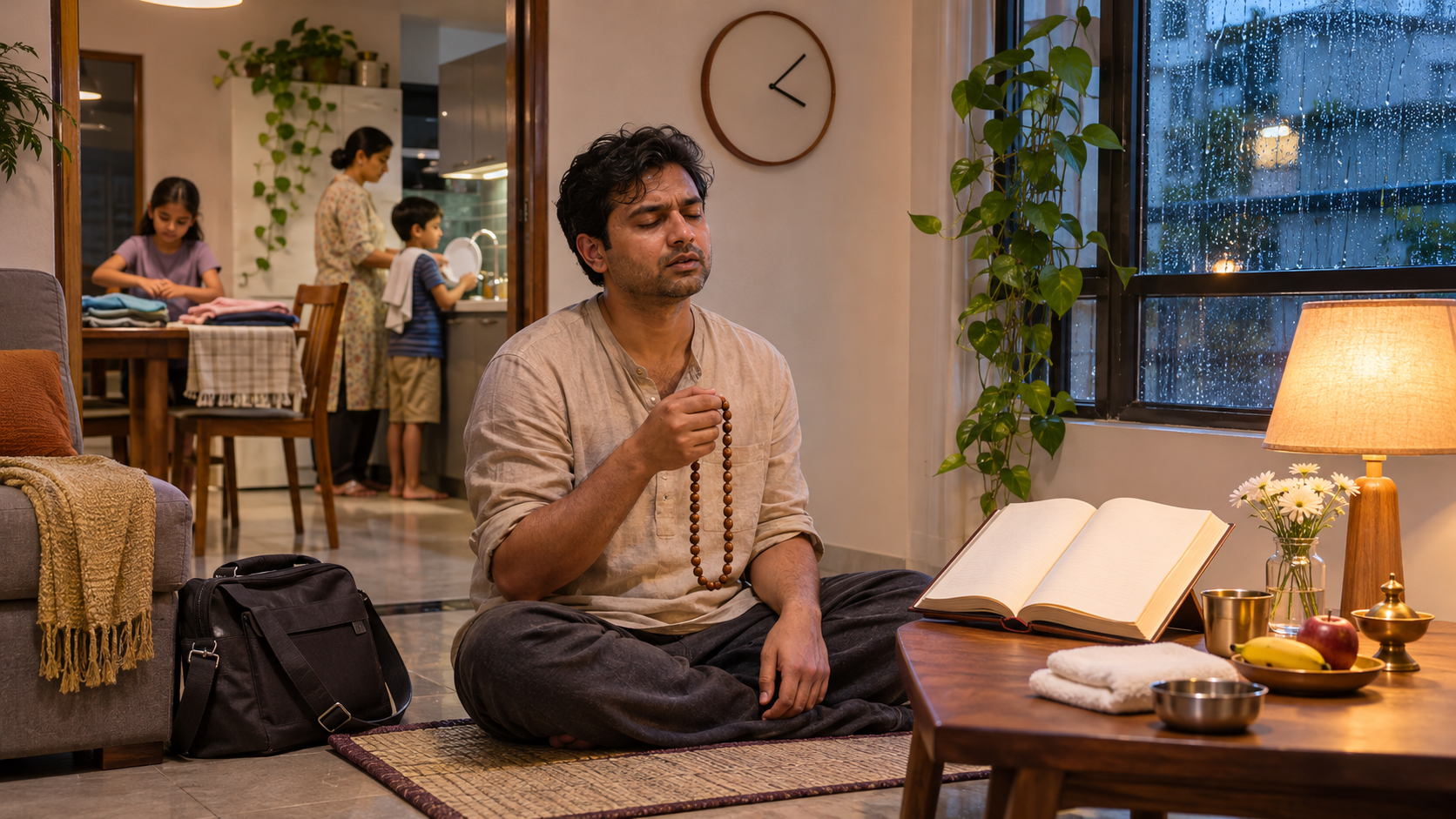
A spiritual routine proves itself on crowded, uneventful, or discouraging days. If your plan works only when you feel inspired, inspiration has quietly become its gatekeeper. Make the return to chanting, reading, and remembrance easy enough that ordinary friction doesn’t decide for you.
- Use a fixed cue. Let an existing part of the day signal the beginning of chanting or reading. Avoid making mood the cue.
- Prepare the physical setting. Keep the book, bookmark, notebook, and anything needed for chanting ready. Every unnecessary choice creates another place to drift.
- Keep a recovery rule. When an interruption breaks the routine, resume at the next suitable opening. Don’t spend the following days negotiating with guilt.
- Record application, not just completion. Write the instruction that stayed with you, the resistance it exposed, and the action it calls for. A log of finished sessions cannot tell you whether you listened.
- Include hearing in association. Listen to faithful remembrance with devotees who direct attention toward Srila Prabhupada’s teachings and service rather than toward novelty or personality display.
At the end of the week, examine the fruit. Which teaching returned to you during a decision? Where did chanting become mechanical? Which remembrance clarified a quality you need to cultivate? Where did you knowingly postpone an instruction? What requires clarification from someone more experienced?
Then adjust the practice at the point of failure. If distraction is the problem, change the environment. If reading remains abstract, write an application before closing the book. If remembrance produces emotion but no service, name the principle and act on it. If confusion persists, seek guidance. A useful review ends with a correction, not with self-condemnation.
Key takeaways
- Following Srila Prabhupada means allowing his guidance to change your conduct, not merely increasing your admiration for him.
- Chanting and reading belong in a regular routine that doesn’t depend on a special mood.
- Read slowly enough to identify an instruction, restate it clearly, and connect it to a present responsibility.
- Receive pastimes as aids to remembrance, then look beneath the surface action for the devotional principle.
- Use written teachings to steady your understanding of remembered incidents, especially when context is incomplete.
- Measure the practice by attention, obedience, recovery, and service rather than by devotional consumption alone.
Open the book you are prepared to keep returning to, protect your next period of chanting from avoidable interruption, and carry a clear instruction into the duty already before you. Let remembrance lead to service before you go looking for more inspiration. That is how affection becomes a path you can actually walk.
References
- Dandavats — Realizations by Bhakti Prabhava Swami – Chant and read Srila Prabhupada books
- Dandavats — Srila Prabhupada’s Pastimes | HH Chandramouli Swami Maharaj | ISKCON Guna

Leave a Reply
You must be logged in to post a comment.