
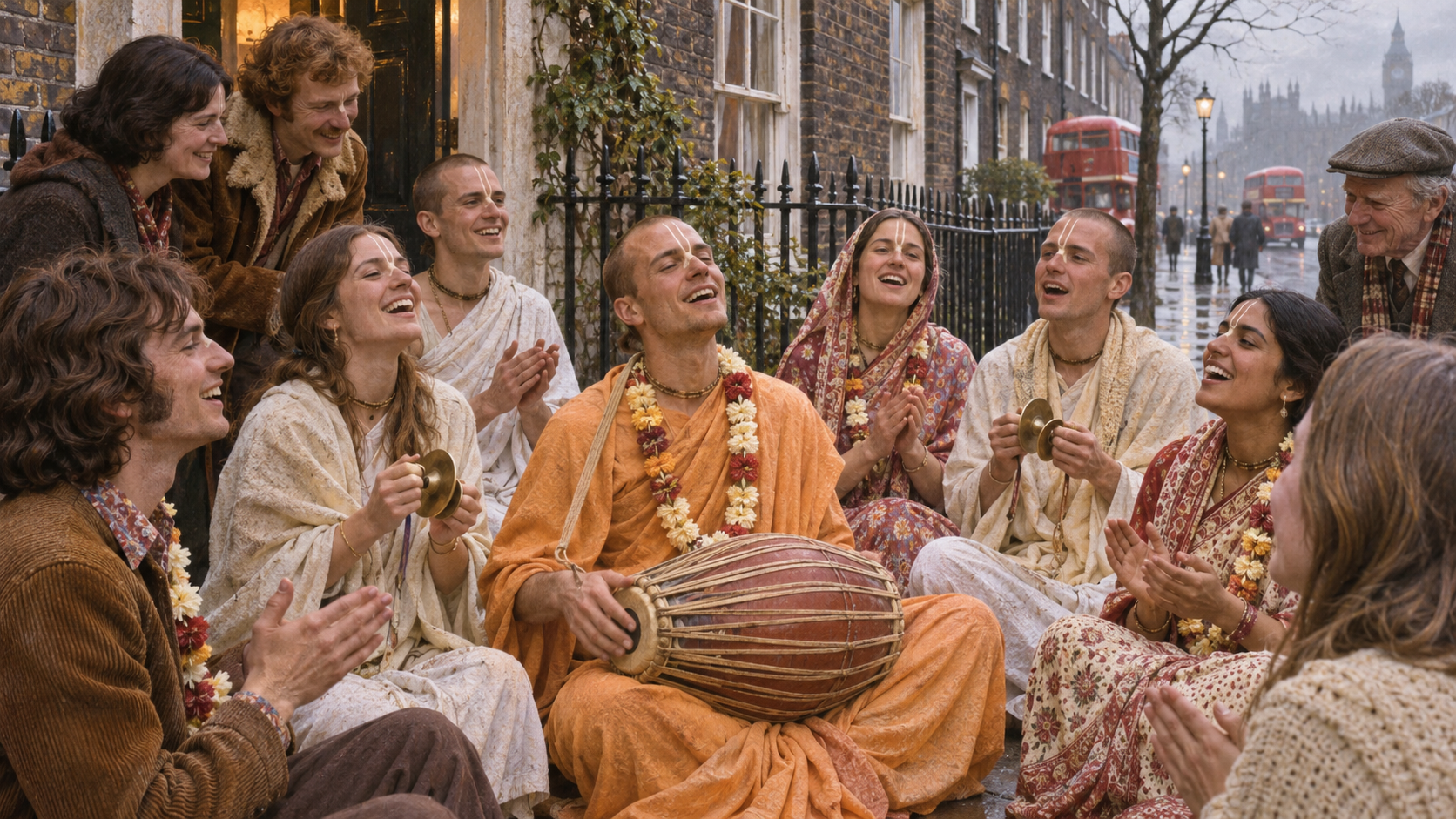
If your picture of Hare Krishna in Britain begins and ends with the Beatles at Abbey Road, you have the opening scene but not the explanation. The movement became durable only after the famous faces, large crowds and first wave of overseas pioneers were gone.
That later phase answers the more useful question: how did an Indian devotional tradition cease to be a passing feature of British counterculture and become a nationwide community? The answer lies in local responsibility, portable practice and patient contact with one person and one town at a time.
The Beatles explain the visibility, not the endurance
The British story began dramatically. Three American couples brought the Hare Krishna movement to Britain in 1968. They met the Beatles, recorded at Abbey Road Studios and helped introduce a generation to the sound of the Hare Krishna mantra.
That encounter should not be dismissed as celebrity trivia. It solved a real problem faced by every unfamiliar tradition: how to become noticeable without first possessing an established public platform. Association with the Beatles carried the mantra into spaces that a small group of missionaries could never have reached on its own.
But visibility is not the same as transmission. A famous musician can make a mantra audible; fame cannot make another person chant it regularly, understand it as devotion or organize a community around it. Public culture grants permission to notice. It does not provide the discipline needed to continue.
This distinction matters when you assess the movement’s place in British history. The Beatles connection explains why many people first heard the chant. It does not explain why anyone was still chanting after the novelty had passed. Treat the celebrity moment as a doorway, neither as an embarrassment to be minimized nor as the whole house.
The chant itself also needs to be understood correctly. Public congregational chanting, often called sankirtana, belongs to Krishna-centered bhakti within the broader Hindu world. It may be musical and joyful, but it is not merely a performance. Its devotional meaning is precisely what separates a spiritual practice from a memorable tune.
The nearly empty room is the more important moment
By 1974, the contrast with the celebrated beginning was severe: the American pioneers had gone, the crowds had disappeared and only a few dozen members remained. In six years, the movement had moved from cultural excitement to a test of survival.
That low point prevents an easy triumphalist history. It shows that early attention did not automatically create stable institutions or committed practitioners. The movement still had to answer the questions that publicity had temporarily concealed: Who would stay? Who would accept responsibility? Could the practice travel without constant support from its original overseas organizers?
If you are trying to decide whether a dharmic movement abroad has genuinely taken root, look for three things:
- Continuity after the visiting pioneers, charismatic personalities or fashionable supporters have left.
- Local practitioners willing to work when attendance is small and public approval is uncertain.
- Practices that can be repeated in ordinary places without depending on a major stage, a large budget or a permanent crowd.
By those tests, 1974 was not merely a period of decline. It exposed the task that would make a distinctly British phase possible. Once the movement could no longer lean on its first burst of attention, responsibility had to pass to people formed within Britain.
The vans turned a London moment into a British network
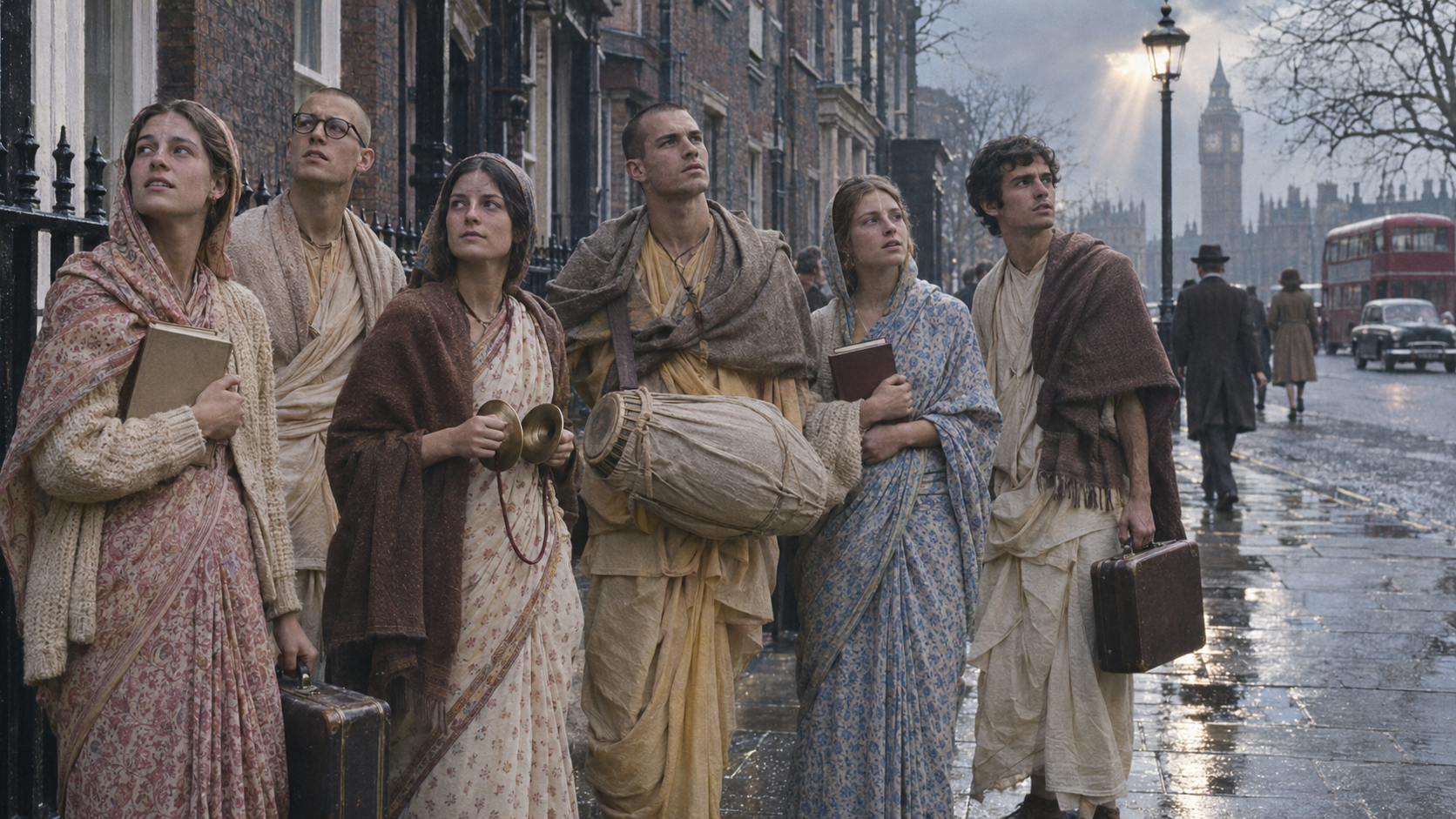
A new generation of young British monks responded by going onto the road. They travelled from town to town, slept in vans and makeshift accommodation, sang, met strangers and distributed books. Kripamoya Das was among the young monks who took part in this travelling phase.
The van was more than transport. It made outreach portable at a time when the community had few people and could not wait for the public to come to it. A small group could enter a town, create a visible encounter through chanting, speak directly with people and leave literature that remained after the travellers had moved on.
The method created a practical sequence:
- Public chanting made the movement audible and gave strangers a low-barrier first encounter.
- Face-to-face meetings allowed curiosity, disagreement and questions to become personal rather than abstract.
- Books gave an interested person something more durable than the memory of a street performance.
- Moving to the next town prevented the movement from remaining only a London cultural episode.
Each part did a different job. Chanting attracted attention, conversation created human trust, and books offered depth. None had to carry the entire burden of transmission. That is a useful design test for any community outreach: do not expect a public celebration to teach everything, or a book table to create a relationship by itself.
The hardship of the vans should not be romanticized or copied for its own sake. Insecure accommodation and physical strain are not measures of spiritual worth. The principle worth retaining is portability: when a community is small, take a simple and repeatable practice to people instead of building plans around facilities and audiences that do not yet exist.
This also explains why the unglamorous years deserve more attention than the Abbey Road moment. Celebrity produced recognition quickly. The travelling monks converted recognition into repeated contact, and they continued when there was little social reward for doing so.
Local responsibility made the movement genuinely British
The transition from three American couples to young British monks was not simply a change of personnel. It marked the point at which Britons became carriers of the tradition rather than only its audience. A transplanted movement becomes locally durable when people within the receiving society accept the cost of maintaining, explaining and sharing it.
Local ownership does not require severing a tradition from its Indian or Hindu roots. The British monks were not inventing a new object of devotion to suit a market. They were carrying Krishna-centered practice through British towns and social conditions. Adaptation concerned who performed the work and how they reached people; continuity concerned what the practice meant.
That distinction helps you recognize healthy cultural transmission. Adaptation is not automatically dilution, just as copying every external feature is not automatically fidelity. Ask whether the devotional center remains intelligible, whether newcomers can progress beyond their first encounter, and whether local practitioners have become responsible stewards rather than permanent spectators.
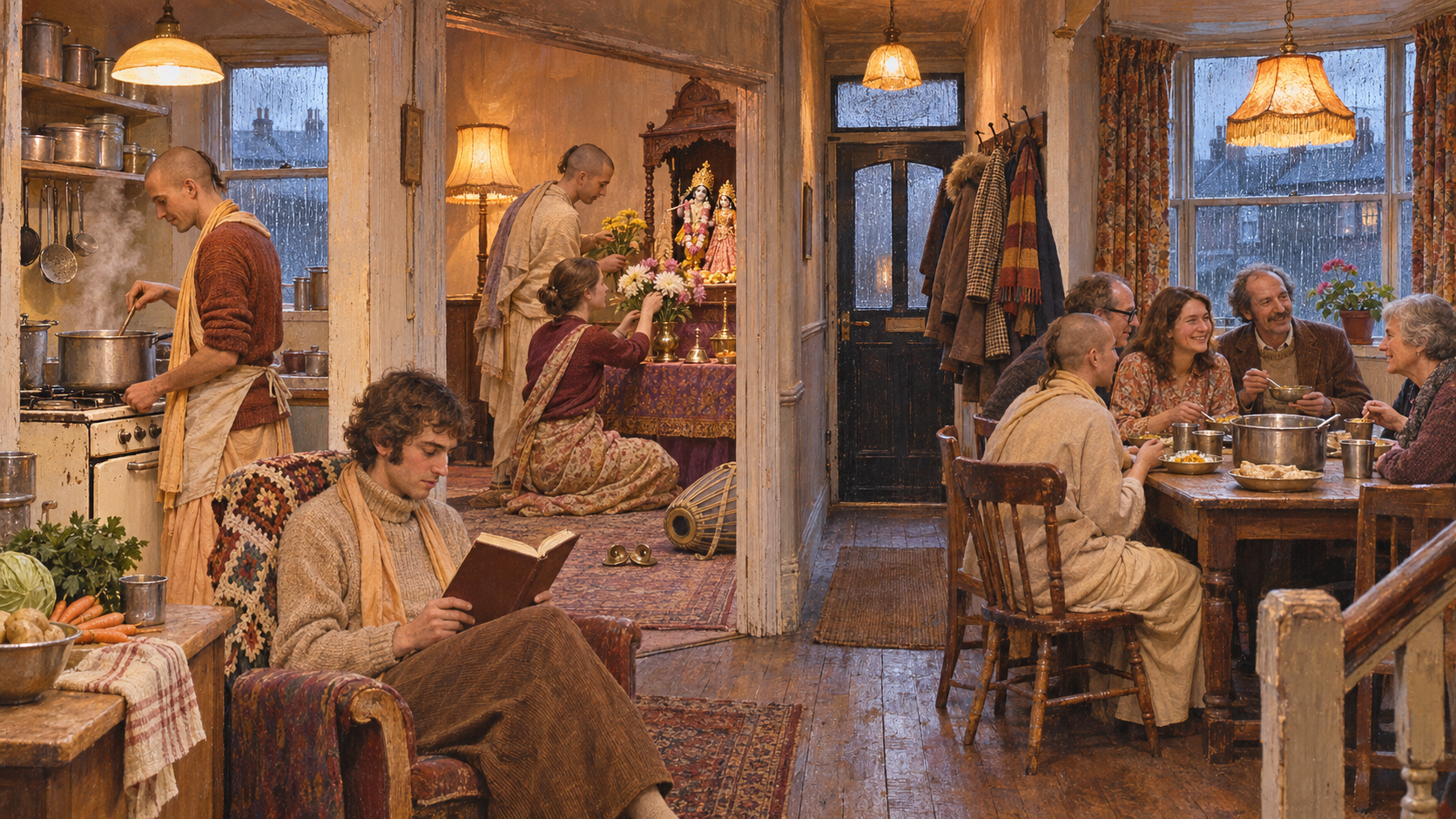
The result was larger than the survival of one small group. The road-going generation helped a tiny remnant grow into a nationwide community. That trajectory cannot be explained by a single record, famous friendship or moment of 1960s curiosity. It required a transfer of responsibility across nationality and generation.
For readers concerned with Bharat’s influence on the world, this is a particularly instructive case. Civilizational influence is not measured only by how often Indian symbols appear in foreign popular culture. It becomes durable when people outside India understand a practice as more than exotic decoration, adopt its disciplines and assume responsibility for passing it forward.
You can use four questions when visiting a community, reading its history or planning dharmic outreach of your own. Is the public practice presented as devotion rather than entertainment? Can a curious person find a path from first contact to sustained learning? Do local members carry real responsibility? Would the work continue if the best-known supporter disappeared? Those questions reveal rootedness more reliably than crowd size.
Key takeaways
- The Beatles and Abbey Road opened an extraordinary cultural door, but they do not explain the movement’s long-term survival.
- The decisive test came by 1974, when the pioneers and crowds were gone and only a few dozen members remained.
- Young British monks made the movement locally owned by accepting responsibility during its least glamorous period.
- Chanting, personal conversation and book distribution served different purposes and worked as a connected path from attention to understanding.
- The vans mattered because they made outreach mobile and repeatable, not because deprivation is spiritually valuable.
- A dharmic tradition has taken root abroad when local people become informed practitioners and responsible custodians, not merely appreciative spectators.
The next time the British Hare Krishna story is reduced to a colourful Beatles footnote, look past the famous beginning. Follow the people who remained after the attention vanished, the practices they could carry from town to town, and the responsibility that passed into British hands. That is where a cultural encounter became living dharma.


References

Leave a Reply
You must be logged in to post a comment.