

If the language of fear in Srimad Bhagavatam 3.29.41 troubles you, don’t hurry to soften it into a pleasant metaphor or harden it into a picture of an angry God. Both reactions can obscure what the verse places before your eyes.
Look instead at its concrete image: trees, creepers, and herbs bear flowers and fruits in their respective seasons under Bhagavan’s authority. The verse uses the order of the living world to challenge a distinctly human illusion: that we are independent, that timing belongs to us, and that fruit must appear whenever we demand it.
What Bhagavatam 3.29.41 actually asks you to notice
A careful paraphrase of the verse is straightforward: trees, creepers, and herbs, standing in awe of the Supreme, receive their flowers and fruits at the proper times. Its movement is from an ordinary observation to a theological recognition. Growth is visible, time governs its appearance, and the whole process remains subordinate to Bhagavan.
This is not offered as a botanical mechanism. The verse is not denying sunlight, water, soil, or the natural processes through which plants develop. It is teaching you how to see those processes. Their regularity is not evidence that creation operates outside divine sovereignty. What we call natural order is itself dependent order.
Three distinctions keep the reading disciplined:
- The observable image: different forms of vegetation bear flowers and fruits at their appropriate times.
- The theological claim: their ordered activity does not exist independently of the Supreme.
- The human implication: you also act within conditions, limits, and times you did not create or command.
The verse does not say that every delay is a punishment, that every visible success proves spiritual superiority, or that devotion requires passivity. Those conclusions add claims the image does not establish. Keep the teaching sharp, but do not make it carry an argument it never makes.
Why “fear” here should not be reduced to panic

The difficult word is usually “fear.” If you hear only human anxiety, the image becomes strange: plants do not possess a human nervous system or worry about divine retaliation. The language operates at the level of sovereignty. Creation cannot ignore the power under which it exists.
That does not mean we should replace fear with a vague word such as appreciation and remove all force from the verse. Bhagavan’s authority is not presented as a suggestion. The tree cannot vote against time, the creeper cannot abolish dependence, and the herb cannot manufacture a season by desire alone. Fear marks the seriousness of the creature’s position before the Supreme: dependent, limited, and unable to make ultimate reality answer to personal preference.
At the same time, fear should not be turned into spiritual terror. A reading has exceeded the verse when it makes you interpret every setback as divine anger, suspect that suffering always proves guilt, or become too frightened to perform your duty. Reverence should puncture arrogance and sharpen responsibility. It should not produce paralysis.
You can test your understanding with a practical question: does this reading make you more attentive to dharma, less possessive about results, and more conscious of dependence on Bhagavan? If it merely makes you afraid of misfortune, return to the verse’s central image. The plants are not shown abandoning their nature. They are shown fulfilling it within divine order.
“In its own season” is a discipline for the devotee
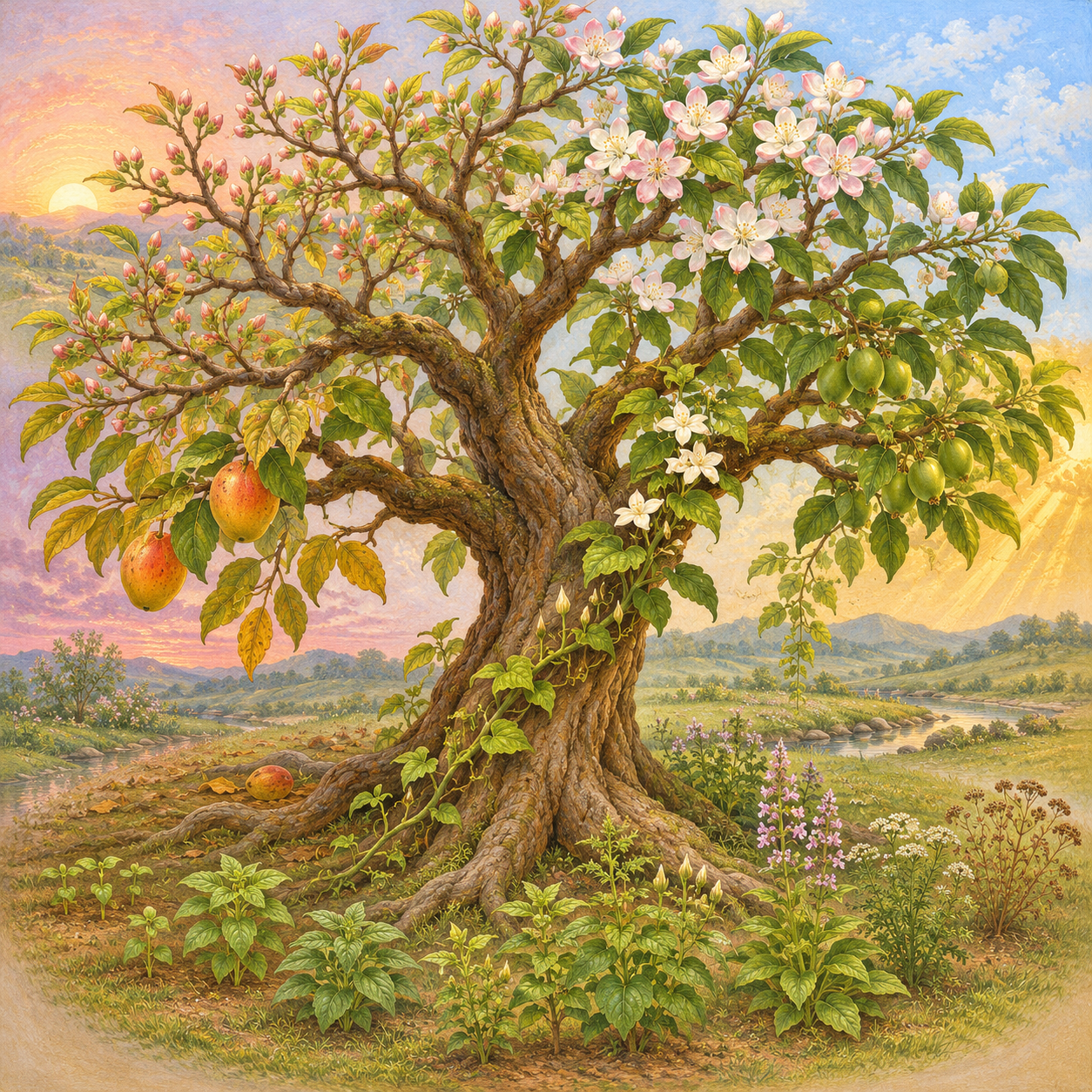
The reference to proper times is not decorative. It prevents you from confusing spiritual sincerity with control over outcomes. A tree and an herb do not bear the same thing on the same schedule. Difference in timing does not by itself mean disorder, neglect, or failure.
This matters when you judge your own sadhana. You may expect prayer to produce immediate clarity, seva to produce recognition, study to remove every doubt, or disciplined conduct to produce an uncomplicated life. When the expected result does not arrive, the ego often reaches one of two conclusions: the practice is useless, or Bhagavan has failed to honour an unspoken bargain. The verse challenges the bargain itself.
Seasonality is not an excuse for spiritual laziness. Plants do not teach indifference; they teach responsive participation. They receive what is given, act according to their nature, and bear what they are meant to bear when the conditions converge. Your equivalent is to perform the duty that belongs to you without claiming ownership of time and fruit.
When impatience appears, separate what belongs to your agency from what does not:
- Yours to do: keep your commitments, correct harmful conduct, study carefully, serve without display, and return your attention to Bhagavan.
- Not yours to command: the speed of inward change, another person’s response, public recognition, or the exact form in which a worthy effort will bear fruit.
- Yours to examine: whether “waiting for the right time” has become a respectable phrase for avoiding a duty that is already clear.
This distinction protects you from both control and fatalism. You do not own the season, but you are still responsible for how you live within it.
Turn the discourse into a method of study

When you sit with H.G. Sarvadrik Das’s discourse on this verse, do more than let it play as devotional background. Prepare a page with four simple labels: text, explanation, application, and question. This keeps the authority of the Bhagavatam distinct from an analogy or application offered during the talk.
- Text: Write only what the verse places before you: vegetation, flowers and fruits, proper times, fear, and supreme authority.
- Explanation: Note how the speaker connects these elements and defines their relationship.
- Application: Record one change in conduct that follows from the teaching. “Be more spiritual” is too vague. “Stop treating delayed recognition as proof that seva was wasted” is usable.
- Question: Preserve what remains unresolved, especially the distinction between reverence, fear, divine control, and human responsibility.
Pause whenever an example becomes memorable and ask what kind of statement you just heard. Is it a translation of the verse, an explanation of its context, an analogy, or a practical extension? All can help, but they do not carry identical authority. This small habit prevents a striking illustration from quietly replacing the primary teaching.
After listening, state the meaning without relying on devotional shorthand. You might say: “Life unfolds within an order I did not create; my duty is faithful action, not control of the season or ownership of the fruit.” If you cannot express the teaching plainly, return to the part of the discourse where your understanding became uncertain.
Then choose an application close enough to practise. Complete a neglected duty without demanding praise. Continue a sound discipline without setting an artificial deadline for inner transformation. Stop using another devotee’s visible progress as the timetable for your own. The verse becomes transformative when it changes how you act under conditions you cannot control.
Key takeaways
- Bhagavatam 3.29.41 presents seasonal fruitfulness as an expression of creation’s dependence on Bhagavan.
- Fear here communicates the seriousness of divine authority; it need not be read as human-style panic or constant expectation of punishment.
- Proper timing challenges the demand for immediate spiritual results, but it does not excuse inaction.
- Your responsibility is to perform dharma faithfully while relinquishing ownership of timing, recognition, and fruit.
- While hearing a discourse, distinguish the verse itself from explanation, analogy, and personal application.
The next time impatience makes you force an outcome, observe what the verse asks you to observe: life bearing fruit without pretending to own the season. Do the work that is yours, release the timetable that is not, and let remembrance of Bhagavan replace the fantasy of independence.
References

Leave a Reply
You must be logged in to post a comment.