
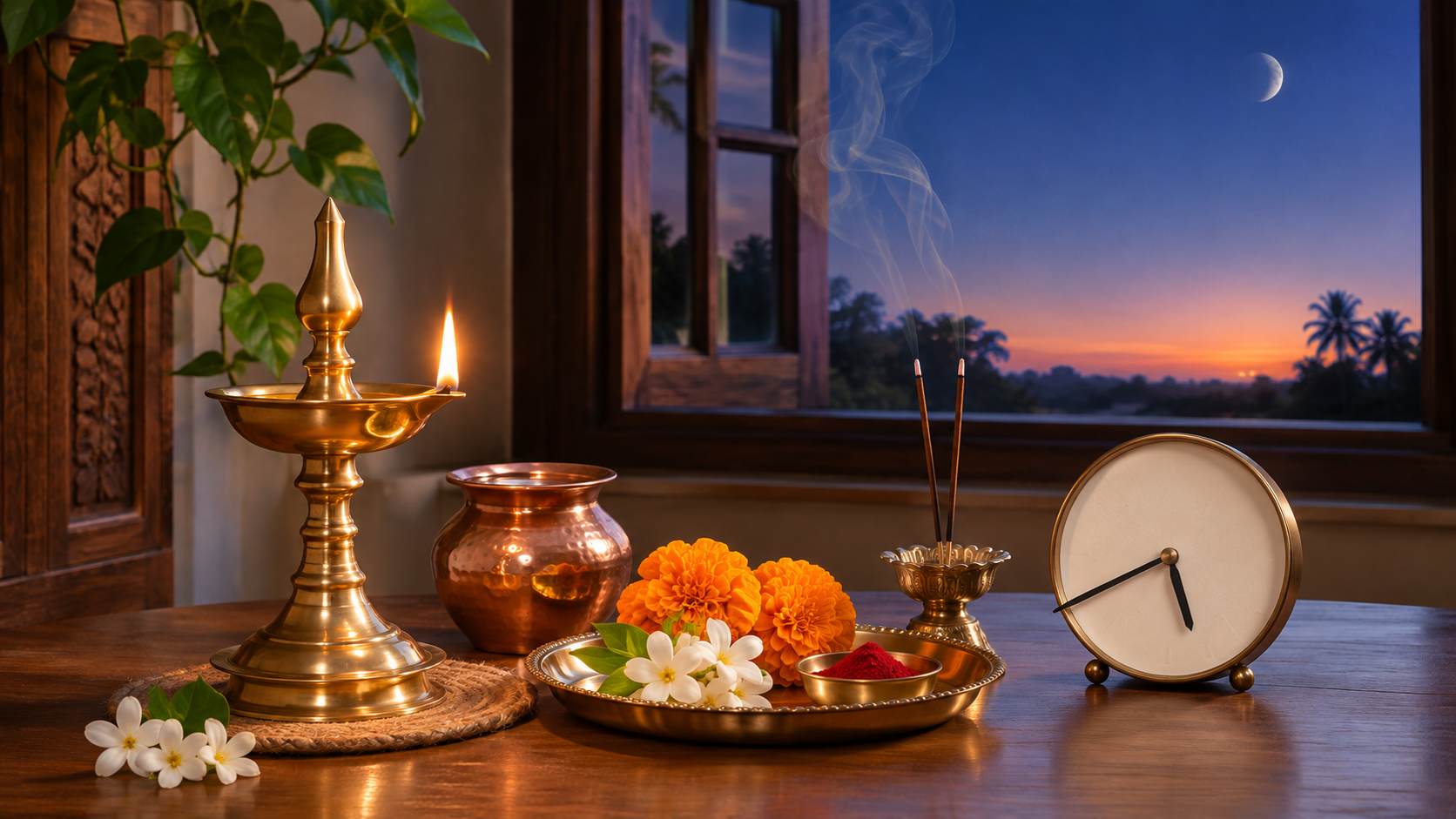
If you are planning puja, japa, vrata observance, or a sankalpa for December 1, the important detail is that the tithi changes early in the morning. The civil date remains Tuesday, but its Hindu calendar designation does not remain the same throughout the day.
For most regions, Krishna Paksha Saptami continues until 5:40 AM, after which Krishna Paksha Ashtami begins. Use that boundary as a general reference, then check a location-specific panchang before any formal observance whose timing matters.
December 1 panchang at a glance
| Calendar detail | December 1, 2026 |
|---|---|
| Weekday | Tuesday |
| Paksha | Krishna Paksha, the waning phase of the lunar month |
| Before 5:40 AM | Krishna Paksha Saptami |
| From 5:40 AM onward | Krishna Paksha Ashtami |
| Tithi covering most of the civil date | Krishna Paksha Ashtami |
If you are simply recording the day’s principal tithi in a diary or household calendar, Ashtami is the practical entry because it covers nearly all of December 1 after the early-morning transition. If your activity occurs before 5:40 AM, however, the applicable tithi in this reference is still Saptami.
Why Saptami and Ashtami share one civil date
A tithi is a lunar division, not another name for a weekday or a midnight-to-midnight date. It begins and ends according to the changing angular relationship between Surya and Chandra. Its boundary can therefore fall at any time: before sunrise, during the afternoon, or late at night.
That is why it would be incomplete to label the whole of December 1 as either Saptami or Ashtami without giving the transition time. Tuesday describes the weekday for the entire civil date. Saptami and Ashtami describe two successive lunar periods that overlap that date.
This distinction matters most when you are performing an observance close to the boundary. A morning entry that merely says “Ashtami” can be adequate for general planning, but it is not precise enough for an activity scheduled before 5:40 AM.
How to apply the timing to your practice
- Write down the actual time of the observance. Do not decide from the date alone. A practice beginning before 5:40 AM falls in Saptami under this reference timing; one beginning after the transition falls in Ashtami.
- Check the city used by your panchang. Hindu calendar boundaries are location-sensitive. If your family follows a temple, sampradaya, or regional calendar, use the timing issued for that place rather than silently transferring a general listing to another location.
- Use the locally applicable tithi in a formal sankalpa. When accuracy is ritually important, confirm the tithi at the moment the sankalpa is made. The tithi governing most of the later day does not retroactively apply to the earlier hours.
- Do not treat tithi as a complete muhurta. Tithi is one part of the panchang. A decision about an auspicious period may also depend on the weekday, nakshatra, yoga, karana, local sunrise, and the requirements of the particular samskara or ritual.
- Follow the rule of the specific vrata or festival. Some observances are assigned by the tithi present at sunrise, while others depend on its presence during a prescribed part of the day. The transition time tells you when the tithi changes; it does not by itself determine every ritual rule.
Avoid the two common calendar mistakes
The first mistake is to assume that Ashtami begins at midnight because December 1 is commonly described as an Ashtami day. It does not: Saptami remains current until the stated early-morning boundary.
The second mistake is to assume that an Ashtami tithi makes every hour after 5:40 AM equally suitable for every purpose. A tithi identifies the lunar day; it is not a universal approval or prohibition. For a wedding, griha pravesha, major purchase, journey, initiation, or another muhurta-sensitive undertaking, consult the complete local panchang and the rules relevant to that undertaking.
You should also resist copying the 5:40 AM boundary into a calendar for another city without verification. A difference in locality can change the displayed transition time, especially when you are close to the boundary. For an ordinary practice well after dawn, that may make no practical difference; for a pre-dawn rite or exact sankalpa, it can.
Key takeaways
- December 1, 2026 falls on a Tuesday.
- Krishna Paksha Saptami lasts until 5:40 AM in the cited general timing.
- Krishna Paksha Ashtami begins at 5:40 AM and continues through the remainder of the stated day.
- Use the time of your observance, not merely the civil date, to identify the applicable tithi.
- Confirm the boundary in a panchang calculated for your location when ritual precision or muhurta selection matters.
For your December 1 planning, first mark 5:40 AM as the reference transition and then replace it with the locally verified time if necessary. That one check prevents the most consequential error: performing an early-morning observance under the assumption that Ashtami had already begun.



References

Leave a Reply
You must be logged in to post a comment.