

Your family has compared two horoscopes, and now one phrase is carrying the weight of the entire alliance: Rasi Porutham. Perhaps the match was called favourable. Perhaps someone said it failed. Either way, you need to know what that conclusion actually answers before you let it decide a marriage.
The sound approach is neither to dismiss the tradition nor to turn one compatibility criterion into a verdict. Understand the scope of Rasi Porutham, verify how the result was reached, and then place it beside the facts only the two prospective spouses can establish.
Begin with the question Rasi Porutham actually answers

Rasi Porutham is one aspect of Hindu marriage matching based on the rashis, or Moon signs, of the prospective spouses. In the broader traditional process, a panchangam may be consulted to consider the stars and planetary positions through an inherited astrological method.
That definition sets an important boundary. Rasi Porutham is not another name for the entire horoscope assessment. If someone says, “The match is good,” ask whether that means this particular porutham was favourable or whether a complete marriage-matching evaluation was performed. Those are different claims.
It is also worth checking what the word rashi means in the calculation you received. In this setting, the relevant designation is the Moon sign used for traditional matching. A familiar sun sign from a newspaper column or general horoscope app is not a safe substitute. If you were told only that both people are, for example, the same popular zodiac sign, you still do not know whether a proper Rasi Porutham calculation was made.
The practical question answered by the calculation is narrow: how does this pair of Moon signs relate within the traditional matching method being applied? It does not directly answer whether two particular people tell the truth, manage anger well, respect one another’s duties, or want the same kind of household.
Treat the result as a signal, not a marriage verdict

A favourable Rasi Porutham can tell you that the pairing meets this traditional compatibility consideration. It cannot guarantee a long or peaceful marriage. A calculation cannot observe how someone behaves when contradicted, whether promises are kept, or how the person treats parents, workers, strangers, and the prospective spouse.
An unfavourable result also needs interpretation. Before anyone cancels an alliance, ask what the finding means within the method used. Was the conclusion based only on Rasi Porutham? Was it one concern within a wider assessment? What practical area is the astrologer asking the family to examine more carefully? A label without that explanation gives you very little with which to make a responsible decision.
Two common mistakes point in opposite directions. The first is to use a favourable result to silence concrete concerns: deception, contempt, coercion, uncontrolled debt, incompatible expectations, or persistent disrespect. The second is to use an unfavourable result as permission to avoid an honest discussion about an otherwise serious alliance. In both cases, the calculation becomes an escape from discernment.
Marriage joins duties, families, habits, resources, and future decisions. Because the consequence is substantial, no astrological result should replace direct inquiry into those realities. If there is evidence of threats, abuse, coercion, fraud, or concealed legal or financial trouble, pause the alliance and address that evidence directly. A favourable porutham does not make such conduct safe.
Ask for a reading you can understand and verify
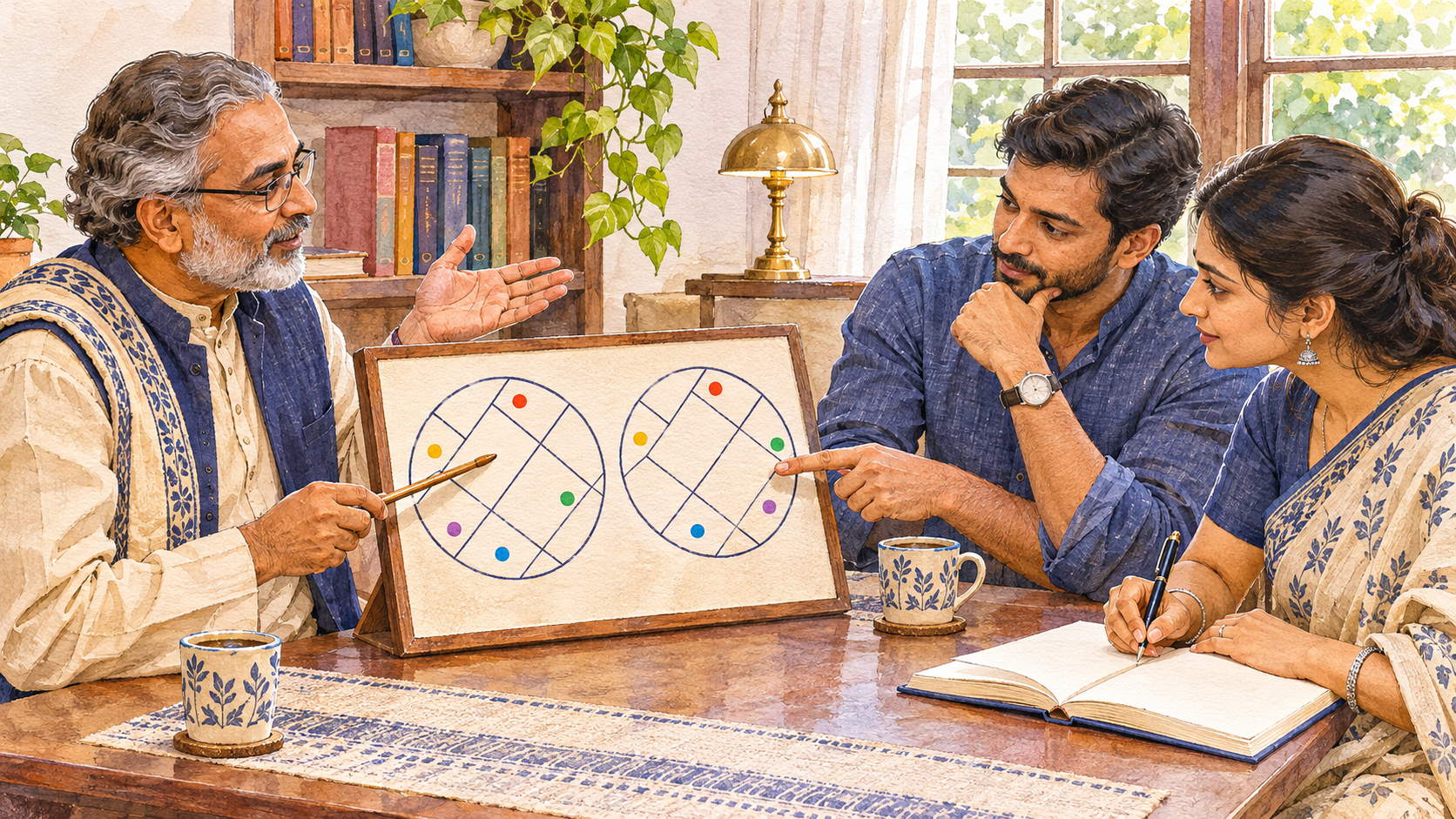
You do not need to become an astrologer to ask disciplined questions. You do need more than a one-word answer passed from one relative to another. Use this sequence when requesting or reviewing a Rasi Porutham assessment:
- Confirm the personal details used for both people. Check the recorded birth information rather than assuming it was copied correctly from a message or family note.
- Ask which rashi was calculated for each person. This catches confusion between a Moon sign used for matching and a sun-sign label taken from a general horoscope.
- Ask whether the conclusion refers only to Rasi Porutham or to a broader horoscope comparison. Write down the answer in those exact terms.
- Ask which traditional method or rule set was applied. If two practitioners reach different conclusions, compare their methods and inputs instead of simply choosing the answer the family prefers.
- Request a plain-language explanation. Ask, “What concern or strength does this result indicate, and how much weight are you giving it within the complete match?”
- Separate the calculation from the recommendation. “This porutham is unfavourable” describes a result; “therefore the marriage must not proceed” is a judgement that requires further reasoning.
This process is especially important when a conclusion arrives second-hand. “The astrologer rejected it” may be an accurate report, but it may also compress several qualifications into a family veto. Whenever the decision matters, hear the reasoning directly or obtain it in writing.
If the recorded information is uncertain, say so before asking for a final judgement. Do not hide uncertainty to secure approval. A traditional assessment deserves accurate inputs, and the prospective spouses deserve to know which parts of the conclusion are firm and which depend on an assumption.
Bring the horoscope back into the actual alliance

Once you understand the Rasi Porutham result, test the alliance in the areas where only conversation and conduct can provide evidence. These discussions should take place between the prospective spouses, not solely between their families.
- Religious life: What place will puja, temple attendance, festivals, dietary observances, and family traditions have in the home? Where practices differ, what accommodation is each person genuinely willing to make?
- Family duties: Where will the couple live? What responsibilities will each person assume toward parents and elders? Who expects to participate in household decisions?
- Money: What income, debt, savings obligations, spending habits, and support for relatives already exist? Which decisions will require joint consent?
- Work and residence: Does either person expect relocation, further study, a career break, or a particular division of domestic labour?
- Children: Do both people want children? What expectations do they hold about timing, upbringing, education, language, and religious formation?
- Conflict: Can each person disagree without humiliation, threats, prolonged silence, or family mobilisation? How will private disagreements be kept from becoming public contests between households?
- Health and personal history: What information is materially relevant to married life, and how will it be shared respectfully and with consent? Where medical, legal, or financial facts matter, use the appropriate qualified professional rather than asking astrology to answer a different kind of question.
The horoscope result and the real-world inquiry should inform different parts of the decision. The following framework keeps one from swallowing the other:
| Rasi Porutham | Real-world evidence | Sensible next step |
|---|---|---|
| Favourable | Values align and difficult questions have clear answers | Continue the wider family and marriage due diligence without treating the result as a guarantee. |
| Favourable | Serious concerns remain unresolved | Resolve the concerns first. Do not use the porutham to overrule observed conduct. |
| Unfavourable | Values align and the relationship appears sound | Ask for the exact reasoning and, if the tradition is important to both families, seek a complete qualified assessment before deciding. |
| Unfavourable | Serious practical concerns also exist | Address those concerns on their own merits. Do not turn the decision into an argument solely about astrology. |
This is not a contest between faith and reason. Careful use of a Dharmic tradition requires both reverence and viveka, the discernment to understand what a practice can tell you and where another form of knowledge is needed.
Key takeaways
- Rasi Porutham compares the rashis, or Moon signs, of two prospective spouses within a traditional Hindu marriage-matching method.
- It is one compatibility criterion, not automatically the complete horoscope assessment.
- Verify the personal inputs, the two calculated rashis, and the method before accepting a favourable or unfavourable label.
- Ask the astrologer to explain the result in ordinary language and state how much weight it carries within the wider match.
- Never let a favourable result erase concrete evidence of deception, coercion, disrespect, financial concealment, or incompatible life plans.
- Use the assessment alongside direct conversations about dharma, family duties, money, work, children, residence, health, and conflict.
Your next step is simple: obtain the exact Rasi Porutham finding, ask how it was calculated, and schedule the conversations that no chart can conduct for you. A marriage decision becomes more responsible when tradition clarifies the inquiry while the two people still answer for their character, commitments, and choices.
References

Leave a Reply
You must be logged in to post a comment.