
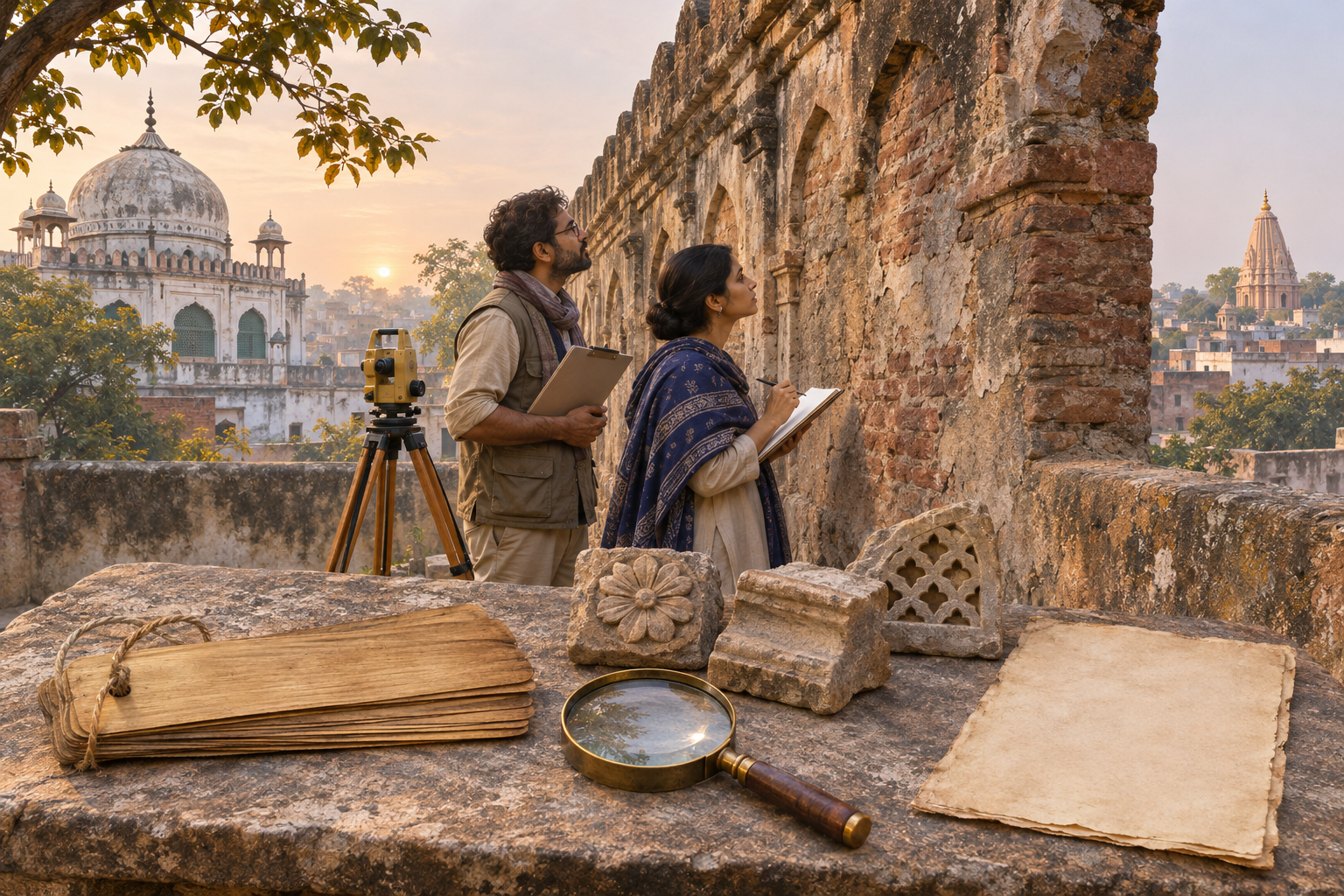
If you are trying to determine whether Sambhal’s Jama Masjid stands on the site of a Harihar Mandir, you need more than a repeated claim or a general reference to a Purana. You need to know exactly which part of the claim is supported, which part remains unverified, and what evidence could close the gap.
The careful answer is that a Puranic association, a modern-site identification, a temple-demolition allegation, and an attribution to Babur are separate propositions. On the information available here, they cannot all be treated as established simply because they appear in one narrative. Taking Hindu civilizational memory seriously requires us to preserve those distinctions.
One familiar narrative contains four separate claims
The widely circulated account combines Puranic references, a Harihar Mandir, the Sambhal Jama Masjid, and an alleged destruction under Babur in the 16th century. It also describes the mosque as a second Babri Masjid. That compact presentation can make the entire chain sound like one fact, but each link needs its own proof.
- Sacred-geography claim: Sambhal has a place in Hindu religious tradition.
- Textual claim: the Skanda, Bhagavata (Bhagwat), or Matsya Purana refers to a Harihar Mandir connected with Sambhal.
- Site-identification claim: that sacred place or temple occupied the particular ground on which the mosque stands.
- Historical-event claim: an earlier temple was destroyed and replaced by the mosque under Babur in the 16th century.
Evidence for the first claim does not automatically prove the second. Evidence for the second does not locate the temple beneath a particular building. Even a secure site identification would not, by itself, establish who demolished what, when it happened, or under whose authority. This is the central distinction to keep in mind whenever you encounter a confident one-sentence version of the Sambhal claim.
The phrase second Babri Masjid is an analogy used by advocates, not an independent historical category. It may communicate how strongly people feel about the site, but it cannot supply missing textual, archaeological, or chronological evidence.
How to test the claimed Puranic connection
The Skanda Purana is central to the religious argument, while the Bhagavata and Matsya Puranas are also invoked. The Puranic assertion is attributed to some historians, but no historian, work, chapter, verse, Sanskrit passage, edition, or translation is identified in the information available here. That does not prove that no relevant passage exists. It means you should not repeat an exact textual claim until an exact textual citation is produced.
If someone tells you that the Puranas prove the case, ask for the following items in order:
- The precise location: the Purana’s name, internal division, chapter, and verse number.
- The original wording: the relevant Sanskrit passage, not merely an English or Hindi paraphrase.
- The edition used: publisher, editor, publication details, and page number. Long textual traditions can differ across editions and recensions.
- A complete translation: enough surrounding text to show whether the passage concerns a town, a sacred region, a deity, a shrine, or a prediction.
- The identification argument: an explanation of why the place named in the passage is the present Sambhal and, separately, why it refers to the mosque’s precise site.
Watch especially for a shift from Sambhal to Harihar Mandir. A passage naming Sambhal would support a connection between the locality and sacred tradition; it would not necessarily name a Harihar temple. A passage naming Harihara would still need to be tied to Sambhal. A passage containing both would be more relevant, but the modern plot would remain a separate historical question.
This standard is not hostile to Hindu tradition. It protects the tradition from weak citations. A verifiable verse can be studied, translated, debated, and preserved. A vague appeal to a large scripture leaves readers unable to distinguish an authentic passage from a later paraphrase or an accidental conflation.
The demolition and Babur claims need independent evidence
The historical allegation is more specific: a Harihar Mandir was destroyed, and the Jama Masjid was built on its site under Babur in the 16th century. A Puranic reference cannot by itself prove that later event. The event claim needs evidence from the period, the structure, the ground, or a traceable chain of records.
A serious investigation would look for several different kinds of material:
- Contemporary or near-contemporary records that name Sambhal, identify the building, and describe construction, destruction, patronage, or an official order.
- Inscriptions documented in their architectural context, accompanied by reliable transcriptions and translations.
- Architectural analysis that distinguishes reused pieces from the original phases of the building and explains how those phases were dated.
- Archaeological evidence from a properly recorded investigation showing the sequence of occupation or construction beneath and around the structure.
- Later administrative records, maps, local histories, or gazetteers that may help trace how the place was named and remembered over time.
- Religious and community memory with a documented history, used as evidence of a continuing tradition rather than treated alone as proof of every event described by that tradition.
Each form of evidence has limits. Reused temple masonry may show that earlier Hindu material was available, but its presence alone may not tell you where the original structure stood, how it ceased to function, or who ordered its reuse. An inscription may establish a patron or construction date without proving the complete history of the ground. A much later account can preserve an older memory, but its distance from the alleged event must be acknowledged.
The strongest case would therefore be cumulative: an exact textual tradition, a defensible identification of the locality, material evidence tied to the plot, and historical records that converge on the event and its chronology. Until that chain is shown, the responsible status is not disproved but unresolved.
Do not try to settle the question through unauthorized digging, removal of masonry, entry into restricted areas, or confrontation at a place of worship. Such actions can destroy the archaeological context that would make an object useful as evidence, may be unlawful, and can endanger people. Site evidence should be recorded by qualified specialists through lawful procedures.
How to discuss Sambhal without weakening the Hindu case
You do not have to choose between dismissing Hindu memory and declaring every disputed detail proven. There is a stronger third position: state the tradition faithfully, identify the present evidence, and name the unresolved links.
- Use the right status word. Say claim, tradition, identification, allegation, or documented fact according to what the evidence supports.
- Name the claimant when possible. Some historians is not enough for verification. Ask which historians, in which works, and on what evidence.
- Do not let one citation carry four claims. A Puranic verse, an archaeological report, an inscription, and a historical chronicle answer different questions.
- Separate absence from disproof. Missing evidence in a short public account does not establish that the event never happened. It does prevent you from calling the event settled on that basis.
- Keep uncertainty attached to the exact disputed point. You can accept Sambhal’s importance within Hindu tradition while reserving judgement about the identity of a particular plot or the agency behind a later construction.
- Prefer reproducible material. A reader should be able to locate the same verse, inspect the same transcription, or consult the same record without depending on a chain of social-media repetition.
A careful public formulation would be: A Hindu historical claim identifies the Sambhal Jama Masjid site with a Harihar Mandir and attributes the temple’s destruction and the mosque’s construction to Babur in the 16th century. The Puranic basis requires exact passage and edition citations, while the site and event claims require independent historical and material evidence.
That wording neither erases the claim nor announces a verdict the available evidence cannot yet carry. It also tells the reader exactly what should be produced next.
Key takeaways
- A sacred association with Sambhal, a reference to Harihar Mandir, identification of the mosque plot, and a 16th-century demolition under Babur are four different claims.
- A general reference to the Skanda, Bhagavata, or Matsya Purana is not enough; ask for the precise passage, original wording, edition, translation, and context.
- Even a verified Puranic passage would not by itself prove what happened at a particular site centuries later.
- The mosque-site claim needs its own historical, architectural, archaeological, or inscriptional evidence.
- The phrase second Babri Masjid expresses an analogy, not proof.
- Where the evidentiary chain remains incomplete, describe the matter as a significant historical and religious claim rather than a settled reconstruction.
Your most useful next step is simple: ask for the exact Puranic citations and the best independently verifiable evidence tied to the physical site. Examine each item for what it actually proves, not for what the wider narrative asks it to prove. That discipline gives Hindu heritage claims a firmer foundation and makes genuine evidence much harder to dismiss.
References

Leave a Reply
You must be logged in to post a comment.