

You may be considering an Agastya Nadi reading but feel unsure about the first four kandams. Are they four stages of one prediction, four separate readings, or four topics from which you choose? The practical answer is that the first kandam has a different function from the next three: it establishes the reading, while the second, third and fourth examine particular areas of life.
That distinction matters before you spend money, disclose personal information or act on anything you hear. If you understand the sequence and the boundaries of each chapter, you can approach the tradition respectfully without surrendering your judgment.
Why the Pothu Kandam must come first
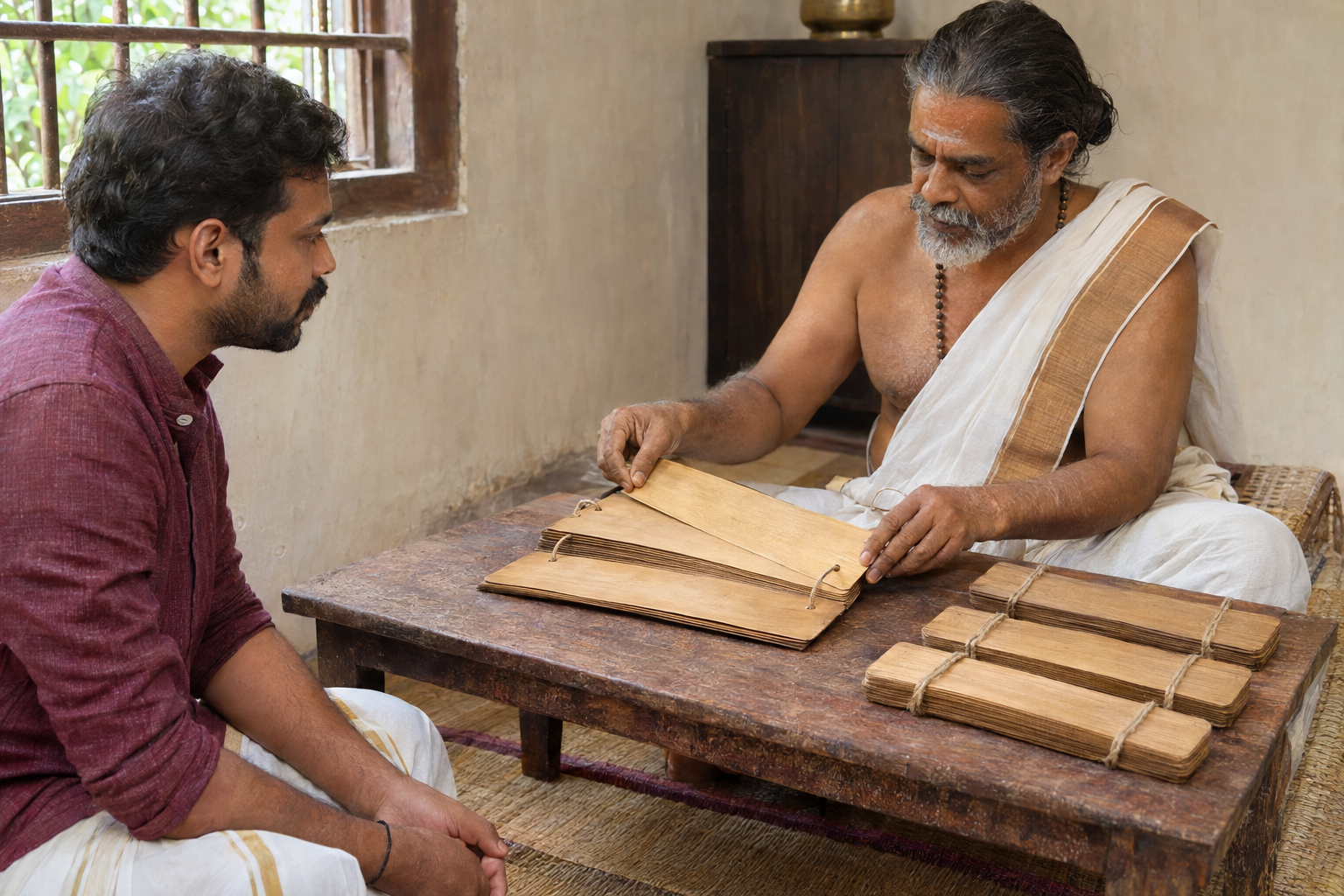
Agastya Nadi is a prominent tradition of Tamil palm-leaf astrology. It is attributed to Maharishi Agastya, who is revered in Southern India as the foremost of the eighteen Siddhas and is traditionally associated with Tamil grammar and Siddha medicine. The attribution expresses the sacred lineage through which practitioners understand the tradition; it should not be silently converted into a modern historical or scientific claim that the available material does not establish.
The first chapter is called the Pothu Kandam, or General Chapter. It is the foundational and mandatory gateway to the rest of an Agastya Nadi reading. It must be located, verified and completed before a practitioner proceeds to a specialised chapter such as those concerning wealth, siblings, property, career or marriage.
This makes the Pothu Kandam a checkpoint, not merely the first item in a package. Its traditional purpose is to authenticate the claimed match between the seeker and the reading. Authentication in this context means verification within the Nadi procedure. It does not, by itself, constitute independent scientific validation of astrology or guarantee that a future prediction will occur.
If you decide to attend a reading, use the Pothu stage deliberately:
- Confirm that the first session or first part of the session is the Pothu Kandam.
- When answering verification questions, answer what was actually asked. Avoid supplying a long biography that makes it difficult to distinguish what came from the reading from what came from you.
- Write down the identifying statements as precisely as possible. Keep them separate from interpretations, predictions and advice offered later.
- Decide whether you accept the claimed match before requesting another kandam. Do not let pressure to continue replace the verification step.
- If a practitioner proposes jumping directly to a later kandam, ask how that method departs from the traditional sequence in which the Pothu Kandam comes first.
A vague resemblance is not the same thing as a verified match. You are allowed to pause, review your notes and decline additional chapters. Respect for a Dharmic tradition does not require abandoning viveka, the faculty of discernment.
What each of the first four kandams covers

The first four kandams move from a general foundation to three focused fields of life. The second, third and fourth kandams correspond directly to the second, third and fourth bhavas of Vedic astrology. Their order is therefore an organising structure, not a claim that every concern in your life must be handled in numerical sequence after the Pothu verification.
| Kandam | Traditional name | Primary scope | Use it when your main question concerns |
|---|---|---|---|
| First | Pothu Kandam | General foundation and authentication of the reading | Whether the claimed Nadi reading has been correctly identified for you |
| Second | Dhana-Kutumba-Vak-Vidya Kandam | Wealth, family, speech and education; corresponds to the second bhava | Resources, family circumstances, the role of speech or learning |
| Third | Sahodara-Parakrama-Dhairya Kandam | Younger siblings, courage, self-effort and communication; corresponds to the third bhava | A younger sibling, personal initiative, courage or communication |
| Fourth | Matru-Bhumi-Vahana-Sukha Kandam | Mother, land and houses, vehicles and sukha; corresponds to the fourth bhava | Your mother, home, immovable property, a vehicle or domestic ease |
The second kandam gives concentrated attention to wealth, family, speech and education. This is broader than asking whether money will arrive. Dhana places resources at the centre, while kutumba, vak and vidya connect those resources with family life, expression and learning. A useful question is therefore specific: are you trying to understand finances, a family matter, education, or the consequences of how you speak? Naming the real concern prevents four distinct themes from collapsing into a generic request for prosperity.
The third kandam concerns younger siblings, courage, self-effort and communication. The inclusion of self-effort is especially important. Even within a divinatory framework, this kandam is not only about events happening to you; it directs attention toward initiative, resolve and the way you act or communicate. If your question is really about an elder relative, general family wealth or your mother, another kandam may provide the more coherent frame.
The fourth kandam examines the mother, land and houses, vehicles and sukha. These subjects belong together through the fourth-bhava field of home, rootedness and material conditions associated with domestic ease. A property question belongs here because it concerns immovable property, not simply because a purchase involves money. The financial capacity for that purchase may touch the second kandam, but the land or house itself belongs to the fourth.
How to separate themes that appear to overlap
Real questions rarely arrive in tidy astrological compartments. A family dispute can involve money, speech, a sibling, a mother and a house at the same time. The useful method is to identify the centre of gravity of your question rather than expecting one kandam to absorb every connected subject.
Family in the second kandam, mother and home in the fourth
Choose the second kandam when the concern is the family unit, family resources, speech within that setting or education. Choose the fourth when your mother is the central person or when the issue is a home, land, house, vehicle or domestic security. If an inheritance dispute concerns a house shared by the family, both frames may be relevant, but you should still begin by stating which decision or relationship you need to understand.
Speech in the second kandam, communication in the third
Vak in the second kandam places speech among wealth, family and learning. Communication in the third sits beside courage and self-effort. That difference gives you a practical test: if your concern is expression as part of family life, knowledge or personal resources, begin with the second. If it concerns taking initiative, conveying a difficult message or communicating in connection with a younger sibling, the third is the tighter fit.
Questions that do not belong in the first four
Do not force every concern into these chapters. The Agastya Nadi structure includes later dedicated kandams for subjects such as career, marriage and Shanti. A general reference during the Pothu reading is not necessarily the complete treatment of that subject. If your actual concern is marriage or career, complete the Pothu verification and then ask which dedicated chapter applies.
A practical protocol for attending a Nadi reading
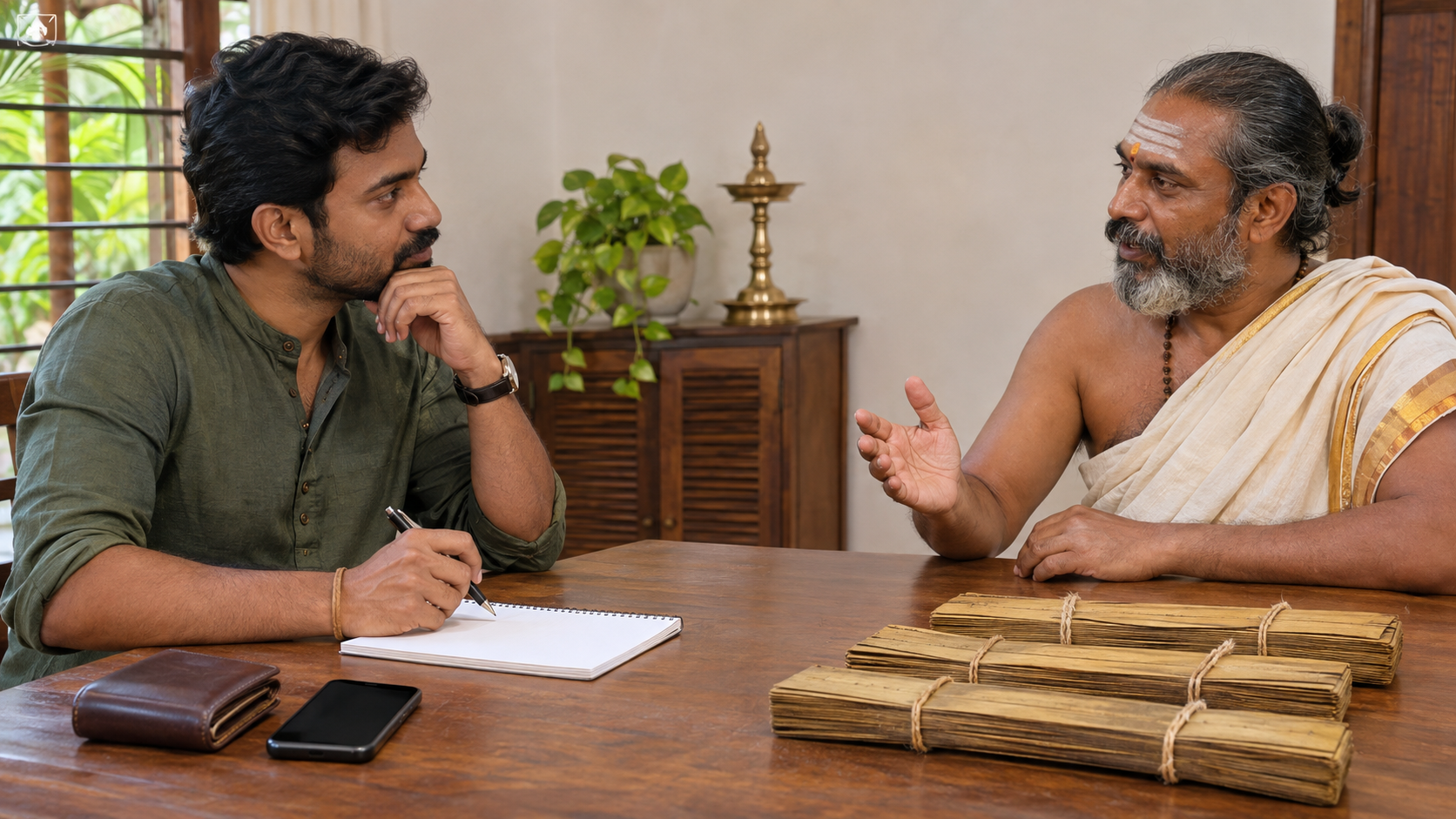
A good protocol lets you receive the reading as a spiritual or traditional encounter while preserving a clear record of what happened. It also reduces the chance that a broad statement, your own disclosure and a later interpretation become fused into one apparently precise prediction.
Before the reading
- Write one sentence naming your main concern. Do not write a request for a complete account of your entire future.
- Ask whether the Pothu Kandam will be located and completed before any specialised kandam.
- Ask what the initial reading includes, what later kandams cost and whether there is any expectation that you purchase them immediately.
- Decide in advance what personal information you are comfortable disclosing and whether you want to take notes or make a recording with permission.
During the reading
- Separate identification from prediction. Mark statements used to verify the Pothu Kandam differently from statements about future events.
- Separate what was stated from what you supplied. If you explain a family situation at length, do not later count those details as information independently produced by the reading.
- Ask which kandam and life domain a statement belongs to. This is particularly useful when family, money and property overlap.
- Write predictions in their original level of specificity. Do not turn a general possibility into a definite event while taking notes.
- If timing or conditions are mentioned, record them exactly. A claim cannot be assessed fairly after its terms have been unconsciously rewritten.
After the reading
Read your notes after the emotional force of the session has settled. Place each important statement under one of four labels: identifying claim, interpretation, future prediction or practical advice. This simple division helps you notice whether the reading was specific, whether it remained internally coherent and how much information originated with you.
Keep material decisions in their proper domain. A fourth-kandam statement about property or a vehicle should not replace a title search, inspection, financing review, insurance check or legal advice. A second-kandam statement about wealth should not replace a budget or qualified financial guidance. An observation concerning family can prompt a thoughtful conversation, but it should not be treated as proof of another person’s motives.
This boundary does not demean the tradition. Spiritual interpretation and practical verification answer different questions. The first may help you reflect on meaning, karma, responsibility or patterns in your life; the second protects you from avoidable financial and legal harm.
Key takeaways and your next step
- Begin with the Pothu Kandam. It is the required verification stage, not one optional topic among several.
- Choose the second kandam for wealth, family, speech or education.
- Choose the third for younger siblings, courage, self-effort or communication.
- Choose the fourth for your mother, land, houses, vehicles or domestic sukha.
- When themes overlap, select the kandam that matches the central person, object or decision in your question.
- Keep an exact record and distinguish traditional authentication from scientific proof or certainty about future events.
- Never use a Nadi reading as the sole basis for a property, vehicle, education or financial commitment.
If you proceed, write your one-sentence question before the appointment. Complete the Pothu verification, pause, and then circle the relevant domain: resources and family for the second kandam; siblings, courage and self-effort for the third; mother, home and property for the fourth. If your concern does not fit, do not force it into these chapters. Ask which later kandam actually addresses it.
That approach preserves two things worth keeping together: respect for the internal discipline of Agastya Nadi and responsibility for the choices that remain yours.
References
- Hindu Pad – 4th Kandam in Agastya Nadi Jyotisha: Matru-Bhumi-Vahana-Sukha Kandam
- Hindu Pad – Brothers, Courage in Agastya Nadi Astrology: Sahodara-Parakrama-Dhairya Kandam: 3rd Kandam
- Hindu Pad – How Career, Family Life Predicted in Agastya Nadi Jyotisha: 1st Kandam
- Hindu Pad – Agastya Nadi Astrology
- Hindu Pad – Dhana-Kutumba-Vak-Vidya Kandam: 2nd Kandam in Agastya Nadi Jyotisha | Finance, Family, Education

Leave a Reply
You must be logged in to post a comment.