
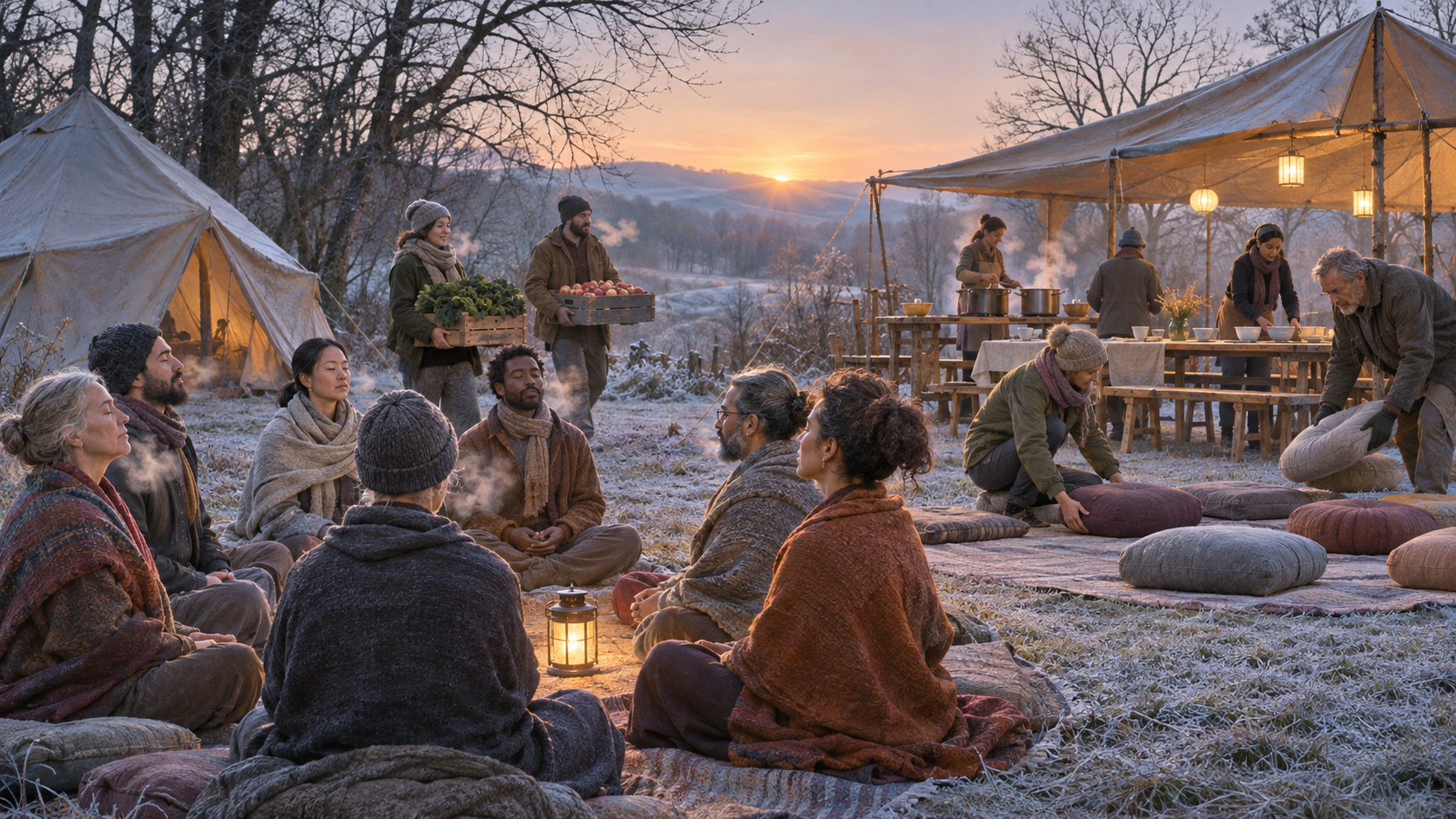
If you are considering the 3HO Winter Solstice 2026 gathering, do not begin with flights or packing lists. Begin by asking whether you want the kind of participation the gathering requires. It is centered on spiritual practice, seva and community: three commitments that call for more than passive attendance.
This guide will help you decide whether that emphasis fits you, identify what must be confirmed before you spend money, and approach the gathering without confusing a particular 3HO setting with the whole of Sikh tradition.
Understand the commitment and test your fit
Spiritual practice is different from spiritual tourism. Tourism asks what you can see or collect. Practice asks what discipline you are prepared to enter. Whatever forms the confirmed program takes, arrive ready to follow instructions, give sustained attention and work within a shared rhythm.
Seva means selfless service. In a gathering, that may translate into practical work that supports other participants and the life of the community. Treat the service itself as part of the practice, but do not confuse selflessness with having no limits. A responsible commitment takes account of your health, mobility, caregiving duties and actual capacity.
Community is the third part of the commitment. It means that your experience will be shaped not only by what you receive but also by how reliably, respectfully and patiently you participate. Someone seeking a private retreat with complete control over the schedule may therefore want something different.
Before making a reservation, mark each of the following statements as yes, no or unresolved:
- I want disciplined spiritual practice, not merely an unusual holiday.
- I am prepared to contribute through seva as well as attend sessions.
- I can follow community etiquette even when it differs from my habits.
- I am willing to ask questions rather than pretend familiarity.
- I can confirm that the accommodation, food, schedule and physical demands suit my needs.
- I can appreciate a 3HO gathering without treating it as a complete representation of every Sikh community.
A no is not a moral failure. It identifies a mismatch. An unresolved answer is a question for the organizers before you commit, especially when it affects money, health, accessibility or travel.
Key takeaways
- Go expecting participation: spiritual practice, service and community are the central frame.
- Clarify the nature and physical demands of seva before accepting an assignment.
- Do not use memories of a previous gathering as confirmation of the 2026 arrangements.
- Verify dates, venue, cost, lodging, meals, program expectations and cancellation terms in current written information.
- Respect the distinct language and boundaries of Sikh practice rather than translating everything into familiar terminology.
- Plan how a practice, an act of service or a relationship will continue after you return home.
Verify every practical detail before spending money
The phrase “Winter Solstice” is not a booking document. Do not infer exact dates, arrival requirements, venue, weather, accommodation or cost from the event name. Use current written information for 2026, and treat anything you cannot confirm as unresolved.
Work through this checklist before purchasing nonrefundable travel:
- Event identity: Confirm the exact name of the gathering, who is organizing it, where registration is handled and which contact can answer participant questions.
- Calendar: Confirm the opening and closing times, the applicable time zone, check-in hours, and whether participants are expected to arrive before the first scheduled practice.
- Full cost: Ask what the registration amount includes. Separate the event fee from transportation, lodging, meals, equipment, donations and any optional activity.
- Cancellation terms: Read the refund, transfer and cancellation rules before paying. Save the version that applies to your booking.
- Accommodation: Establish whether lodging is included, shared or private; whether bedding is supplied; and what check-in, quiet-hour and accessibility arrangements apply.
- Meals: Confirm which meals are provided and how dietary requirements are handled. If you have a serious allergy, ask specifically about ingredients, food preparation and cross-contact rather than relying on a broad label such as vegetarian.
- Program: Request the current schedule and ask which elements are required, which are optional, whether newcomer orientation is available and what level of physical exertion may be involved.
- Seva: Ask whether roles are assigned or selected, what each role involves, how long it lasts, whether training is provided and whom you should contact if the task exceeds your capacity.
- Accessibility and health: Ask about walking distances, terrain, seating, restrooms, heating, sleeping arrangements and any other condition that affects you. If a practice conflicts with medical advice or your physical limits, request an appropriate alternative rather than pushing through it.
- Families: If you are considering attending with children or dependants, confirm age rules, supervision responsibilities, sleeping arrangements and whether any family programming is actually offered.
- Travel: Verify the precise destination, arrival options, parking or transfer arrangements and the realistic time needed to reach check-in.
- What to bring: Obtain current guidance on clothing, footwear, weather protection, practice materials, bedding, identification and any site-specific restrictions.
Keep the confirmation, payment receipt, practical instructions and cancellation policy together. If an important answer is given verbally, ask for it in writing. That small step prevents confusion when different volunteers, venues or booking systems are involved.
Participate without flattening Sikh distinctions
Readers interested in the shared values of Dharmic traditions may readily recognize discipline, service and community as familiar principles. Shared values, however, do not make traditions interchangeable. Respect begins when you allow Sikh vocabulary, practices and boundaries to stand on their own terms.
A 3HO gathering is also a particular community setting. It should not be treated as a substitute for learning about the breadth of Sikh history, scripture, institutions and lived traditions. You can participate sincerely without turning one gathering into a universal claim about Sikhs.
Use a few simple disciplines while you are there:
- Follow the terminology used by the community instead of automatically replacing it with words from another tradition.
- Ask about unfamiliar conduct before assuming that it is mandatory, optional or merely symbolic.
- Request permission before photographing, recording or publishing images of people, practices or sacred settings.
- Do not expect an individual Sikh participant to speak for the entire Sikh Panth or answer every historical and political question.
- Carry out accepted seva reliably. If circumstances change, tell the responsible person early enough for the work to be reassigned.
- State physical or practical limits clearly. Seva offered honestly is more useful than a promise you cannot safely keep.
- Listen during practice instead of treating every difference as an invitation to debate comparative theology.
This approach does not require you to suspend discernment or pretend agreement. It asks you to distinguish between observing respectfully, participating voluntarily and making claims about a tradition larger than the gathering in front of you.
Carry a practice, a service and a relationship home
A gathering can feel meaningful while you are inside its schedule and still leave little trace once ordinary life resumes. Prevent that by deciding in advance what continuity will look like. Do not try to reproduce the entire event at home.
Before leaving, identify:
- a spiritual practice you can repeat consistently within your real schedule;
- a form of seva you can offer in your own family, gurdwara, temple, neighbourhood or civic community;
- a relationship you would like to continue, with the other person’s consent;
- a question about Sikh or Dharmic tradition that deserves careful study rather than a quick answer; and
- a boundary you learned to respect, especially if the gathering challenged an assumption you brought with you.
Write these down before travel and revisit them after returning. The test is not whether you can preserve the atmosphere of a gathering. It is whether your attention becomes steadier, your service more dependable and your understanding more precise.
Open the current event information, work through the planning checklist and leave every unanswered item marked unresolved. If the gathering still fits after those answers are clear, register with a definite intention for practice and a realistic offer of seva. That is how you arrive ready to participate rather than merely attend.


References

Leave a Reply
You must be logged in to post a comment.