

If you arrived after seeing the phrase “cow-smuggling encounter,” you probably want to know whether police broke up a smuggling gang or merely arrested a suspect. The careful answer is narrower: one man was reportedly wounded and arrested after police say two motorcycle riders fired at officers, while the second man escaped. The alleged connections to cow slaughter and a wider network still require investigation and judicial testing.
For Hindu readers, the protection of gau carries deep civilizational importance. That makes accuracy more necessary, not less. You can support firm enforcement against illegal slaughter and animal cruelty while distinguishing an arrest, a police allegation, physical evidence and a conviction.
What reportedly happened in Premnagar
The confrontation began during Operation Prahar, an anti-crime checking initiative in Dehradun. Police personnel conducting vehicle checks near the Tea Estate area on Thakurpur Road in Premnagar signalled two men on a motorcycle to stop late at night. Police say the riders accelerated instead, prompting a pursuit during which the suspects allegedly produced a firearm and opened fire.
Officers returned fire. Irshad was struck in the leg and taken into custody, while the second suspect, identified as Shamim, escaped. Irshad was subsequently moved to Premnagar Hospital for treatment under police custody. Senior Dehradun police officers reached the scene, and a search was launched for Shamim.
Police linked Irshad to recent cow-slaughter incidents in the Tea Estate and Bidhauli Road areas of Premnagar. They identified him as a resident of Khajunawar village and Shamim as a resident of Gandebada village, both under the Fatehpur police jurisdiction in Saharanpur, Uttar Pradesh. Those claimed links are important investigative leads, but they are not findings of guilt.
The items reportedly recovered were a firearm, a motorcycle, an axe, two knives and a rope. Their combination may support the police theory of planned cattle-related crime, but the objects do not establish their own purpose. Ownership, forensic examination, witness evidence and the circumstances of recovery all matter.
Why “cow-smuggling encounter” is an incomplete label

A headline can compress several legally distinct questions into one phrase. In this case, the reported seizure at the encounter site lists no cattle. The cattle-related allegation instead arises from the suspects’ alleged connection to earlier slaughter cases and from the axe, knives and rope recovered after the shooting.
You should therefore keep three layers separate:
- The immediate incident: police stopped two motorcycle riders, say they came under fire, returned fire, arrested one injured man and continued searching for the other.
- The supporting evidence: officers reportedly recovered a firearm, motorcycle, axe, knives and rope from the scene.
- The larger allegation: police suspect involvement in recent cow slaughter and may investigate possible associates, routes and an organized network.
The first layer describes the police operation. The second requires forensic authentication and a reliable chain of custody. The third is a theory that investigators must prove through evidence. Treating all three as already settled weakens public understanding and gives critics an easy reason to dismiss legitimate concern about cattle crime.
The encounter narrative also comes from police officials. That does not make it false, but it means later developments matter: recovery records, ballistic findings, medical evidence, witness accounts, the identification of the weapon’s user and eventual proceedings in court. A responsible reader watches for those developments before turning an allegation into a verdict.
The cross-border trail matters more than the chase

The reported residences of both suspects in Saharanpur, across the Uttar Pradesh boundary, give investigators an obvious line of inquiry. They can examine whether the motorcycle, weapon, travel pattern and earlier Premnagar incidents connect to other people or locations. Residence in another state does not itself prove an interstate network, but it makes coordination between jurisdictions practically important.
A separate operation in Ramnagar illustrates why readers should distinguish individual cases from the broader enforcement effort. Police there reportedly rescued 11 cattle from two pickup vehicles and arrested the drivers. The animals were said to have been bound with ropes and crowded into the vehicles. That operation involved actual cattle in transit; the Premnagar encounter involved suspects whom police associated with earlier slaughter incidents. Combining the two as if they were one case would obscure rather than clarify the pattern.
A checkpoint can stop a vehicle or produce an arrest. Disrupting a durable criminal operation requires the less visible work that follows: tracing vehicles and weapons, locating buyers and handlers, comparing earlier cases, identifying transport routes and prosecuting offences with evidence that survives scrutiny. The measure of success is therefore not the drama of the encounter alone. It is whether the investigation reaches the people, logistics and finances behind any proven offence.
A Dharmic response protects cows without abandoning law
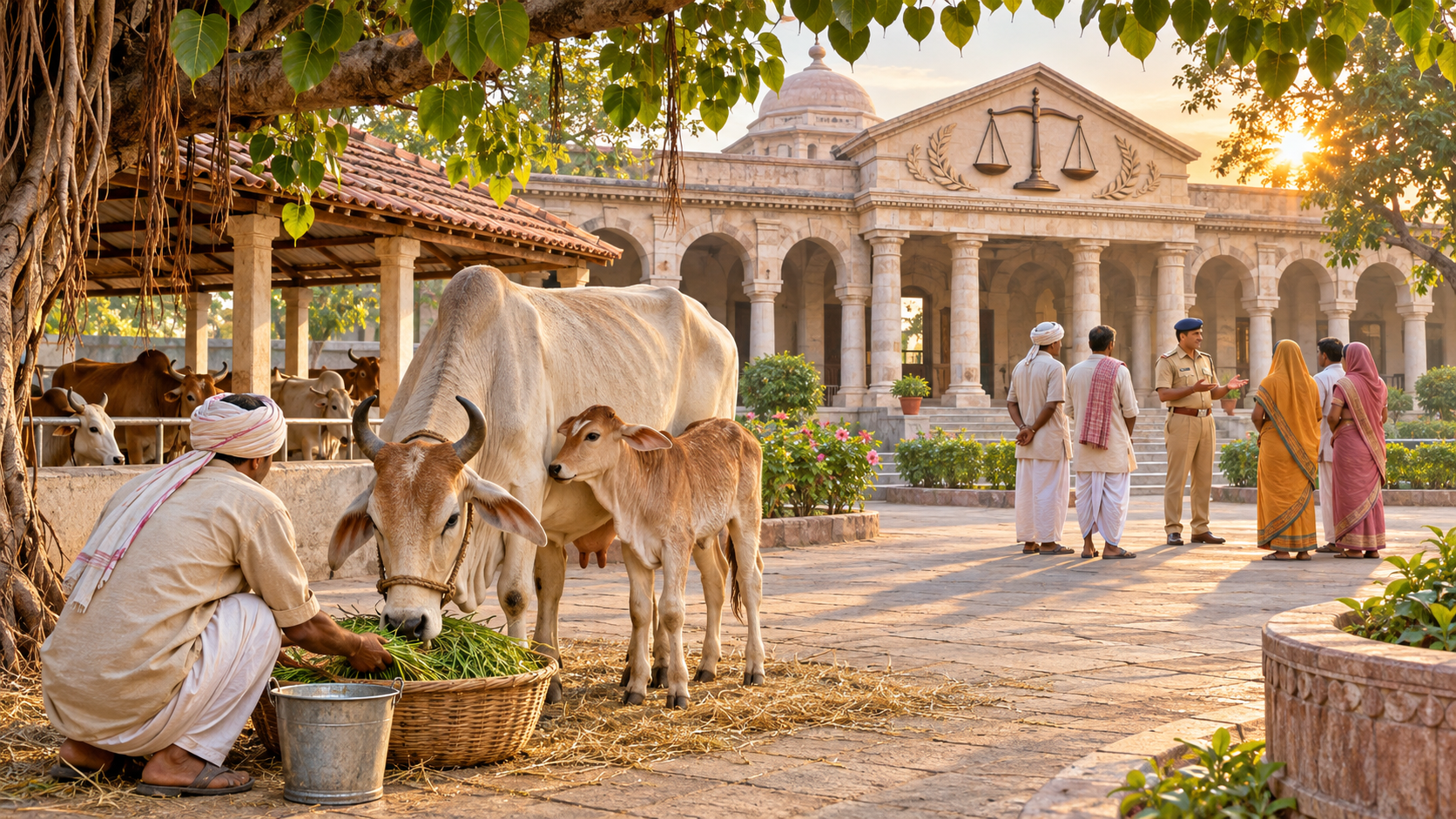
Gau raksha loses moral clarity when concern for the cow becomes permission for rumour, collective blame or private violence. A pro-Hindu response can be both uncompromising about illegal slaughter and disciplined about evidence. Ahimsa is not served by cruelty to animals, attacks on police, or retaliation against people who have not been shown to have committed an offence.
If you encounter suspicious cattle transport or activity, use a response that protects life and preserves the case:
<!– wp:list {
Leave a Reply
You must be logged in to post a comment.