
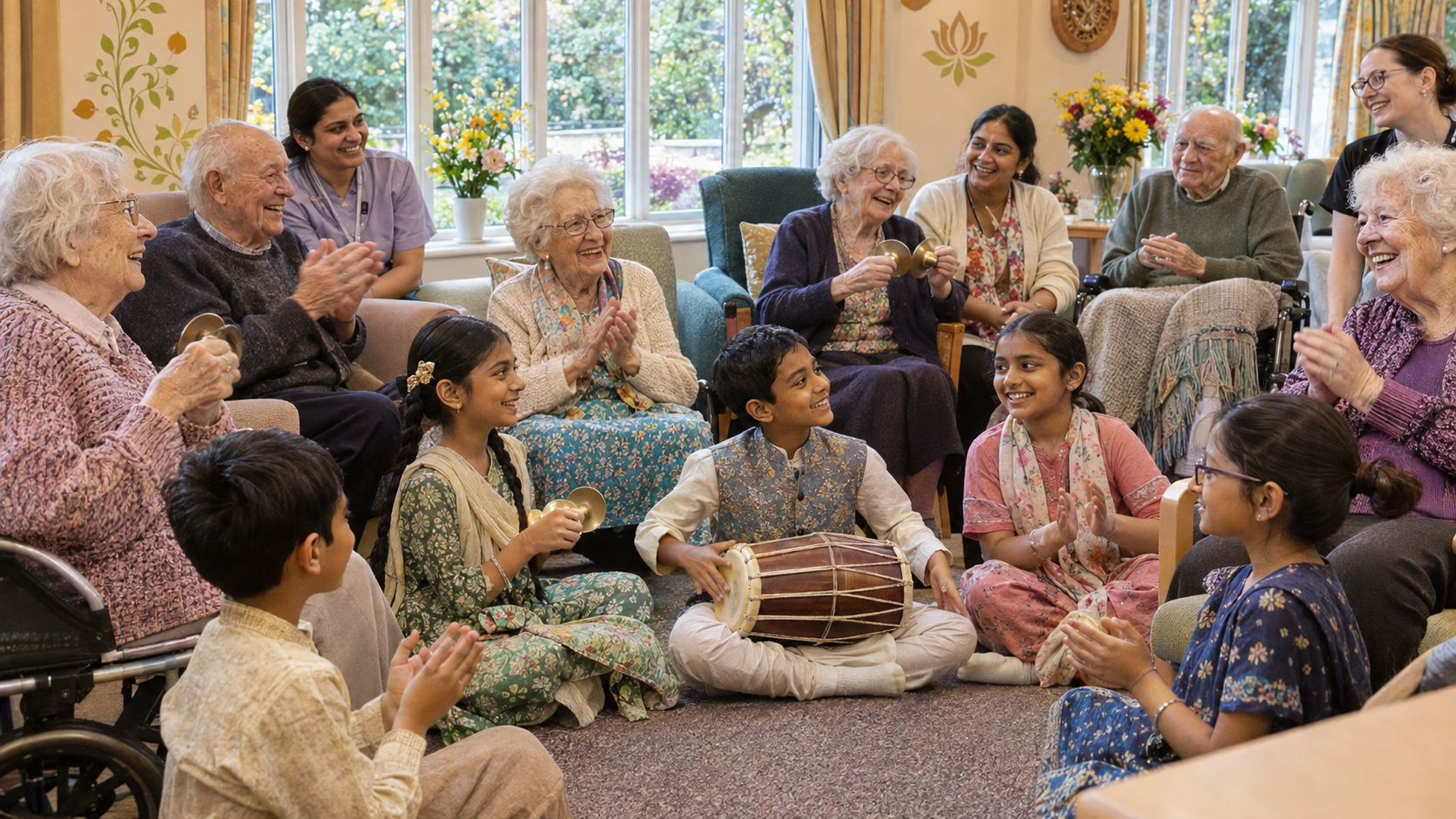
If you have wondered whether temple life is doing enough for elders, or whether children are learning seva as a lived practice, the answer will not come from another lecture. It comes when the two generations are given time to meet, listen and recognise one another.
Bhaktivedanta Manor’s Growing Through Generations programme brings local older residents and primary-aged Gurukul children together in care homes for kirtan, singing, dancing and storytelling. The useful way to understand it is not as a children’s performance for an elderly audience. It is an attempt to build relationships in which both generations participate and both have something to give.
Care begins by creating a place to belong
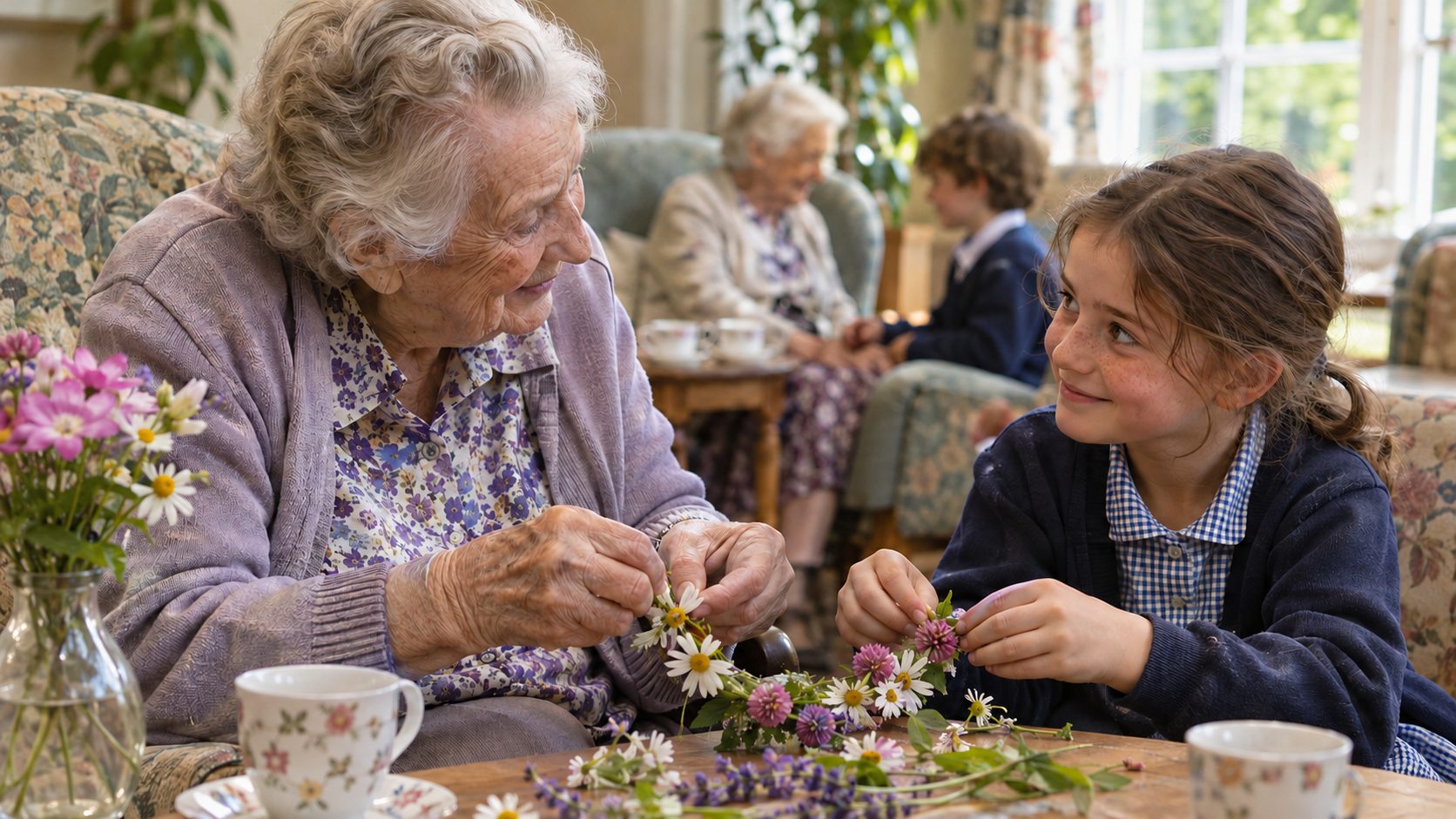
An older person can receive competent practical care and still miss companionship, familiar spiritual sound and the feeling of being part of a wider community. Reduced mobility may also make it harder to attend a temple, visit friends or take part in ordinary social life. Devotee care can respond by taking attentive human presence to the person rather than waiting for the person to reach the temple.
Growing Through Generations is intended to offer older participants companionship, joy, spiritual connection, memory recall and creative expression. These are related needs, but they are not interchangeable. Someone may enjoy hearing kirtan without wanting to dance. Another resident may prefer telling a story to joining a song. Care begins by leaving room for those differences.
Regularity is important because belonging grows through recognition. A single visit can brighten an afternoon; repeated contact gives people a chance to remember names, continue conversations and form genuine friendships. The programme therefore seeks to create regular opportunities for connection rather than treating intergenerational care as a ceremonial appearance on a special day.
Its scope matters too. The programme reaches local elderly residents in care homes, not only people already able to participate in Manor life. That makes devotee care outward-facing. Seva is offered through relationship, without requiring an older person to cross a social, physical or religious threshold first.
Kirtan and storytelling create different kinds of participation
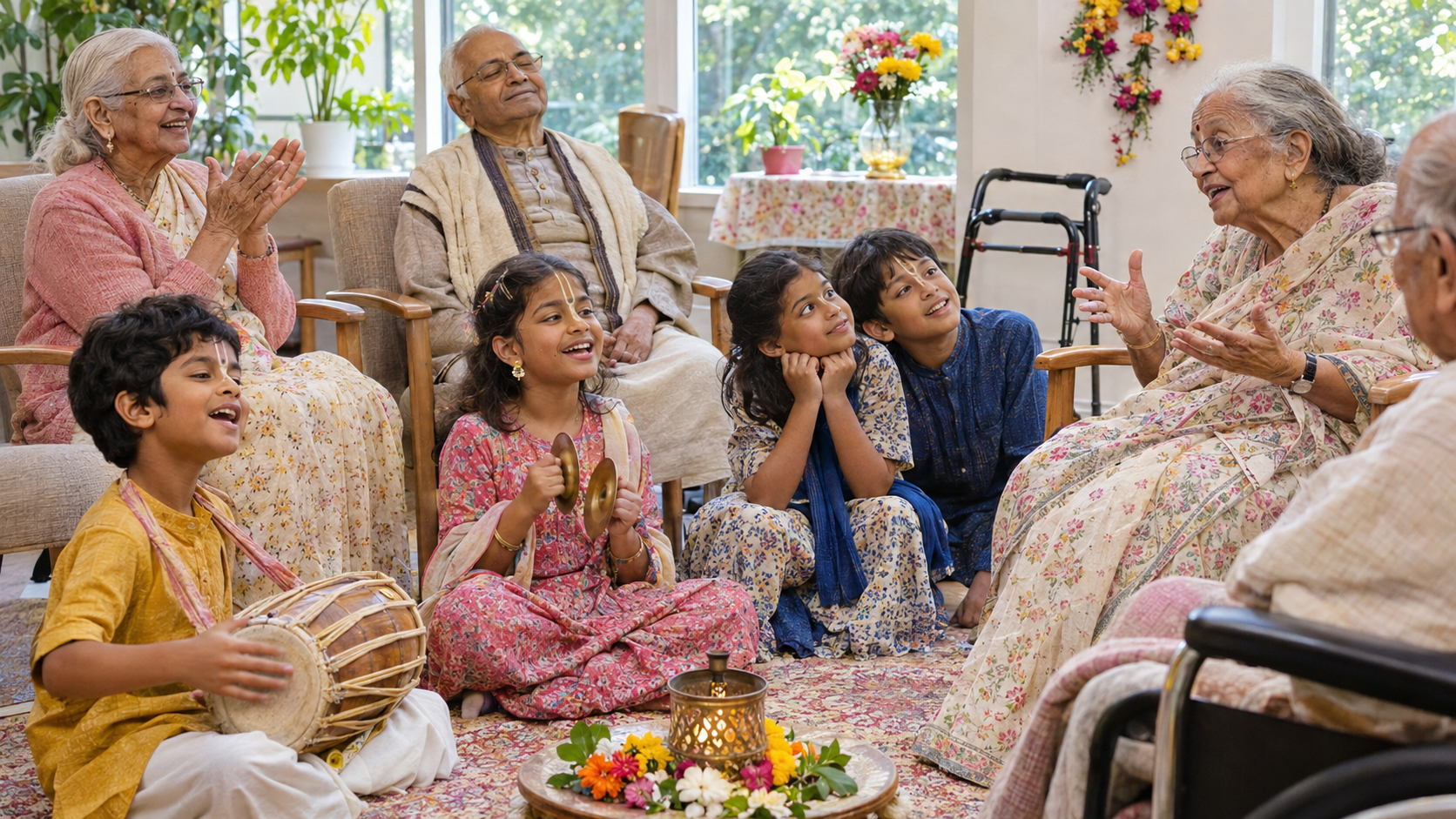
Kirtan works especially well across an age boundary because nobody needs to carry an entire conversation. A repeated response, a rhythm or attentive listening can create a shared moment. Singing and movement can invite physical and emotional engagement, while familiar sounds may help memory and expression. The aim is participation, not polish.
Storytelling does different work. It gives an older person the possibility of becoming a contributor rather than remaining an audience member. A child who listens patiently encounters a life far beyond his or her own experience. The exchange is simple, but it corrects two common mistakes: treating elders only as recipients of care and treating children only as providers of entertainment.
You should not judge a session solely by how animated the room appears. Quiet listening can be participation. A person with limited mobility may engage without moving. Someone may join for only part of an activity. A safe session respects those limits instead of pressing every resident to display enthusiasm in the same way.
When you observe or help with an intergenerational gathering, use five practical questions:
- Could each older participant choose whether and how to join?
- Were volume, movement and duration responsive to the residents in the room?
- Did the elders have opportunities to speak, remember or contribute?
- Did the children listen as well as sing, dance or tell stories?
- Did the encounter create a natural opening for another visit?
The spiritual purpose never cancels personal consent. Care-home staff should guide visitors on residents’ needs, suitable movement, photography and other safeguards. A resident should not be touched, moved, recorded or pressed to participate simply because the activity has a devotional intention.
Children learn compassion by practising it
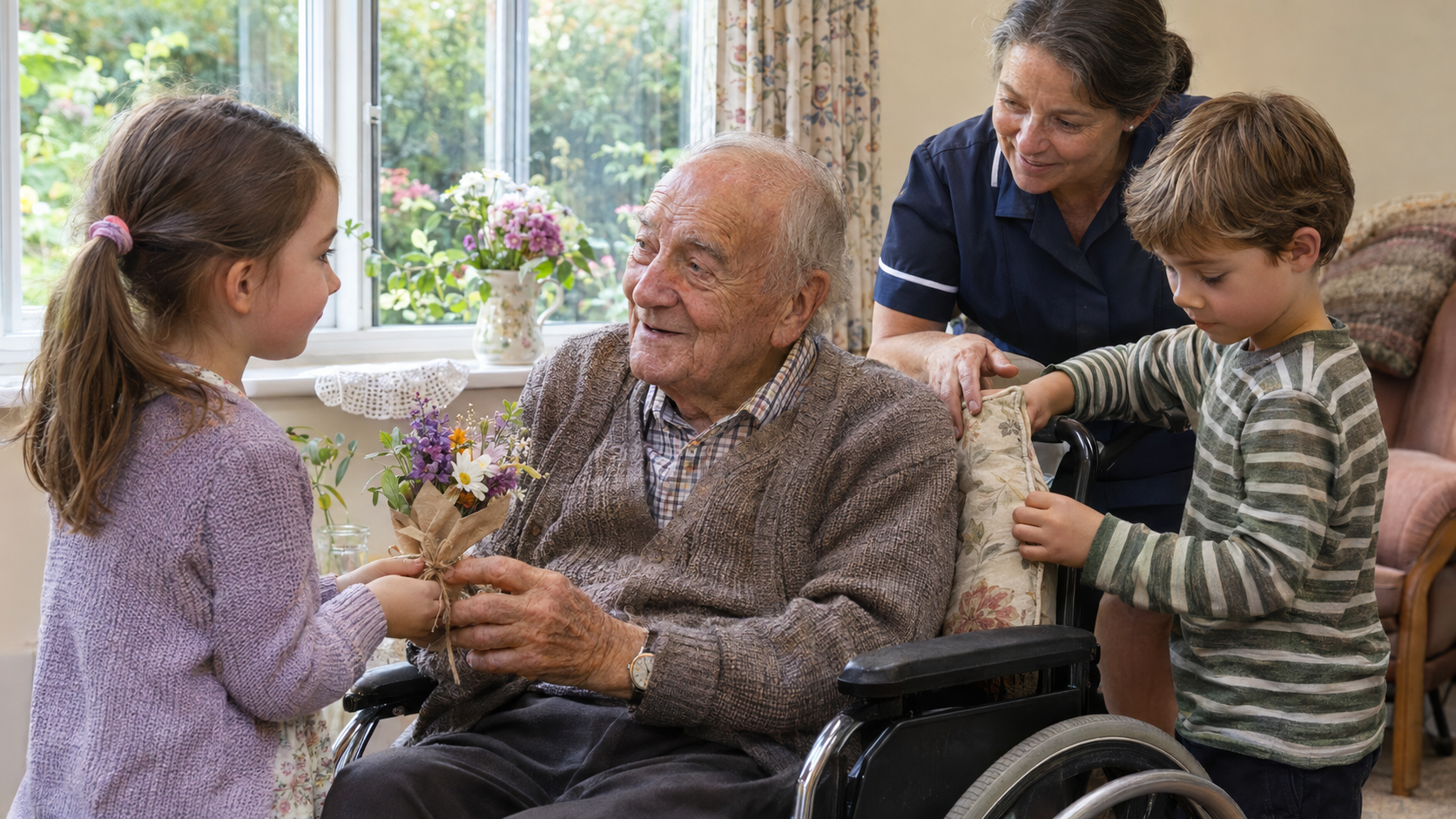
Intergenerational contact is valuable to children precisely because it takes them beyond an age-segregated world. Growing Through Generations is designed to help them develop empathy, compassion, confidence and appreciation for older members of the community. Those qualities do not appear automatically merely because children and elders occupy the same room. Adults must help children turn contact into attentive conduct.
Before a visit, parents and educators can prepare a child with four habits:
- Greet the person in front of you, rather than addressing the room as an anonymous group.
- Speak clearly and patiently without assuming that age has diminished a person’s understanding.
- Ask before sitting very close, offering physical help or handling someone’s belongings.
- Listen to a memory as a gift, not as a fact-checking exercise or a prompt to hurry the speaker along.
Reflection after the visit matters as much as preparation. Instead of asking only whether the child enjoyed it, ask what the child learned about a particular person. What did that person remember? What did the child notice about listening, movement or loneliness? What might make the next meeting more welcoming? Specific questions turn a pleasant outing into moral education.
The elder-child relationship must remain reciprocal. Older people are not teaching aids for a lesson in compassion, and children are not a free entertainment service. Each person retains dignity when each is allowed to receive, contribute and decline.
How to support the programme without overcomplicating it
Growing Through Generations has been designed as a low-cost, community-led programme in a safe and supportive setting. Low-cost does not mean unstructured. It means the central resources are people, preparation and continuity rather than elaborate equipment.
If you want to help, begin with the existing team rather than designing a parallel project. A practical sequence is:
- Ask Bhaktivedanta Manor’s Devotee Care team what support is currently needed and which opportunities are suitable for you or your child.
- Learn the care home’s rules before preparing an activity. Ask specifically about consent, safeguarding, photography, mobility and any limits on sound or movement.
- Offer something you can repeat. One well-prepared kirtan, song or story is more useful than an ambitious plan that cannot be sustained.
- Follow the room. Be ready to lower the volume, shorten an activity, pause or let a resident participate through listening alone.
- Commit only to a level of involvement you can keep. The programme’s relationship-building purpose depends more on dependable return than on a large first visit.
- Debrief with the responsible adults. Record what helped participation and what should change next time, without circulating residents’ personal details casually.
The hoped-for expansion into gardening and walking can widen the ways people meet. It also introduces different questions about mobility, weather, routes and supervision. Those activities should grow from care-home guidance and participants’ abilities, not from an assumption that every resident can join in the same manner.
This is also a useful model for another mandir, gurukul or Dharmic community. Start with an existing relationship with a care setting, choose an activity both generations can enter, establish the relevant safeguards and create a realistic path to return. Do not copy the visible activity while leaving out the continuity that gives it meaning.
Key takeaways
- Growing Through Generations connects primary-aged Gurukul children with local older residents through kirtan, singing, dancing and storytelling in care homes.
- The programme is designed for mutual benefit: companionship and spiritual connection for elders, and empathy and confidence for children.
- Participation should remain voluntary and adaptable to each resident’s mobility, energy and preferences.
- Children need preparation to listen and relate, not merely instructions to perform.
- The most useful support is safe, coordinated and dependable enough to make another meeting possible.
If you want to take part, ask the Manor’s Devotee Care team what the next suitable opportunity is and what steady support it needs. A living tradition does more than preserve sacred practices: it teaches its youngest members to serve while ensuring that its elders remain visible, heard and included.
References

Leave a Reply
You must be logged in to post a comment.