
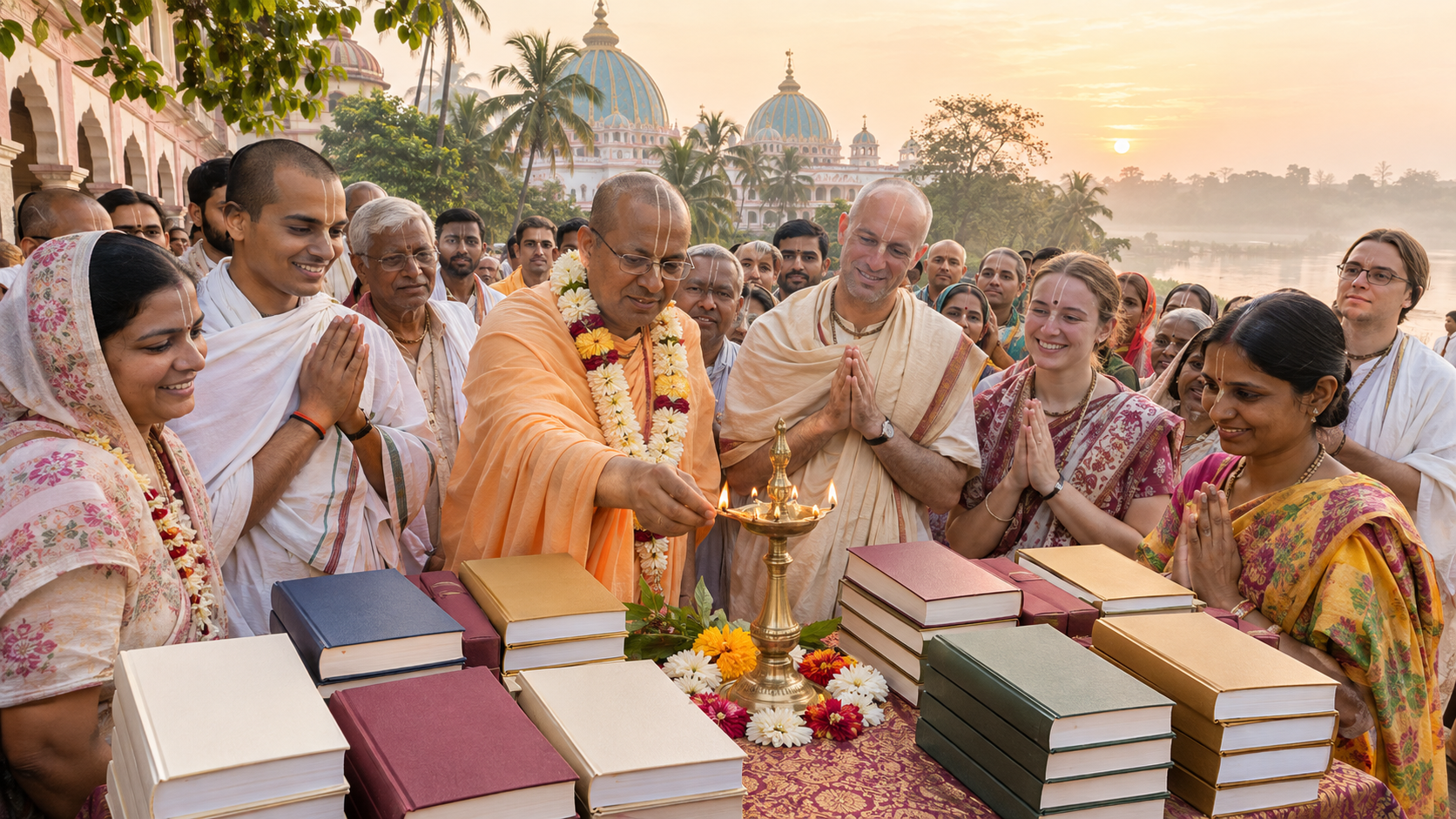
If you heard about Mayapur’s Book Distribution Marathon and are deciding whether to watch, travel, volunteer, or distribute books where you live, begin with the distinction that prevents most confusion: 20 November 2026 is the announced inauguration date, not a published timetable for the entire marathon.
The opening can still give you a useful point of commitment. Treat it as the moment to confirm the practical details, understand the books you may share, and decide how you will approach readers with knowledge, honesty, and respect.
What has been confirmed in Mayapur
The confirmed details are narrow but clear:
- Occasion: the inauguration of a Book Distribution Marathon.
- Place: Sri Dham Mayapur.
- Date: 20 November 2026.
- English-language channel: Mayapur TV.
Those facts do not establish a start time, a detailed programme, the duration of the wider campaign, a registration process, a list of participating locations, or the books to be distributed. Do not convert an inauguration announcement into logistical certainty. If you plan to travel, obtain books, or coordinate other people, act only after the relevant details have been explicitly confirmed by the organizers.
This distinction also matters for readers following from outside Mayapur. English-language coverage through Mayapur TV gives you a way to follow the opening, but the announcement alone does not establish whether that coverage will be live, recorded, or available at a particular hour.
From an opening ceremony to meaningful seva
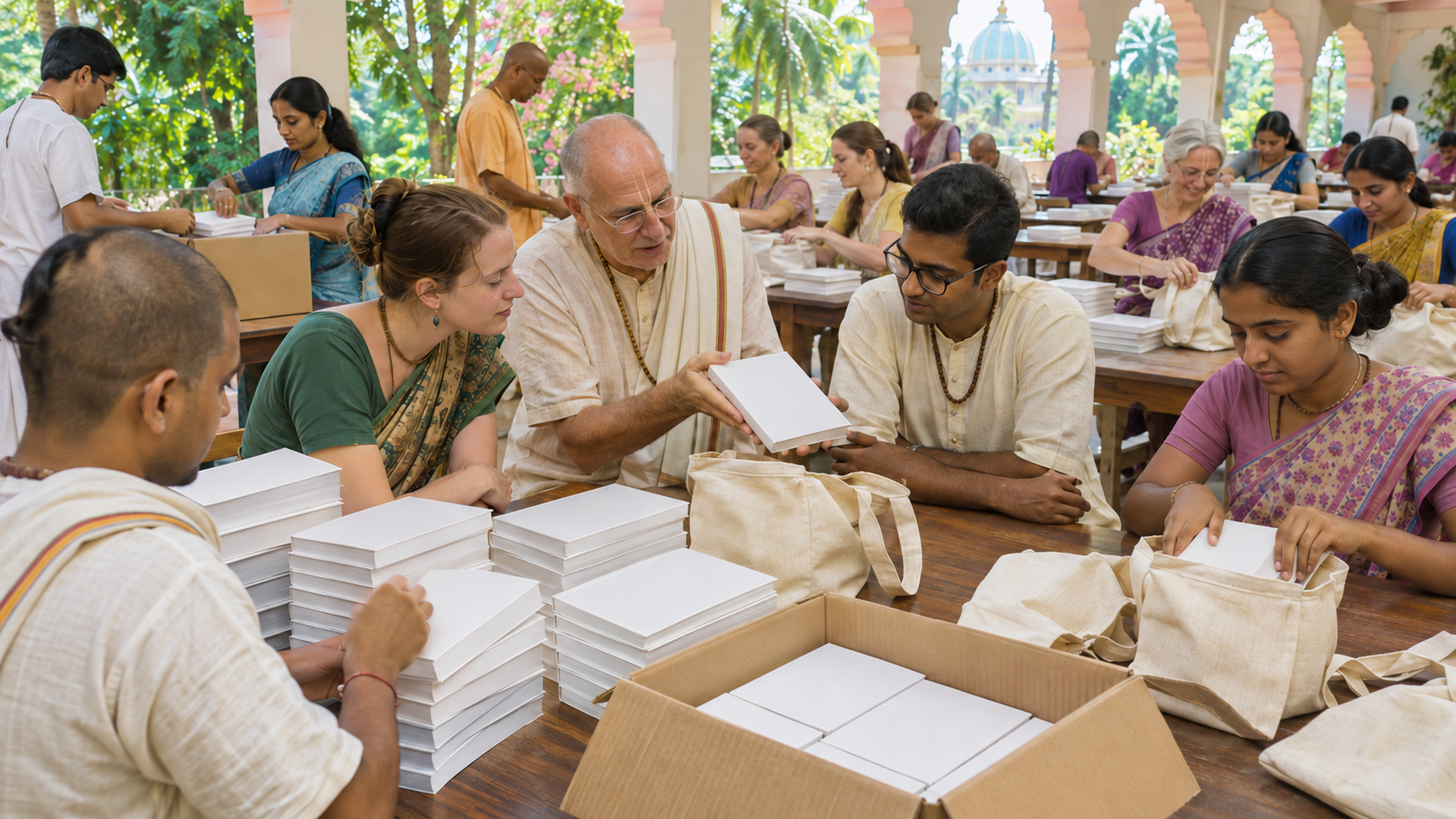
A public inauguration can help you form a sankalpa, a clear intention that leads to disciplined action. Yet the energy of an opening ceremony is useful only when it changes what happens after the ceremony.
Book distribution is not simply the movement of printed copies. A spiritual book has been meaningfully shared when the recipient knows what it contains, freely chooses to receive it, and can find help if questions arise. That requires more care than handing a book to the nearest person.
Before approaching readers, understand the book well enough to explain its subject in plain language. Know which language and level of familiarity it suits. If someone is looking for an introduction, do not overwhelm them with terminology. If someone already studies a tradition, ask what they have read before recommending a text. The fit between the reader and the book matters because an unread book does not become effective merely by changing hands.
The same principle protects the dignity of the encounter. An invitation is not an argument, and persistence is not the same as devotion. Give the other person room to decline. Avoid presenting acceptance of a book as a test of faith, generosity, or cultural loyalty. Seva remains credible when the teaching and the reader are both treated with respect.
A practical way to take part

- Confirm the logistics. Use the event information as a starting point, then verify the time, location, viewing format, campaign period, and local contact before making plans.
- Ask which books are included. Confirm the titles, languages, formats, and any organizer-set distribution arrangements. Do not assume that every spiritual title is part of the same campaign.
- Read before you recommend. Review the introduction, contents, central teaching, intended audience, and any unfamiliar terms. You should be able to describe the book without exaggerating what it promises.
- Listen before choosing a book. Ask what the reader is interested in and whether they prefer an introductory or more detailed treatment. A thoughtful question is more useful than a rehearsed pitch.
- Be transparent about the exchange. State clearly whether the book is a gift, offered for a contribution, or sold under an organizer-approved arrangement. Do not improvise prices or allow uncertainty about money to cloud a spiritual interaction.
- Respect consent. Do not pressure someone to accept a book, pose for a photograph, provide contact information, or continue a conversation. Ask before doing any of these things.
- Offer a verified next step. If the reader wants to continue, provide an accurate contact, temple programme, reading group, or official resource. Do not pass along details you have not checked.
- Report honestly. If coordinators request distribution records, use their stated method and count only completed distributions. Numbers can support coordination, but they should not tempt anyone to inflate results or neglect the quality of the encounter.
You do not need to wait for a large operation to practise these standards. You can prepare by studying a suitable text, learning how to describe it clearly, and identifying readers whose interests genuinely match it. The inauguration then becomes a shared beginning rather than a substitute for the work itself.
Key takeaways
- Sri Dham Mayapur’s Book Distribution Marathon inauguration is announced for 20 November 2026.
- Mayapur TV is identified as the English-language channel for the occasion.
- The inauguration date should not be treated as a confirmed start time, campaign end date, registration instruction, or complete programme.
- If you want to participate, verify the logistics and approved arrangements before travelling or obtaining books.
- Responsible distribution begins with reading the book, matching it to the reader, explaining any financial arrangement, and respecting the reader’s choice.
What to verify before making plans

If the inauguration prompts you to attend or organize locally, ask for clear answers to the practical questions that remain open:
- What is the exact start time and meeting point in Mayapur?
- Will the English coverage be live, recorded, or both?
- How long will the broader marathon run?
- Which titles, languages, and formats are part of the campaign?
- Who is the authorized contact for volunteers or local coordinators?
- How are books obtained, and what financial arrangements apply?
- Are there specific expectations for reporting distributions or protecting recipients’ privacy?
Until those answers are issued, keep firm facts separate from expectation. That is especially important if other devotees are relying on you for travel, books, money, or scheduling.
If you are following from afar, use the inauguration to begin with a text you understand and a reader you can genuinely serve. If you are joining activity in Mayapur, carry that same standard into every encounter: clarity before enthusiasm, consent before counting, and sustained study after the opening day.
References

Leave a Reply
You must be logged in to post a comment.