
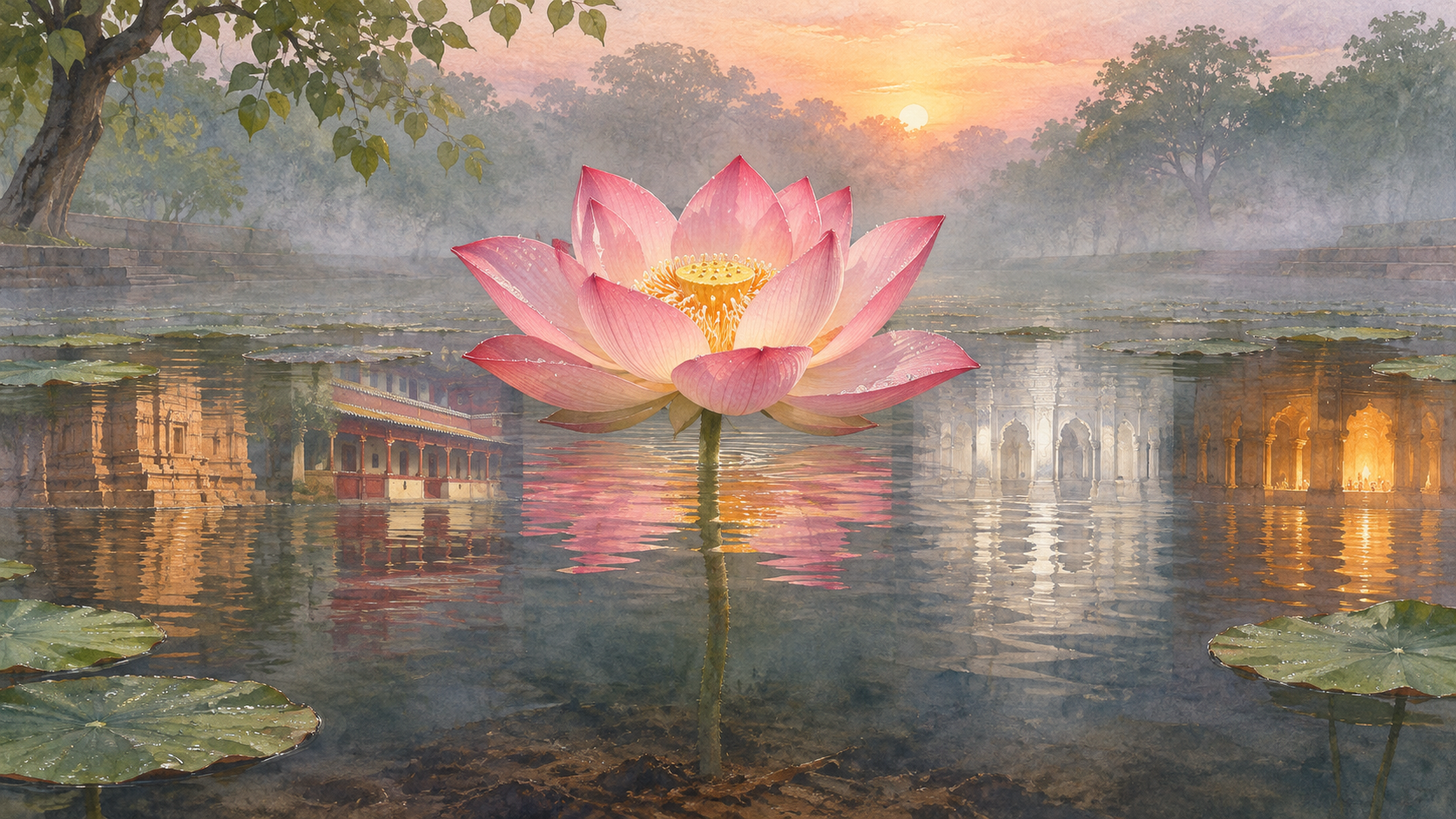
You see a lotus beneath a murti, beside a Buddha, in Jain art, or within a Sikh spiritual metaphor. Is it simply decoration, or does it carry the same meaning everywhere? The short answer is that it is sacred across several Indian traditions, but its precise work changes with the setting.
You do not need an encyclopaedia of symbols to read it well. Notice where the lotus appears, what it is doing, and which tradition is using it. Those three questions will usually tell you more than a rigid list of supposed colour meanings.
Begin with the lotus’s physical logic
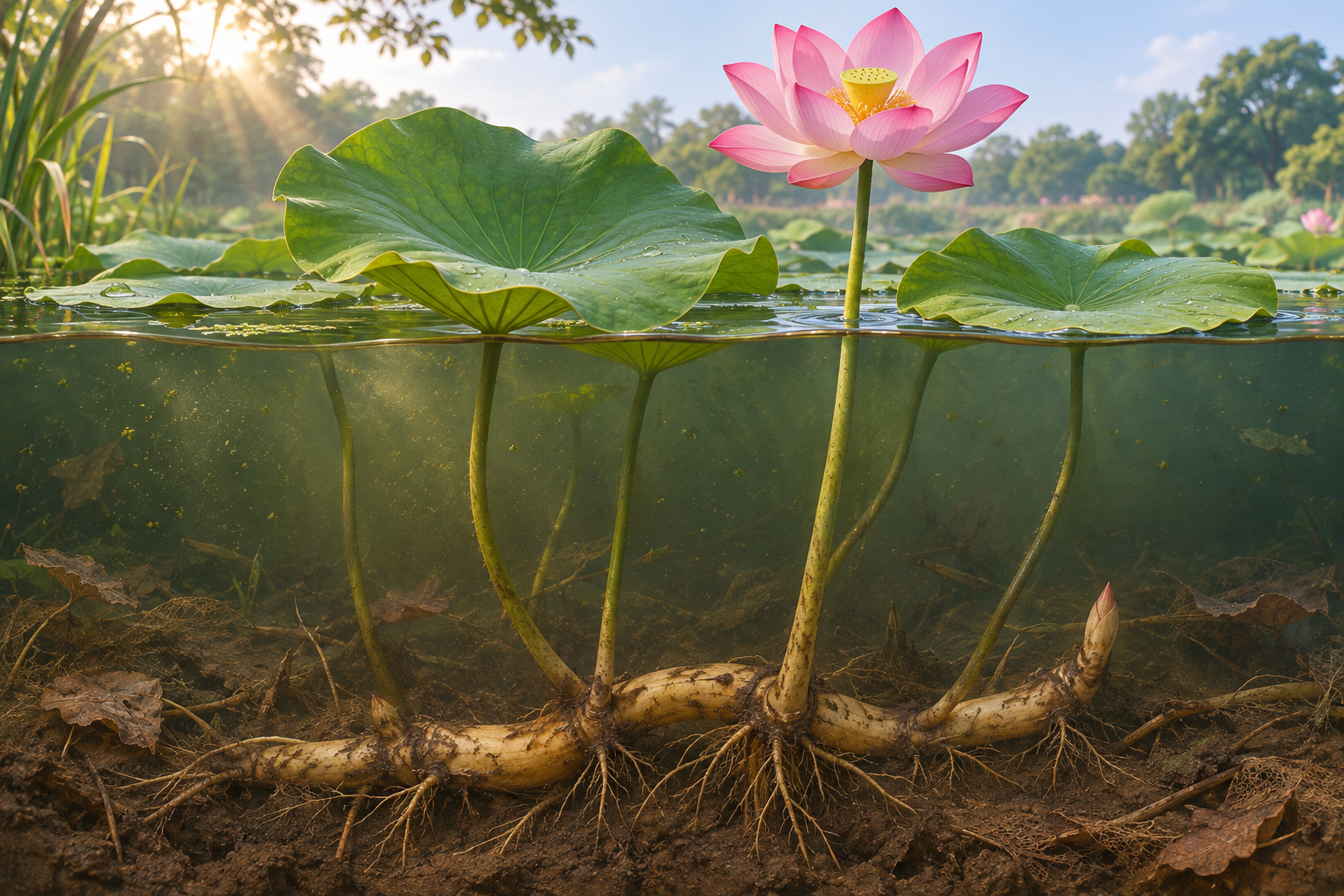
The lotus grows from silt beneath the water and opens above the surface. That movement gives the symbol its basic spiritual grammar: difficulty need not determine character, and participation in the world need not result in enslavement to it.
This is more demanding than the familiar slogan about being “untouched by the mud.” Mud is not merely filth to be despised. It is the condition from which growth begins. The symbol therefore holds two truths together: ordinary life contains attachment, confusion, and hardship, yet those conditions can become the ground of spiritual development.
When you encounter a lotus, look for this relationship between origin and flowering. The image may emphasise purity, awakening, auspiciousness, divine presence, detachment, or some combination of them. What it does not imply is that holiness requires a life without difficulty.
One flower enters four distinct religious vocabularies
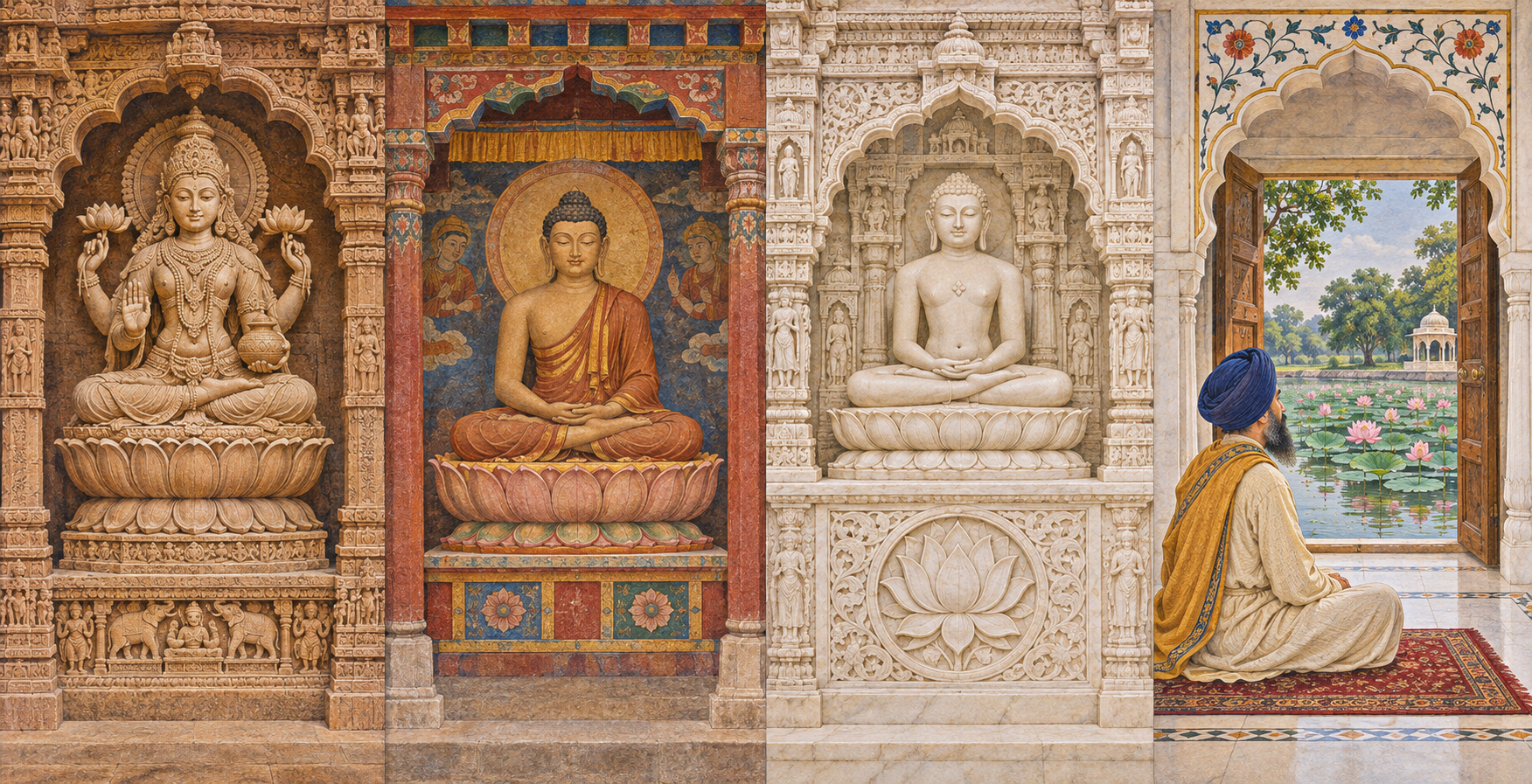
The lotus has an important place in Hinduism, Buddhism, Jainism, and Sikhism. That shared reverence reveals a family resemblance among Dharmic traditions, not a single doctrine secretly repeated under four names. Respectful interpretation begins by preserving both the connection and the difference.
In Hinduism, the lotus makes divine qualities visible
In Hindu worship and iconography, the lotus is especially associated with Lakshmi. Her lotus seat presents prosperity, beauty, purity, and auspiciousness as qualities grounded in the divine rather than in possession alone. A prosperous life, in this frame, is not merely a large accumulation of things; it should unfold with order, generosity, and spiritual orientation.
The flower is also offered in puja to Vishnu and Lakshmi. Here the lotus is not just an emblem to decode. It becomes an act of devotion: something beautiful and carefully chosen is returned to the divine. If you see a lotus in a shrine, ask whether it is functioning as a seat, an attribute, an offering, or more than one of these at once.
In Buddhism, the emphasis falls on awakening
In Buddhist settings, the lotus commonly directs attention toward purity of mind and awakening. The flower’s rise toward open air makes it an apt image for the movement from ignorance and attachment toward clarity.
Do not automatically carry Lakshmi’s association with prosperity into a Buddhist image. The same flower is now working inside a different religious vocabulary. Look first for the condition of the mind, the path of transformation, or the awakened figure being represented.
In Jainism, purity is joined to disciplined liberation
In Jain contexts, the lotus belongs to a broader visual language of auspiciousness, purity, and spiritual elevation. Its meaning should be read alongside the figure, emblem, or ritual setting in which it appears. Jain spiritual purity is not passive prettiness. It belongs to a demanding path of self-mastery, non-attachment, and liberation from karmic bondage.
If a lotus appears in Jain art, therefore, resist treating it as generic “Indian spirituality.” Identify the sacred figure or setting first. The symbol supports that context; it does not erase it.
In Sikhism, read the lotus first as a way of living
In Sikh spiritual thought, the lotus is especially useful as a metaphor for living in the world without becoming mastered by attachment. The point is not withdrawal from work, family, or society. It is inward freedom while fulfilling one’s responsibilities.
This changes how you should read the image. In a Hindu shrine the lotus may be a divine seat or ritual offering; in Sikh teaching its force is more readily ethical and contemplative. It asks whether you can remain spiritually oriented while standing in the middle of ordinary life.
Read placement before assigning a meaning
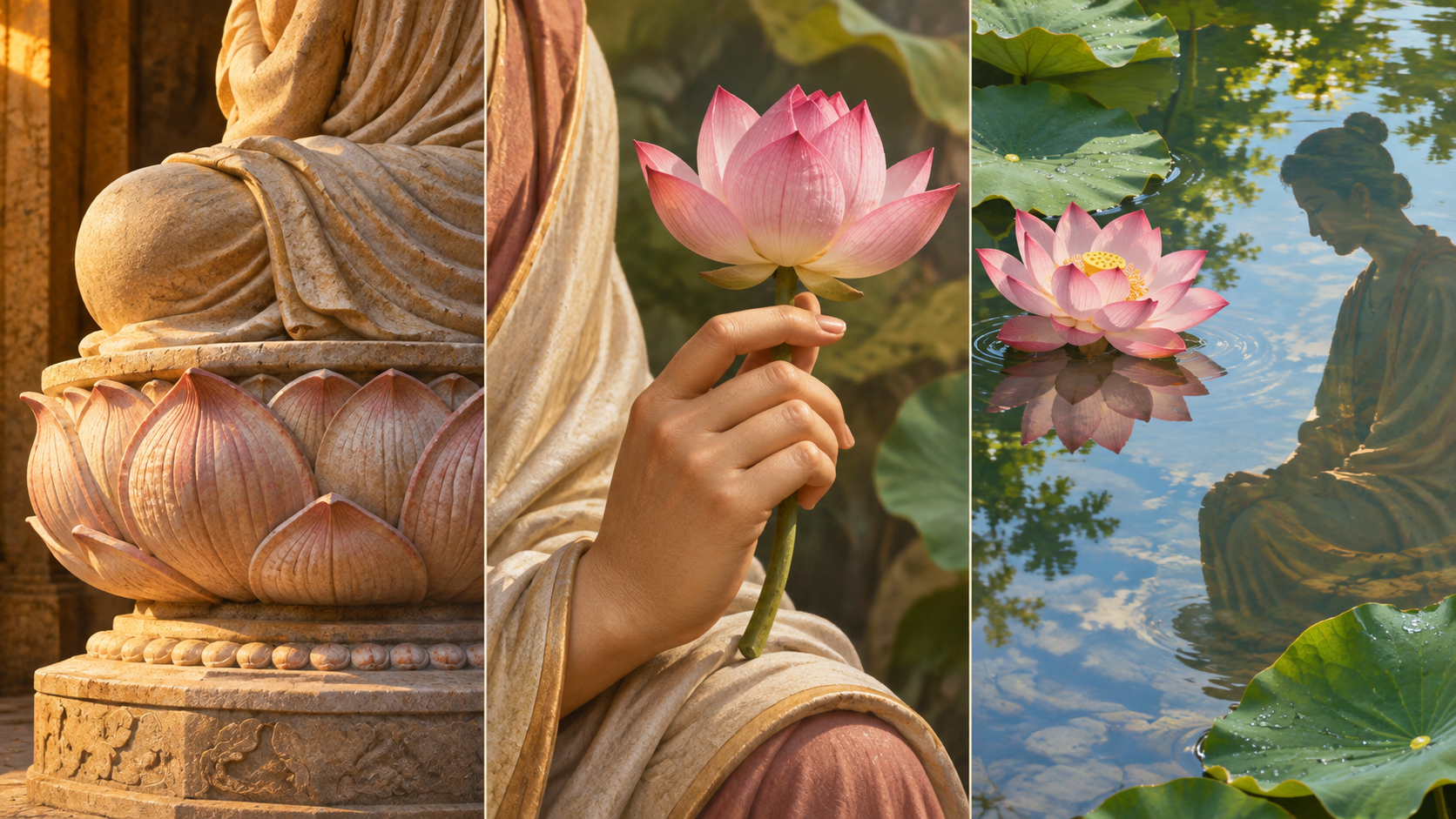
A symbol does not carry its full meaning in isolation. Before deciding what a lotus means, use this sequence:
- Name the tradition. A lotus in a Vishnu temple, a Buddhist shrine, Jain art, and a Sikh verse should not be interpreted through an identical formula.
- Notice its role. A seat supports a sacred figure, a flower held in the hand marks a quality or identity, an offered flower enacts devotion, and a verbal metaphor teaches a way of living.
- Identify the central figure or teaching. Lakshmi’s lotus, for example, should be read through her association with auspiciousness and prosperity. In a teaching about attachment, the flower’s relation to the surrounding water may be the decisive feature.
- Separate a shared motif from a shared doctrine. Similar imagery can reveal a common civilisational vocabulary without making Hindu, Buddhist, Jain, and Sikh theology interchangeable.
- Treat colour charts cautiously. Colour may matter in a particular artistic or ritual system, but placement and context are safer starting points than universal internet lists.
This method also prevents a common mistake: calling every many-petalled design a lotus and then imposing a spiritual explanation on it. First establish that the form is being used symbolically. Architecture and ornament can echo sacred imagery, but resemblance alone does not prove a precise theological message.
Turn the symbol into a practice without inventing a ritual
You can let the lotus guide reflection without pretending that a personal exercise is an inherited rite. Use its structure as a three-part examination of conduct:
- Name the mud. Identify one difficult condition you cannot immediately remove: resentment, pressure, distraction, or an uncomfortable duty. Describe it plainly without making it your identity.
- Find the waterline. Notice the reaction that keeps pulling you under, such as compulsive comparison, avoidance, or the need to control another person.
- Choose the bloom. Define one visible action that would express clarity amid that condition: speak truthfully without cruelty, finish a neglected duty, give without seeking recognition, or pause before an angry response.
The point is not to imagine yourself spiritually spotless. It is to act without allowing the surrounding condition to dictate the quality of your action. That makes the lotus a standard for conduct rather than a piece of uplifting decoration.
If you use a lotus in a home shrine, artwork, teaching handout, or public event, name its particular context. “Lakshmi seated on a lotus” is more respectful and informative than “an Eastern symbol of enlightenment.” Precision protects living traditions from being dissolved into a vague spiritual aesthetic.
Key takeaways
- The lotus commonly expresses the possibility of purity or spiritual growth amid difficult worldly conditions.
- Its shared presence across Dharmic traditions does not give it one identical meaning in every setting.
- In Hindu contexts, it can serve as a divine seat, sacred attribute, or devotional offering, with a particularly strong association with Lakshmi and Vishnu worship.
- In Buddhist and Jain settings, read it in relation to awakening, purity, disciplined transformation, and the sacred figure represented.
- In Sikh thought, its most useful interpretive key is living responsibly in the world without being mastered by attachment.
- To interpret an unfamiliar lotus, identify the tradition, placement, central figure, and ritual or literary function before assigning a meaning.
The next time you meet the lotus in a shrine, manuscript, painting, or verse, pause before translating it into a single word. Ask what surrounds it and what it asks of the worshipper. Then carry one part of its discipline into the day: remain fully present in the world, but do not let the world’s confusion decide how you will act.
References

Leave a Reply
You must be logged in to post a comment.