

You may have encountered a bija mantra in a chart, a video, or a book and then turned to the Prapanchasara Tantra hoping for a simple definition. The more important question is not merely what the sound means. You need to know whether you are studying a sacred text, learning accurate recitation, or adopting a spiritual practice.
Keep those activities separate and the subject becomes much clearer. You can take bija mantras seriously without reducing them to magical passwords, borrowing practices from incompatible settings, or pretending that a translation is a complete instruction.
Begin with the relationship, not the isolated sound
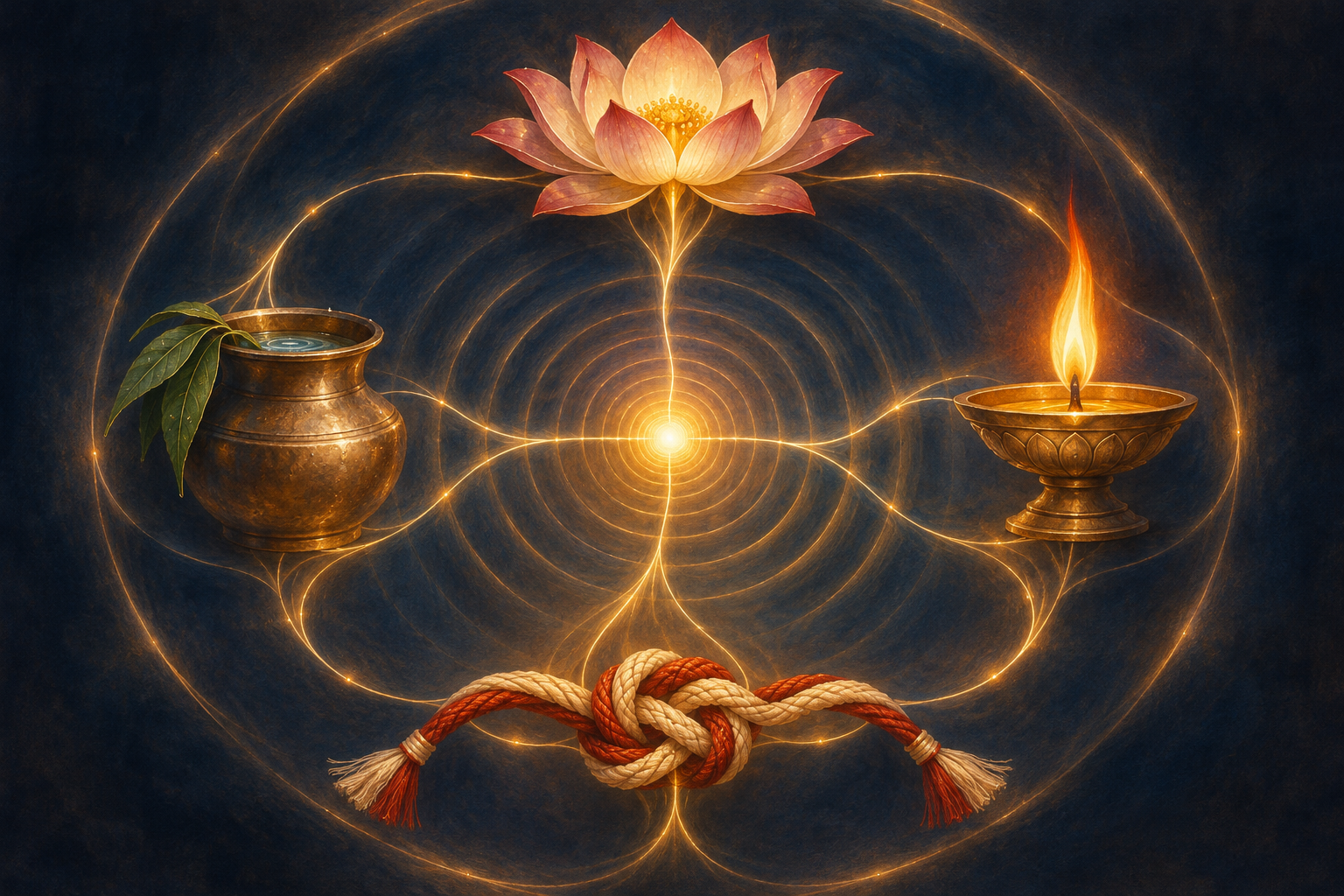
The Prapanchasara Tantra is traditionally attributed to Adi Shankaracharya, and its fourth chapter connects bija mantras with divine consciousness. The larger work places mantra within a Tantric world that also includes yantra and subtle dimensions of practice. That setting should govern how you read any individual bija.
Bija means seed. A seed may be compact, but it is neither a miniature dictionary nor an independent mechanism. Its significance unfolds through relationships: the sacred form or principle with which it is associated, its place in a larger mantra, the ritual or contemplative setting in which it appears, and the consciousness toward which the practice is directed.
This gives you a useful first-pass rule. Whenever you meet a bija in the text, ask what surrounds it. Is a deity or divine principle named? Does the sound stand alone, or does it belong to a longer formula? Is a yantra, visualization, sequence, or other practice involved? Is a result expressly stated, or have later readers merely assumed one?
If the passage does not answer one of those questions, write down not specified. Do not fill the gap with the first explanation you find elsewhere. An honest blank protects the integrity of the text and prevents a school-specific interpretation from becoming a supposedly universal rule.
The traditional attribution also needs to be handled carefully. It gives the work an important place in Hindu intellectual memory, but it does not turn every Tantric instruction into elementary Advaita philosophy. Read the work in its own ritual and contemplative setting rather than using a famous name as a substitute for context.
Read a bija through sound, sacred relation, and procedure
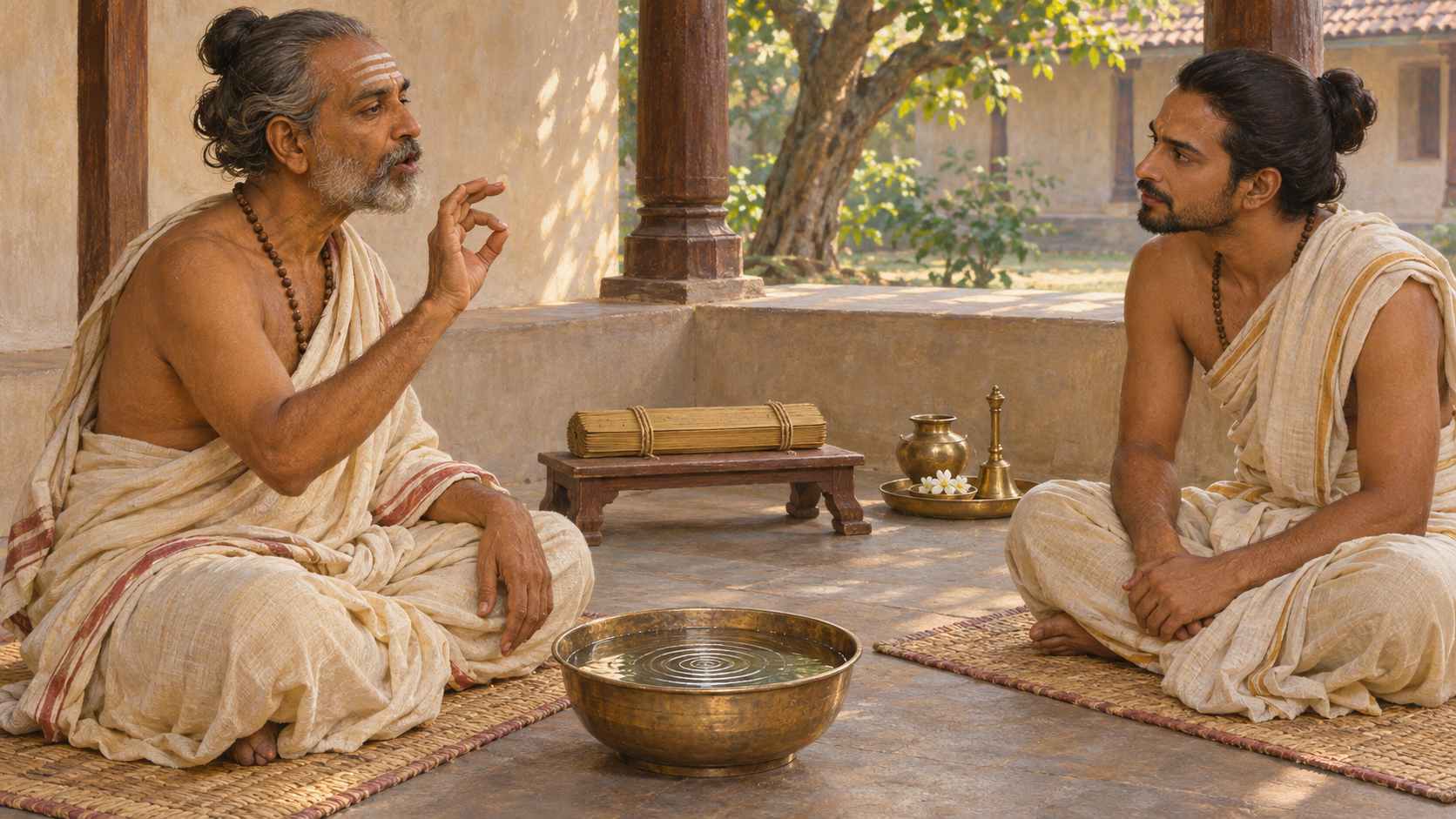
A practical reading method separates three aspects that are often collapsed. This does not divide the mantra itself. It simply stops you from mistaking one aspect for the whole.
- Sound-form: Record the bija exactly as it appears. Preserve the original script when available, and note which transliteration system an editor or teacher uses. Roman letters without a declared system may conceal distinctions that matter in recitation. Do not silently simplify unfamiliar marks or pronounce them through ordinary English spelling habits.
- Sacred relation: Note the deity, power, principle, or dimension of consciousness with which the passage connects the sound. Write associated with rather than automatically writing means. A sacred correspondence is richer than an ordinary word-to-definition equation.
- Procedure: Determine what the practitioner is instructed to do. A bija may appear alone, within a larger mantra, alongside a yantra, or within an ordered practice. The surrounding procedure is not decorative material. It helps define what kind of use the text actually intends.
This method guards against opposite mistakes. Literalism treats a bija as though it were an ordinary vocabulary item with one portable definition. Vagueness treats it as an undefined sound onto which anyone may project any desired meaning. Tantric reading asks for greater precision: preserve the sound, trace the sacred relationship, and respect the prescribed setting.
You should also distinguish symbolic interpretation from phonetic instruction. An explanation of a bija’s theological significance does not necessarily teach you how to pronounce it. Conversely, hearing a clear pronunciation does not give you the ritual context, authority, or purpose of the practice. Each question needs its own kind of answer.
Avoid the shortcuts that turn mantra into guesswork

Most confusion begins when a useful fragment is detached from the system that makes it intelligible. Watch for these common shortcuts:
- The equivalence-chart shortcut: A list that pairs every bija with a single English word may be convenient for memory, but it can erase textual and lineage differences. Use such a list as an index for further inquiry, not as a complete teaching.
- The effect-shopping shortcut: Do not select a bija solely because someone promises a desired result. First establish where the formula comes from, what its full context is, and whether the stated result is actually attached to it in that setting.
- The mix-and-match shortcut: Combining a bija from one context, a yantra from another, and a visualization from a third does not produce a more comprehensive practice. It produces a new arrangement that none of those settings may teach.
- The translation shortcut: A gloss can orient your understanding, but it cannot replace the original sound-form or the instructions around it. Translate for comprehension; preserve the mantra for recitation.
- The famous-author shortcut: Traditional attribution does not automatically make a specialized Tantric passage suitable for unsupervised experimentation. Complexity remains complexity even when the reader recognizes the attributed author.
- The scientific-proof shortcut: A teaching about subtle reality or divine consciousness should not be converted casually into a claim about experimental physics. Sacred knowledge does not become more Dharmic by being dressed in borrowed scientific vocabulary. State theological and contemplative claims in the terms in which they are actually made.
None of this asks you to approach the tradition with suspicion. It asks you to approach it with discipline. Reverence without discrimination leaves you vulnerable to confident misinformation; discrimination without reverence can reduce a living practice to a specimen. A serious reader needs both.
Use a clear path from textual study to spiritual practice

You do not need to begin by chanting every bija you encounter. Begin by deciding what you are actually trying to do, then move only as far as your information and guidance support.
- State your present goal. Choose among textual understanding, pronunciation study, and personal sadhana. If your goal changes, acknowledge the change rather than drifting from reading into practice unnoticed.
- Anchor the passage. Record the work, chapter, edition or translation, and location of the mantra. Keep the original script beside the transliteration whenever possible. This makes later verification possible.
- Inventory the context. Note the associated divine form or principle, any longer mantra, any yantra, the surrounding action, and the intended purpose only where these are actually supplied.
- Separate text from interpretation. Mark what is explicitly present, what an editor or commentator explains, and what you have inferred. Do not allow an attractive inference to migrate into the first category.
- Verify the sound. If the written system or pronunciation is unclear, consult someone competent in the relevant recitation tradition. A familiar-looking Roman spelling is not enough when its transliteration rules are unknown.
- Ask about the practice’s status. Find out whether the mantra is taught openly, requires initiation, or is used only as part of a larger discipline. Do not assume that every printed formula is therefore a self-contained public practice.
- Practise only what you have actually received or verified. Preserve the order, purpose, and limits of the instruction. Adding extra sounds or ritual elements because they seem powerful changes the practice rather than strengthening it.
Questions to take to a qualified teacher
A useful conversation is more precise than asking whether a mantra is powerful. Bring the passage with you and ask:
- Is this bija meant to be recited independently, or only within the complete mantra shown here?
- Which script and pronunciation tradition should govern its recitation?
- Is the correspondence being described universal in this tradition, or specific to this textual and ritual context?
- Does the practice require initiation or other preparation?
- Are a yantra, visualization, ritual sequence, or observance integral to it?
- What should a student do when the available edition leaves an instruction ambiguous?
A careful teacher may narrow your intended practice rather than expand it. That is not withholding for its own sake. It can be the difference between learning a coherent discipline and collecting disconnected sacred fragments.
What you can do while the practice status remains unclear
You can still study the passage closely. Compare the original script with the transliteration, map the relationships named around the bija, identify what the text leaves unstated, and formulate questions for competent guidance. This is substantive work. Restraint at this stage is not spiritual inactivity; it is part of learning how a mantra tradition communicates.
You can also resist the pressure to turn every piece of knowledge immediately into a personal technique. A scripture can first reshape how you understand sacred sound, consciousness, and ritual order. Practice becomes more meaningful when it grows from that understanding instead of racing ahead of it.
Key takeaways
- A bija is a compact sacred sound, not merely an abbreviated dictionary definition.
- The Prapanchasara Tantra places bija mantras in relation to divine consciousness and a wider Tantric setting.
- Read every bija through its sound-form, sacred associations, and prescribed procedure.
- Keep textual study, pronunciation learning, and sadhana distinct until you have the basis to connect them.
- When a passage does not specify a correspondence or instruction, record the absence instead of importing an answer.
- Before ritual use, verify the mantra’s full context, pronunciation, and requirements with a competent person in the relevant tradition.
Your next move can be modest and exact. Choose one passage, make notes under the headings Sound-form, Sacred relation, and Procedure, and leave every unsupported field blank. Take those blanks, not a bundle of internet claims, to someone qualified to help you. That is how curiosity begins to become disciplined Dharmic study.
References

Leave a Reply
You must be logged in to post a comment.