
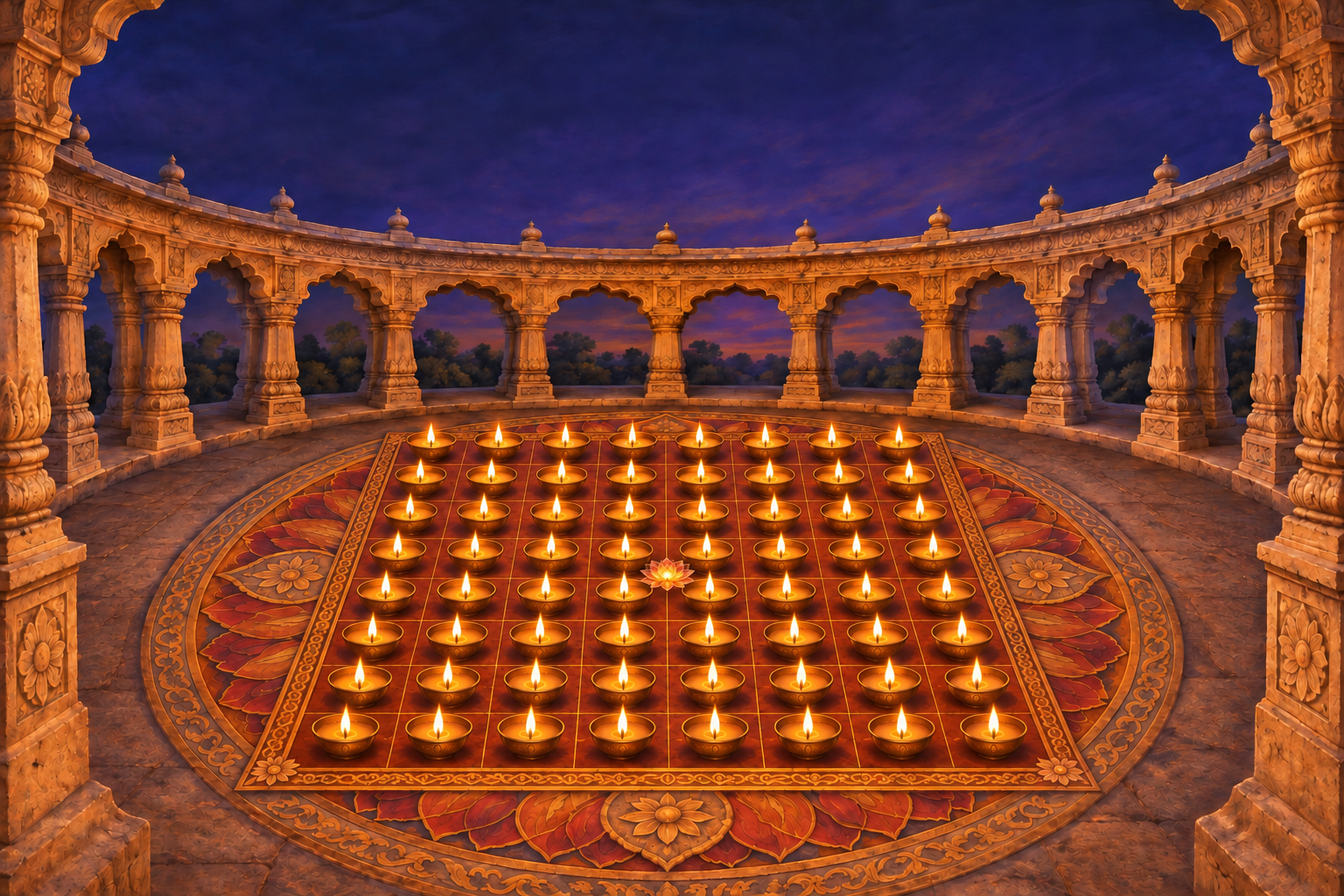
You may have encountered the number 64 beside the Yoginis, a collection of arts, or an ordered sacred space and wondered whether it carries one hidden meaning. It does not function like a code with a single translation. Its significance comes from what it helps a tradition gather into a complete and intelligible whole.
The most useful way to read 64 is therefore contextual. First ask what is being counted. Then ask what the completed set allows a practitioner to learn, contemplate, arrange, or honour. That approach reveals far more than treating the number as a promise of luck or a piece of detached numerology.
64 expresses completeness through ordered multiplicity
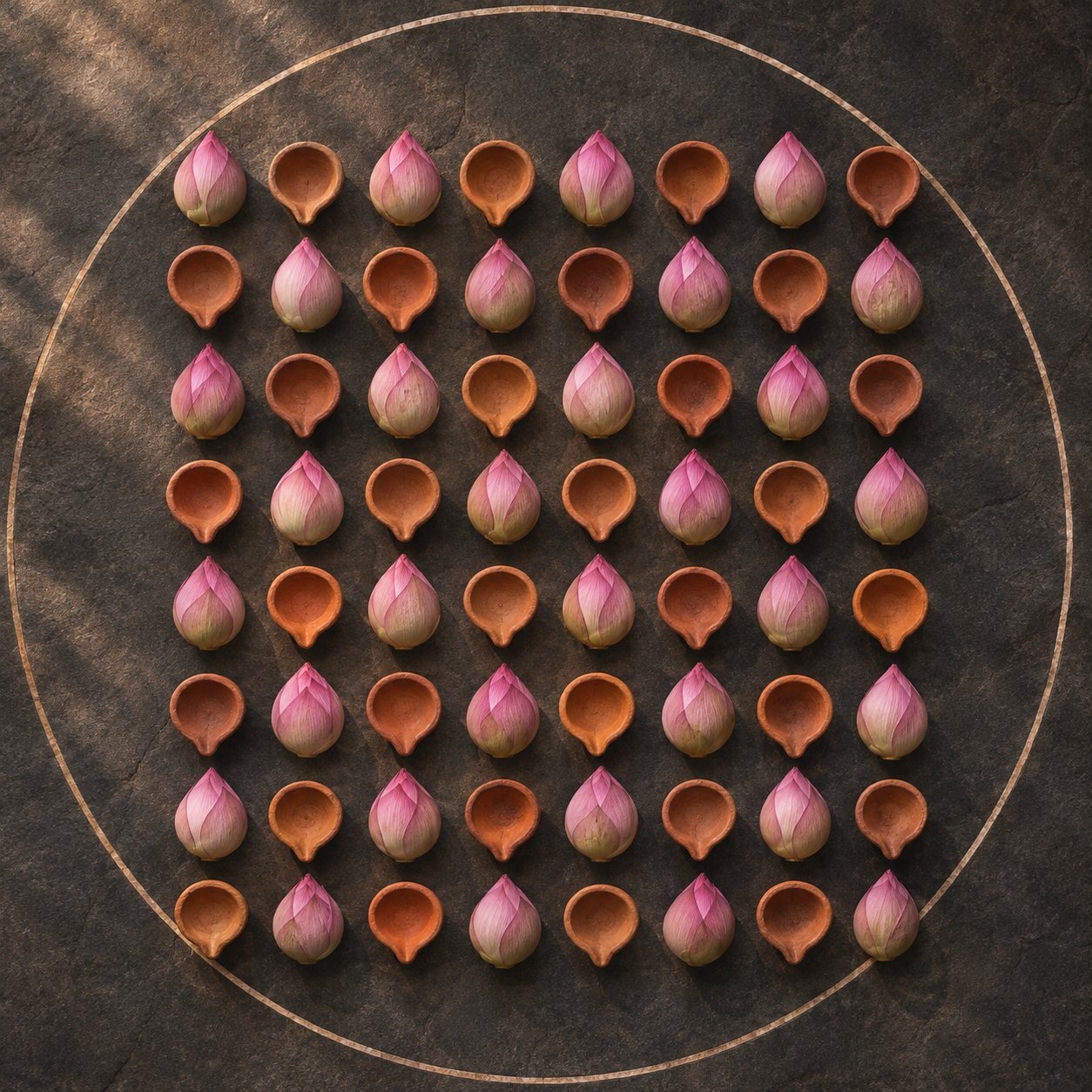
In Hindu symbolism, completeness does not always mean reducing everything to one undifferentiated idea. A whole can contain many distinct forms, powers, skills, positions, or paths while remaining coherent. Sixty-four is especially suited to expressing that kind of fullness: numerous enough to suggest abundance, yet definite enough to be arranged as a complete set.
This is why 64 repeatedly carries associations with knowledge, creativity, divine energy, sacred space, order, multiplicity, and completeness. These are not separate dictionary definitions. They describe a shared symbolic pattern: diversity is gathered, given form, and understood as belonging to a larger order.
The arithmetic supports the image without exhausting it. Sixty-four is eight multiplied by eight, so it can be represented as a balanced square. That makes it naturally useful when thinking about systematic arrangement and bounded space. Arithmetic alone, however, does not make a number sacred. The religious meaning comes from the practices, teachings, and forms in which the number is used.
When you encounter 64, read it as a statement about a whole before searching for an isolated meaning attached to each unit. The governing question is not merely, “Why this number?” It is, “What kind of completeness is this arrangement making visible?”
Arts, Shakti, and sacred space reveal different facets
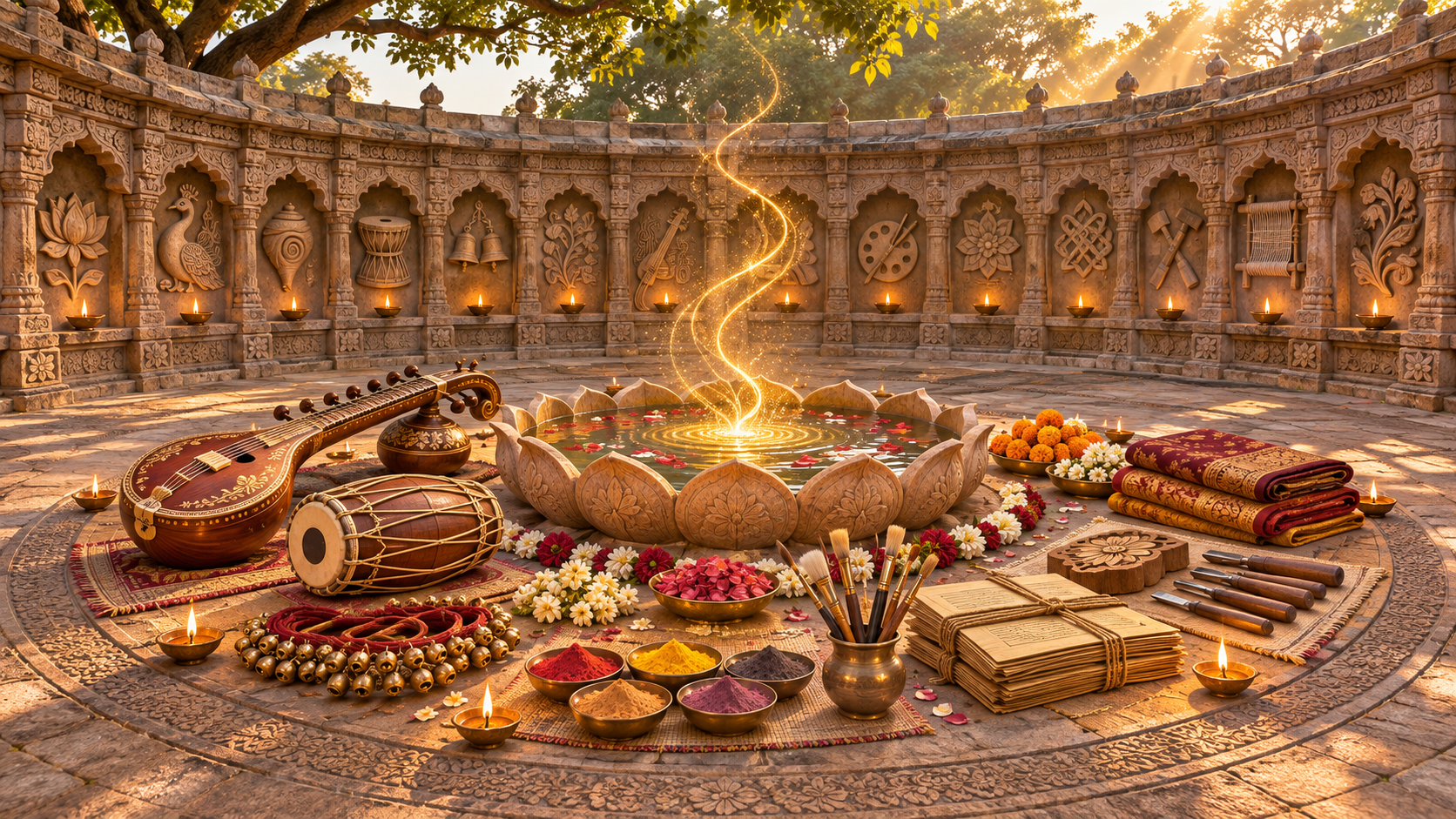
The number becomes clearer when you examine the domain in which it appears. Its symbolic grammar remains recognisable, but its practical force changes from one setting to another.
The arts: human capacity cultivated into a whole
When 64 is associated with arts or forms of knowledge, the point is broader than entertainment. Art includes disciplined capacities through which intelligence, perception, dexterity, memory, expression, and social understanding can be refined. A complete collection of arts presents culture as something embodied and practised, not merely stored in books.
You should not assume that every traditional enumeration must preserve an identical list. The symbolic work of the number lies in defining a horizon of cultivated ability. It says that learning has many branches and that a well-formed life requires more than mastery of a single narrow subject.
For a modern reader, this corrects a familiar misunderstanding. Specialisation is valuable, but it is not the same as completeness. The symbolism of 64 asks whether your education also develops attention, creativity, expression, practical competence, and the ability to relate different kinds of knowledge.
The 64 Yoginis: divine energy in manifold forms
In the grouping of the 64 Yoginis, multiplicity belongs to the language of Shakti. The many forms invite contemplation of divine energy as active, differentiated, and present through more than one expression. The number does not require you to imagine 64 unrelated powers competing with one another. It points toward a field of distinct manifestations held within a sacred unity.
This distinction matters. If you reduce the Yoginis to entries in a numerical catalogue, you retain the count but lose the theology. If you erase their differences in the name of unity, you lose the richness through which that unity is disclosed. The symbol holds both truths together: the forms are many, and the sacred order is whole.
When reading about the 64 Yoginis, therefore, pay attention to form, relationship, placement, and ritual setting. Do not detach a name or image from its tradition and assume that the count alone explains it.
Sacred space: cosmic order made inhabitable
Where 64 is used to organise sacred space, the meaning becomes spatial. A bounded arrangement turns plurality into orientation. Every position belongs to a larger pattern, and the pattern allows cosmic order to be represented in a place that human beings can enter, build around, or contemplate.
The important idea is not that the divine can be trapped inside a diagram. Sacred geometry gives disciplined form to relationships that would otherwise remain abstract. Centre and boundary, part and whole, direction and position become visible together.
If you encounter a 64-part arrangement in a temple, plan, or ritual diagram, begin by observing how its parts relate. Look for the centre, edges, directions, repetitions, and differences among positions. Reading the whole structure before isolating one compartment will usually bring you closer to its intended meaning.
A five-step method for interpreting any appearance of 64
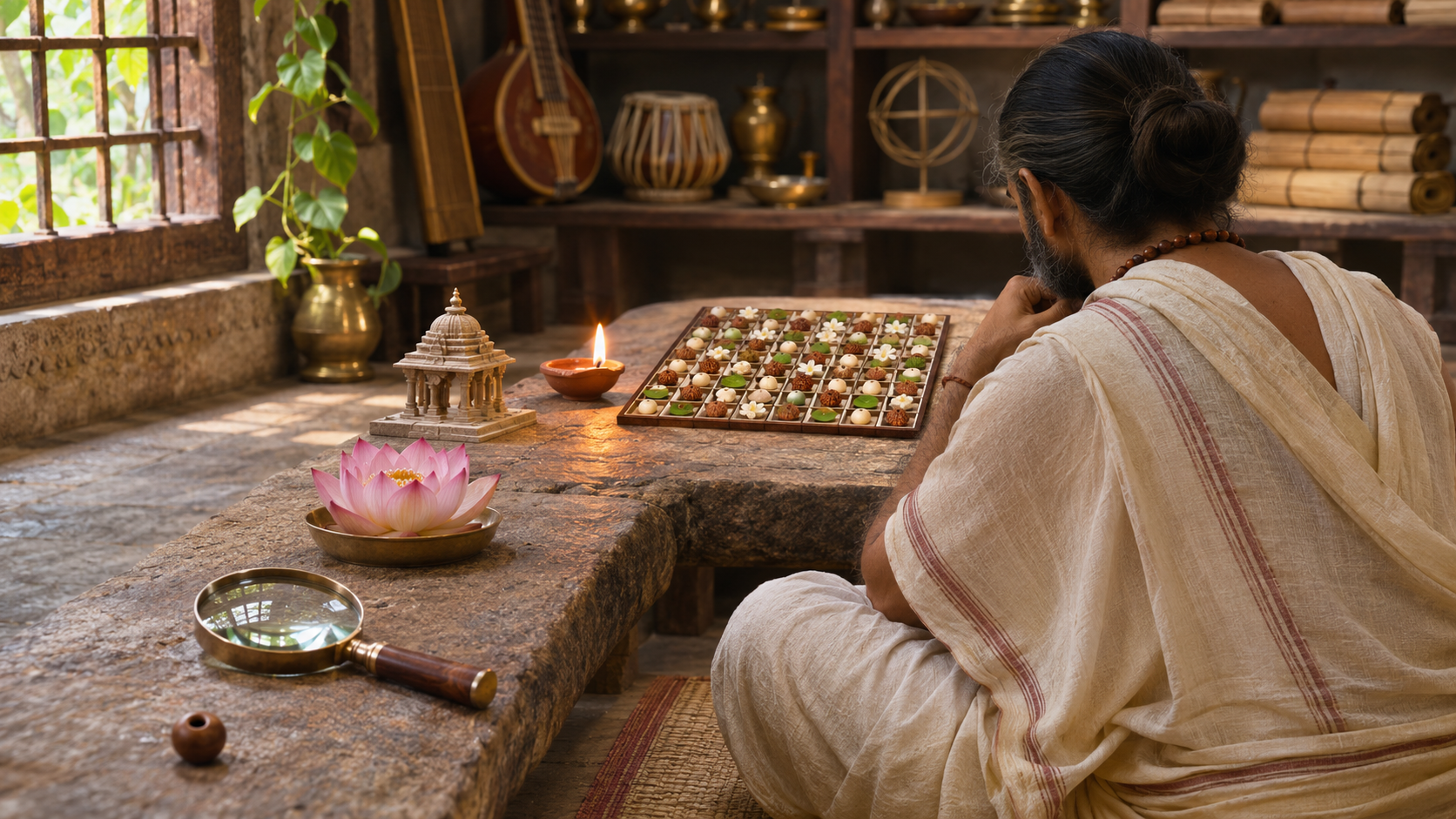
You do not need to guess whenever the number appears. Use this sequence to distinguish a genuine traditional association from a free-floating numerical claim.
- Name what is being counted. Ask, “Sixty-four what?” Yoginis, arts, positions, and other ordered units do not become interchangeable merely because they share a number.
- Locate the tradition and setting. Identify the relevant lineage, teaching, ritual, temple, text, or artistic convention. Context determines which differences matter.
- Determine whether the enumeration is fixed. Some uses depend on a particular set. Others use 64 chiefly to convey comprehensiveness. Do not force exact equivalence between lists unless the tradition itself establishes it.
- Ask what the arrangement does. Does it teach a range of capacities, honour forms of Shakti, organise sacred space, or guide contemplation? Function is often more revealing than abstract numerology.
- Read unity and plurality together. Notice the individuality of the members without losing the completed whole. This tension is central to the symbolism.
This method also gives you a quick test for exaggerated claims. A bare assertion that 64 automatically brings success, controls an event, or carries exactly the same meaning everywhere has removed the number from the relationships that make it sacred. Ask for the specific tradition and practice. If none can be named, treat the claim cautiously.
A second mistake is to demand one universal master list. Variation does not necessarily invalidate a symbolic grouping. Different settings may organise knowledge or divine manifestation for different purposes. The responsible question is whether a particular enumeration is grounded in its own context, not whether every context reproduces it word for word.
Key takeaways
- Sixty-four does not have one rigid meaning in every Hindu context.
- Its recurring symbolic force is completeness achieved through ordered multiplicity.
- In the arts, it evokes a broad horizon of cultivated human capacity.
- In the 64 Yoginis, it presents Shakti through many distinct yet related forms.
- In sacred space, it helps make order, position, boundary, and wholeness visible.
- The safest interpretation begins with what is counted, where the grouping belongs, and what the completed arrangement is meant to do.
The next time you meet 64 in a Dharmic setting, resist the urge to translate it immediately into a slogan. Identify the forms, study their arrangement, and ask what becomes complete only when all of them are held together. That shift from number-hunting to attentive seeing is where the symbol begins to teach.
References

Leave a Reply
You must be logged in to post a comment.