
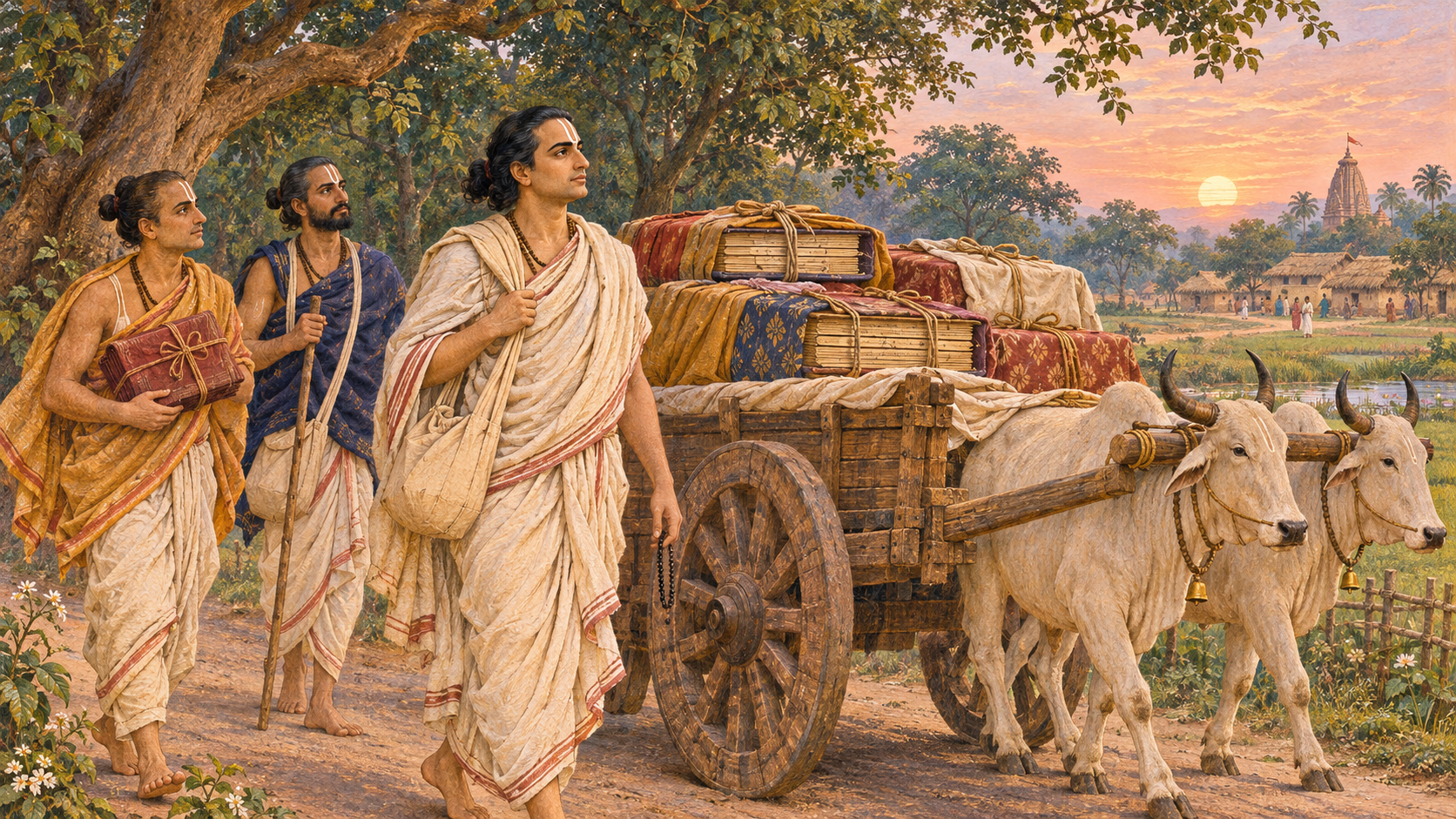
If you are deciding whether a temple book table, travelling library, or community distribution effort is worth the work, Srinivas Acharya gives you a better question than “How many copies can we move?” Ask whether the right person can receive a trustworthy path into bhakti.
That change of emphasis matters. A book can be handed over and never opened. It can also become the beginning of study, remembrance, discussion, and practice. The distributor helps determine which of those outcomes is more likely.
Why the word “pioneer” is more demanding than it sounds
Srinivas Acharya is remembered as a pioneer of book distribution in the Gaudiya Vaishnava tradition. That description should not be reduced to a historical compliment. It identifies a form of responsibility: sacred learning must be carried beyond the circle in which it was composed, preserved, or first taught.
A tradition does not remain alive merely because its books exist. Texts must be protected, transmitted, explained, read, and discussed. If any link breaks, the book may survive as an object while its teaching becomes remote from ordinary people. Distribution therefore joins preservation to living reception.
This is especially important in a dharmic tradition, where a text is commonly approached through a relationship among teacher, teaching, practice, and community. Placing a book in someone’s hands does not replace those relationships. Done properly, it opens a door into them.
The practical lesson is easy to miss. The distributor is not simply transporting paper. The distributor is making a judgement about audience, language, readiness, and context. Which work should travel? Who is prepared to receive it? What explanation will help the reader begin? Where can that reader take a sincere question? These are part of distribution, not optional additions after the “real” work is finished.
For Gaudiya Vaishnavas, this makes book distribution a form of seva before it becomes a campaign. Seva requires attention to the person being served. Pressure, exaggeration, and indiscriminate handouts may increase a count, but they weaken the relationship between the reader and the teaching. Srinivas Acharya’s remembered role points toward faithful transmission, not the mechanics of moving inventory.
Key takeaways for book distribution today
- Distribution is complete only when a book has a realistic chance of being read, not merely received.
- The right book is the one suited to the reader’s language, interest, and level of familiarity, not necessarily the most prestigious volume on the table.
- A short, accurate explanation serves the reader better than an inflated promise or a rehearsed sales pitch.
- Clear donation terms, respect for refusal, and honest answers protect the dignity of both the teaching and the recipient.
- A reading circle, contact point, or invitation to ask questions turns a handoff into a continuing path of study.
What genuine distribution includes
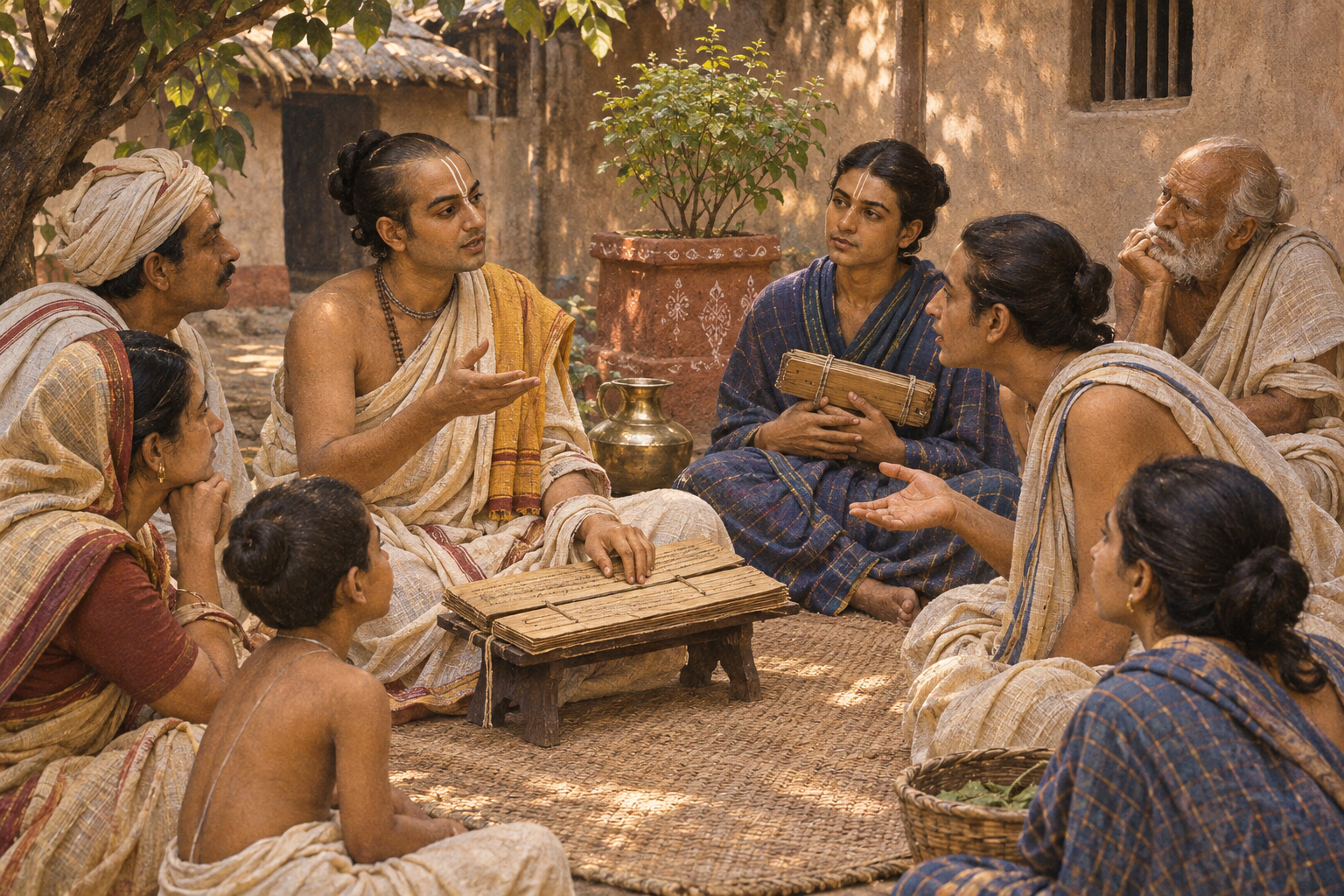
It helps to distinguish production, placement, and distribution. Production makes a text available. Placement puts a physical copy in a new location or a new person’s hands. Distribution connects that text with a reader who understands why it may matter and knows how to begin. All three have value, but they are not the same achievement.
That distinction changes how you prepare. If your only goal is placement, you need stock and volunteers. If your goal is distribution in the fuller sense, you also need suitable editions, readable languages, people who know the books, an honest way to introduce them, and some provision for questions afterward.
Selection comes first. Do not arrange a book table only by size, price, or visual prominence. Arrange it by the reader’s likely doorway into the tradition. Someone seeking a daily devotional practice is asking a different question from someone investigating Gaudiya philosophy. A newcomer may need orientation before detail. A long-time practitioner may want a work that supports close study. Treating those readers as interchangeable creates avoidable friction.
Conversation comes next. You do not need an aggressive pitch. Two questions will usually reveal more than a speech:
- “Are you looking for an introduction to bhakti, guidance for practice, or a text for deeper study?”
- “Would you prefer something you can begin quickly, or something you can study slowly over time?”
Listen to the answer before recommending anything. If you do not know a book well enough to describe its purpose accurately, say so and ask a more knowledgeable devotee. Confidence without knowledge does not serve the reader.
The handoff should include a starting point. Show the reader where the text begins to address the question they brought. Explain unfamiliar devotional vocabulary in plain language. If the edition contains an introduction or reading aids, point them out. A person who knows what to read first is more likely to open the book than someone sent away with a title and no orientation.
Follow-through completes the process. Offer a local reading group, a temple contact, or another clear way to return with questions. Ask permission before collecting contact information, and do not make continued communication a condition of receiving the book. The invitation should remain an invitation.
A practical standard for a temple or community book table

You can translate Srinivas Acharya’s legacy into a repeatable discipline without pretending that a modern book table is identical to historical transmission. Use the following process whenever your community prepares to distribute Gaudiya literature.
- Define the reader before selecting the stock. Decide whether you are serving temple visitors, students, families, experienced practitioners, curious passers-by, or a mixed audience. A mixed audience requires a clearly differentiated selection.
- Check every edition. Volunteers should know its language, reading difficulty, subject, intended audience, and any features that help a newcomer. Do not describe a translation, commentary, or teaching that you have not checked.
- Prepare a plain-language introduction. Each book should have a brief explanation of what it is, whom it will help, and how to start reading it. This is orientation, not advertising.
- Ask before recommending. Find out what the person wants to understand. Match the recommendation to that question rather than to the title you most want to distribute.
- State the terms clearly. If a book is free, say that it is free. If a donation is requested, explain whether it is optional or expected. Ambiguity at this point damages trust.
- Respect a refusal immediately. A gracious “no” preserves the person’s freedom and the dignity of the encounter. Sacred literature should not become associated with social pressure.
- Give the reader a next step. Suggest a manageable starting section, a discussion opportunity, or a person who can answer questions. Avoid promising that a book will solve every spiritual or personal difficulty.
- Learn from what happens afterward. Record recurring questions, language needs, and signs of difficulty with particular editions. Do not record personal details without consent. Use what you learn to improve the next selection and briefing.
Volunteer preparation is essential. A sincere volunteer who has not read the material may unintentionally misrepresent it. Before opening the table, let each volunteer choose a small number of books to know well. They should be able to identify the intended reader, explain the central subject without overclaiming, and show a sensible place to begin.
It is also useful to agree on what volunteers will not do. They should not invent answers, conceal donation expectations, disparage another tradition to make a sale, or collect contact details without permission. These boundaries are not bureaucratic obstacles. They keep the method aligned with the devotional purpose.
Online distribution follows the same discipline. Sending a file or link to a large list is placement. Helping a reader understand what the text contains, why it may answer a real question, and where discussion can continue is distribution. Digital reach changes the channel; it does not remove the need for judgement and care.
Measure whether books are becoming part of people’s lives

Counting copies is useful for stock control and planning, but it cannot tell you whether readers encountered the teaching. Pair the distribution count with signs of reception. Notice how many people chose a book after a real conversation, which subjects generated questions, which languages were requested, whether readers returned for discussion, and whether a reading group or study relationship formed.
Do not turn follow-up into surveillance. You do not need to track every reader. Invite voluntary feedback with questions that respect the person’s pace: “Where did you begin?” “Was anything difficult to understand?” “Which passage would you like to discuss?” These questions reveal more than “Did you finish it?” because they make room for actual reading rather than testing compliance.
Pay attention to books that are repeatedly accepted but rarely discussed. The obstacle may be language, length, unfamiliar terminology, weak orientation, or a poor match between the book and the setting. Do not blame the reader automatically. Change the recommendation, improve the introduction, or offer a more accessible point of entry.
The most faithful way to honour Srinivas Acharya is therefore not to imitate a slogan about distribution. It is to accept the discipline that his remembered example places before us: carry Gaudiya wisdom carefully, represent it honestly, and help another person enter into a living relationship with it.
If you are organising your next effort, begin with one shelf rather than a grand target. Identify whom it is for, make sure every volunteer understands what is on it, and give every interested reader a clear first step. A book travels fully when its teaching begins to travel within the reader.
References

Leave a Reply
You must be logged in to post a comment.