
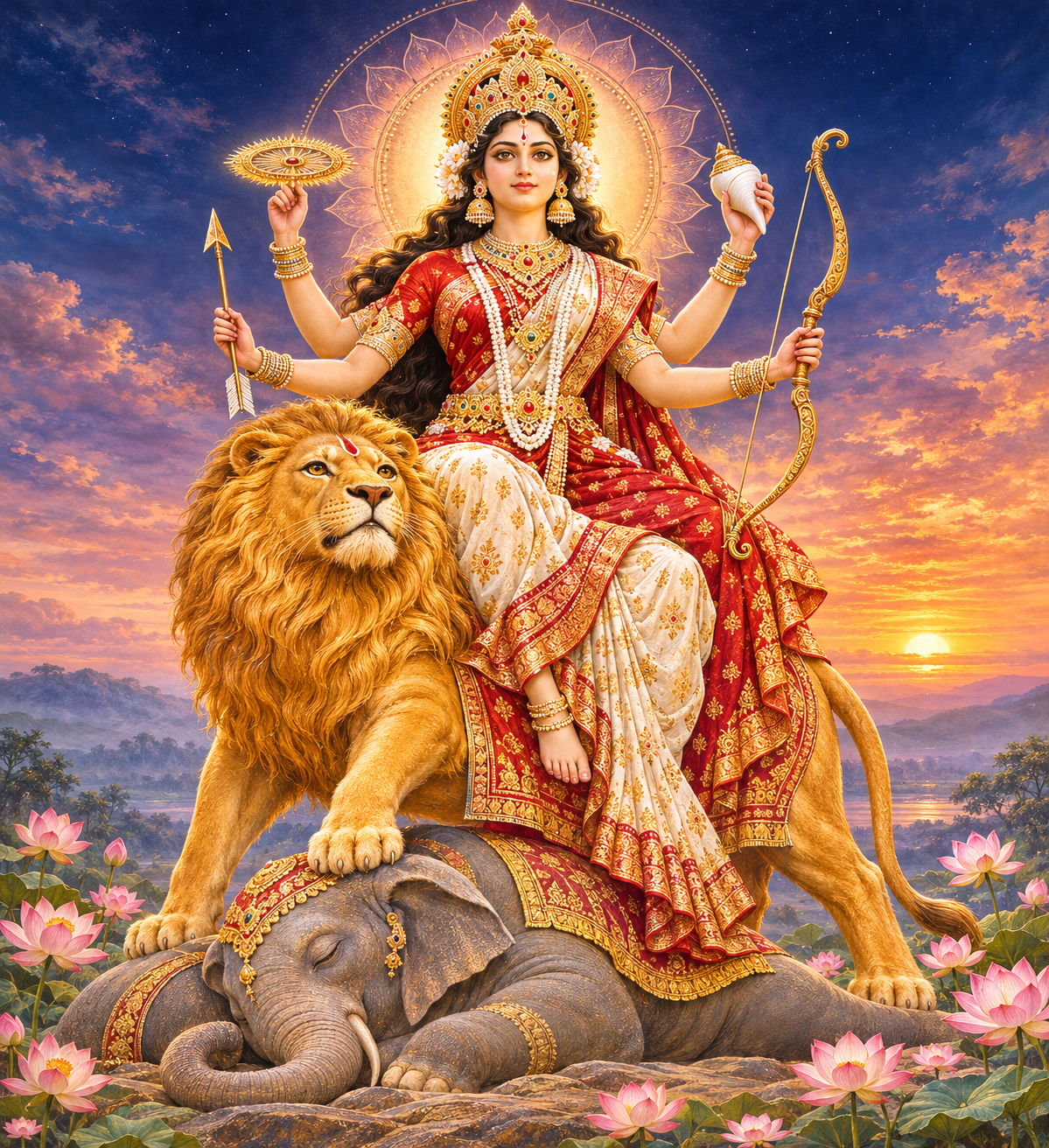
You may come to Jagaddhatri Puja carrying a fear you cannot solve: uncertainty at home, a responsibility that feels too large, or the sense that something precious is becoming fragile. The useful question is not whether worship guarantees the outcome you want. It is how to take refuge without becoming passive, and how devotion can make you more capable of protecting what has been entrusted to you.
Jagaddhatri is worshipped as the Divine Mother who protects the universe. For a devotee, this is not merely a comforting metaphor. It is a declaration that existence is not abandoned and that divine care reaches beyond the limits of individual control. It also carries a moral demand: if the Mother sustains the world, worship of her should make us less careless with the part of that world placed in our hands.
Divine protection is refuge without passivity
It is tempting to treat protection as a bargain: we perform the puja, and the Mother prevents the event we fear. That expectation makes devotion dependent on a particular outcome. If events unfold differently, faith can turn into confusion or resentment.
A more durable understanding begins with refuge. You acknowledge that your power is limited, place what exceeds that power before the Mother, and then act within the field of duty that remains yours. Prayer and action are not rivals. Prayer can purify the motive; action gives the prayer a body.
This is also a practical way to understand abhaya, or freedom from fear. It does not require you to pretend that danger, grief, or uncertainty is unreal. It asks you not to let fear become the ruler of your speech and conduct. When fear says, “Protect only yourself,” devotion can widen the question: “What must be protected, and what is my dharma toward it?”
- Name the fear plainly. Avoid turning it into a vague prediction that everything will go wrong.
- Separate what you can influence from what you cannot command.
- Place the uncontrollable before the Mother without disguising your attachment to the result.
- Identify the next truthful, non-harmful action that belongs to you.
- Do that action even while uncertainty remains.
This practical reading does not reduce Devi to a mental technique. It asks what recognition of the living Divine Mother changes in your conduct. If you truly believe that the world is held by her, panic need not have the final word. Neither does negligence.
Bring a sankalpa that joins your need to your duty
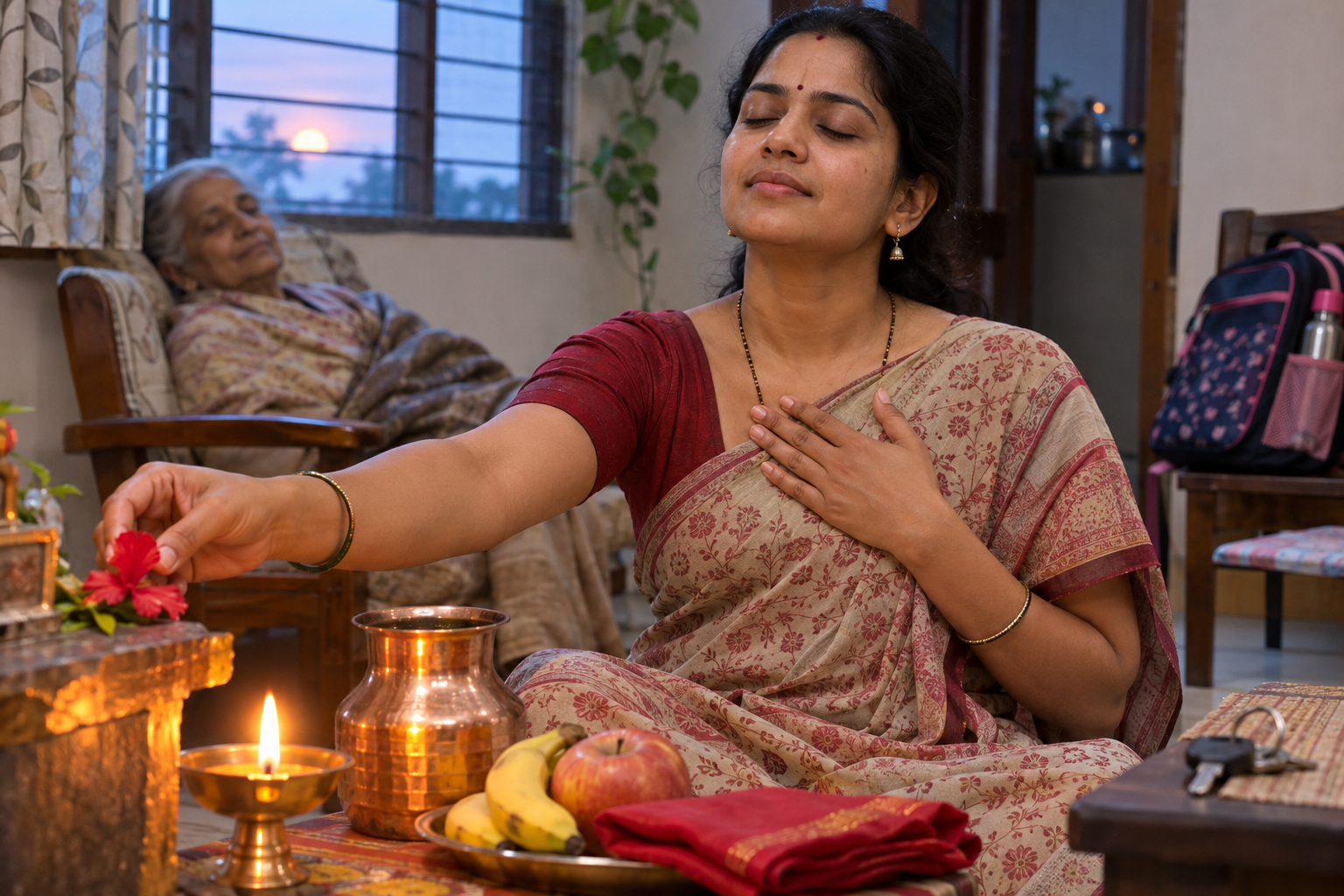
A clear sankalpa keeps Jagaddhatri Puja from becoming a collection of hurried wishes. Before the worship begins, decide what you are actually placing before the Mother. Then connect that request to a responsibility you are prepared to accept.
A useful sankalpa has a visible consequence after the ritual. It names what should be protected, recognises your own conduct as part of the problem or solution, and leads to an action that can be performed rather than merely imagined.
- If you seek protection for your family, include the patience, honesty, presence, or restraint through which you can make the household safer.
- If you seek protection for your community, include the service through which you will strengthen it rather than waiting for someone else to act.
- If you seek protection for Dharma, include disciplined study, transmission to the next generation, support for a temple or teacher, or correction of misinformation without cruelty.
- If you seek protection from an adversarial situation, ask that truth and justice prevail without allowing hatred to decide what kind of person you become.
- If you seek inner steadiness, name the habit that repeatedly gives fear control over your mind and attention.
Compare “Mother, remove every difficulty” with “Mother, protect what is true in this situation and help me perform my duty without fear or spite.” The second prayer does not tell the Divine exactly how reality must unfold. It asks for protection while making you available to Dharma.
You can write your sankalpa in a single sentence before the puja. Brevity is useful because it exposes confusion. If the sentence contains several unrelated demands, return to the concern beneath them. Often the real prayer is simpler: clarity, courage, restraint, reconciliation, endurance, or the protection of someone who depends on you.
A simple observance when elaborate puja is not possible
If you are attending an established community or temple puja, follow the local discipline and ask the priest or organisers what participation is appropriate. Ritual traditions differ, and an online checklist should not be treated as a replacement for a family, temple, or lineage-specific vidhi.
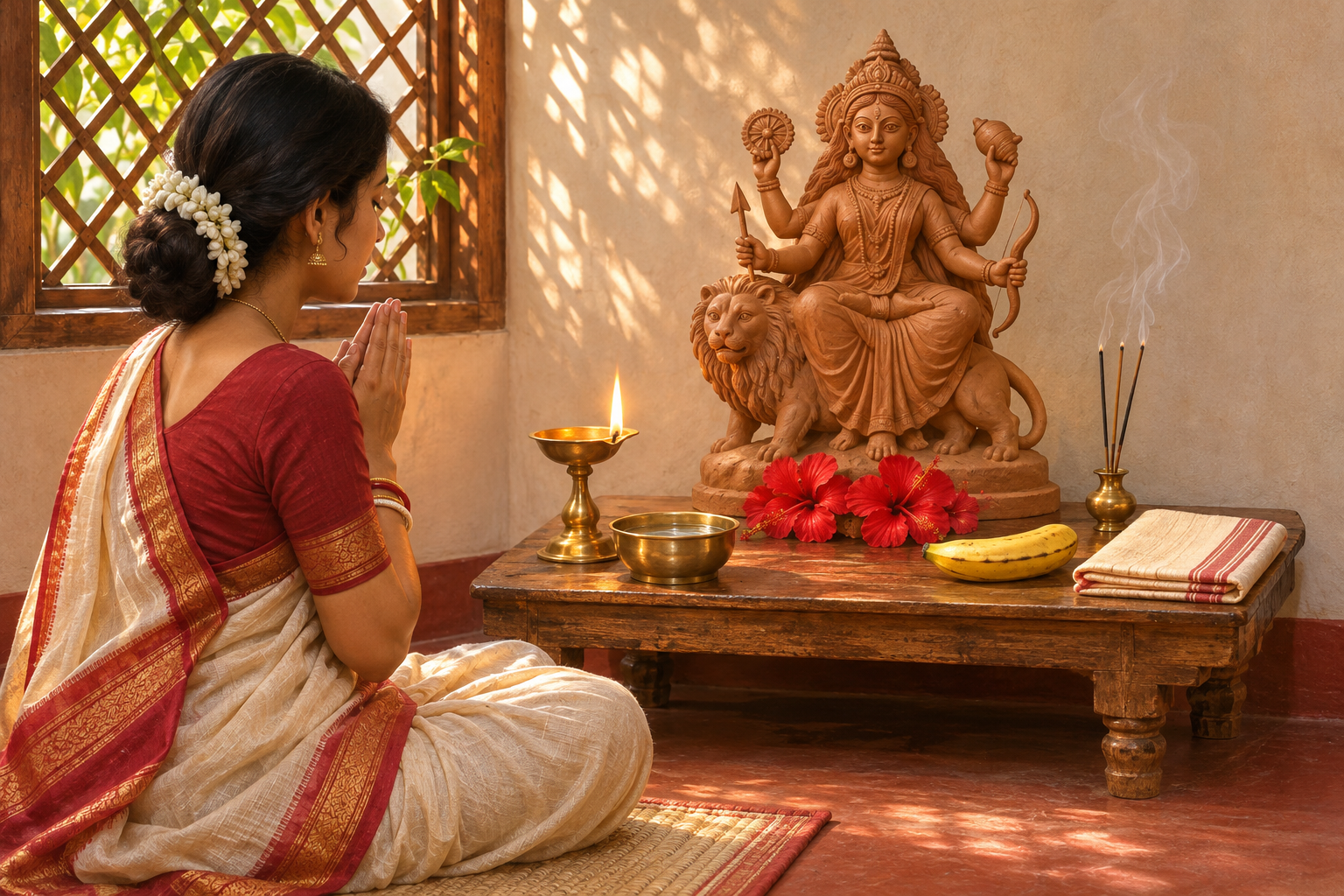
If formal arrangements are unavailable, you can still make a sincere personal observance. Do not present it as a complete ceremonial puja. Let it be what it is: a respectful act of remembrance, prayer, offering, and renewed duty.
- Prepare a clean, quiet place. Put away the phone and anything that will pull your attention into another task.
- Place an image of Jagaddhatri if you already use one in worship. A simple flower or water offering is sufficient for a personal observance. If you light a lamp, keep it attended and omit it when an open flame cannot be used safely.
- Become still before asking for anything. Let the agitation that brought you to prayer become visible without rehearsing it endlessly.
- Address the Mother by name and speak your sankalpa. Plain, honest words are better than impressive language you do not mean.
- If a mantra belongs to your family or received practice, follow that discipline. Do not borrow a mantra merely to make the observance feel authoritative. Repetition of the Divine Mother’s name and a sincere prayer are more fitting than pretending to possess an initiation you have not received.
- Sit quietly after the prayer. Notice the duty you have been avoiding, the untruth you need to correct, or the person you need to serve.
- Close with gratitude. Then perform the practical action contained in your sankalpa.
The last step matters. Without it, devotion can remain emotionally intense but morally weightless. You need not manufacture a dramatic feeling during worship. The steadier sign is that you leave the altar less divided about what you should do.
Test your devotion by what it teaches you to protect
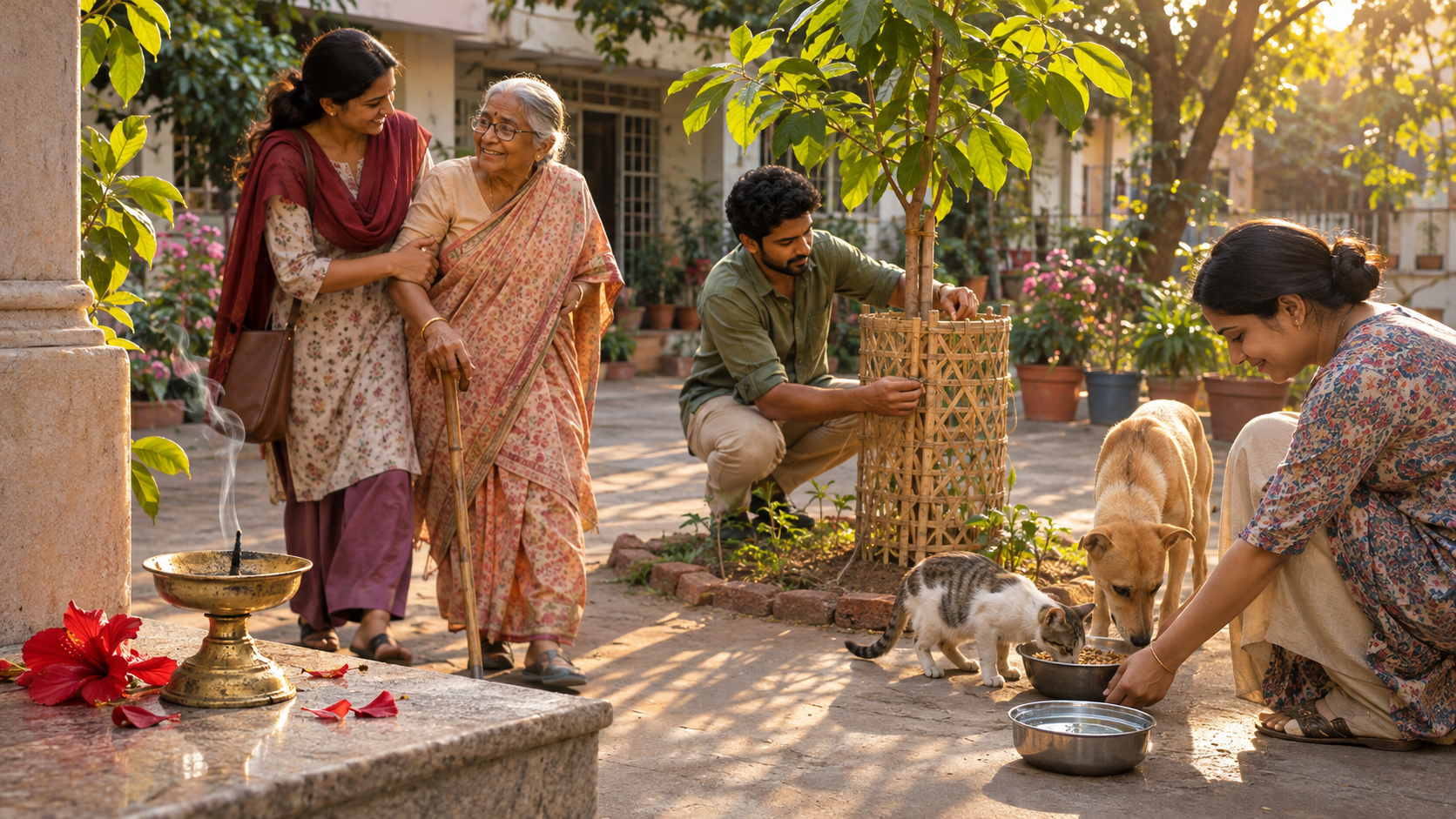
The language of protection can shrink into self-interest if it is never examined. You can ask the Mother to guard your comfort while ignoring another person’s dignity. You can defend the outward signs of tradition while neglecting truthfulness, self-command, and care within your own home. You can even use “the Mother will protect” as an excuse to postpone a necessary decision.
Jagaddhatri’s universal scope challenges that smallness. Protection cannot be confined to whatever confirms the ego. A dharmic response begins close to home, but it should become wider rather than narrower.
- Protect truthful speech. Refuse both deliberate falsehood and the careless forwarding of claims you have not checked.
- Protect the vulnerable. Notice who bears the cost when a family, institution, or community avoids a difficult responsibility.
- Protect inherited wisdom through understanding. Learn the meaning of a practice well enough to transmit more than its outer appearance.
- Protect community without dehumanising outsiders. Firm defence of Dharma loses its own centre when hatred, contempt, or dishonesty becomes acceptable.
- Protect your attention. A mind continually captured by outrage cannot easily recognise the next quiet duty.
- Protect the conditions of worship. Support the people, places, knowledge, and voluntary labour that allow sacred traditions to remain living practices.
Ask yourself what changes after the puja. Are you more truthful when truth costs something? More reliable toward those who depend on you? More willing to correct a wrong without turning correction into humiliation? More careful with the tradition you claim to defend? These are demanding questions, but they keep the idea of divine protection from becoming a religious label for personal preference.
The Mother’s protection is not a licence for aggression, fatalism, or avoidance. It is a reason to stand firmly without surrendering your conduct to fear. The devotee does not have to choose between tenderness and strength. Protective motherhood contains both.
Key takeaways
- Approach Jagaddhatri as the Divine Mother who protects and sustains, not as a mechanism for obtaining a guaranteed result.
- Place what you cannot control before her, then act on the part that belongs to your dharma.
- Use a clear sankalpa that joins your request for protection to a duty you will actually perform.
- Follow temple, family, or lineage-specific ritual guidance where it is available; keep a personal observance simple and honest when it is not.
- Measure the fruit of devotion through steadier conduct, truthful speech, responsible care, and protection that extends beyond the ego.
Before your next observance, complete this sentence: “Mother, protect ______, and help me protect it by ______.” Let the first blank become your prayer and the second become your action. Perform that action while the prayer is still fresh. That is where refuge begins to take the shape of Dharma.
References

Leave a Reply
You must be logged in to post a comment.